
Software Development Consulting: Complete Guide for CTOs 2026
January 12, 2026

Software Development Consulting: Complete Guide for CTOs
The decision to engage software development consultants is rarely just about adding capacity. For CTOs and engineering leaders, it’s usually a response to a specific inflection point: systems that can’t scale further, modernization work that carries real risk, or architectural decisions that will shape the next five to ten years.
In those moments, consulting isn’t a staffing shortcut. It’s a way to bring experienced judgment into high-impact decisions without committing to long-term headcount before the path is clear.
Research indicates that 72% of companies turn to consulting to solve specific technical challenges¹. The difference in outcomes is rarely the technology—it’s how well the engagement model, team seniority, and delivery accountability align to the problem being solved.
This guide examines the software development consulting landscape through a practical lens of cost-effectiveness, strategic value, and operational risk; providing CTOs and VPs of Engineering with clear frameworks for deciding when consulting makes sense, how to evaluate partners, and how to avoid the most common failure modes.
What this guide covers:
- Fundamental differences between consulting engagement models
- Five distinct consulting service types and their optimal use cases
- Structured evaluation framework for assessing consulting partners
- Pricing models, TCO considerations, and ROI calculation methodologies for consulting investments
- Vendor selection criteria that reduce long-term delivery risk
What Software Development Consulting Actually Delivers
Software development consulting brings external engineering leadership into situations where internal teams need support defining, designing, or delivering complex systems.
Unlike staff augmentation, consulting engagements are outcome-driven. Consultants are accountable for architectural decisions, delivery execution, and knowledge transfer—not just task completion. In practice, effective consultants operate with autonomy. They assess requirements, shape technical direction, implement solutions, and embed delivery practices that strengthen internal teams long after the engagement ends.
The goal is not dependency. It’s clarity, momentum, and reduced risk during moments when mistakes are expensive and hard to reverse.
Consulting vs. Staff Augmentation: Core Distinctions
The consulting engagement model differs fundamentally from staff augmentation in several critical dimensions:
| Dimension | Consulting | Staff Augmentation |
|---|---|---|
| Delivery Model | Consultant-managed delivery | Client-directed execution |
| Engagement Focus | Problem solving and outcomes | Capacity and skill gaps |
| Management Overhead | External project leadership | Internal management required |
| Accountability | Vendor owns delivery risk | Client retains delivery risk |
| Typical Duration | Project-based (3–12 months) | Extended (6–24 months) |
Organizations typically choose consulting when they need strategic guidance to define solutions but lack the internal expertise to architect the approach². Staff augmentation works best when direction is already clear and internal leadership is prepared to own architectural and delivery decisions.
When Technical Leaders Engage Consultants
CTOs and VPs of Engineering typically engage consulting partners at moments of elevated risk—when decisions are hard to reverse and internal teams lack the time, specialization, or distance to move safely.
These moments are rarely optional. Systems must scale, regulations must be met, or modernization must happen without disrupting operations. Consulting aligns best when it reduces uncertainty, accelerates informed decisions, and prevents downstream rework.
Understanding these scenarios helps leaders choose the right engagement model and avoid misalignment that leads to rework, dependency, or stalled outcomes.
Strategic Planning and Architecture
Organizations facing major technology decisions often lack the internal perspective to evaluate alternatives objectively. A consultant brings cross-industry experience evaluating similar challenges, enabling faster, more informed decision-making. An external technology strategy consultant might assess an organization’s current architecture, evaluate modernization options, and provide a multi-year roadmap with implementation phases.
This model works best when organizations are prepared to act on the guidance. Advisory engagements break down when recommendations are treated as theoretical exercises rather than inputs into real change.
Specialized Technical Expertise
When projects require niche technical skills unavailable internally, consultants provide focused expertise for defined periods. A cybersecurity consultant might implement zero-trust architecture, or a machine learning specialist might build recommendation algorithms that internal generalists cannot efficiently develop.
These engagements succeed when scope and decision authority are clear. They struggle when consultants are asked to “advise” without being empowered to implement.
Capacity Constraints and Delivery Acceleration
Internal teams operating at capacity cannot absorb additional strategic initiatives without delaying core product development. Consultants handle discrete projects independently, allowing internal teams to maintain focus on primary objectives. This separation of concerns enables parallel workstreams that accelerate overall organizational velocity.
This separation works well when roles are clearly defined. It becomes risky when consultants are expected to compensate for missing internal ownership.
Legacy System Modernization
Modernization efforts carry disproportionate risk. Legacy systems often encode decades of business logic, undocumented dependencies, and operational assumptions. Legacy modernization requires architectural knowledge spanning old and new technology stacks.
Consultants experienced in migration patterns, risk mitigation strategies, and phased transition approaches reduce modernization risk while maintaining business continuity.
Compliance and Regulatory Requirements
Regulated environments demand specialized knowledge. Organizations entering regulated industries or facing new compliance mandates benefit from consultants who specialize in regulatory technology requirements. These experts implement controls, establish audit trails, and ensure systems meet industry-specific standards like HIPAA, SOX, or sector-specific regulations.
These engagements fail quietly when compliance is treated as documentation rather than something enforced in architecture and delivery.
Five Consulting Service Models
Consulting engagements typically fall into distinct service categories, each addressing different organizational needs.
Advisory Consulting
Advisory consultants provide strategic guidance without implementation responsibility. They assess current state, recommend future direction, and create roadmaps defining transformation paths. A CTO might engage advisory consultants to evaluate build-versus-buy decisions for core systems, receiving detailed analysis including TCO projections, architectural risk assessments, and vendor evaluations.
Advisory consulting works best when decisions are high-impact but execution has not yet begun. It breaks down when organizations expect clarity without committing to the organizational or technical changes required to act on the recommendations.
For example, Keyhole led an architectural assessment for a financial technology platform, defining an incremental migration path from a legacy monolith to a modern, service-based architecture. Through targeted proof-of-concepts and a phased roadmap, the engagement helped the client reduce risk and align future implementation before committing to delivery.
Implementation Consulting
Implementation consultants execute defined projects from requirements through deployment. Unlike advisory roles, implementation consultants build systems, migrate data, integrate platforms, and deliver working solutions. Organizations with clear requirements but insufficient internal capacity benefit from this model.
Implementation consulting succeeds when requirements and decision authority are clear. It struggles when scope remains fluid but delivery risk is still pushed onto the vendor, leading to friction, rework, or defensive execution.
Staff Augmentation Consulting
Staff augmentation involves consultants integrating directly into client teams, working under client direction while bringing senior expertise. This model works well when organizations have clear project plans and need specialized skills or additional capacity.
Staff augmentation becomes risky when architectural ownership is unclear or when augmented staff are expected to make long-term system decisions without defined authority or continuity expectations.
For example, Keyhole has supported a global entertainment leader AMC Theatres’ mobile platform through embedded senior engineers who scaled with release demands, improved stability across iOS and Android, and delivered incremental enhancements while the client executed a broader platform modernization. The success of the model relied on strong internal leadership, clear ownership, and flexible continuity over multiple years.
Managed Services and Ongoing Support
Managed service consultants assume ongoing operational responsibility for specific systems or functions. They might manage cloud infrastructure, maintain legacy applications, or provide Level 2/3 support. This model works when organizations need specialized skills continuously but cannot justify full-time positions.
Managed services work best for stable systems with predictable operational needs. They are a poor fit when systems are still evolving rapidly.
Transformation and Change Management
Large-scale organizational change requires coordinated shifts in process, decision-making, and ownership—not just new software. Transformation consulting bridges the technical and organizational gaps, ensuring new systems are adopted, sustained, and trusted in day-to-day operations.
Transformation and change management efforts fail when new processes are layered on top of existing structures without changing how decisions are made or who owns outcomes. Effective transformation work closes that gap, pairing system delivery with pragmatic process redesign and stakeholder alignment.
Efforts succeed when incentives, authority, and engineering realities are aligned across teams and leadership. A recent Agile and SDLC modernization for an industrial automation organization demonstrates this approach, combining process structure, leadership enablement, and tooling alignment to drive sustainable delivery change.
Evaluation Framework for Consulting Partners
Selecting the appropriate consulting partner requires systematic assessment across multiple dimensions. A structured evaluation framework reduces selection risk and increases likelihood of successful outcomes.
Technical Capabilities Assessment
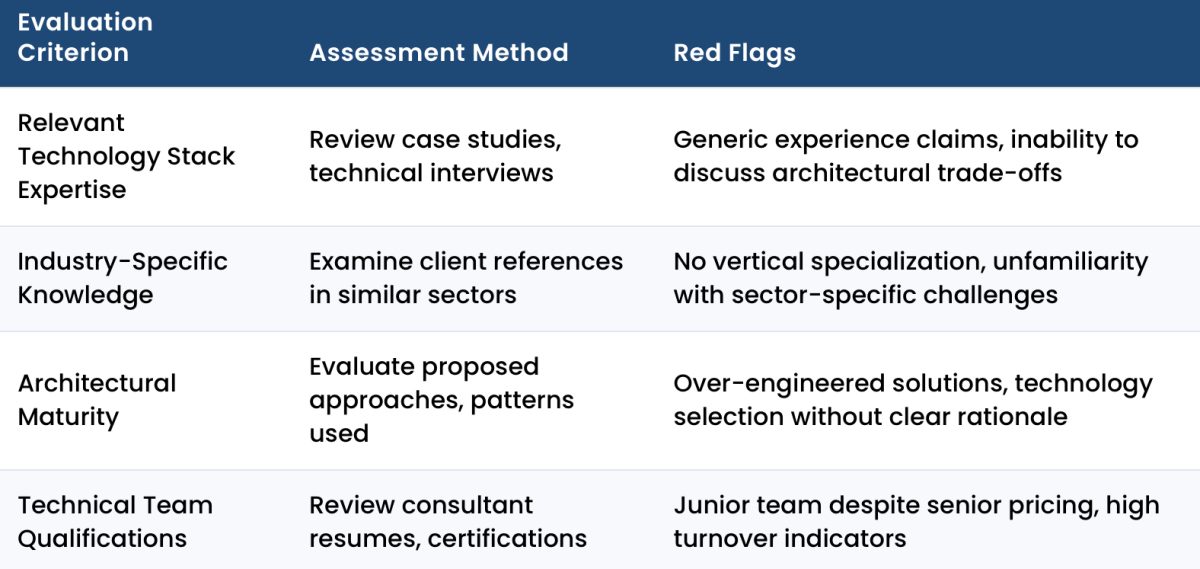
| Evaluation Criterion | Assessment Method | Red Flags |
|---|---|---|
| Relevant Technology Stack Expertise | Review case studies, technical interviews | Generic experience claims, inability to discuss architectural trade-offs |
| Industry-Specific Knowledge | Examine client references in similar sectors | No vertical specialization, unfamiliarity with sector-specific challenges |
| Architectural Maturity | Evaluate proposed approaches, patterns used | Over-engineered solutions, technology selection without clear rationale |
| Technical Team Qualifications | Review consultant resumes, certifications | Junior team despite senior pricing, high turnover indicators |
Delivery Track Record and References
Past performance indicates future results more reliably than proposals. Request references from organizations with similar project complexity, technology requirements, and organizational size. Specific questions for references include:
- Did the consultant deliver on time and within budget?
- How did they handle scope changes or unexpected challenges?
- What was the quality of deliverables and knowledge transfer?
- Would you engage them again for similar work?
Absence of relevant references or reluctance to provide contacts warrants caution.
Cultural and Communication Fit
Technical capability alone does not ensure successful partnerships. Communication patterns, work style, and values alignment significantly impact collaboration effectiveness. Organizations should assess:
- Communication responsiveness and clarity during sales process
- Willingness to adapt methodologies to client preferences
- Transparency about challenges, risks, and unknowns
- Alignment on project management approaches and reporting cadence
Keyhole Software works with organizations that require senior-level, U.S.-based engineering expertise to design and build custom applications, modernize legacy systems, and make sound technology decisions that reduce risk.
Engagement Models and Pricing Structures
At Keyhole, pricing discussions are fundamentally about risk ownership and decision quality, not just rates. The right engagement model depends on how much uncertainty exists in the work—and who is best positioned to manage it as reality unfolds.
For complex enterprise systems, modernization efforts, and architecture-heavy initiatives, Time & Materials (T&M) is often the most responsible and transparent model. It allows teams to surface unknowns early, adapt as constraints emerge, and make informed tradeoffs as real technical and organizational factors come into focus, rather than forcing artificial certainty into work that inherently evolves.
Why Time & Materials Is Often the Best Fit
In our experience, T&M works best when:
- Requirements are expected to evolve as systems meet real data, integrations, and users
- Architectural decisions carry long-term consequences
- Legacy systems or regulatory constraints introduce unknowns
- Senior engineers are actively shaping scope and sequencing as risk emerges
Rather than locking teams into assumptions made too early, T&M aligns incentives around continuous clarity. Work is prioritized based on what is learned, not what was predicted, progress is visible, priorities are revisited regularly, and decisions are made with current information instead of outdated estimates. This often leads to better sequencing, fewer late-stage surprises, and more durable outcomes, even when scope changes along the way.
Pricing Model Comparison
| Model | Structure | Best For | Risk Profile |
|---|---|---|---|
| Time & Materials | Hourly or daily rates | Complex systems, modernization, evolving scope | Risk managed collaboratively |
| Fixed Price | Set fee for defined deliverables | Narrow, well-understood projects | Vendor bears delivery risk |
| Retainer | Monthly fee for availability | Ongoing advisory, support needs | Shared risk, predictable costs |
| Value-Based | Fee tied to business outcomes | Clearly measurable initiatives | Shared risk tied to results |
| Hybrid Models | Base fee plus outcome bonuses | Large initiatives with mixed certainty | Balanced risk allocation |
Fixed-price engagements can be effective when scope is tightly constrained and uncertainty is minimal. In practice, many enterprise initiatives appear “well-defined” on paper but reveal complexity once integration, compliance, and operational realities are encountered. In those cases, fixed pricing often shifts risk downstream—resulting in change orders, reduced flexibility, or compromised outcomes.
Total Cost of Ownership Considerations
Evaluating consulting investments requires analysis beyond initial engagement fees. Total Cost of Ownership typically includes:
- Direct consulting fees (professional services)
- Travel and expenses (if on-site work required)
- Internal team time (for collaboration, review, decision-making)
- Software licenses or infrastructure costs
- Ongoing maintenance post-implementation support
- Knowledge transfer and training time
- Opportunity cost of delayed or misdirected work
A comprehensive TCO analysis typically reveals 20-30% additional costs beyond base consulting fees³. In our experience, organizations using T&M for complex initiatives often control these downstream costs more effectively, because risks are addressed earlier—before they become expensive rework, operational instability, or architectural debt. Organizations should budget accordingly rather than facing unexpected overruns.
Calculating ROI for Consulting Investments
Rigorous ROI analysis justifies consulting expenditures and enables comparison across investment alternatives. The calculation methodology combines tangible and intangible benefits against total costs.
ROI Calculation Framework
Step 1: Quantify Expected Benefits
Identify specific, measurable outcomes the consulting engagement will deliver:
- Cost savings (reduced operational expenses, eliminated licenses)
- Revenue impact (faster time-to-market, new capabilities enabling sales)
- Productivity gains (time saved, increased throughput)
- Risk reduction (compliance, security improvements)
Step 2: Estimate Total Costs
Calculate full TCO including direct fees, internal resources, and ongoing costs over the analysis period (typically 3-5 years).
Step 3: Apply Financial Metrics
| Metric | Formula | Interpretation |
|---|---|---|
| Simple ROI | (Total Benefits – Total Costs) / Total Costs × 100% | Percentage return on investment |
| Payback Period | Total Costs / Annual Benefits | Time to recover investment |
| Net Present Value (NPV) | ∑ (Cash Flows / (1 + Discount Rate)^t) | Present value of future benefits |
Example ROI Calculation: Legacy Modernization Consulting
A mid-size organization engages consultants to modernize a core business system:
Costs (Year 1):
- Consulting fees: $250,000
- Internal team time: $50,000
- Infrastructure migration: $30,000
- Total Year 1 Costs: $330,000
Ongoing Costs (Years 2-5):
- Maintenance: $40,000/year
- Total 5-Year TCO: $490,000
Benefits (Annual):
- Reduced maintenance costs: $80,000/year
- Productivity improvements: $45,000/year
- Avoided compliance risk: $25,000/year
- Total Annual Benefits: $150,000
Financial Analysis:
- 5-Year Total Benefits: $750,000
- 5-Year Total Costs: $490,000
- Simple ROI: 53.1%
- Payback Period: 2.2 years
- NPV (10% discount rate): $183,000
This analysis demonstrates financial viability with positive NPV and reasonable payback period, justifying the consulting investment⁴.
Vendor Selection: Critical Decision Criteria
Systematic vendor evaluation prevents costly misalignment. Technical leaders should assess candidates across multiple dimensions using consistent scoring methodologies.
In our experience, vendor selection problems rarely stem from a lack of information; rather they stem from evaluating the wrong signals. Technical leaders who take a systematic approach are far more likely to avoid misalignment that surfaces months later as missed expectations, rework, or delivery friction.
Effective evaluation looks beyond surface credentials and assesses how a firm actually operates when complexity, ambiguity, and pressure are present. That requires consistent criteria applied across multiple dimensions, and not just proposals or conversations with their sales team.
Evaluation Scorecard Framework
| Category | Weight | Evaluation Criteria | Scoring Method |
|---|---|---|---|
| Technical Expertise | 30% | Relevant stack experience, architectural maturity, team qualifications | Case study review, technical interviews, reference checks |
| Delivery Track Record | 25% | On-time/budget performance, quality of deliverables, client satisfaction | Reference calls, project examples, success metrics |
| Communication & Cultural Fit | 20% | Responsiveness, transparency, collaborative approach, values alignment | Interaction assessment, methodology review, team meetings |
| Pricing & Value | 15% | Cost competitiveness, pricing model flexibility, TCO reasonableness | Proposal analysis, benchmark comparison |
| Security & Compliance | 10% | Data protection practices, compliance certifications, audit history | Security questionnaire, certification verification |
Organizations should establish minimum threshold scores for each category. In practice, candidates failing to meet thresholds in critical categories (Technical Expertise, Delivery Track Record) rarely recover through strong pricing or presentation polish—and eliminating those early reduces downstream risk.
Due Diligence Checklist
Prior to final selection, complete comprehensive due diligence:
- Financial Stability: Verify the firm’s financial health to ensure project continuity
- Insurance and Liability: Confirm adequate professional liability and cyber insurance coverage
- Intellectual Property: Clarify IP ownership and reuse rights in engagement agreements
- Conflict of Interest: Ensure no competing client relationships or conflicts
- Exit Strategy: Define knowledge transfer, documentation, and transition expectations
- Escalation Procedures: Establish how issues are raised and resolved when stakes are high
These checks are not about distrust, they’re about clarity. Ambiguity here almost always becomes friction later.
Implementation Best Practices
Successful consulting engagements require active client participation and structured governance. Technical leaders should establish clear frameworks before work commences.
Governance Structure Requirements
Effective consulting governance includes:
- Executive sponsor providing strategic direction and removing obstacles
- Technical steering group making architectural decisions
- Regular progress reviews (typically weekly or bi-weekly) focused on outcomes, not activity
- Defined decision-making authority and escalation paths
- A formal change control process to manage scope as realities emerge
Knowledge Transfer Planning
Consulting engagements are temporary by design, requiring thorough knowledge transfer to internal teams. Organizations can require:
- Comprehensive technical documentation (architecture, code, deployment procedures)
- Hands-on training sessions for relevant internal staff
- Shadowing periods where internal teams work alongside consultants
- Post-engagement support period (typically 30-90 days)
- Clear ownership transition for ongoing maintenance
Failure to plan knowledge transfer results in hidden vendor dependency extending beyond intended engagement periods, increasing total costs and reducing strategic flexibility.
Risk Mitigation Strategies
Every consulting engagement carries risk. The difference between successful and disappointing outcomes is not whether risk exists—but whether it is acknowledged early, owned explicitly, and managed deliberately as work unfolds.
In our experience, most delivery issues are not caused by technical failure. They stem from unclear ownership, untested assumptions, or delayed decision-making. Effective risk mitigation focuses less on contractual language alone and more on aligning incentives, authority, and visibility throughout the engagement.
Key Risk Categories and Mitigation Approaches
Risk mitigation works best when addressed proactively and revisited continuously—not when controls are applied after issues surface.
| Risk Category | Mitigation Strategy |
|---|---|
| Delivery Delays | Milestone-based payments, schedule performance incentives/penalties, regular progress monitoring |
| Quality Issues | Acceptance criteria definition, staged deliverable reviews, code review requirements, testing protocols |
| Scope Creep | Formal change control process, statement of work clarity, scope boundary documentation |
| Knowledge Loss | Mandatory documentation requirements, knowledge transfer milestones, shadowing periods |
| Vendor Dependency | Source code escrow arrangements, open technology choices, internal team training |
| Security Breaches | Security requirements in contracts, access controls, audit rights, liability provisions |
Senior-led teams surface risks early, make tradeoffs explicit, and adjust course before small problems compound.
Making the Consulting Decision
The decision to engage software development consultants is ultimately a decision about risk, focus, and long-term ownership.
Consulting delivers the most value when organizations face moments that require experienced judgment—architectural decisions that are hard to reverse, modernization efforts that carry operational risk, or delivery initiatives that internal teams cannot absorb without sacrificing core priorities.
The model breaks down when:
- Scope is unclear but treated as fixed
- Internal teams cannot commit time for collaboration and decision-making
- Consulting is used to mask long-term capacity gaps rather than address them intentionally
Organizations that approach consulting with clarity—about what they want to own, what they want help with, and how decisions will be made—see consistently better outcomes.
Keyhole Software works with organizations across Java, .NET, and JavaScript technologies, as well as cloud-native architectures on AWS, Azure, and Google Cloud. Our 100% U.S.-based senior consultants design and build custom software, modernize legacy systems, and strengthen internal engineering teams through hands-on collaboration and knowledge transfer—helping clients reduce risk today while building systems and teams that endure.
Sources
¹ Mismo Team, “Staff Augmentation vs Consulting in 2025: How to Choose,” 2025
² Bertoni Solutions, “IT Staff Augmentation vs Consulting: When To Choose Each,” 2024
³ Deltek, “Consulting Pricing Models: Strategies, Examples & How to Choose,” 2025
⁴ Baytech Consulting, “CFO’s Guide to Calculating the ROI of Custom Software Development,” 2025
Last updated: December 29, 2025
More From Keyhole Software
About Keyhole Software
Expert team of software developer consultants solving complex software challenges for U.S. clients.
Share This Post
Related Posts
Join The Thousands Of Devs Who Subscribe

Discuss This Article
Subscribe
Login
0 Comments
Oldest