
Modernization Sequencing Strategy: Building an Executable Legacy System Roadmap
Prioritization determines which systems to modernize. Sequencing determines the order in which modernization should happen.
The Keyhole Modernization Dependency Model helps organizations execute modernization in the correct sequence by aligning work to technical dependencies rather than urgency.
Even the right modernization strategy can fail if work begins in the wrong place. Starting with application code before stabilizing infrastructure or addressing data dependencies often leads to unnecessary complexity, higher costs, and significant rework.
Successful modernization efforts consistently follow the same dependency sequence: Infrastructure → Data → Application Modernization → Delivery & Innovation
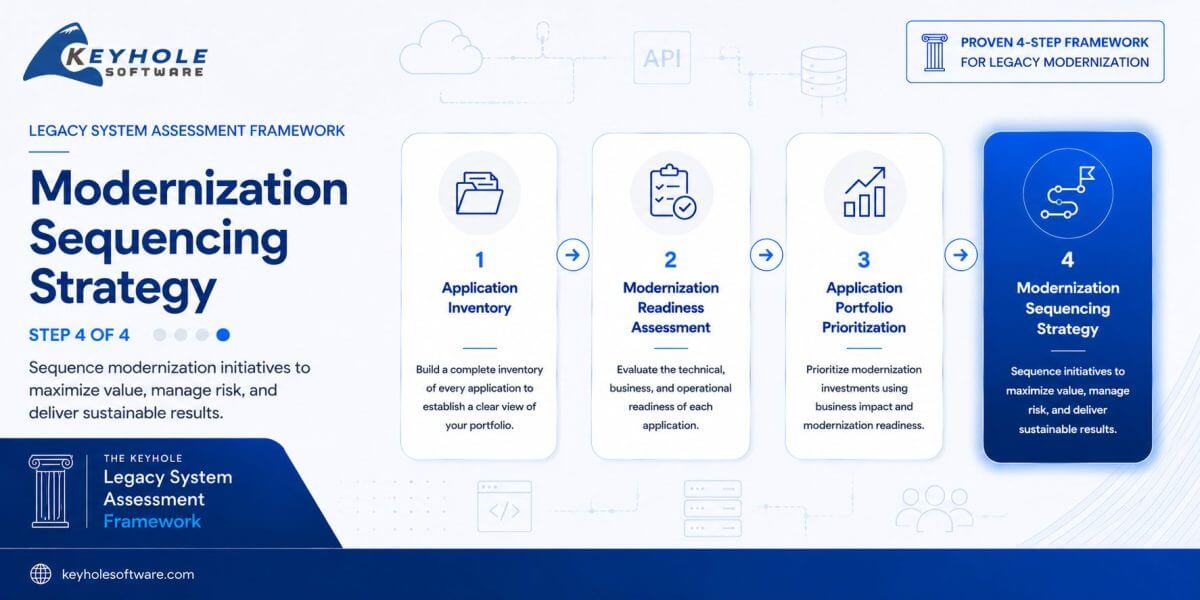
This article is Step 4 of a complete legacy system assessment framework, covering application inventory, readiness assessment, prioritization, and modernization sequencing. Each step builds toward a practical modernization roadmap.
By the end of this guide you’ll know how to:
- Sequence modernization work based on technical dependencies rather than urgency.
- Understand why infrastructure, data, and application modernization should occur in a specific order.
- Recognize common sequencing mistakes before they become costly.
- Create a phased modernization execution roadmap.
- Move from portfolio prioritization to successful delivery.
Follow Along with the Workbook
Use the Modernization Sequencing Planner included in the free Legacy System Assessment Toolkit to map dependencies, sequence modernization activities, and build an executable roadmap.
The toolkit includes:
- Modernization Sequencing Planner
- Dependency Mapping worksheet
- Execution roadmap template
- Portfolio prioritization workbook
- Example modernization roadmap
→ Download the Free Legacy System Assessment Toolkit
Legacy System Modernization Dependency Model
Unlike prioritization, sequencing is governed primarily by technical dependencies rather than business value. Applications with the highest priority are not always the first systems that should be modernized.
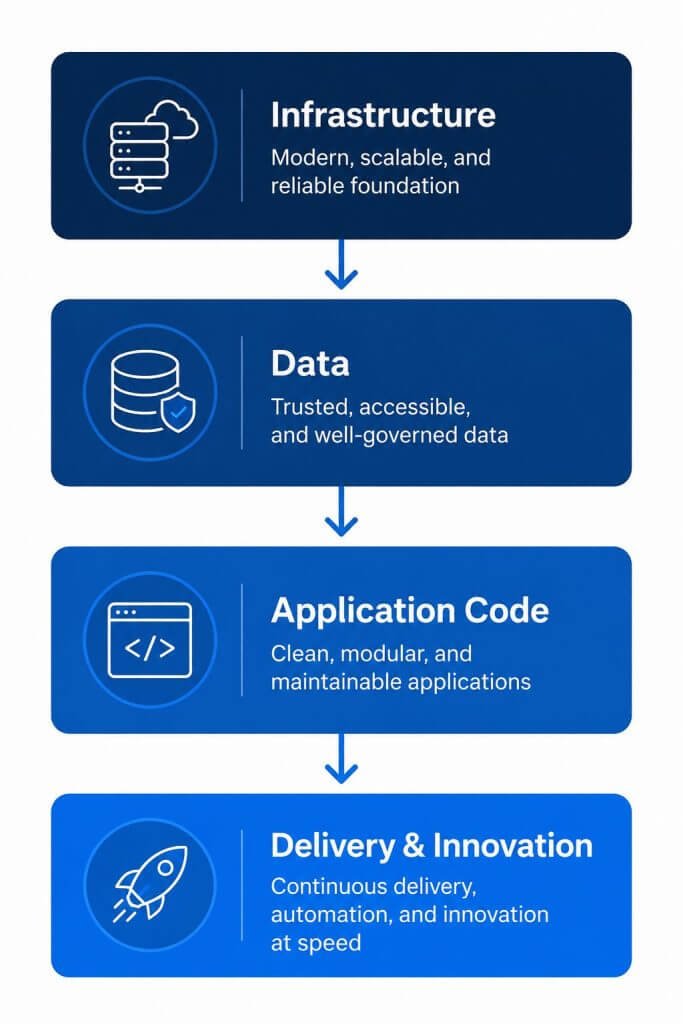
Modernization should follow the natural dependencies within the technology stack rather than the visibility or urgency of individual applications.
Each layer provides the foundation for the next:
- Infrastructure provides the stability, scalability, and operational foundation.
- Data establishes trusted information, governance, and integration boundaries.
- Application Code can then be modernized on a stable platform with predictable data and fewer downstream risks.
- Delivery & Innovation become possible once the underlying platform supports frequent, low-risk change.
By following this dependency model, organizations reduce modernization risk, minimize costly rework, and create a stronger foundation for long-term business agility.
Why Modernization Sequencing Matters
Each phase of modernization reduces constraints for the phase that follows. Skipping foundational work often causes hidden dependencies, infrastructure limitations, or data quality issues to surface later in the project, when they are significantly more expensive and disruptive to address.
This sequencing model is a core part of a successful legacy system modernization strategy, helping organizations execute modernization in the right order while reducing technical risk and improving delivery outcomes.
Assessing Modernization Readiness for Execution
If your team cannot clearly map:
- infrastructure dependencies
- data flows
- application interactions
on a single page, you are not ready to begin modernization work. One of the most common surprises during modernization planning is that the systems generating the most business value are often the most dependent on undocumented infrastructure, integrations, and data relationships.
That does not mean you stop. It means Phase 1 should focus on creating that clarity.
What Organizations Typically Discover During Modernization Planning
When organizations begin mapping modernization efforts across infrastructure, data, and application layers, several patterns emerge:
- Infrastructure dependencies are usually better understood than data dependencies
- Business-critical applications often rely on undocumented integrations
- Data complexity is frequently underestimated
- Teams discover modernization blockers that were not visible during prioritization
- Sequencing decisions often reveal hidden project risk
These findings help organizations build realistic execution plans and avoid costly rework later in the modernization process.
One of the most common surprises is that systems perceived as “stable” often depend on undocumented infrastructure, integrations, or data relationships that become visible only during modernization planning.
The Four Phases of Modernization Execution
These phases represent the most common application modernization phases used in enterprise environments.
These phases often overlap in practice, but the dependency order remains the same.
Phase 1: Infrastructure Modernization
Focus: Stabilize and modernize the environment the system runs on
Sample Timeline: Months 1 to 3
What You Are Doing
- Moving workloads to cloud or virtualized infrastructure
- Containerizing applications where appropriate
- Eliminating single points of failure
- Establishing network connectivity across environments
- Implementing monitoring, logging, and backup strategies
Why This Comes First
- Infrastructure establishes the foundation for everything that follows. Without a stable and scalable environment, application and data changes are difficult to validate and operate reliably.
- This phase often delivers the fastest return by reducing operational overhead and dependency on aging hardware.
If Skipped or Incomplete
- Systems remain fragile during modernization
- Teams are blocked by environment inconsistencies
- Infrastructure constraints surface mid-project
- Unplanned costs emerge (for example, expiring data center contracts or unsupported platforms)
Phase 2: Data Modernization
Focus: Understand, clean, and structure the data layer
Sample Timeline: Months 3 to 6
What You Are Doing
- Cleaning and validating master and reference data
- Identifying and resolving duplicate or conflicting data sources
- Defining domain boundaries and ownership
- Implementing encryption, masking, and compliance controls (PII, PHI, SOC 2, GDPR)
- Designing data access patterns and service layers
- Planning hybrid or multi-environment data strategies
Why This Comes Second
- Data is the most complex and least visible layer of the system.
- Decisions made here affect application behavior, integrations, and compliance.
- If data is not well understood, modernization efforts will introduce inconsistencies, break downstream systems, or create regulatory risk.
If Skipped or Started Too Late
- Data inconsistencies break applications
- Compliance risks increase
- Downstream systems fail due to schema or dependency changes
- Rework increases as assumptions about data prove incorrect
Phase 3: Application Code Modernization
Focus: Modernize application architecture and delivery
Sample Timeline: Months 6 to 18
What You Are Doing
- Introducing API layers around legacy systems
- Refactoring monolithic applications
- Applying patterns such as the strangler architecture
- Moving toward modular or service-based design
- Implementing CI/CD for independent deployments
Why This Comes Last
- Application changes depend on stable infrastructure and predictable data. Without both, code must be reworked repeatedly as dependencies shift.
- Modernization at this stage is more effective because underlying constraints have already been addressed.
If Started Too Early
- Code must be rewritten due to unstable infrastructure or changing data dependencies
- Integration issues surface late in the process
- Deployment instability slows progress
- Delivery timelines extend significantly due to rework
Even with a strong modernization strategy, certain failure patterns appear consistently across organizations. These failures are rarely caused by technology choices. They are almost always the result of incorrect sequencing.
Example Modernization Roadmap
The example below shows a typical modernization roadmap. Although timelines vary, successful initiatives generally follow the same dependency sequence.
| Phase | Primary Objective | Example Activities |
|---|---|---|
| Phase 1 Infrastructure |
Establish a stable, scalable operating environment. | Cloud migration, containerization, monitoring, logging, backups, networking, high availability. |
| Phase 2 Data |
Create trusted, governed, and well-understood data. | Master data cleanup, data governance, domain modeling, encryption, service-layer design. |
| Phase 3 Application Modernization |
Modernize application architecture and delivery. | API encapsulation, refactoring, rearchitecting, strangler pattern, modularization, CI/CD. |
| Phase 4 Application Delivery & Innovation |
Accelerate delivery and continuous improvement. | Independent deployments, automated testing, platform optimization, feature delivery, ongoing modernization. |
Example Modernization Execution Blueprint
The following blueprint expands on the roadmap above by illustrating how each phase typically unfolds during execution.
PHASE 1: INFRASTRUCTURE (Months 1-3)

├── Lift servers to virtualization/containers
├── Eliminate single points of failure
├── Establish network connectivity (hybrid/multi-cloud)
└── Ops team freed for higher-value work

PHASE 2: DATA (Months 4-6)
├── Clean master/reference data
├── Define domain boundaries
├── Encryption/masking for PII/PHIPA/SOC2
├── Hybrid/multi-provider data strategy
└── Service layers (no direct app-to-DB calls)

PHASE 3: APPLICATION MODERNIZATION (Months 7-18)
├── Introduce API wrappers around legacy systems
├── Refactor monolithic applications
├── Apply the strangler pattern where appropriate
├── Move toward modular or service-based architecture
└── Implement CI/CD for independent deployments

PHASE 4: DELIVERY & INNOVATION
├── Independent deployments become routine
├── Automated testing supports rapid releases
├── Teams deliver new features with lower risk
├── Platform optimization becomes continuous
└── Modernization shifts from projects to ongoing improvement
90-Day Modernization Execution Plan
Large modernization efforts often span months or years, but organizations can begin delivering measurable value almost immediately. The example below illustrates how many teams approach the first 90 days.
WEEK 1: CLEAN HOUSE
├── Retire 3-5 dead systems (Priority < 25)
├── Document $ savings in quarterly review
├── Celebrate quick win with team
└── Free ops team for Phase 1 work

WEEK 4: STANDARD WORKLOADS
├── Replace 2 HR/finance/reporting apps w/ SaaS
├── Migrate reference data only
├── Decommission originals
└── 60-80% cost savings realized

WEEK 12: BEGIN INFRASTRUCTURE MODERNIZATION
├── Target lowest-risk custom app (Highest-priority modernization candidate)
├── Infrastructure lift only (no code changes)
├── Validate stability
└── Ops team now contributes to innovation
This phased approach provides a practical modernization execution strategy that organizations can adapt based on portfolio size, team capacity, and business priorities.
Common Modernization Sequencing Failures and How to Avoid Them
The Cloud-Ready Trap (Infrastructure Without Data Alignment)
What happens: Infrastructure teams move systems to cloud infrastructure and declare the environment “cloud-ready,” while critical data remains tied to long-term on-premises systems or contracts.
Real-World Scenario
- Infra team: “All servers are lifted to IaaS. We’re cloud-native.”
- Data team: “Our Oracle RAC cluster is under a 5-year contract. Data stays on-prem.”
Result
- Complex hybrid architecture
- Unplanned integration layers
- Increased operational cost
- Project delays measured in months, not weeks
Why It Happens
Infrastructure decisions are made without aligning to data dependencies or long-term data strategy.
How To Avoid It
- Align infrastructure and data planning early
- Evaluate data location, contracts, and dependencies before migration
- Include data stakeholders in infrastructure decisions
The Code-First Rewrite (Application Changes Without Data Understanding)
What happens: Development teams begin rewriting applications without fully understanding underlying data dependencies and data quality issues.
Real-World Scenario
- Dev team rewrites a payroll application using microservices.
- Six months later, they discover customer and payroll data is spread across multiple siloed databases with no consistent source of truth.
Result
- Hidden data complexity surfaces late
- Significant rework required
- Projects are paused or abandoned
- In extreme cases, teams revert to legacy systems
Why It Happens
Application modernization begins before data readiness is established.
How To Avoid It
- Validate data sources, quality, and ownership before rewriting applications
- Map dependencies across systems and databases
- Prioritize data readiness before major code changes
The Data-Only Dead End (Data Changes Without Application Alignment)
What happens: Data teams restructure or clean data without aligning changes to how applications actually use that data.
Real-World Scenario
- Data team builds a clean domain model for customer data.
- Applications still expect large, denormalized structures and tightly coupled schemas.
Result
- Applications break due to mismatched data expectations
- Extensive regression testing required
- Delivery timelines extend significantly
Why It Happens
Data design is optimized without considering application dependencies and usage patterns.
How To Avoid It
- Align data models with application requirements
- Introduce service layers instead of direct schema changes
- Validate changes against real application behavior before rollout
Moving From Strategy to Execution
Your prioritization model from Step 3 tells you which systems to modernize. Sequencing determines how and when to modernize them.
Different systems often require different execution paths based on their readiness, business importance, and risk profile. For example:
- A high-risk system may begin with infrastructure stabilization before any application changes.
- A moderate-risk system may move through infrastructure, data, and application modernization in phased increments.
- A retained system may receive only infrastructure improvements and API enablement while continuing to operate with minimal functional change.
At this point, you have completed the core assessment framework:
- Step 1: Application Inventory — Build a complete inventory of your application portfolio.
- Step 2: Modernization Readiness Assessment — Evaluate each system across infrastructure, code, data, DevOps, and team readiness.
- Step 3: Application Portfolio Prioritization — Combine business impact and technical readiness to determine what to modernize first.
- Step 4: Modernization Sequencing — Determine the safest execution order by modernizing infrastructure, data, and application code in the correct sequence.
Together, these outputs provide the foundation for your modernization execution roadmap.
- Prioritized systems based on business impact and technical risk
- A defined modernization approach for each system (retire, replace, modernize, or retain)
- Risk mitigation activities aligned to each phase
- Realistic timelines based on team capacity and business priorities
- Compliance and governance considerations for regulated systems
Rather than modernizing everything at once, organizations begin with a small number of systems and apply this approach in controlled, phased increments. This reduces risk, creates measurable momentum, and validates the modernization strategy before expanding across the broader portfolio.
How Keyhole Applies Modernization Sequencing in Practice
In enterprise engagements, this assessment is not performed in isolation. We pair structured portfolio analysis with:
- Architect-led validation of dependencies and modernization risk
- AI-assisted codebase analysis to uncover hidden dependencies and technical debt
- Test-gated modernization workflows that maintain quality throughout each phase
- Incremental execution aligned to the infrastructure → data → application modernization sequencing model
When organizations apply this sequencing approach, execution changes in measurable ways. Instead of large, high-risk initiatives, teams move through modernization in structured phases aligned to real system dependencies. In practice:
- Technical teams work from a prioritized backlog based on business impact and technical readiness
- Architects validate sequencing decisions and identify dependencies before they become blockers
- Infrastructure and data constraints are addressed early, reducing rework later in the process
- Leadership has a clear, defensible roadmap tied to cost, risk, and business outcomes
- Early actions such as system retirement or replacement create measurable cost savings and momentum
The result is a modernization effort that progresses steadily, avoids common failure patterns, and remains aligned with business priorities.
When to Bring in an External Partner
Many organizations begin modernization planning internally. External expertise becomes most valuable when execution risk begins to outweigh internal capacity or when modernization decisions require specialized architectural experience. External support becomes valuable when:
- Systems are poorly documented or high-risk
- Multiple business units have competing priorities
- Teams lack experience with modernization at scale
- Leadership requires a clear, defensible roadmap
In these cases, structured guidance can accelerate decision-making and reduce risk.
Need Help Building a Modernization Roadmap?
If you’re planning a modernization initiative, begin with a structured assessment before committing to implementation. The combination of application inventory, readiness assessment, portfolio prioritization, and modernization sequencing creates a roadmap that reduces risk before development begins. Once scored, dive into our Software Modernization Strategy workflow.
If you’re working through a large or complex portfolio, sequencing often surfaces hidden dependencies, architectural constraints, and execution challenges. We help organizations:
- Run modernization planning workshops
- Validate sequencing decisions
- Build phased execution roadmaps
- Reduce modernization risk before implementation begins
→ Schedule a Legacy System Assessment Workshop
→ Download the free Keyhole Legacy System Assessment Toolkit
Whether you’re modernizing five applications or five hundred, following a structured sequencing model helps reduce risk, improve delivery predictability, and build momentum through incremental success.
Completing the Legacy System Modernization Framework
This article completes the four-step Legacy System Assessment Framework.
- Step 1: Application Inventory — Understand what systems you have and where they provide business value.
- Step 2: Modernization Readiness Assessment — Evaluate infrastructure, code, data, DevOps, and team readiness.
- Step 3: Application Portfolio Prioritization — Identify which systems should be modernized first based on business impact and technical readiness.
- Step 4: Modernization Sequencing — Execute modernization in the correct order to reduce risk and improve delivery outcomes.
Together, these four steps create a repeatable modernization methodology that helps organizations reduce technical debt, prioritize investment, and modernize legacy systems with greater confidence.
The framework is intentionally iterative. As business priorities change, organizations can revisit inventory, reassess readiness, reprioritize applications, and adjust execution sequencing without restarting the entire process.
Common Questions About Modernization Sequencing
Why isn’t the highest-priority application always modernized first?
Because technical dependencies often determine execution order. A lower-priority infrastructure or data initiative may need to be completed before a high-priority application can be modernized safely.
Can infrastructure, data, and application modernization happen at the same time?
Yes—but only when dependencies have been identified and managed. Most successful modernization programs overlap phases where appropriate while preserving the overall dependency sequence.
What is included in an application portfolio assessment?
It includes system inventory, technical scoring, business impact analysis, and prioritization for modernization.
How often should modernization priorities be reassessed?
Most organizations revisit application inventories and prioritization annually, or whenever major business initiatives, acquisitions, regulatory changes, or technology shifts significantly affect the application portfolio.
How do you prioritize legacy systems?
By combining technical readiness with business impact using a structured scoring model.
What are the biggest risks in modernization?
Poor sequencing, undocumented dependencies, and underestimating data complexity.
Why should infrastructure be modernized before application code?
Application code depends on stable infrastructure and predictable operating environments. Modernizing infrastructure first reduces operational risk and creates a consistent foundation for future application and data changes.
More From Keyhole Software
About Keyhole Software
Expert team of software developer consultants solving complex software challenges for U.S. clients.
Share This Post
Join The Thousands Of Devs Who Subscribe

Discuss This Article
Subscribe
Login
0 Comments
Oldest