
How to Build a Software Modernization Strategy (2026)
Legacy application maintenance consumes up to 80% of total enterprise IT budgets.12 That’s not just inefficiency, it is a structural cost problem that starves innovation and expands security exposure. U.S. software technical debt alone reached $1.52 trillion by 2022.13
The urgency is reflected in the market. The global legacy modernization market reached $24.98 billion in 2025.14 It is projected to hit $66.21 billion by 2031. Organizations are no longer asking whether to modernize. They are deciding how to do it effectively.
At the same time, the execution model is changing. AI-accelerated execution is compressing modernization timelines that once spanned years into months. But speed alone is not the differentiator. Without a clear strategy and strong architectural governance, faster execution simply introduces risk more quickly.
The organizations seeing meaningful results are not just using AI, they are applying it within a structured, architect-led delivery model to accelerate discovery, transformation, and delivery while maintaining control and system integrity. This guide walks through a practical, seven-step framework for building a software modernization strategy from initial assessment through execution, and where AI meaningfully changes how each step is delivered.
What This Guide Covers
- The six core modernization approaches, including where they fit best and how AI accelerates outcomes for each.
- A framework for weighing the cost, risk, and speed tradeoffs of each approach against your business context.
- A decision framework for selecting the right strategy based on your system and business goals.
- How AI-accelerated, architect-governed delivery changes the economics and risk profile of modernization.
- How these patterns apply in real-world client projects across industries.
At Keyhole Software, we’ve applied this approach across financial services, healthcare, manufacturing, and logistics. Our senior consultants, averaging 17+ years of experience, use AI-accelerated, architect-led delivery to compress complex modernization initiatives by 3–5x while maintaining full traceability, testability, and system integrity.2
Software Modernization Strategy at a Glance
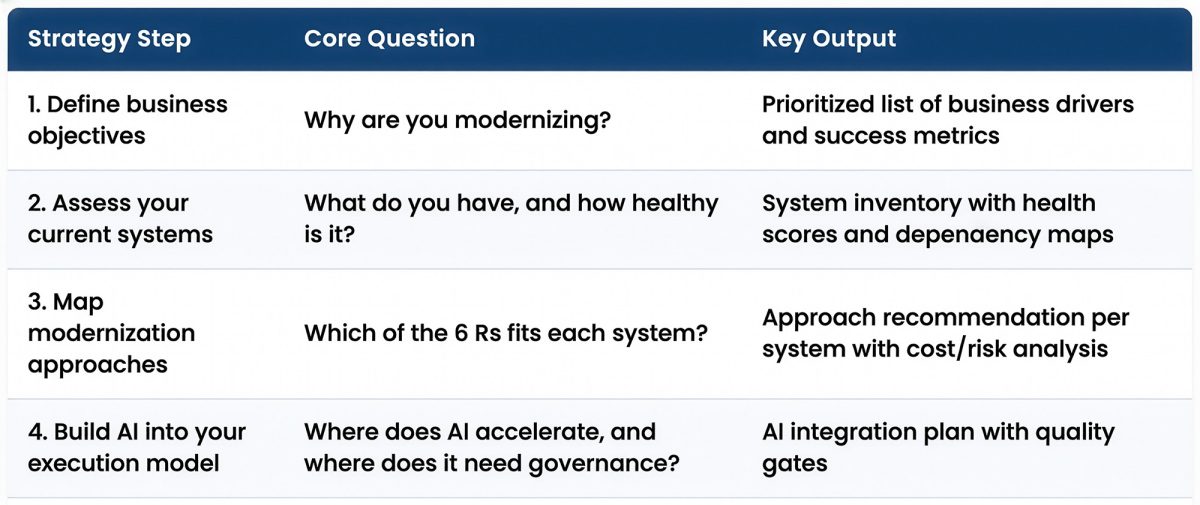
A complete software modernization strategy answers seven core questions. Each step builds on the one before it, moving from business alignment through execution.
Use the table below as a quick reference. If you can clearly answer each question, you have the foundation for a sound, executable modernization strategy.
| Strategy Step | Core Question | Key Output |
|---|---|---|
| 1. Define business objectives | Why are you modernizing? | Prioritized list of business drivers and success metrics |
| 2. Assess your current systems | What do you have, and how healthy is it? | System inventory with health scores and dependency maps |
| 3. Map modernization approaches | Which of the 6 Rs fits each system? | Approach recommendation per system with cost/risk analysis |
| 4. Build AI into your execution model | Where does AI accelerate, and where does it need governance? | AI integration plan with quality gates |
| 5. Apply a decision framework | Which approach matches each system’s business context? | Decision matrix mapping business drivers to approaches |
| 6. Plan for data, security, and cutover | What cross-cutting risks could derail the program? | Risk register with mitigation plans |
| 7. Create a phased roadmap | What order delivers the most value with the least risk? | Phased timeline with quick wins and milestones |
Seven-step software modernization strategy framework showing each step’s core question and expected output.
Now that you have a high-level view of the software modernization strategy, the next sections walk through how to apply each step in practice, from defining business outcomes to executing with AI-accelerated delivery.
Step 1: Define Your Business Objectives and Success Metrics
The most common failure in a software modernization strategy is choosing a technology path before defining the business problem. PwC surveyed 610 operations leaders and found that 82% struggle to balance short-term firefighting with long-term change.15 Your strategy should start with the outcome.
Start with the business driver. Cost reduction, business agility, risk mitigation, and compliance pressure each point toward different approaches. A CTO focused on cutting infrastructure costs needs a different strategy than one trying to ship features twice as fast.
Define measurable success criteria. Every strategy needs metrics you can evaluate against. Mainframe modernization programs have historically reported ROI of 288% to 362%.13 Financial services firms that modernize achieve 30 to 40% infrastructure cost reductions.14 Set targets that match your business driver.
Business Driver Assessment
| Business Driver | What It Means for Strategy | Typical Modernization Path |
|---|---|---|
| Cost reduction | Focus on infrastructure savings and operational efficiency | Rehost or replatform first; refactor high-cost systems |
| Business agility | Focus on faster delivery and independent team deployment | Rearchitect to microservices or rebuild |
| Risk and compliance | Focus on security posture, regulatory alignment | Refactor for testability; rebuild for security-by-design |
| Technical debt | Focus on maintainability and developer productivity | Refactor incrementally; stabilize before deeper changes |
| Talent and retention | Focus on modern stack to attract and retain engineers | Rebuild or rearchitect on modern frameworks |
Pro tip: In our experience, organizations that define success metrics first are far more likely to stay on track. The metric becomes the tiebreaker when technical decisions compete.
Once business objectives and success metrics are clearly defined, the next step is understanding the systems that must support them.
Step 2: Assess Your Current System Portfolio
You cannot build a sound software modernization strategy without a clear understanding of your current system landscape. A well-architected but dated application is often a strong refactoring candidate. A brittle, tightly coupled monolith may need to be rebuilt or replaced entirely.
Inventory your systems. List every application in scope. For each, capture the technology stack, business criticality, maintenance cost, code quality, integration dependencies, and compliance requirements.
Score system health. Rate each system on a simple scale. Green means healthy and low maintenance. Yellow means aging with growing tech debt. Red means brittle, high risk, and blocking business goals. The score guides which systems to modernize first.
System Assessment Checklist
| Assessment Area | Key Questions | Tools and Methods |
|---|---|---|
| Business criticality | What happens if this system goes down for 24 hours? | Stakeholder interviews, revenue impact analysis |
| Code quality | Is the codebase maintainable? How deep is the technical debt? | SonarQube, static analysis, AI-assisted code review |
| Architecture | Is the system modular or monolithic? How tightly coupled? | Dependency mapping, AI-assisted discovery |
| Data dependencies | Where does data live? What formats and schemas are in use? | Data profiling, schema analysis tools |
| Team capacity | Does your team have skills for the target architecture? | Skills inventory, training needs assessment |
| Compliance exposure | Which regulations apply (HIPAA, PCI-DSS, SOC 2)? | Compliance audit, security review |
AI can accelerate the assessment phase significantly. Teams can use AI-assisted discovery to map dependencies across systems, identify infrastructure requirements, and surface undocumented business logic. This reduces weeks of manual analysis that typically delay modernization programs. (See how Keyhole applies AI to enterprise development)
Step 3: Map the Right Modernization Approach to Each System
Once you understand your system landscape, the next step is deciding how each system should evolve.
Most software modernization strategies use multiple approaches across different systems. A CRM replacement, a mainframe refactor, and a cloud rehost can all exist within the same program. The 6 Rs framework provides a shared vocabulary for making these decisions consistently.
The “6 Rs” framework below is a hybrid model, combining Gartner’s original rationalization approach3 with the migration terminology used by AWS4 and Microsoft5 in practice. We’ve gone into significant detail in our recent blog Legacy System Modernization Approaches: A CTO’s Guide to Rehost, Refactor, or Rebuild.
The 6 Rs of Software Modernization
Each approach represents a different tradeoff between speed, cost, risk, and long-term flexibility.
| Approach | What It Does | Timeline | Cost | Risk | Best Fit |
|---|---|---|---|---|---|
| Rehost | Move to cloud, minimal code changes | 2–4 months | Low | Low | Data center exit, quick savings |
| Replatform | Optimize for cloud services | 3–6 months | Low–Med | Low–Med | Cloud efficiency without redesign |
| Refactor | Restructure code, preserve behavior | 6–12 months | Medium | Medium | Reduce tech debt, improve maintainability |
| Rearchitect | Shift to modern architecture | 9–18 months | High | High | Business agility, independent teams |
| Rebuild | Rewrite from the ground up | 12–24+ months | Very High | High | System too outdated to salvage |
| Replace | Switch to SaaS or COTS | 3–9 months | Medium | Low | Commodity functions (CRM, HR) |
For many organizations, the strongest path is not the most ambitious one. It is the path that delivers the best balance of business impact and execution risk.
How Organizations Are Prioritizing Modernization
Market data shows how organizations are prioritizing different modernization approaches. Replatforming holds the largest share of specific approaches at 31.85%.14 Rearchitecting is the fastest-growing segment, expanding at a 22.74% CAGR through 2031.14 Cloud deployments capture 67.10% of revenue, with hybrid cloud specifically holding 49.63%.14
The spending pattern by industry also matters for your strategy. Banking and financial services account for 26.30% of the modernization market.14 Healthcare is the fastest-growing vertical at an 18.19% CAGR.14 The U.S. federal government spends 80% of its $100+ billion annual IT budget purely on maintaining existing systems.16
Each of these approaches serves a different purpose. The sections below break down when each approach fits, what to watch for, and how AI changes the speed and execution of each.
Across a software modernization strategy, AI plays a different role in each approach: accelerating discovery in some cases, reducing implementation effort in others, and improving quality throughout. The following sections highlight where that impact is most meaningful.
Rehosting: When Speed and Stability Are the Priority
Rehosting moves your application from on-premises infrastructure to the cloud with minimal code changes.4 It is the fastest path and strongest for data center exits.
| Aspect | Description | Key Considerations | Real-World Example |
|---|---|---|---|
| Process | Re-deploying applications to VMs or containers in the cloud | Requires detailed dependency mapping and IaC for repeatability | Migrating a Java app from a local server to an AWS EC2 instance |
| Tooling | AWS Application Migration Service, Azure Migrate, Terraform, Ansible | IaC tools like Terraform are critical for managing the new environment | Using Terraform to define and provision VPC, subnets, and security groups |
| Outcomes | Reduced infrastructure costs, increased operational resilience | Does not address technical debt or improve application architecture | The application still runs on Windows Server, but now in the cloud |
| Risks | “Cloud-washing” legacy problems; performance may not improve without tuning | A poorly performing on-premise app will likely perform poorly in the cloud | An app with chatty DB connections becomes more expensive due to egress fees |
When it fits: You need to exit a data center on a compressed timeline. The application is stable, but the infrastructure is expensive or hard to support. You want a cloud landing zone for future optimization.
What to watch for: Rehosting carries technical debt into the cloud rather than eliminating it. Applications not designed for distributed, latency-aware environments rarely perform well at scale. At minimum, run a penetration test post-migration and assess alignment with Zero Trust architecture.
How AI Accelerates Rehosting
AI improves rehosting by:
- mapping dependencies across systems and services
- identifying infrastructure requirements and configuration gaps
- generating infrastructure-as-code templates
- validating environment configurations before deployment
This is especially valuable when planning and discovery work would otherwise slow cloud migration inside a broader software modernization strategy.
Used within a governed delivery process, this shortens the time required to prepare stable environments and reduces surprises during migration.
The practical impact is fewer unknowns during migration and a shorter path from planning to stable deployment.
Replatforming: Cloud Benefits Without Full Redesign
Replatforming makes targeted cloud optimizations during migration, such as swapping a self-managed database for Amazon RDS or containerizing on Kubernetes.5 It is the most popular initial approach, holding 31.85% of the modernization market.14 Survey data shows that 47% of organizations use replatforming as an interim step before deeper refactoring.14
| Aspect | Description | Key Considerations | Real-World Example |
|---|---|---|---|
| Process | Modifying components to use cloud-native services | Identify components that are expensive or difficult to manage on-premises | Swapping a self-hosted message queue for AWS SQS or Azure Service Bus |
| Tooling | Docker, Kubernetes, AWS RDS, Azure SQL Database | Managed services reduce operational burden but can introduce vendor lock-in | Moving from self-managed MySQL to Azure Database for MySQL |
| Outcomes | Improved performance, reduced operational overhead, better scalability | A good balance between cost, effort, and benefit | The app now auto-scales based on traffic; database patching is automated |
| Risks | Can introduce new dependencies; requires cloud-specific skills | The team needs to monitor and debug managed services effectively | A misconfigured managed service can cost more than the on-premise equivalent |
When it fits: The application works well enough, but supporting infrastructure is too expensive or difficult to manage. You want cloud benefits like managed services and auto-scaling without a full redesign.
What to watch for: Replatforming can introduce new dependencies on managed cloud services. Your team needs operational skills for monitoring, troubleshooting, and cost control in the new environment. Overdoing it can push the effort into rearchitecture territory without the same level of planning.
How AI Accelerates Replatforming
AI improves replatforming by:
- evaluating bottlenecks and workload patterns
- identifying inefficient infrastructure usage
- recommending cloud services that better fit the workload
- assisting with configuration changes and migration planning
This is especially valuable when teams need to make targeted improvements without letting the effort expand into a full rearchitecture initiative.
In a governed modernization effort, AI helps teams move through infrastructure and platform decisions more efficiently while senior architects validate fit, cost implications, and operational impact. The practical impact is faster execution without unnecessary scope expansion.
Refactoring: Reducing Technical Debt While Preserving Behavior
Refactoring restructures existing code without changing its external behavior.6 This is often a necessary step before larger modernization work can succeed. The urgency is real: the average COBOL programmer is 55 years old. This workforce is retiring at roughly 10% per year.13 AI-assisted refactoring directly addresses this knowledge transfer gap.
| Aspect | Description | Key Considerations | Real-World Example |
|---|---|---|---|
| Process | Applying small, behavior-preserving transformations to existing code | Requires a strong suite of automated tests to prevent regressions | Extracting a complex calculation into its own service with a clean API |
| Tooling | SonarQube, IDE refactoring tools (IntelliJ, VS Code), JUnit, NUnit | Static analysis tools can identify code smells and improvement areas | Using SonarQube to find duplicated code blocks for consolidation |
| Outcomes | Reduced technical debt, improved code quality, easier feature development | A necessary investment before larger architectural changes | Developers can now add features in days instead of weeks |
| Risks | Can be time-consuming; may not deliver immediate business value | Stakeholders must understand refactoring is an investment in future velocity | Spending three months refactoring a module without shipping new features |
When it fits: The application still solves the right business problem, but the codebase is hard to maintain. You need to reduce technical debt without changing the system’s outward behavior. You are planning a larger modernization effort and need to stabilize the foundation first.
What to watch for: Refactoring can be time-consuming and may not produce obvious short-term business gains. Without automated tests and clear quality gates, refactoring can introduce regressions instead of reducing risk.
How AI Accelerates Refactoring
AI improves refactoring by:
- identifying redundant or outdated code patterns
- suggesting restructuring opportunities across modules
- generating unit and integration tests automatically
- summarizing complex or undocumented business logic
This is especially valuable in older systems where institutional knowledge is limited and understanding the existing behavior is the primary bottleneck.
Experienced engineers still guide priorities, validate behavior, and protect architectural integrity as AI accelerates discovery and low-level transformation work. The practical impact is a shorter path to safe changes in systems where understanding, not coding, is the main constraint.
Rearchitecting: When the Business Needs a New Operating Model
Rearchitecting fundamentally changes the application’s architecture, typically moving from a monolith to microservices.7 This segment is growing at a 22.74% CAGR through 2031.14
| Aspect | Description | Key Considerations | Real-World Example |
|---|---|---|---|
| Process | Decomposing a monolithic application into smaller, independent services | Requires deep understanding of domain-driven design for correct boundaries | Creating a separate “Payments” microservice for all credit card processing |
| Tooling | Docker, Kubernetes, API Gateways (Apigee, Kong), Service Mesh (Istio) | A service mesh helps manage inter-service communication complexity | Using Istio to handle traffic routing, retries, and circuit breaking |
| Outcomes | Increased deployment frequency, improved scalability, team independence | The primary driver for most large-scale digital transformations | The checkout team can deploy updates without impacting the catalog team |
| Risks | High complexity, requires mature DevOps, risk of distributed monolith | Without proper governance, the result can be more complex than the original | Two microservices tightly coupled and forced to deploy together |
When it fits: The monolith is slowing delivery and blocking independent team deployment. The organization requires greater scalability, faster releases, or stronger resilience. You can identify clear domain boundaries that map to distinct services.
What to watch for: Rearchitecting is one of the highest-risk modernization paths. Poorly defined service boundaries create a distributed monolith, which is worse than the original. Use incremental patterns like the Strangler Fig approach9 rather than attempting a full rewrite. You need mature DevOps practices, strong observability, and clear data ownership.
How AI Accelerates Rearchitecting
AI improves rearchitecting by:
- analyzing dependencies across modules and data flows
- identifying likely service boundaries based on usage patterns
- generating early API contracts and service scaffolding
- speeding up documentation of complex legacy flows before major design decisions
This is especially valuable in complex systems where undocumented coupling can slow architectural planning.
The long-term success of rearchitecting still depends on human judgment around domain boundaries, data ownership, team structure, and operational design.
The practical impact is faster movement through architectural uncertainty while keeping critical decisions human-led.
Rebuilding: When the Current System Cannot Be Salvaged
Rebuilding means rewriting the application from scratch with a modern technology stack. This approach is reserved for cases where the existing system is too outdated, brittle, or limiting to salvage.
| Aspect | Description | Key Considerations | Real-World Example |
|---|---|---|---|
| Process | A greenfield development project to replace a legacy system | An opportunity to rethink business processes, not just replicate them | Designing a new workflow that automates manual steps from the old system |
| Tooling | Modern frameworks (React, Angular, Spring Boot, .NET), cloud-native services | The technology stack choice will impact the application for 10 to 15 years | Building a new app using React for the front end and .NET for the back end |
| Outcomes | A modern, scalable application aligned with current business needs | The highest potential for business transformation | The new system allows the business to enter markets that were previously impossible |
| Risks | Highest cost and timeline; risk of big-bang failure | A phased rollout is critical to mitigate risk and deliver value incrementally | A two-year project canceled after 18 months because it delivered no value |
When it fits: The application still matters to the business, but the current design blocks growth. The codebase is unsalvageable. The organization is willing to invest in long-term transformation rather than a quick fix.
What to watch for: Rebuilds carry the biggest risk of delay, scope creep, and big-bang failure. A phased, tightly governed approach works best. Avoid recreating every old process exactly. The value of a rebuild comes from rethinking the business process itself.
How AI Accelerates Rebuilding
AI improves rebuilding by:
- generating application scaffolding and boilerplate code
- assisting with feature development and UI/API creation
- automating repetitive coding tasks such as mapping DTOs, controllers, and database layers
This is especially valuable when teams need to reduce repetitive engineering effort and move more quickly from concept to implementation.
Senior engineers still define the architecture, business rules, and delivery decisions that shape the long-term success of the platform.
The practical impact is a faster path from concept to working system without shifting core design responsibility away from experienced engineers.
Replacing: When the Capability Is Better Bought Than Built
Replacing decommissions a legacy application and switches to a SaaS or commercial off-the-shelf solution.3 This approach can deliver value quickly because the business adopts a proven platform rather than funding a new build. The real effort is typically vendor evaluation, configuration, data migration, integration, and organizational change management.
| Aspect | Description | Key Considerations | Real-World Example |
|---|---|---|---|
| Process | Migrating data and processes to a SaaS platform | Requires thorough vendor evaluation for business and security fit | Moving from a custom-built HR system to Workday |
| Tooling | SaaS platforms (Salesforce, Workday, ServiceNow), data migration tools | The focus is on configuration and integration, not coding | Configuring custom fields and workflows in Salesforce to match processes |
| Outcomes | Reduced maintenance overhead, access to new features, predictable costs | Frees development teams to work on competitively differentiating systems | The IT team no longer patches or upgrades the CRM system |
| Risks | Vendor lock-in, data migration complexity, loss of custom features | The SaaS vendor’s roadmap may not align with your business priorities | A critical custom feature is not available in the new SaaS product |
When it fits: The application supports a commodity function (HR, CRM, ticketing, finance). A proven SaaS product already covers most of the required capability. Maintaining or securing the current system costs more than it delivers in business value.
What to watch for: Replacing can create vendor lock-in. Pay close attention to data migration, security requirements, and the fit between the SaaS product’s workflows and your actual processes. Do not assume SaaS is automatically simpler; you still manage configuration, integrations, identity, and user adoption.
How AI Accelerates Replacement
AI improves replacement by:
- mapping legacy workflows to the target SaaS platform
- assisting with data transformation and migration planning
- identifying gaps between current and target capabilities, including custom fields, approval patterns, and reporting logic
This is especially valuable during evaluation and migration planning, where hidden process complexity often creates delays. Human judgment is still required to validate platform fit, confirm business-process support, and manage the downstream change implications.
The practical impact is faster evaluation and planning with fewer surprises during transition.
Step 4: Build AI-Accelerated Execution Into Your Strategy
Up to this point, the focus has been on selecting the right modernization approach for each system. The next step is defining how that work actually gets executed.
AI is fundamentally changing that execution model. It shifts modernization from a primarily manual effort to an accelerated, iterative process – when applied within the right delivery structure.
Over 75% of organizations now use AI to support modernization initiatives.13 But the impact is not automatic. Applied within a governed, architect-led model, AI accelerates delivery while maintaining control, traceability, and system integrity. Applied without that structure, it introduces risk just as quickly as it increases speed.
The Numbers Behind AI-Accelerated Modernization
The impact of AI-accelerated modernization is now measurable, not theoretical. BCG documented an Asian financial institution that mapped 3.1 million lines of legacy code in under three weeks.17 The AI system extracted over 5,000 business rules. This represents a 225x acceleration over manual discovery.
Deloitte reported that a major U.S. airline spent six years manually refactoring just 10% of its legacy system. After shifting to AI-assisted tools, the airline completed equivalent work in approximately 1.5 years.18 AI code tools improve developer proficiency by roughly 20%.18
Building custom data layers manually costs upwards of $1.5 million and takes 12 to 18 months. AI-augmented API generation tools collapse this to days.13 AI is also projected to reduce overall project cycle times by up to 45%, shortening the payback period for modernization capital expenditures.13
Where Does AI Create the Most Impact by Approach?
| Approach | AI Accelerates | Human Judgment Required |
|---|---|---|
| Rehost | System discovery, dependency mapping, IaC generation | Cutover planning, security validation |
| Replatform | Workload analysis, cloud service selection | Cost optimization, vendor decisions |
| Refactor | Code understanding, test generation, restructuring | Refactoring priorities, architectural direction |
| Rearchitect | Dependency analysis, API scaffolding | Domain modeling, service boundaries |
| Rebuild | Code generation, scaffolding, feature development | Product decisions, business logic |
| Replace | Workflow mapping, data transformation, gap analysis | Vendor selection, change management |
These gains become more tangible when applied in real-world modernization efforts.
Real-World Example: AI-Accelerated Modernization in Practice
Keyhole recently compressed an insurance platform modernization effort estimated at 18 to 24 months into roughly five months. The team applied AI-accelerated replatforming within a governed delivery model.11 AI was used to help:
- analyze and map legacy system dependencies
- accelerate code transformation and restructuring
- generate and strengthen test coverage
Senior architects governed each phase to ensure:
- functional equivalence
- architectural alignment
- production readiness
The result was not just faster delivery. It was faster delivery with control, traceability, and confidence.
Keyhole’s AI-Accelerated Delivery Model
At Keyhole, AI operates as a governed accelerator within a structured delivery process rather than a substitute for engineering judgment. The objective is faster execution with full traceability and architectural alignment.
In practice, AI supports every phase of modernization:
- Analysis: mapping legacy systems, business logic, and dependencies
- Transformation: converting code, re-expressing workflows, and generating tests
- Documentation: summarizing undocumented logic and creating reference assets
- Delivery: automating scaffolding, form-style code, and repetitive patterns
How AI Fits Into Our Delivery Loop
Our delivery model follows a tightly governed loop:
- Define the intent and backlog for each modernization increment.
- Apply AI-assisted transformation: code conversion, test generation, documentation.
- Validate every output with human review, automated testing, and quality gates.
- Commit and maintain traceability: every change is traceable to a requirement.
- Repeat for the next scope. The loop keeps AI productive and governed.
AI does not replace the architect, the subject matter expert, or the testing gate. It absorbs the repetitive, mechanical work so those roles can focus on decisions that matter.
Why Governance Matters More Than Speed
The faster AI makes execution, the more governance matters. Velocity only creates value when every output is testable, traceable, and aligned to the target architecture. Without those gates, automation compounds risk: inconsistent patterns, hidden defects, and unverified outputs.
At Keyhole, governance means:
- Every AI-generated change is validated through quality gates
- Architectural decisions remain human-driven, even when AI helps execute them
- Full traceability is maintained from requirement to deployed code
As a member of the Claude Partner Network, Keyhole applies agentic agents like Claude and Codex inside this governed loop. The result: AI becomes a controlled force multiplier rather than a source of unmanaged risk.
Step 5: Apply a Decision Framework to Your System
With an execution model in place, the next step is ensuring that each modernization decision aligns with business priorities, technical reality, and organizational capacity.
Choosing the right path is less about finding the “best” technical option and more about matching the approach to the business problem. The same system may be a rehost candidate in one context, a refactoring candidate in another, or a rebuild if the business need justifies it.
The best decisions start with the business outcome, not a technology preference. A structured framework helps ensure each modernization path aligns with business goals, technical constraints, and what the organization can realistically absorb.
1. Assess the business context. Why is modernization on the table now? Cost pressure, growth constraints, risk exposure, or compliance gaps? The answer shapes every subsequent decision.
2. Evaluate the existing system. How structurally sound is it? A sound application can be refactored; a brittle monolith may need rebuilding.
3. Analyze cost and ROI. Consider not just the upfront project cost, but total cost of ownership: licensing, infrastructure, and maintenance.
4. Consider the human element. Does your team have the skills for the chosen approach? Change management and upskilling are critical.
5. Define a phased roadmap. Identify quick wins that build momentum and fund later, more complex modernization efforts.
Quick Decision Guide
The table below provides a simplified starting point for aligning business priorities to modernization approaches.
| If Your Priority Is… | Start With… | Why |
|---|---|---|
| Speed and minimal change | Rehost | Fastest path to cloud; preserves existing logic |
| Cloud efficiency without redesign | Replatform | Targeted optimizations with moderate effort |
| Structural improvement to the code | Refactor | Reduces tech debt, improves future velocity |
| A new operating model or agility | Rearchitect | Enables independent teams, faster releases |
| A system too constrained to support future needs | Rebuild | Clean slate with modern architecture |
| A capability better bought than built | Replace | Mature SaaS covers commodity needs |
AI can accelerate each step of this process by compressing analysis, generating system summaries, and revealing hidden dependencies. But the final decisions still requires human judgment.
At its core, software modernization strategy is a business decision supported by technology, not the other way around.
Step 6: Address Data Migration, Security, and Cutover Risks
These cross-cutting concerns derail more modernization programs than any technical decision. Your software modernization strategy must address them explicitly, regardless of which approach you choose.
Data Migration and Governance
Data is frequently the highest-value and highest-risk element of any modernization program. It is often stored in legacy formats with years of inconsistent business rules embedded within it. In our experience, underestimating the data migration workstream is the single most common reason projects exceed their budgets.
AI can assist with data transformation, schema mapping, and validation. The governance decisions still require human judgment. What to keep, what to archive, and what to transform are business calls, not technical ones.
Practical steps:
- Start data profiling before the modernization project formally begins.
- Document every transformation rule.
- Run reconciliation checks between source and target after each migration batch.
- Build rollback procedures for every data migration step.
Security, Compliance, and Risk Management
Each modernization approach has different security implications. A rehost might carry forward existing vulnerabilities. A rebuild offers the chance to design security from the start. For regulated industries, compliance with frameworks such as HIPAA, PCI-DSS, and SOC 2 must be a primary architectural consideration.
Practical steps:
- Run a security assessment before and after each modernization phase.
- Include penetration testing for rehosted systems.
- Assess alignment with Zero Trust architecture for all new cloud deployment.
- Map compliance requirements to specific architectural decisions early.
Testing and Cutover Strategies
How you transition from the old system to the new one matters as much as the new system itself. The Strangler Fig pattern9 allows incrementally replacement of legacy components with the new services, reducing cutover risk.
Parallel runs, where old and new systems operate simultaneously, provide a safety net but add operational cost. Choose your cutover strategy based on system criticality and your organization’s risk tolerance.
Practical steps:
- Define rollback criteria before every cutover.
- Automate regression testing across both old and new systems.
- For critical systems, plan a parallel run period and define success thresholds before decommissioning the legacy system.
Step 7: Create a Phased Roadmap with Quick Wins
A phased roadmap that delivers incremental value is almost always more effective than a big-bang transformation. Phased delivery builds organizational confidence, generates early ROI, and funds later phases.
A typical phased modernization roadmap follows a progression like the one below:
| Phase | Focus | Typical Timeline | Expected Outcome |
|---|---|---|---|
| Phase 1: Quick wins | Rehost or replatform systems with immediate cost savings | Months 1–3 | Infrastructure cost reduction, cloud landing zone |
| Phase 2: Foundation | Refactor high-debt codebases; improve test coverage | Months 3–6 | Stabilized systems, improved developer velocity |
| Phase 3: Transformation | Rearchitect or rebuild systems with the strongest business case | Months 6–18 | New capabilities, modern architecture |
| Phase 4: Continuous evolution | Ongoing optimization, replacement of commodity systems | Ongoing | Technology portfolio aligned to business strategy |
In practice, start with systems where the gap between current cost and cloud-native cost is largest. These quick wins generate the budget and executive confidence to fund deeper modernization later. AI can help prioritize by analyzing system dependencies and calculating potential savings per system.
5 Mistakes That Derail a Software Modernization Strategy
Even well-structured software modernization strategies can fail when execution risks are underestimated. The most common pitfalls include:
1. Choosing the Approach Before Defining the Business Outcome
Teams often start with a technology preference (“we need microservices”) instead of a business problem. Always start with the business driver. The right modernization approach follows from the right problem definition.
2. Treating Rehosting as the Finish Line
A successful lift-and-shift is a first step, not a destination. Applications not designed for cloud-native environments carry forward performance issues, security gaps, and operational inefficiencies. Plan your next phase before the rehost is complete.
3. Underestimating Data Migration
Data migration consistently causes the most budget and timeline overruns. Legacy data is often inconsistent, poorly documented, and embedded with years of undocumented business rules. Start data assessment early and allocate more time than expected.
4. Skipping Governance for AI-Generated Outputs
AI can accelerate every approach, but ungoverned AI outputs compound risk rather than reducing it. Every AI-generated change requires validation through quality gates and human review. Velocity without traceability creates more problems than it solves.
5. Attempting a Big-Bang Transformation
Large-scale modernization programs fail most often when they try to deliver everything at once. Use incremental patterns, phased roadmaps, and the Strangler Fig approach to reduce risk and deliver value continuously.
Build Your Software Modernization Strategy with Confidence
A strong software modernization strategy is not about finding a single right answer. It is about making informed tradeoffs – choosing the right approach for each system, executing it with discipline, and applying AI in a way that accelerates delivery without introducing new risk.
You now have a seven-step framework to guide those decisions. Organizations that modernize for high interoperability grow revenue 2.5 times faster than peers with siloed architectures.13 The organizations that succeed combine AI-accelerated execution with architect-led governance and a structured modernization plan.
Keyhole Software’s 100% U.S.-based senior consultants help organizations build and execute software modernization strategies with AI-accelerated, architect-governed delivery. Clients like AMC Theatres, Commerce Bank, Mastercard, and Northwell Health trust Keyhole for modernization work across Java, .NET, COBOL/Mainframe, and cloud-native architectures.
Schedule a Modernization Consultation to assess your systems, identify the right approach, and understand how AI-accelerated software delivery could impact your timeline.
References
1. McKinsey & Company, “Losing from day one: Why even successful transformations fail,” 2022. mckinsey.com
2. Keyhole Software. keyholesoftware.com
3. Gartner, “The 5 Rs of Application Modernization,” 2010.
4. AWS, “6 Strategies for Migrating Applications to the Cloud,” 2016. aws.amazon.com
5. Microsoft Azure, “The 6 Rs of Application Modernization.” learn.microsoft.com
6. Martin Fowler, Refactoring: Improving the Design of Existing Code.
7. Martin Fowler & James Lewis, “Microservices,” 2014. martinfowler.com
8. Keyhole Software, “COBOL Modernization and Microservices Implementation for KC Southern.” keyholesoftware.com
9. Martin Fowler, “StranglerFigApplication,” 2004. martinfowler.com
10. Keyhole Software, “AI-Accelerated COBOL Modernization to Spring Batch.” keyholesoftware.com
11. Keyhole Software, “AI-Accelerated Insurance Platform Modernization.” keyholesoftware.com
12. Mordor Intelligence, “Legacy Modernization Market,” Updated January 2026. mordorintelligence.com
13. DreamFactory, “Legacy System Modernization Statistics,” Updated January 2026. dreamfactory.com
14. Mordor Intelligence, “Legacy Modernization Market: Size, Share & Trends,” Updated January 2026. mordorintelligence.com
15. PwC, “2025 Digital Trends in Operations Survey,” 2025.
16. U.S. Government Accountability Office, “Agencies Need to Develop Modernization Plans for Critical Legacy Systems,” May 2023. gao.gov
17. Boston Consulting Group, “How AI Is Paying Off in the Tech Function,” July 2025. bcg.com
18. Deloitte, “Legacy System Modernization,” June 2025.
deloitte.com
More From Keyhole Software
About Keyhole Software
Expert team of software developer consultants solving complex software challenges for U.S. clients.
Share This Post
Join The Thousands Of Devs Who Subscribe
Discuss This Article
Subscribe
Login
0 Comments
Oldest