
The Software Modernization Process: 7 Phase, Pitfalls, and Best Practices
Most enterprise IT departments spend the majority of their budgets keeping existing systems running rather than improving them. Estimates place legacy maintenance at up to 80% of total IT spend,1 while cumulative U.S. software technical debt hit $1.52 trillion as of 2022.2 These figures point to a structural problem: the longer organizations wait to address aging systems, the more expensive and risky they become to change.
Investment in modernization reflects this reality. The global application modernization market reached $24.98 billion in 2025, and is projected to grow to $66.21 billion by 2031.3 But committing a budget is only the beginning. The real challenge is execution. What does the software modernization process actually look like from end to end?
This guide walks through the full enterprise software modernization process as it actually plays out, including where programs typically stall and how to avoid the most common failure patterns. It also covers how AI-accelerated delivery is compressing timelines across each phase when applied inside a structured, architect-governed model.
At Keyhole Software, our consultants have guided modernization programs across financial services, healthcare, manufacturing, and logistics. With an average of 17+ years of experience per consultant, we apply AI-accelerated, architect-governed delivery to shorten timelines by 3 to 5x without sacrificing traceability or system integrity.4
The Software Modernization Process at a Glance
Successful modernization programs follow a structured progression. Each phase builds on the one before it, and gaps in early stages tend to surface later as delays, rework, or increased risk.
In practice, most challenges don’t come from the transformation work itself, but from incomplete discovery, unclear strategy decisions, or insufficient planning before execution begins.
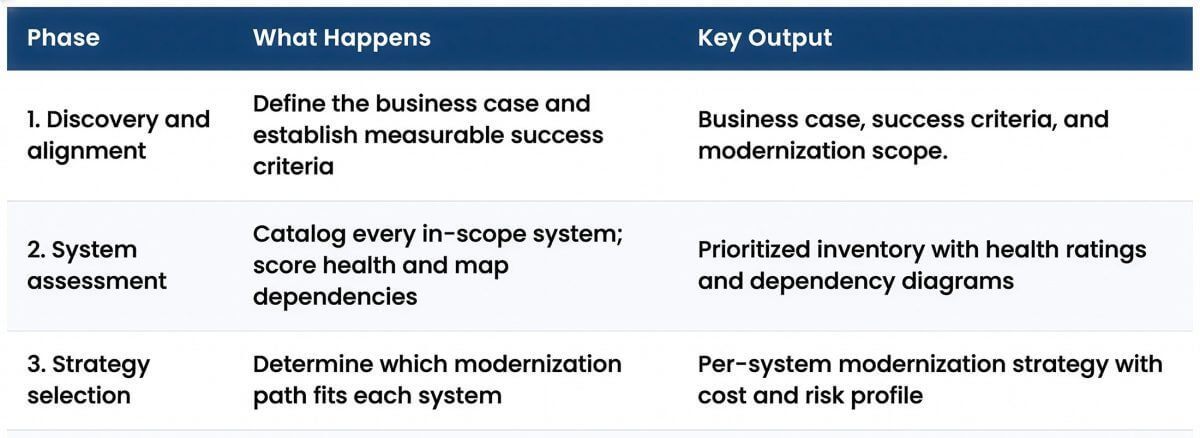
The full software modernization process spans seven phases, from initial modernization strategy alignment through post-deployment optimization. Each phase produces a specific output that informs the next. When these phases are clearly defined and executed in sequence, organizations gain a complete, actionable view of the work ahead.
| Phase | What Happens | Key Output |
|---|---|---|
| 1. Discovery and alignment | Define the business case and establish measurable success criteria | Business case, success criteria, and modernization scope |
| 2. System assessment | Catalog every in-scope system; score health and map dependencies | Prioritized inventory with health ratings and dependency diagrams |
| 3. Strategy selection | Determine which modernization path fits each system | Per-system modernization strategy with cost and risk profile |
| 4. Planning and architecture | Sequence the work, plan data migration, lock down security needs | Phased roadmap, migration plan, and security/compliance checklist |
| 5. Execution and transformation | Perform the modernization work using AI-accelerated delivery | Production-ready modernized systems with automated tests and full traceability |
| 6. Testing, validation, and cutover | Confirm equivalence, shift production traffic, retire legacy | Validated cutover plan, rollback path, and production deployment sign-off. |
| 7. Optimization | Monitor performance, reduce cloud spend, plan next iteration | Performance baselines, cost optimization backlog, and next-step roadmap. |
The following sections explain each phase in detail: what it involves, which decisions matter most, and where the process commonly stalls.
Phase 1: Discovery and Business Alignment
Most modernization efforts fail before any code is written because the business problem is not clearly defined. This phase establishes why the organization is modernizing, what success looks like, and which business driver should guide tradeoffs later in the program.
A PwC survey of 610 operations leaders found that 82% struggle to reconcile day-to-day operational demands with long-term transformation goals.5 This tension often leads teams to default to technical decisions before defining business outcomes, which introduces misalignment that compounds throughout the program.
The work in this phase is straightforward but frequently skipped: articulate why modernization is happening now and define what a successful outcome looks like in measurable terms. A program driven by infrastructure cost pressure will follow a very different path than one driven by the need to release features more frequently.
Historical benchmarks help calibrate expectations. Mainframe modernization programs have delivered a ROI of 288% to 362%.6 Financial services organizations that complete modernization typically see 30% to 40% reductions in infrastructure costs.3 Your targets should be specific to your own business drivers, not generic industry averages.
How Business Drivers Shape Modernization Decisions
When business drivers are unclear or competing, modernization efforts tend to drift toward the most convenient technical solution rather than the one that delivers the most value.
| Primary Business Driver | How It Influences Decisions | Typical Starting Approach |
|---|---|---|
| Reduce operating costs | Prioritize infrastructure savings and lower maintenance overhead | Rehost or replatform high-cost systems first |
| Increase release velocity | Prioritize team independence and deployment frequency | Rearchitect tightly coupled systems; consider rebuilds |
| Improve security or compliance posture | Prioritize testability, audit trails, and regulatory alignment | Refactor for observability; rebuild where compliance requires it |
| Pay down technical debt | Prioritize code quality and the ability to onboard new developers | Begin with targeted refactoring; stabilize the foundation before expanding scope |
| Attract and retain engineering talent | Prioritize a modern technology stack and development experience | Rebuild on current frameworks; rearchitect around modern tooling |
Most organizations are influenced by multiple drivers. The goal of this modernization phase is not to pick just one, but to clearly define which driver takes priority when tradeoffs emerge later in the program.
A practical note: in our experience, the clearest sign of a well-run discovery phase is clarity. If the team cannot articulate the business driver in a single sentence, the discovery phase is not finished. There should also be at least a one-page document that any executive sponsor can point to when priorities conflict downstream.
Phase 2: System Assessment and Prioritization
With the business case established, the next phase produces a complete and accurate view of the current system landscape: what systems are in scope, how healthy each one is, and which dependencies connect them. This is the foundation every downstream decision rests on. Every decision that follows depends on the quality of this assessment.
In practice, this is where modernization programs often uncover the most risk. Legacy environments frequently contain undocumented dependencies, inconsistent data flows, and integrations that only surface under real production conditions. Gaps in system understanding at this stage almost always reappear later as delays, rework, or failed migrations.
This requires building a complete system inventory, evaluating the health of each application, and mapping dependencies across the environment. These insights directly determine sequencing, strategy selection, and overall program risk.
Build a complete inventory. For each application in scope, capture the technology stack, who owns it, how critical it is to revenue, how much it costs to maintain, and what other systems it depends on. Gaps in this inventory surface as surprises later in the process.
If you need help evaluating current-state architecture, our legacy system modernization services page explains how we assess systems, define gaps, and shape modernization decisions.
Rate each system’s health. A simple red/yellow/green score works well. Green systems are stable and inexpensive to run. Yellow systems show increasing maintenance cost or growing technical debt. Red systems are fragile, expensive, and actively blocking business objectives. These scores drive the sequencing decisions in Phase 4.
Key Areas to Evaluate During System Assessment
| Evaluation Area | Questions to Answer | How to Assess |
|---|---|---|
| Revenue impact | What is the financial cost of 24 hours of downtime? | Stakeholder interviews, historical incident data |
| Code health | How maintainable is the codebase? What is the debt load? | Static analysis (SonarQube), AI-powered code review |
| Coupling and modularity | Is the application monolithic? What are the integration points? | Architecture diagrams, AI-assisted dependency mapping |
| Data landscape | Where is data stored? What schemas and formats are in use? | Data profiling, ETL documentation review |
| Skills availability | Can the current team operate the target architecture? | Skills gap analysis, training timeline estimates |
| Regulatory requirements | Which compliance frameworks apply (HIPAA, PCI-DSS, SOC 2)? | Compliance audit, legal and security review |
In many environments, the most critical dependencies are not documented. They exist in scheduled jobs, shared databases, or implicit workflows between systems. Identifying these early is one of the most important factors in avoiding downstream failure.
System assessment should uncover dependency, reliability, and architecture risks before modernization work begins. One example is our case study for a large Midwestern health system, where architecture review surfaced hidden issues early and informed modernization planning.
AI-assisted tooling has changed how long this phase takes. Automated dependency mapping and code analysis can compress what was historically weeks of manual effort into days. However, speed does not eliminate risk. AI can surface relationships and patterns, but interpreting those findings (and determining what matters) still requires experienced architectural judgment.
Phase 3: Strategy Selection
With a clear understanding of system inventory and health scores, this phase matches each system to the modernization approach that best fits its technical condition and business context. The industry-standard vocabulary for these options is the “6 Rs” framework, a hybrid of Gartner’s original rationalization model7 and the migration terminology popularized by AWS8 and Microsoft.9
The goal of this phase is not to select a single strategy, but to align each system with the approach that best supports business priorities while minimizing unnecessary complexity and disruption. Most programs apply several of these approaches in parallel. One system might be rehosted to capture quick infrastructure savings while another is rebuilt from scratch. The table below summarizes the tradeoffs.
The 6 Rs: How Modernization Approaches Compare
| Approach | What Changes | Typical Duration | Relative Cost | Risk Level | Strongest Fit |
|---|---|---|---|---|---|
| Rehost | Infrastructure changes only; application code stays the same | 2-4 months | Low | Low | Exit legacy infrastructure quickly |
| Replatform | Introduces targeted cloud optimizations during migration | 3-6 months | Low to moderate | Low to moderate | Move to cloud services with limited code change |
| Refactor | Improves internal code structure; external behavior preserved | 6-12 months | Moderate | Moderate | Reduce debt while preserving functionality |
| Rearchitect | Redefines system design and component boundaries | 9-18 months | High | High | Break up a monolith to support independent delivery |
| Rebuild | Replaces the system with a new, greenfield implementation | 12-24+ months | Very high | High | Replace systems that block future growth |
| Replace | Decommissions and replaces it with a SaaS/COTS product | 3-9 months | Moderate | Low | Commodity capabilities better served by a vendor |
Current market data shows where organizations are placing their bets. Replatforming accounts for the largest share of active modernization work at 31.85%.3 Rearchitecting is growing fastest, at a 22.74% CAGR through 2031.3
Aligning Business Priorities to Modernization Approaches
This table provides a quick starting point. The right answer depends on your specific system assessment from Phase 2.
| Your Priority | Consider Starting With | Rationale |
|---|---|---|
| Minimize disruption and move fast | Rehost | Preserves existing logic; fastest time to cloud |
| Capture cloud efficiencies without a redesign | Replatform | Replaces specific components with managed cloud services |
| Improve the codebase without changing behavior | Refactor | Addresses debt while preserving what works |
| Enable team autonomy and deployment speed | Rearchitect | Decomposes the monolith into independent services |
| Start fresh because the current system blocks growth | Rebuild | Establishes a clean architecture aligned to current and future business needs |
| Stop building what a vendor already does well | Replace | Redirects engineering effort to differentiating work |
These selections are not permanent. Many organizations begin with lower-risk approaches such as rehosting to reduce immediate cost or exit legacy infrastructure, then evolve toward refactoring or rearchitecting as priorities shift and system understanding improves.
Modernization strategy should follow system risk, business urgency, and technical fit. One example is our project for a financial institution, where we used phased replacement rather than a big-bang rebuild because it was the safest path to reduce legacy dependency while preserving operational continuity.
AI-assisted analysis can help identify patterns and suggest potential approaches, but selecting the right strategy still depends on architectural judgment, business context, and long-term maintainability considerations.
For More Information: We’ve discussed some of the nuances you may experience in this phase in great detail in our recent guide on Legacy Modernization Approaches for CTOs, including tradeoffs of each of the 6 R’s and how AI has changed each approach in recent years.
Phase 4: Planning and Architecture
Once a modernization strategy is selected, planning turns that strategy into a sequenced roadmap. This phase defines the order of work, addresses data migration, and sets the security and compliance requirements that guide execution.
With each system assigned to a modernization approach, this phase shifts the focus to execution design – specifically, how the work will be sequenced, how data will move, and how risk will be managed throughout the program.
Effective planning turns strategy into an executable roadmap. It defines the order of work, aligns dependencies, and ensures that each phase delivers measurable progress without introducing unnecessary risk. It also addresses the two areas that derail more programs than any technical decision: data migration and security.
This is where many modernization efforts break down. The challenge is not defining what to do, but determining how to do it in a way that maintains system stability while introducing meaningful change. This is also the point where many organizations benefit from a second set of eyes on sequencing, data migration, and security planning before execution begins.
In practice, the most successful programs treat planning as a form of risk control. Decisions made in this phase directly impact delivery speed, system stability, and the ability to adapt as new information emerges.
Sequencing the Work
Incremental delivery almost always outperforms attempting large, everything-all-at-once enterprise modernization efforts. Attempting to transform multiple systems simultaneously increases coordination complexity, delays feedback, and concentrates risk.
The most effective approach is phased execution. Organizations typically begin with lower-risk, high-impact systems to establish momentum, validate patterns, and build confidence. These early wins often create the organizational support needed to sustain deeper transformation efforts.
As the program progresses, sequencing should account for system dependencies, business criticality, and data complexity. The goal is controlled progress that reduces uncertainty at each stage.
| Roadmap Phase | Typical Focus | Timeline | Key Outcome |
|---|---|---|---|
| Quick wins | Rehost or replatform systems with clear cost savings | Months 1-3 | Lower infrastructure spend; initial cloud footprint |
| Stabilization | Refactor high-debt codebases; expand automated test coverage | Months 3-6 | Healthier code, faster developer onboarding |
| Core transformation | Rearchitect or rebuild the systems with the strongest business case | Months 6-18 | Modern architecture; new capabilities unlocked |
| Sustained improvement | Ongoing optimization; replace commodity systems with SaaS | Ongoing | Technology portfolio continuously aligned to the business |
Preparing for Data Migration
In our experience, data migration is the single most underestimated workstream in the software modernization process.
Legacy data is often stored in inconsistent formats with undocumented transformation rules accumulated over years. These issues rarely surface until migration is underway, where they introduce delays, rework, and increased risk.
Successful programs treat data migration as a primary workstream, not a secondary task. This includes early data profiling, documenting transformation rules, validating data mappings, and establishing reconciliation and rollback procedures before execution begins.
AI can assist with schema mapping and anomaly detection, but decisions about what data to retain, transform, or decommission require domain knowledge and architectural judgment.
Locking Down Security and Compliance
Security and compliance requirements should be treated as architectural inputs, not post-migration validation steps.
Different modernization approaches carry different security implications. Rehosted systems may carry forward existing vulnerabilities, while rebuilt systems provide an opportunity to implement modern security controls from the ground up.
For organizations operating in regulated environments, requirements such as HIPAA, PCI-DSS, and SOC 2 should be incorporated into planning decisions early. This includes aligning architecture, access controls, auditability, and testing strategies with compliance expectations before implementation begins.
Conduct security assessments before and after each phase, include penetration testing for rehosted workloads, and map compliance requirements to architectural decisions early.
If you are planning a modernization program, the best first step is understanding your current systems, constraints, and modernization options before choosing a path. Schedule a modernization consultation to evaluate your portfolio and identify the right approach for each system.
Phase 5: Execution and Transformation
This is where the modernization work is performed, and where execution models are tested under real conditions. It is also the phase where AI has had the most dramatic impact on timeline acceleration.
McKinsey’s 2025 global survey found that 78% of organizations now use AI in at least one business function,10 and the results in modernization are measurable: BCG documented an Asian financial institution that extracted over 5,000 business rules from a large legacy codebase in under three weeks, a 225x acceleration over manual analysis.11
Deloitte found that a major U.S. airline spent six years manually reworking just 10% of its legacy platform. After adopting AI-assisted tooling, the airline completed comparable scope in roughly 18 months.12 Separately, AI-augmented API generation has collapsed custom data layer creation from a $1.5 million, 12-to-18-month effort to a matter of days.13
However, speed alone does not determine success. Without structure, accelerated execution introduces risk just as quickly as it delivers progress. The defining characteristic of successful modernization programs is not the use of AI, but how it is applied. High-performing teams integrate AI into a governed delivery model that maintains architectural integrity, enforces quality standards, and ensures traceability across every change.
In this model, AI handles repetitive and mechanical tasks, while architects and engineers retain control over decisions that shape system behavior, design, and long-term maintainability.
AI Impact Across Modernization Approaches
| Approach | Where AI Adds Speed | Where Humans Must Lead |
|---|---|---|
| Rehost | Dependency discovery, IaC template generation, config validation | Cutover sequencing, post-migration security review |
| Replatform | Workload pattern analysis, managed-service recommendations | Vendor cost tradeoffs, long-term lock-in assessment |
| Refactor | Code comprehension, automated test creation, dead code identification | Prioritization of refactoring targets, design integrity |
| Rearchitect | Cross-module dependency analysis, API contract drafting | Domain boundary decisions, data ownership, team structure |
| Rebuild | Scaffolding, boilerplate generation, UI/API prototyping | Product requirements, business rule definition, UX decisions |
| Replace | Legacy workflow documentation, gap analysis against target platform | Vendor evaluation, organizational change management |
A Governed Execution Loop
Sustained acceleration requires more than tooling. Regardless of which modernization approach is in play, a repeatable execution model that balances speed, quality, and architectural control is required
In practice, successful teams operate within a governed loop that ensures every increment of work is validated before it moves forward:
- Define an increment. Scope the specific systems, features, or components covered in this iteration.
- Apply AI-assisted transformation. Use AI for code conversion, test generation, documentation, and scaffolding.
- Validate through quality gates. Every AI-generated output passes human review, automated tests, and architectural checks.
- Commit with traceability. Each change links back to a requirement. Nothing enters the codebase without a clear audit trail.
- Advance to the next increment. Carry forward lessons; adjust scope as confidence and velocity build.
In our experience, the principle holds across every modernization approach: AI handles the repetitive, mechanical work while architects, subject matter experts, and testing gates retain authority over every decision that shapes the system’s future.
What This Looks Like in Practice
In one engagement, Keyhole reduced a full platform modernization originally estimated at 18 to 24 months to approximately five months.14
The team combined AI-assisted transformation with architect-led governance, using AI to accelerate dependency mapping, code transformation, and test generation while maintaining strict validation gates at each stage. Senior consultants worked alongside client engineers to validate outputs, ensure functional equivalence, and maintain production readiness throughout the process.
As a member of the Claude Partner Network, Keyhole applies agentic agents like Claude and Codex within this governed loop, treating AI as a force multiplier under human oversight rather than an autonomous actor.
This approach illustrates a consistent pattern: AI delivers speed, but structured execution determines whether that speed translates into successful outcomes
Phase 6: Testing, Validation, and Cutover
The transition from legacy to modernized production is where execution risk is highest. This phase validates that the new system behaves as expected under real-world conditions and and whether the transition can occur without disrupting business operations.
At this stage, the focus shifts from building to validation. Every assumption made during earlier phases must be confirmed, and every system behavior must be verified before production traffic is fully transitioned.
Successful cutovers are not defined by speed, but by confidence. The objective is to ensure that the modernized system behaves correctly, performs reliably, and can be rolled back if necessary.
Confirming Functional Equivalence
Every modernized system must demonstrate that it preserves the behavior of its predecessor unless a change was deliberately designed. Validating this equivalence is critical to ensuring continuity during and after cutover.
Automated regression suites, integration tests, and side-by-side comparison runs are the primary instruments. The deeper the automated test coverage built during Phase 5, the faster and more confident this validation becomes.
Selecting a Cutover Approach
Cutover is a strategic decision about how risk is managed during the transition to production, rather than a single event.
Incremental approaches, such as the Strangler Fig pattern,15 routes traffic from legacy components to new services, reducing the blast radius of any single failure. It is the lowest-risk option for complex systems.
Parallel runs, where both old and new systems process the same transactions simultaneously, provide a strong safety net for mission-critical workloads but increase operational cost during the overlap window.
Non-Negotiable Practices for Cutover
Certain practices are essential to maintaining control during this phase:
- Define rollback criteria before every cutover event
- Ensure comprehensive automated regression testing across legacy and modernized systems
- Require successful parallel run validation for high-criticality workloads
- Conduct security and penetration testing on newly deployed systems
- Verify compliance alignment for all systems handling regulated data
These practices establish a controlled transition process and reduce the likelihood of unexpected production issues.
The appropriate strategy depends on system complexity, business criticality, and tolerance for risk. In all cases, the goal is the same: minimize disruption while maintaining the ability to respond quickly if issues arise.
Phase 7: Optimization and Continuous Improvement
Going live is not the finish line because modernization does not end at deployment. The software modernization process produces the most value when it becomes an ongoing discipline rather than a one-time project.
This phase shifts the focus from delivery to performance. It is where organizations validate whether modernization goals are being met and identify opportunities to improve efficiency, reduce cost, and expand capabilities.
In practice, organizations that treat modernization as an ongoing discipline rather than a one-time initiative consistently outperform those that approach it as a finite project.
Establishing Performance Baselines
Immediately following deployment, organizations should establish performance baselines across key metrics such as response times, system reliability, resource utilization, and operational cost.
These baselines provide a reference point for optimization efforts and serve as measurable evidence of modernization impact. They also inform future phases of the roadmap by identifying where additional improvements will deliver the greatest value.
Optimizing Cloud and Infrastructure Costs
Newly modernized systems often operate inefficiently in their initial state. Overprovisioned resources, conservative scaling assumptions, and unused services are common immediately after migration.
Targeted optimization efforts such as right-sizing infrastructure, refining scaling policies, and eliminating unused resources can significantly reduce ongoing operational costs. In our experience, active post-migration optimization typically yields an additional 15% to 25% in infrastructure savings.
Feeding Results Back into the Roadmap
Modernization programs are inherently iterative. Insights gained during early phases should directly influence future prioritization, sequencing, and strategy decisions.
The phased plan from Phase 4 identified systems for later modernization. Use production data and lessons from early phases to sharpen priorities and timelines. Many organizations find that quick-win savings and executive confidence from the first phases accelerate the more ambitious work originally slated for later.
Performance data, cost metrics, and operational feedback provide a clearer understanding of system behavior and business impact. This information allows organizations to refine their roadmap, accelerate high-value initiatives, and adjust plans as conditions change. Over time, this feedback loop transforms modernization from a discrete effort into a continuous capability.
Research supports this approach. Accenture’s research shows that organizations modernizing for high interoperability grow revenue six times faster than those maintaining siloed architectures.16 Treating the software modernization process as continuous, not finite, is what separates sustained results from a temporary improvement. Organizations that modernize for interoperability and adaptability significantly outperform those maintaining siloed architectures, achieving substantially higher growth over time.
The organizations that see the greatest return from modernization are those that continue investing in it after the initial transformation is complete.
5 Pitfalls That Stall the Software Modernization Process
Even well-planned modernization programs can lose momentum. The most common failure patterns are not technical, they generally stem from misalignment, incomplete planning, and breakdowns in execution.
- Leading with technology instead of the business problem. “We need microservices” is a technology preference, not a business case. When the approach is chosen before the objective is clear, the program optimizes for the wrong outcome. Phase 1 exists to prevent this.
- Declaring victory after the rehost or initial migration. Moving an application to cloud infrastructure is the beginning of the process, not the end. Systems that were difficult to change on-premises remain difficult to change in the cloud. The roadmap should specify what comes after the initial migration before it begins.
- Underestimating data migration complexity. Data migration generates more budget and schedule overruns than any other workstream. Legacy data carries years of accumulated inconsistency, undocumented rules, and format drift. Start profiling early and allocate substantially more time than initial estimates suggest.
- Letting AI outputs bypass quality gates. AI acceleration produces value only when every generated artifact passes the same validation as human-written code. Skipping review to preserve speed introduces defects that compound across the program. Governance and velocity are not in tension; governance is what makes velocity sustainable.
- Planning a single large release instead of phased delivery. Programs that attempt to deliver everything in one release are the most likely to be canceled before they deliver any value. Incremental delivery, phased roadmaps, and the Strangler Fig pattern exist specifically to avoid this outcome.
Start Your Software Modernization Process
This guide covers the full arc of the software modernization process: from identifying why you are modernizing through optimizing the results in production. The software modernization process is not defined by the tools you choose or the architecture you adopt. It is defined by how effectively you execute across each phase from initial alignment through ongoing optimization.
Organizations that succeed take a structured approach. They align on business outcomes early, build a clear understanding of their system landscape, and execute in phases that balance speed with control. They apply AI where it accelerates delivery, but within a governed model that ensures quality, traceability, and long-term maintainability.
The difference between successful and stalled modernization efforts is rarely technical. It is the result of decisions made early, reinforced through disciplined execution, and sustained through continuous improvement.
Keyhole Software’s 100% U.S.-based senior consultants partner with organizations to plan and deliver modernization programs across Java, .NET, COBOL/mainframe, and cloud-native architectures. Clients including AMC Theatres, Commerce Bank, Mastercard, and Northwell Health rely on Keyhole for modernization work that requires both senior technical depth and a structured delivery process.Our consultants bring deep experience in architecting and executing complex transformations, combining AI-accelerated delivery with structured, low-risk implementation models.
If you are evaluating modernization, the most effective first step is gaining a clear understanding of your current systems, priorities, and constraints before committing to execution. Schedule a modernization consultation to assess your current systems, identify the right approach for each, and understand what AI-accelerated delivery could mean for your timeline.
References
- Mordor Intelligence, “Legacy Modernization Market,” Updated January 2026. mordorintelligence.com
- Consortium for Information & Software Quality (CISQ), “The Cost of Poor Quality Software in the US: A 2022 Report,” 2022. it-cisq.org
- Mordor Intelligence, “Legacy Modernization Market: Size, Share & Trends,” Updated January 2026. mordorintelligence.com
- Keyhole Software, Legacy Modernization Services. keyholesoftware.com/services/legacy-modernization
- PwC, “2025 Digital Trends in Operations Survey,” 2025. pwc.com
- Kyndryl, “2025 State of Mainframe Modernization Survey,” 2025. kyndryl.com
- Gartner, “The 5 Rs of Application Modernization,” 2010.
- AWS, “6 Strategies for Migrating Applications to the Cloud,” 2016. aws.amazon.com
- Microsoft Azure, “The 6 Rs of Application Modernization.” learn.microsoft.com
- McKinsey & Company, “The state of AI in early 2024: Gen AI adoption spikes and starts to generate value,” 2024. mckinsey.com/capabilities/quantumblack/our-insights/the-state-of-ai-2024
- Boston Consulting Group, “How AI Is Paying Off in the Tech Function,” 2025. bcg.com/publications/2026/how-ai-is-paying-off-in-the-tech-function
- Deloitte, “Legacy System Modernization,” June 2025. deloitte.com
- DreamFactory, “The Hidden Cost of Building Your Own LLM Data Layer,” 2025. blog.dreamfactory.com
- Keyhole Software, “AI-Accelerated Insurance Platform Modernization.” keyholesoftware.com
- Martin Fowler, “StranglerFigApplication,” 2004. martinfowler.com
- Accenture, “Value Untangled: Accelerating Radical Growth through Interoperability,” 2022. accenture.com/us-en/insights/technology/interoperability
More From Keyhole Software
About Keyhole Software
Expert team of software developer consultants solving complex software challenges for U.S. clients.
Share This Post
Join The Thousands Of Devs Who Subscribe
Discuss This Article
Subscribe
Login
0 Comments
Oldest