
Legacy Modernization Trends: 2026 Market Size, Growth Drivers, and Enterprise Adoption Data
Legacy modernization is no longer a deferred IT initiative. By 2026, enterprise organizations are accelerating modernization programs as technical debt compounds, cloud adoption becomes standard, AI reshapes delivery timelines, and aging systems create growing operational and cybersecurity risk.
From January through April 2026, the Keyhole Software research team analyzed data from 8 market intelligence reports, 4 industry surveys, and publicly available analyst forecasts to map the current state of the legacy modernization market.
This analysis covers market sizing across six tracked segments: regional modernization spending, industry-specific adoption rates, the technology catalysts reshaping modernization timelines, AI adoption trends and their implications for AI-accelerated delivery, and the organizational barriers that continue to constrain enterprise transformation programs.
Together, these trends reflect a shift in how organizations approach modernization, from large-scale replacement initiatives to incremental, AI-assisted transformation programs.
Legacy Modernization Trends Covered in This Report
- Legacy modernization market size and growth
- Regional modernization spending
- Industry adoption and sector-specific urgency
- Technology drivers reshaping modernization timelines
- Organizational barriers to modernization success
- AI adoption and AI-accelerated modernization delivery
All market valuations, growth rates, and adoption metrics cited in this report are sourced from named, verifiable third-party research organizations. Where multiple firms track the same segment using different methodologies, we present the range of estimates and note the definitional differences.
How We Use These Statistics
Keyhole Software tracks these market dynamics as part of our ongoing work in legacy modernization and AI-accelerated delivery. As a custom software development and consulting firm with 100% U.S.-based senior consultants averaging 17+ years of experience, we use data like this to inform modernization roadmaps, help clients prioritize which systems to address first, and benchmark project timelines against industry norms.
The statistics in this report are not theoretical for our team. They reflect the conditions we encounter in active engagements across financial services, healthcare, manufacturing, and retail. Where the data points to a market trend, we explain how that trend shows up in real modernization programs and what enterprise teams should consider when planning their next step.
The Legacy Modernization Market in 2026: Size and Growth in Context
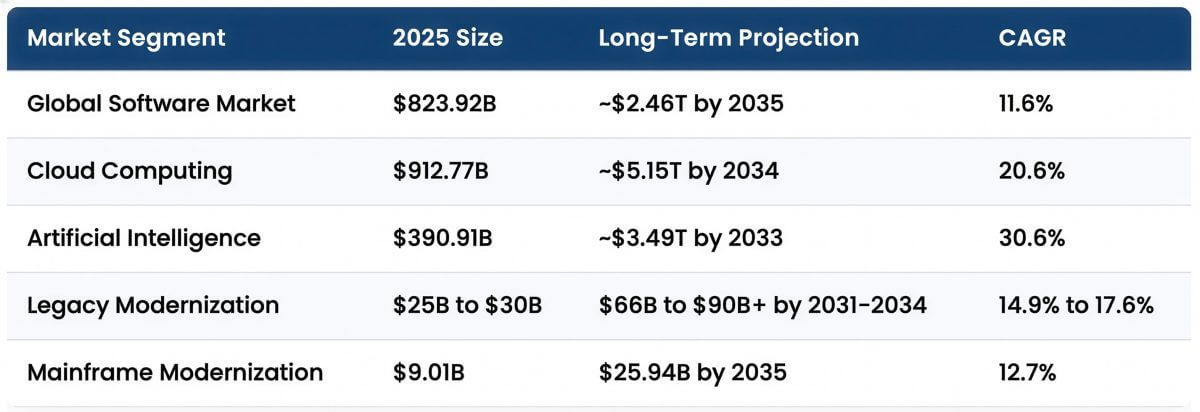
Legacy modernization represents roughly 3% to 4% of the global software market, but it is growing faster than the overall sector. Placing modernization alongside cloud computing and artificial intelligence reveals where enterprise spending is accelerating and how these markets intersect.
In practice, this positions legacy modernization as the enabling layer between existing enterprise systems and cloud- and AI-driven architectures.
| Market Segment | 2025 Size | Long-Term Projection | CAGR |
|---|---|---|---|
| Global Software Market | $823.92B | ~$2.46T by 2035 | 11.6% |
| Cloud Computing | $912.77B | ~$5.15T by 2034 | 20.6% |
| Artificial Intelligence | $390.91B | ~$3.49T by 2033 | 30.6% |
| Legacy Modernization | $25B to $30B | $66B to $90B+ by 2031-2034 | 14.9% to 17.6% |
| Mainframe Modernization | $9.01B | $25.94B by 2035 | 12.7% |
Sources: Precedence Research (Software, Cloud), Grand View Research (AI), Fortune Business Insights, 360iResearch, Mordor Intelligence, The Business Research Company, InsightAce Analytic / Straits Research
What this means: While legacy modernization represents a smaller portion of total software spend, its growth rate and strategic role make it a priority investment area for organizations modernizing toward cloud and AI-driven architectures.
Key Findings
- Legacy modernization is valued between $25 billion and $30 billion in 2025 across five major research firms, with projections reaching $66 billion to $90 billion+ by 2031–2034. At 14.9% to 17.6% CAGR, it is growing faster than the overall software market (11.6%) but slower than cloud computing (20.6%) and AI (30.6%).
- The legacy modernization market has nearly doubled in three years. According to Grand View Research, application modernization services were valued between $16.84 billion and $17.80 billion in 2023. By 2026, that figure approaches $30 billion.
- Mainframe modernization is a distinct subcategory at $9.01 billion according to InsightAce Analytic and Straits Research. It carries outsized strategic importance: mainframes still process the majority of global financial transactions and government entitlement programs.
This growth reflects increasing urgency across enterprise IT environments, where aging systems are becoming both a cost burden and a constraint on innovation.
In Practice
In enterprise modernization programs, we consistently see the intersection of these three markets in active client engagements.
Cloud computing is often the destination for modernized systems, AI is increasingly the mechanism, and legacy modernization is the program that connects the two.
This relationship is increasingly shaping how organizations prioritize modernization investments and sequence transformation initiatives. Organizations that deferred modernization during the pandemic are now facing compounding technical debt, and the mainstream adoption of generative AI coding tools has shifted the cost-benefit calculation in favor of action.
Mainframe modernization carries particular weight in our work. The organizations modernizing these systems are typically making high-stakes decisions with limited margin for error, which is where senior architectural oversight matters most. What was previously a multi-year commitment with uncertain ROI now has clearer timelines and measurable conversion accuracy.
Strategic takeaway: Organizations that treat modernization as a prerequisite for cloud and AI adoption tend to move faster and reduce long-term risk, while those that delay face compounding technical debt and rising transformation costs.
Regional Distribution of Modernization Spending
Modernization spending varies by region based on infrastructure maturity, regulatory environment, and the type of technical debt organizations are managing. These regional differences often influence not just where organizations invest, but how they approach modernization strategy, architecture, and cloud adoption.
| Region | Market Share | Regional CAGR | Largest Submarket |
|---|---|---|---|
| North America | 35% to 39.7% | ~14% | United States ($2T ICT spend) |
| Europe | 24% to 27% | ~14% | Germany (~34% of region) |
| Asia-Pacific | 21% to 25% | 15.71% to 16.9% | China (40% of APAC) |
| Rest of World | ~12% | N/A | Emerging markets |
Sources: Fortune Business Insights, Market Data Forecast, Mordor Intelligence, IDC
What this means: Regional modernization patterns reflect different types of legacy environments, regulatory constraints, and infrastructure maturity, which directly shape how modernization programs are prioritized and executed.
Key Findings
- North America commands 35% to 39.7% of modernization spending, driven largely by decades of legacy code in financial and government institutions, according to Fortune Business Insights.
- Asia-Pacific is the fastest-growing region at 15.71% to 16.9% CAGR per Mordor Intelligence, often upgrading early-2000s web-era infrastructure rather than mainframe architectures.
- Europe accounts for 24% to 27% of the market, with Germany representing roughly 34% of the European submarket according to Market Data Forecast. GDPR and data sovereignty mandates shape regional modernization priorities.
Together, these regional patterns highlight that modernization is not a uniform problem, but one shaped by the type and age of systems organizations are managing.
In Practice
While most of our direct client work is concentrated in the United States, the regional patterns reflected in the data align with what we see across enterprise environments, particularly as organizations operate within increasingly global structures.
North American clients, particularly in financial services and government, are often untangling decades-old mainframe architectures. U.S. accumulated technical debt reached an estimated $1.52 trillion earlier in the decade, per DreamFactory’s analysis. This concentration of legacy infrastructure makes modernization both more complex and more critical in North American enterprise environments.
By contrast, Asia-Pacific clients are more often upgrading early-2000s web-era infrastructure to support mobile-first populations rather than managing 40-year-old mainframe environments.
In Europe, modernization is shaped more heavily by regulatory pressure. The landscape is distinctly shaped by GDPR and data sovereignty mandates, driving higher adoption of hybrid cloud and confidential computing according to Gartner’s 2026 strategic technology trends analysis.
For organizations operating across regions, including those that have expanded through acquisition or operate under global parent companies, modernization strategies need to account for regulatory variation, not just technical requirements. This often leads to more deliberate adoption of hybrid and multi-cloud architectures compared to other regions. Global ICT (Information and Communications Technology) spending is forecast to reach $4 trillion in 2026, with the United States contributing $2 trillion, per IDC.
Even for organizations primarily operating in the U.S., these global considerations increasingly influence architecture decisions, especially in environments shaped by mergers, acquisitions, or international ownership structures.
Industry Vertical Adoption and Sector-Specific Urgency
Modernization urgency varies by sector based on regulatory pressure, competitive threat, and the financial consequences of system failure. These differences shape not only how quickly organizations modernize, but also which systems they prioritize and how they sequence transformation efforts.
| Industry Vertical | Market Share / CAGR | Key Risk Indicator | Risk Cost / Figure |
|---|---|---|---|
| BFSI (Banking, Financial Services, and Insurance) | 24% to 26.79% share | % citing legacy integration as obstacle | 70% |
| Healthcare | 18.19% to 18.40% CAGR | Avg. data breach cost | $7.42M |
| Retail and E-commerce | ~21% share | Software as % of tech budget | Dominant |
| Manufacturing | ~18% share | % still on legacy systems (2022) | 74% |
Sources: Fortune Business Insights, Mordor Intelligence, DreamFactory, IBM, The Manufacturer / Intoware
What this means: Modernization is not evenly distributed across industries. Sectors with higher regulatory pressure, security risk, or operational dependency on legacy systems tend to prioritize modernization earlier and invest more aggressively.
Key Findings
- Financial services bears the heaviest modernization burden, accounting for 24% to 26.79% of the market according to Fortune Business Insights, with 70% of leaders citing legacy integration as a primary obstacle per DreamFactory.
- Healthcare is the fastest-accelerating vertical at 18.19% to 18.40% CAGR per Mordor Intelligence, driven by cybersecurity exposure and breach costs averaging $7.42 million according to IBM’s 2025 Cost of a Data Breach Report.
- Manufacturing remains heavily dependent on legacy systems, with 74% of manufacturers still operating on disconnected platforms according to The Manufacturer and Intoware, constraining Industry 4.0 adoption.
Across industries, modernization urgency is most closely tied to risk exposure, whether that risk is operational, regulatory, or financial.
In Practice
In our experience, the API-led integration approach prevalent in banking reflects a pragmatic strategy: preserve what works, expose what’s trapped. Roughly 70% of financial services leaders cite legacy integration as a primary obstacle, per DreamFactory. As a result, many organizations in this sector prioritize incremental modernization strategies that preserve core systems while improving access and flexibility.
Healthcare faces a different but equally urgent pressure: legacy systems that cannot receive security patches extend breach detection timelines to an average of 279 days, according to IBM’s 2025 Cost of a Data Breach Report, with average healthcare breach costs reaching $7.42 million. This risk profile often accelerates modernization timelines, particularly for systems that can no longer be patched or secured effectively.
Manufacturing modernization is a prerequisite for Industry 4.0 adoption, requiring integration of operational technology with modern IT data networks for IoT and edge computing deployment. In these environments, it is foundational for adopting IoT, automation, and real-time data capabilities.
According to The Manufacturer and Intoware, 74% of manufacturers still operate on disconnected legacy systems. Retail modernization is driven by omnichannel survival, with software spending now dominating retail technology budgets as brands prioritize real-time forecasting and supply chain execution.
In practice, this often spans multiple systems. For example, in a long-term engagement supporting the modernization of a large-scale digital commerce platform for AMC Theatres, work included API modernization, cloud migration, frontend rebuilds, and ongoing performance improvements across high-volume customer-facing services. Keyhole has also helped organizations like the government of British Columbia with several modernization efforts.
Strategic takeaway: The urgency and approach to modernization vary significantly by industry. Organizations that align modernization strategy with their specific risk profile and operational constraints are more likely to see measurable outcomes and sustained value.
Technology Drivers Reshaping Modernization Timelines
The high-risk, wholesale system replacement approach is now widely discredited. By 2026, the industry has pivoted toward continuous, iterative strategies accelerated by AI-driven tools. These shifts are not just changing how modernization is executed, but also how organizations evaluate risk, timelines, and return on investment.
| Technology / Approach | Adoption Rate | Measured Impact |
|---|---|---|
| AI-Driven Code Refactoring | 80% of Fortune 500 using AI agents | 93%+ COBOL-to-Java accuracy |
| Replatforming | 32.45% of service type share | Immediate infrastructure cost reduction |
| Hybrid/Multi-Cloud Deployment | 89% multi-cloud adoption | 67.78% of modernization revenue via cloud |
| API-Led Modernization | Gartner baseline standard for 2026 | Legacy data exposed without core rewrites |
| DSLMs and Multiagent Systems | Gartner Top 10 Trends for 2026 | 80% of orgs to shift to AI-augmented teams by 2030 |
Sources: Microsoft Security Blog, Grand View Research, Flexera, Gartner, DreamFactory
What this means: Modernization is no longer defined by large, one-time system replacements. Instead, organizations are adopting incremental, AI-assisted approaches that reduce risk while accelerating delivery timelines.
Key Findings
- According to Microsoft’s Security Blog, 80% of Fortune 500 companies are now using active AI agents. In legacy modernization specifically, AI-driven code refactoring has achieved 93%+ COBOL-to-Java conversion accuracy per DreamFactory.
- However, high conversion accuracy at the code level does not guarantee functional equivalence at the business-logic level, which is why architect-governed validation remains essential throughout migration.
- Hybrid and multi-cloud deployment has reached 89% adoption according to Flexera, with 67.78% of modernization revenue attributed to cloud-based delivery per Grand View Research.
Together, these trends reflect a shift toward AI-augmented modernization, where automation accelerates execution but does not replace the need for architectural oversight and validation.
In Practice
In practice, generative AI is addressing one of the most persistent bottlenecks in legacy modernization: the shortage of specialized legacy system expertise.
COBOL comprises roughly 33% of the legacy code demand footprint, with 220 billion lines still in production, according to DreamFactory. The average COBOL programmer is 55 years old, and approximately 10% retire annually. This demographic cliff makes AI-assisted conversion not merely convenient but essential for organizations dependent on mainframe systems.
In our modernization work, we pair agentic AI tools like Claude and Codex with senior architectural oversight. As part of the Claude partner ecosystem, we apply these tools within structured, governed workflows where AI handles automated code analysis and conversion, and our consultants validate business logic and test-gate every step. This combination allows teams to accelerate execution without introducing unacceptable levels of risk.
For example, in one modernization engagement, we applied AI-assisted tooling to migrate a legacy COBOL batch process to Spring Batch, reducing manual development effort by approximately 20–30% while maintaining strict validation of business logic. This allowed the team to accelerate early-phase delivery without compromising correctness.
Where AI tools are used without this level of validation, the risk shifts from speed to correctness. (We talked about this in our recent three-part blog series on using agentic AI software development for the enterprise.) This layered approach reflects the broader industry shift toward AI-augmented teams rather than fully autonomous AI-driven development.
Domain-Specific Language Models, trained on enterprise codebases rather than general-purpose text, deliver higher accuracy when refactoring industry-specific architectures such as healthcare records systems or financial ledgers, according to Gartner’s analysis of 2026 technology trends. These models are most effective when applied within well-defined architectural boundaries and supported by strong governance. Gartner also projects that 80% of organizations will shift to AI-augmented development teams by 2030.
Strategic takeaway: AI is accelerating modernization timelines, but it does not eliminate the need for architectural judgment, testing, and governance. Organizations that combine AI-assisted delivery with experienced engineering oversight are better positioned to achieve accurate, scalable, and production-ready outcomes.
Organizational Barriers to Modernization Success
The barriers to successful legacy transformation are rarely just technical. Across our client engagements, the obstacles that stall modernization most often are data readiness, talent availability, and the difficulty of funding long-horizon initiatives with near-term budget cycles. These constraints often determine whether modernization initiatives move forward, stall, or fail to deliver expected outcomes.
| Barrier | % of Leaders Citing | Financial / Operational Cost |
|---|---|---|
| Data Quality and Availability | 72% | AI overlays fail without clean data |
| AI and Technology Talent Gaps | 53% | 10% of COBOL workforce retiring annually |
| Funding Constraints | 50% (internal reprioritization) | 64% ROI for $500M+ firms vs. 11% for smaller |
| Legacy Maintenance Burden | 60% to 80% of IT budgets | $1.52T U.S. accumulated technical debt |
| Cybersecurity Vulnerability | 180% YoY increase in exploitation | $7.42M avg. healthcare breach; $5.56M financial |
Sources: Deloitte, DreamFactory, Verizon, IBM
What this means: The primary risks to modernization success are organizational, not technical. Without addressing data quality, talent gaps, and funding models, even well-designed modernization initiatives are likely to stall.
Key Findings
- Data quality is the top obstacle, with 72% of private company leaders citing data availability and quality as their primary challenge, according to Deloitte’s 2026 survey.
- Talent gaps follow at 53%, compounded by the COBOL demographic cliff: the average COBOL programmer is 55 years old, and approximately 10% retire annually per DreamFactory.
- Cybersecurity vulnerability accelerates urgency, with a 180% year-over-year increase in vulnerability exploitation as a breach vector per Verizon’s 2024 DBIR, largely facilitated by unpatchable legacy systems.
Across organizations, these barriers tend to reinforce one another, making modernization increasingly difficult to initiate the longer it is deferred.
In Practice
In practice, data readiness is consistently the first challenge that surfaces when organizations begin exploring modernization. If foundational data is not modernized and cleansed, subsequent AI overlays will not produce accurate insights regardless of tooling sophistication. This often forces organizations to address data issues earlier than initially planned.
The 64% vs. 11% ROI gap between companies with $500 million or more in revenue and smaller organizations, per Deloitte, indicates that enterprise scale allows faster compounding of modernization benefits, creating a structural disadvantage for organizations that defer.
Cybersecurity further compounds the urgency. Average breach costs of $7.42 million in healthcare and $5.56 million in financial services, according to IBM’s 2025 report, rapidly offset the capital required for modernization. The 180% year-over-year increase in vulnerability exploitation as a breach vector, per Verizon’s 2024 Data Breach Investigations Report, is largely facilitated by unpatchable legacy systems. In many cases, this shifts modernization from a strategic initiative to an operational necessity.
Organizations routinely allocate 60% to 80% of IT budgets merely to maintain legacy infrastructure, per DreamFactory, meaning the cost of inaction accelerates over time. This limits the ability to fund modernization, creating a cycle where legacy systems persist because they are too expensive to replace.
Strategic takeaway: Successful modernization programs require more than the right technology approach. Organizations that address data quality, talent constraints, and funding alignment early are significantly more likely to execute effectively and realize long-term value.
AI Adoption and AI-Accelerated Delivery in Legacy Modernization
AI adoption in enterprise software development has accelerated faster than most forecasts predicted, with implications that extend directly into legacy modernization programs. The gap between adoption rates and developer trust, however, signals that organizations are deploying AI tools faster than they are learning to govern them. This gap is shaping how AI is integrated into modernization efforts, particularly in environments where accuracy and reliability are critical.
| Indicator | Current Value | Year-over-Year Trend |
|---|---|---|
| Organizations using AI in at least one business function | 88% | Up from 78% in 2024 |
| Developers using or planning to use AI tools | 84% | Up from 76% in 2024 |
| Professional developers using AI tools daily | 51% | First year measured at this level |
| AI-generated code share (with AI-assisted tools) | 46% | Up from 27% at 2022 launch |
| Fortune 500 companies using active AI agents | 80% | First year measured |
| Developer trust in AI output accuracy | 29% | Down from 43% in 2024 |
Sources: McKinsey, Stack Overflow 2025 Developer Survey, GitHub, Microsoft Security Blog
What this means: AI adoption is widespread, but effective use in modernization depends on how well it is governed. High adoption does not automatically translate to reliable outcomes, particularly in complex legacy environments.
Key Findings
- AI adoption across enterprise functions reached 88% in 2025 according to McKinsey, up from 78% the prior year. Yet the same research found that more than 80% of companies report no material contribution to earnings from their generative AI initiatives, underscoring the gap between deployment and measurable business impact.
- Among software developers specifically, 84% are now using or planning to use AI tools according to Stack Overflow’s 2025 Developer Survey, with 51% using them daily. However, developer trust in AI output accuracy has dropped to 29%, down from 43% the prior year, a tension that shapes how AI tools should be integrated into high-stakes modernization work.
- AI-generated code now accounts for approximately 46% of code written with AI-assisted tools according to GitHub, up from 27% at launch. In legacy modernization specifically, Anthropic published a COBOL modernization playbook in February 2026 demonstrating how AI agents can compress the discovery, analysis, and documentation phases that make legacy migration prohibitively expensive.
These trends highlight a growing gap between AI adoption and measurable business impact, particularly in complex engineering domains like legacy modernization.
In Practice
The trust gap in Stack Overflow’s data aligns with what we observe in modernization work. AI coding tools are effective at the mechanical layers of migration: scanning codebases, identifying dependencies, generating target-language equivalents. These capabilities are most valuable in the early phases of modernization, where scale and speed are critical.
Where they consistently fall short is in reliably preserving the business logic that accumulated over decades of iterative development. A COBOL program that processes insurance claims may contain branching logic reflecting regulatory changes from 1987, and no AI model reliably distinguishes between an intentional workaround and a defect without human review. This is why architect-governed validation matters more, not less, as AI adoption accelerates.
In our modernization engagements, the practical impact of AI-accelerated delivery is most pronounced in the early phases: code analysis, dependency mapping, and test generation. These are the phases where AI tools compress timelines without introducing business-logic risk. The decisions AI cannot reliably make, such as target architecture design, data migration sequencing, and business-logic equivalence validation, remain the province of senior engineering judgment. These decisions are critical to ensuring that modernized systems behave correctly in production environments.
The 88% enterprise adoption rate and the 29% developer trust rate are not contradictory; they reflect different stages of maturity in how organizations are using AI. Organizations are deploying AI faster than they are learning to govern it, which is why the most successful modernization programs pair AI acceleration with experienced architectural oversight.
Strategic takeaway: AI is fundamentally changing the speed of modernization, but not the responsibility for correctness. Organizations that treat AI as an acceleration layer within a governed engineering process are more likely to achieve accurate, scalable, and production-ready modernization outcomes.
Need Help Interpreting These Trends?
If your organization is evaluating legacy modernization options in 2026, these trends highlight the importance of aligning strategy, architecture, and delivery approach early.
The difference between successful and stalled modernization efforts increasingly comes down to how well these elements are integrated, particularly as AI accelerates certain phases of delivery while increasing the need for validation and oversight.
Keyhole Software works with enterprise teams to translate these trends into practical modernization strategies, helping organizations:
- Prioritize which systems to modernize based on risk, cost, and business impact
- Evaluate modernization approaches such as rehosting, replatforming, refactoring, and rearchitecting
- Integrate AI-assisted development into a governed, testable delivery process
- Design scalable, cloud-aligned architectures across AWS, Azure, and Google Cloud
- Reduce modernization risk through phased execution and architectural oversight
Whether you are modernizing a COBOL mainframe environment, untangling legacy integrations, or planning a broader transformation initiative, the approach you take early will shape long-term outcomes.
Talk with an expert from Keyhole Software: keyholesoftware.com/contact
Sources
- Fortune Business Insights. “Application Modernization Services Market Size, Share | Growth Report, 2032.” Available at: https://www.fortunebusinessinsights.com/application-modernization-services-market-111580. April 2026.
- 360iResearch. “Legacy System Modernization Market Size 2026-2032.” Available at: https://www.360iresearch.com/library/intelligence/legacy-system-modernization. March 2026.
- Mordor Intelligence. “Legacy Modernization Market Size, Share & Industry Growth Report, 2031.” Available at: https://www.mordorintelligence.com/industry-reports/legacy-modernization-market. 2026.
- The Business Research Company. “Legacy Software Modernization Global Market Report.” Available at: https://www.thebusinessresearchcompany.com/report/legacy-software-modernization-global-market-report. January 2026.
- Grand View Research. “Application Modernization Services Market Size Report, 2030” and “Application Transformation Market.” Available at: https://www.grandviewresearch.com/industry-analysis/application-modernization-services-market-report. 2024-2030 Forecast.
- InsightAce Analytic / Straits Research. “Mainframe Modernization Market Size, Share & Growth.” Available at: https://www.insightaceanalytic.com/report/mainframe-modernization-market/3306. 2025-2026.
- IDC. “Worldwide ICT Spending Guide.” Reported via InfotechLead. Available at: https://infotechlead.com/networking/global-ict-spending-to-hit-4-trillion-in-2026-ai-platforms-to-grow-over-70-percent-idc-93912. April 2026.
- Market Data Forecast. “Europe Application Modernization Services Market Size, 2033.” Available at: https://www.marketdataforecast.com/market-reports/europe-application-modernization-services-market. 2026.
- DreamFactory. “Legacy System Modernization Statistics.” Available at: https://www.dreamfactory.com/hub/legacy-system-modernization-statistics. Continuously updated.
- IBM. “Cost of a Data Breach Report 2025.” Available at: https://www.ibm.com/reports/data-breach. 2025.
- The Manufacturer / Intoware / Surveygoo. “74% of Manufacturers Held Back by Disconnected Data.” Available at: https://www.themanufacturer.com/articles/74-of-manufacturers-held-back-by-disconnected-data/. 2022.
- Microsoft Security Blog. “80% of Fortune 500 Use Active AI Agents.” Available at: https://www.microsoft.com/en-us/security/blog/2026/02/10/80-of-fortune-500-use-active-ai-agents-observability-governance-and-security-shape-the-new-frontier/. February 2026.
- Flexera. “2024 State of the Cloud Report.” Available at: https://www.flexera.com/blog/finops/cloud-computing-trends-flexera-2024-state-of-the-cloud-report/. 2024.
- Gartner. “Top Strategic Technology Trends for 2026.” Available at: https://www.gartner.com/en/articles/top-technology-trends-2026. October 2025.
- Deloitte. “Private Company Outlook: Digital and AI Investment.” Available at: https://www.deloitte.com/us/en/about/press-room/deloitte-private-survey-private-companies-shift-digital-and-ai-investment-from-exploration-to-Implementation.html. April 2026.
- Verizon. “2024 Data Breach Investigations Report.” Available at: https://www.verizon.com/about/news/2024-data-breach-investigations-report-vulnerability-exploitation-boom. 2024.
- Precedence Research. “Software Market Size, Share and Trends 2026 to 2035.” Available at: https://www.precedenceresearch.com/software-market. 2026.
- Precedence Research. “Cloud Computing Market Size to Hit USD 5,946.84 Billion by 2035.” Available at: https://www.precedenceresearch.com/cloud-computing-market. 2026.
- Grand View Research. “Artificial Intelligence Market Size | Industry Report, 2033.” Available at: https://www.grandviewresearch.com/industry-analysis/artificial-intelligence-ai-market. 2026.
- McKinsey & Company. “The State of AI: How Organizations Are Rewiring to Capture Value.” Available at: https://www.mckinsey.com/capabilities/quantumblack/our-insights/the-state-of-ai-how-organizations-are-rewiring-to-capture-value. March 2025.
- Stack Overflow. “2025 Developer Survey: AI.” Available at: https://survey.stackoverflow.co/2025/ai. 2025.
- GitHub. “How GitHub Copilot and AI Agents Are Saving Legacy Systems.” Available at: https://github.blog/ai-and-ml/github-copilot/how-github-copilot-and-ai-agents-are-saving-legacy-systems/. 2026.
- Anthropic. “How AI Helps Break the Cost Barrier to COBOL Modernization.” Available at: https://claude.com/blog/how-ai-helps-break-cost-barrier-cobol-modernization. February 2026.
More From Keyhole Software
About Keyhole Software
Expert team of software developer consultants solving complex software challenges for U.S. clients.
Share This Post
Join The Thousands Of Devs Who Subscribe
[…] Research into 2026 legacy modernization trends further reinforces the AI dimension: 80% of IT leaders identify data integration and data silos as the primary blockers to AI adoption. A REST wrapper resolves this directly by making legacy system data consumable by LLM pipelines, RAG architectures, and AI agents that depend on standardized API access. […]
[…] alive, and U.S. accumulated technical debt has reached an estimated $1.52 trillion, according to Keyhole Software’s 2026 market analysis. That spend buys maintenance, not capacity. The same report notes the average COBOL programmer is […]