
Vibe Coding Trends 2026: Adoption, Productivity, and Code Quality Data
Between January and April 2026, the Keyhole Software research team aggregated data from 14 industry reports, developer surveys, and market analyses to map the current state of vibe coding in enterprise software engineering. The findings span adoption rates, productivity metrics, code quality trends, security exposure, and market projections.
In this article, “vibe coding” refers to prompt-driven, minimally governed use of AI coding tools, where code is generated and often deployed with limited architectural planning or review.
One tension stands out immediately: ninety-two percent of U.S. developers now use AI coding tools daily, but only 29% trust the code those tools produce. That gap shows how quickly adoption is outpacing governance, the defining challenge of enterprise AI coding adoption.
Vibe coding has clear value in prototyping, greenfield development, and individual productivity. But in enterprise environments, where systems must be secure, maintainable, and integrated, ungoverned use introduces measurable risk.
This report examines vibe coding adoption, productivity gains, code quality risks, security exposure, and the emerging shift toward AI-accelerated and agentic development.
How We Use These Statistics
For engineering leaders, the question is not whether to adopt these tools, but how to apply them responsibly.
At Keyhole Software, we track vibe coding adoption and quality data because our clients are navigating these decisions in real time. Engineering leaders come to us asking how AI coding tools can accelerate delivery timelines, what the quality trade-offs look like, and how to govern AI-generated code alongside existing systems, especially when ad hoc, prompt-driven “vibe coding” approaches begin to introduce risk in enterprise environments.
As a member of the Claude Partner Network, with 100% U.S.-based senior consultants averaging 17+ years of experience, we use data like this to ground conversations in evidence rather than vendor marketing. It directly informs how we design and implement AI-accelerated, architect-governed delivery workflows in real client environments, helping organizations make informed decisions about adoption, governance, and risk management.
Keyhole Perspective: We see AI coding tools create durable value only when they are paired with architect-led design, test gates, human review at production boundaries, and clear ownership of maintainability.
The State of Vibe Coding in 2026
For clarity, we use “vibe coding” to refer to prompt-driven, minimally governed use of AI coding tools. This is distinct from structured enterprise development workflows where generated code follows the same standards, testing, and oversight as human-written code.
Vibe Coding, AI-Accelerated Development, and Agentic Engineering
To keep the terms distinct, we use a three-part framework: vibe coding, AI-accelerated development, and agentic engineering.
| AI Category | Description |
|---|---|
| Vibe Coding | Prompt-driven, minimally governed, best for prototyping. |
| AI-Accelerated Development | Architect-defined intent, AI-assisted implementation, test-gated CI/CD, human accountability. |
| Agentic Engineering | Spec-driven agents, system context and constraints, bounded autonomy within guardrails. |
At Keyhole, we design AI-accelerated and agentic delivery workflows that are architect-governed, test-gated, and production-ready. Here is a category-by-category snapshot of how vibe coding and the broader use of AI coding tools are shaping the enterprise landscape.
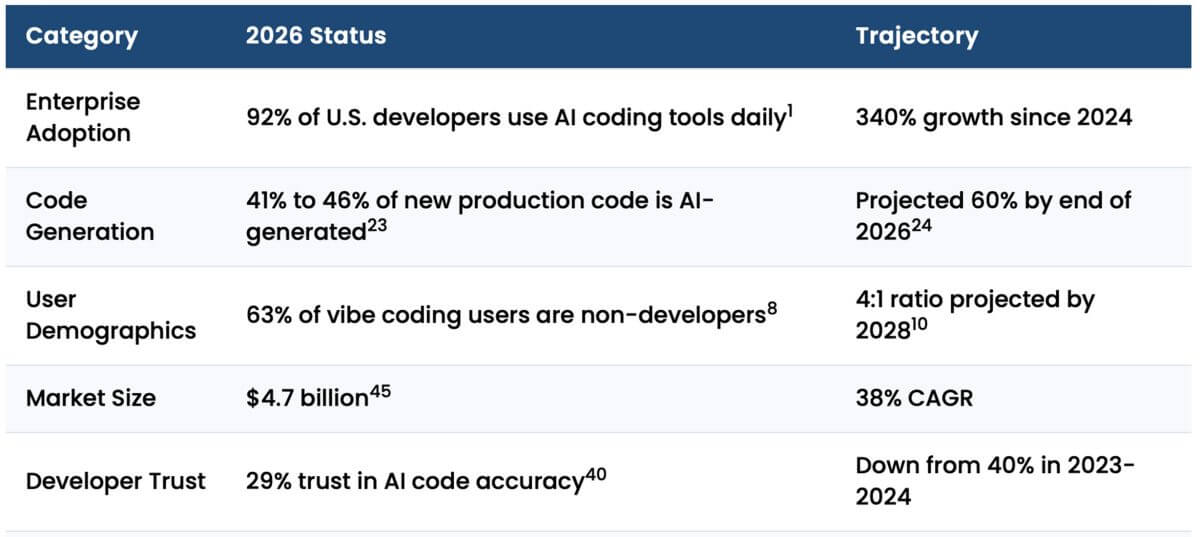
Vibe Coding Industry Status by Category, 2026
| Category | 2026 Status | Trajectory |
|---|---|---|
| Enterprise Adoption | 92% of U.S. developers use AI coding tools daily1 | 340% growth since 2024 |
| Code Generation | 41% to 46% of new production code is AI-generated23 | Projected 60% by end of 202624 |
| User Demographics | 63% of vibe coding users are non-developers8 | 4:1 ratio projected by 202810 |
| Market Size | $4.7 billion45 | 38% CAGR |
| Developer Trust | 29% trust in AI code accuracy40 | Down from 40% in 2023-2024 |
| Code Quality | 41% increase in bug rates post-adoption25 | 30% to 41% increase in tech debt28 |
| Security | 91.5% of vibe-coded apps have AI-traceable vulnerabilities33 | 45% fail OWASP Top-1031 |
| Rescue Engineering | 8,000+ startups need rebuilds37 | $50K to $500K per rescue |
Key Findings
- 92% daily adoption with only 29% trust: Every adoption and volume metric in the table is accelerating while every quality, security, and trust metric is declining. That pattern points to a governance gap.1,40
- 41% increase in bug rates post-adoption: Organizations are adopting AI coding tools faster than they are building the review processes needed to govern how those tools are used including test gates and architectural oversight.25
- 91.5% of vibe-coded apps have AI-traceable vulnerabilities: This gap compounds: each sprint of ungoverned AI-generated code (often introduced through vibe coding workflows) adds to a growing layer of technical debt and security exposure that gets harder to fix the longer it sits.33
In Practice
What we see consistently is this: vibe coding is not inherently the problem. It is highly effective for rapid prototyping, greenfield development, and accelerating well-defined tasks.
The breakdown happens when those same patterns are applied directly to enterprise systems without the architectural context, review processes, and governance required for production environments.
Across our client engagements, we see this gap play out in a consistent way. Teams adopt vibe coding tools, productivity goes up on isolated tasks, and leadership assumes the gains are universal. Then defect rates climb, security reviews surface patterns that were not there before, and sprint capacity starts going to bug fixes instead of new features.
We typically see a consistent timeline. The first month feels transformative. By weeks five through eight, integration issues start appearing. By week twelve, teams spend 20% to 30% of sprint capacity on bugs that trace back to AI-generated code. The organizations that avoid this cycle are the ones governing their tools differently.
The data that follows reflects that gap. Adoption is accelerating across every segment, but the organizations seeing sustained success are the ones treating vibe coding as a tool within an engineering system, not a replacement for one.
Enterprise Adoption by Organization Size
AI coding tool adoption has moved from early experimentation to enterprise standard, with many teams initially engaging through vibe coding-style workflows.
AI Coding Tool Adoption by Organization Segment, 2026
| Organization Segment | Adoption Rate |
|---|---|
| Fortune 500 companies | 87%1 |
| Fortune 100 (GitHub Copilot integration) | 90%2 |
| Fortune 1000 (Cursor penetration) | 70%3 |
| U.S. developers (daily AI tool usage) | 92%1 |
| All engineering teams (daily, globally) | 73%1 |
| Gartner 2028 projection | 90%4 |
Enterprise adoption grew 340% from 2024 to early 2026.1 GitHub Copilot reports 26 million cumulative users and 4.7 million paid subscribers.2 Cursor has penetrated roughly 70% of Fortune 1000 companies.3
Gartner now projects 90% enterprise adoption by 2028.4 What stands out in the data is how compressed this adoption curve has been. Most enterprise technology takes five to seven years to reach saturation. AI coding tools—often initially adopted through vibe coding-style workflows—are on track to do it in three.
Key Findings
- 340% adoption growth in under two years: Adoption is no longer a differentiator. The competitive question has shifted from whether to adopt vibe coding tools to how effectively teams govern what gets shipped.1
- 90% projected enterprise adoption by 2028: Compressed adoption leaves less time for organizations to develop mature governance. Most enterprise technologies take five to seven years to reach saturation. Vibe coding tools are reaching saturation in three, which means governance has to be built deliberately rather than organically.4
- 70% Fortune 1000 Cursor penetration: Teams that delay adoption do not avoid the governance challenge. They compress it into an even shorter window when they eventually standardize.3
In Practice
In our experience, teams that treated vibe coding and prompt-driven tools as optional six months ago are now standardizing on them. The shift often happens faster than engineering leadership expects, which means governance processes are playing catch-up. A common pattern: individual contributors adopt tools informally, leadership sees productivity gains, and then mandates org-wide rollout before review standards are in place.
Organizations getting ahead of this are establishing code review standards and deployment gates before full rollout, not after problems surface. That means defining what AI-generated code requires before it can be committed:
- Minimum test coverage thresholds for any AI-generated code path
- Mandatory human review for all production-touching changes
- Automated linting rules tuned specifically for AI-generated patterns
Teams that treat governance as a Phase 2 initiative consistently underestimate how quickly ungoverned AI code accumulates.
The AI Coding Tool Landscape
Market share has fragmented into a three-way race, with the top tools separated by just five percentage points.
Primary AI Coding Tool Market Share, 2026
| Tool | Primary Usage Share |
|---|---|
| GitHub Copilot | 29% (at-work usage)5 |
| Claude Code | 28%5 |
| Cursor | 24%5 |
| Windsurf | Emerging contender |
| Amazon Q Developer | Enterprise-focused growth |
IDE-based code assistants have captured 49% of market share, signaling a structural shift toward deeply integrated development environments.5 Claude Code and Cursor together account for over half of primary-tool selections.
Cursor’s revenue trajectory stands out. The company went from $1 billion ARR in November 2025 to $2 billion by February 2026.6 That pace earned Anysphere a $29.3 billion Series D valuation, with follow-on discussions at $50 to $60 billion.7
Key Findings
- 49% IDE-based market share: As AI coding tools—and the vibe coding workflows built around them—move from plugin to core development environment, teams choosing tools are increasingly choosing their entire development workflow. This market will likely narrow to a handful of dominant platforms.5
- $1B to $2B ARR in three months (Cursor): The market is still volatile enough that today’s dominant tool may not hold its position in 18 months. Teams that build workflows tightly coupled to one platform’s proprietary features face switching costs when the landscape shifts.6
- Tool selection matters less than governance: What separates teams that succeed from teams that accumulate debt has more to do with review standards and deployment gates than which tool they chose.
In Practice
At Keyhole, we have seen teams succeed with every major tool on this list. The common factor is the governance wrapper: code review standards, test coverage requirements, and deployment gates. When the engineering process is sound, the tool is interchangeable.
This is why we advise engineering leaders to invest in process before platform. Define your code review standards, test coverage requirements, and deployment gates as tool-agnostic policies. Teams that establish governance first can swap tools with minimal disruption. Teams that select a platform first and build governance around it end up with processes that are hard to transfer when the tool landscape inevitably shifts.
The Rise of the Citizen Developer
A year ago, the conversation was about how developers use AI. Now it is about who else is writing code.
Vibe Coding User Demographics, 2026
| User Segment | Share of Vibe Coding Users |
|---|---|
| Non-developers (citizen developers) | 63%8 |
| Full-stack developers | 32.1%8 |
| Frontend developers | 22.1%8 |
| Backend developers | 8.9%8 |
Sixty-three percent of vibe coding users identify as non-developers: product managers, marketing directors, startup founders, and designers.8 Forrester estimates 16.2 million active citizen developers worldwide.9 Gartner predicts they will outnumber professional engineers 4:1 by 2028.10
Build economics have shifted dramatically. Twenty-five percent of Y Combinator Winter 2025 startups have codebases that are 95%+ AI-generated.11 The cost of building a functional SaaS product has dropped from roughly $200,000 to about $5,000. Build timelines compressed from six months to six weeks.
This democratization introduces Shadow IT risk. Sixty-one percent of IT leaders cite ungoverned AI usage as their top security barrier.12 Applications built without architectural review are reaching production every day.
Labor markets are responding. Junior developer hiring has declined nearly 20% for developers aged 22 to 25 between late 2022 and mid-2025.13 An estimated 40% to 70% of entry-level work has been abstracted by AI tools.
Key Findings
- 63% of vibe coding users are non-developers: Citizen development is real, and it is not going away. The economics are too compelling: a functional SaaS product for $5,000 instead of $200,000 shifts the build-versus-buy calculation for every department in the organization.8
- 61% of IT leaders cite ungoverned AI usage as top security barrier: Non-developers building applications is not the risk. Applications reaching production without architectural review or security assessment is. Shadow IT has always existed, but vibe coding tools have lowered the barrier to “describe what you want and deploy it in an afternoon.”12
- 20% decline in junior developer hiring (ages 22-25): If entry-level development roles shrink while citizen developers multiply, the pipeline that produces senior engineers narrows. The organizations that will need experienced engineers to govern AI-generated code in five years are reducing the pipeline that produces them today.13
In Practice
Organizations that avoid these outcomes take a different approach. They introduce lightweight review processes and pairing non-developers with senior engineers for anything that touches production data or customer-facing systems. The key word is lightweight. Heavy approval workflows create the same bottleneck that drove departments to build outside of standard processes in the first place.
At the same time, the rise of vibe coding has been genuinely empowering, especially for nontechnical stakeholders. Founders, product managers, and business leaders can now go from idea to a working application faster than ever. That shift is real, and it has fundamentally changed how software gets started.
What is less obvious is what it takes to make those applications hold up over time.
We are often brought in after early success, when entrepreneur- or citizen-built applications begin to outgrow the way they were built. These systems may look polished and functional, but they lack the structure required to scale. That includes consistent architecture, shared abstractions, security controls, and test coverage.
We recently worked with a founder who had spent close to a year building a stock alerting application using AI-assisted tools. The interface worked, but the system was not reliable. Large portions of the source code were missing, the application could not be redeployed, and core processing jobs were timing out.
We reconstructed the application, rebuilt the alerting engine in Python, and introduced proper structure around deployment and dependency management. We then addressed performance constraints through asynchronous processing, database optimization, and caching. The system went from unreliable to usable, and more importantly, became something the client could build on.
This pattern is common. Development is not as simple as the prompt that creates the first version. What works for an initial build does not automatically translate into a system that can evolve, integrate, and operate reliably under real-world conditions.
As these applications gain traction, underlying gaps begin to surface:
- Performance limits under real user load
- Data and validation issues as complexity increases
- Integration challenges with existing systems
- Security and compliance gaps
At that point, the work shifts from building features to stabilizing the system.
The most expensive rescue projects are not failed enterprise initiatives. They are applications that succeeded early, accumulated real users and real data, and then required structural rework to move forward.
The organizations that avoid this adopt a tiered model early:
- Internal tools can move quickly with minimal review
- Customer-facing or data-sensitive systems require architectural review, testing, and security validation
The difference is not the tool. It is when engineering discipline is introduced. When governance is applied early, it enables scale. When applied later, it becomes rescue engineering. The first version of an application is easier than ever to generate. Building one that holds up over time still requires engineering.
Developer Productivity: Gains and Limits
Productivity is the primary selling point for AI coding tools, particularly when used in rapid, prompt-driven workflows (often referred to as vibe coding) or agentic-based code assists. The data is more complicated than vendor marketing suggests.
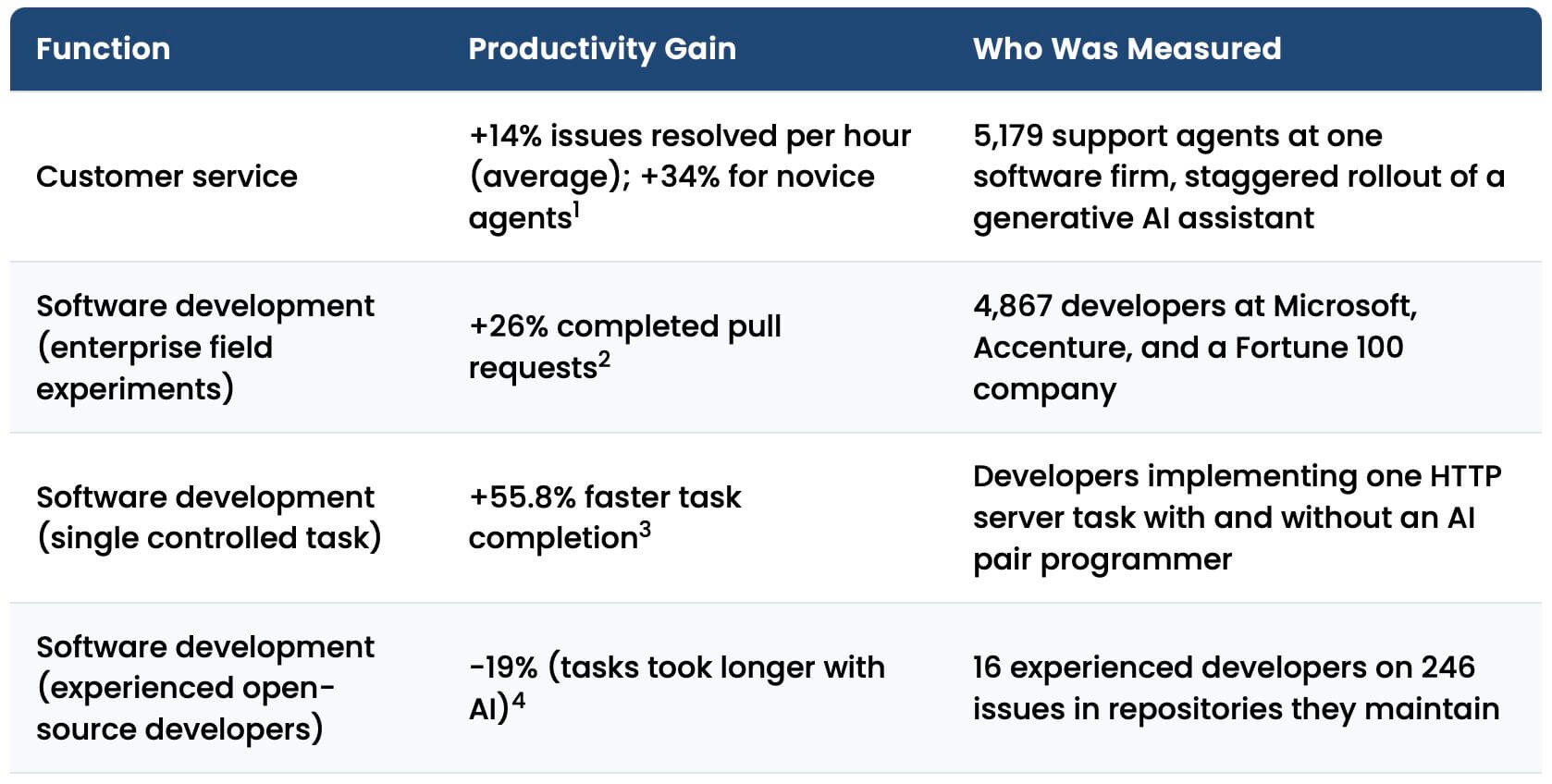
An ArXiv study found 55.8% faster completion times for building a JavaScript HTTP server from scratch. Median time dropped from 161 minutes to 71 minutes.17
An MIT randomized controlled trial of 4,867 developers showed a 26% increase in completed tasks, with 13.55% more code commits and 38.38% more successful builds.18
Google’s internal data showed a 21% increase in completion speed for multi-file tasks.19 McKinsey’s February 2026 study of 4,500 developers across 150 enterprises reported a 46% reduction in routine coding task time, translating to 3.6 hours saved per week per developer.20
But those averages obscure a critical detail. Only the top quintile of organizations achieved 16% to 30% gains, and they did it by overhauling their processes for spec-driven development.
The METR study offers the sharpest counterpoint. Sixteen experienced open-source developers working in million-line codebases were 19% slower with AI tools.21 Despite this, those developers reported feeling 20% faster.
That creates a nearly 40-point perception gap, which has real consequences for project planning.
Sources: ArXiv (2023), MIT Management Science (2026), Alphabet Q3 2024 earnings, McKinsey enterprise study (2026), METR open-source developer study (2025).
Key Findings
- 19% slower with AI in legacy codebases, yet developers felt 20% faster: The METR finding reveals a 40-point perception gap that has real consequences for project estimation. If teams are planning sprints based on self-reported productivity gains, they are overcommitting.21
- Top-quintile organizations achieved 16% to 30% gains: They did so by overhauling their development processes, not by simply deploying tools. The productivity came from the process change; the tool is what made it possible.20
- 26% more completed tasks in MIT trial of 4,867 developers: Prompt-driven AI coding workflows accelerate isolated greenfield tasks but can decelerate complex integration work in legacy environments. The gains are real but context-dependent.18
In Practice
In our experience, the gains are real on isolated tasks. Building a new API endpoint, scaffolding a microservice, generating test boilerplate: these are areas where vibe coding workflows consistently accelerates delivery on isolated tasks. Where teams get into trouble is assuming those gains scale linearly when the work involves integrating with existing systems, navigating complex business logic, or working within architectural constraints.
For example, in a recent AI-accelerated insurance modernization engagement, where Keyhole helped replace a legacy platform in five months instead of the estimated 18 to 24 months. The team defined the architecture, delivery framework, and engineering guardrails up front, then used structured AI-accelerated workflows to replace the UI, services, database, and administrative tooling while maintaining enterprise-grade security and governance. That is the difference between using AI to speed up delivery and using it to deliver production-ready systems.
In legacy modernization work, vibe coding requires senior oversight at every integration point. Without it, the generated code works in isolation but breaks when it meets real-world constraints:
- Database schemas it does not understand
- API contracts it cannot see
- Error handling patterns specific to the domain
One missed constraint creates a cascade that takes longer to debug than writing the code manually would have. The perception gap makes this worse: developers report feeling faster even when aggregate metrics tell a different story.
AI-Generated Code Volume and the Quality Crisis
The volume of AI-generated code has crossed a threshold. In many environments, AI-generated code now makes up the majority of the codebase, which makes how that code is governed the defining question.
AI-Generated Code as Share of New Production Code
| Context | AI-Generated Share |
|---|---|
| AI-generated lines of code (2024) | 256 billion lines22 |
| Google new code (Q3 2024) | 25 to 30%23 |
| Global enterprise average (2026) | 41 to 46%23 |
| Java backend code specifically | Up to 61%23 |
| Gartner projection (end of 2026) | 60%24 |
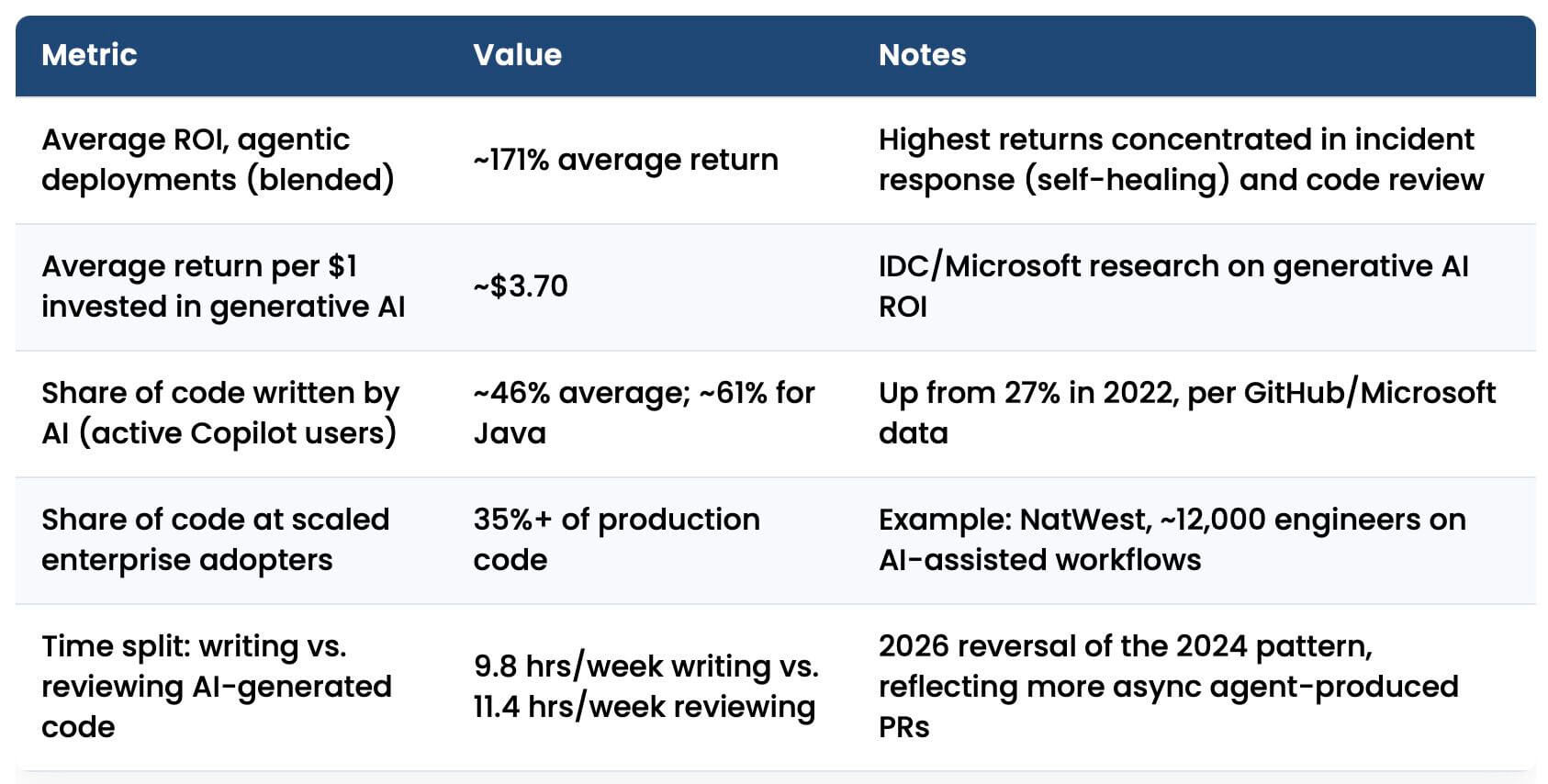
AI tools generated an estimated 256 billion lines of code in 2024.22 By early 2026, the global enterprise average has reached 41% to 46% of new production code.23 Java backend environments are as high as 61%.
Gartner projects that figure will reach 60% across all enterprise environments by the end of 2026.24 At that volume, quality controls designed for human-written code do not automatically transfer.
Quality data confirms why that volume matters. An Uplevel study of roughly 800 developers found that after Copilot adoption, initial speed gains were neutralized by a 41% increase in bug rates.25 A CodeRabbit analysis of 470 open-source pull requests showed AI-coauthored code contained 1.7x more major issues. Logic flaws increased 75%. Readability and maintainability issues tripled.26
GitClear’s analysis revealed code duplication at 4x higher rates. Refactoring dropped from 25% of changed lines in 2021 to under 10% by 2024.27 A study of 8.1 million pull requests confirmed that technical debt increases 30% to 41% after AI tool adoption.28
Forrester projects that 75% of technology decision-makers will face moderate to severe technical debt by end of 2026.29 McKinsey reports that 60% of CIOs acknowledge their technical debt is actively growing.30
By Day 90 of vibe-coded projects, teams typically spend 20% to 30% of sprint capacity on bugs tracing to AI-generated code.
Key Findings
- 41% increase in bug rates after Copilot adoption: An Uplevel study of roughly 800 developers found initial speed gains were neutralized by increased defect rates. AI-generated debt accumulates invisibly because the code looks clean, passes linting, and compiles, and is introduced without consistent review, testing, and architectural oversight.25
- 1.7x more major issues in AI-coauthored code: CodeRabbit’s analysis of 470 pull requests showed logic flaws increased 75% and readability issues tripled. The problems are structural: duplicated logic, shallow error handling, and patterns that break at scale.26
- Refactoring dropped from 25% to under 10% of changed lines: GitClear’s data shows codebases are growing without consolidating. Generating new code is always faster than refactoring existing code, and by Day 90, 20% to 30% of sprint capacity shifts to AI-traced bugs.27
- 75% of tech leaders face moderate to severe technical debt by end of 2026: Forrester projects this trend will intensify as AI-generated code volume reaches 60% of new production code.29
In Practice
Our team sees this pattern consistently. The code passes initial review because it is syntactically correct and well-formatted. A reviewer scanning for obvious errors will not flag it. The problems emerge during integration, load testing, and edge-case handling, which is often weeks or months after the code was committed.
We call the most common pattern “copy-paste architecture.” The AI generates similar but not identical implementations for related functions instead of building shared abstractions. Each function works individually, but when business logic changes, teams have to find and update every copy. In one engagement, a single business rule change required modifications in 14 places because the AI had generated 14 variations instead of one reusable component.
Teams that stay ahead of this build dedicated refactoring cycles into their sprint cadence, separate from bug fixes. In the engagements where we have seen this work, teams allocate roughly 15% to 20% of each sprint to code consolidation, specifically targeting the duplication and shallow abstraction patterns vibe coding produces.
Security Vulnerability Exposure
When nearly half of production code is AI-generated and governance practices such as review, testing, and validation are inconsistent, the security surface changes.
Forty-five percent of AI-generated code fails OWASP Top-10 benchmarks.31 Java projects show a 70%+ security failure rate. AI-generated code exhibits a 2.74x higher XSS vulnerability rate compared to human-written equivalents.32
A Q1 2026 assessment of over 200 vibe-coded applications found that 91.5% contained at least one vulnerability traceable to AI hallucination.33 The AI does not know what it does not know, and it generates plausible code that omits security fundamentals.
Data from a Fortune 50 company showed AI tools produced 10x more security findings per month versus human baselines. That included a 322% increase in privilege escalation paths and a 153% rise in architectural design flaws.34
Tenzai tested five vibe coding tools by building 15 identical applications across Claude Code, Codex, Cursor, and Replit. The result: 69 distinct vulnerabilities, six critical.35
Only 8.25% of Claude Sonnet 4 outputs are both functionally correct and secure.36
Sources: Veracode OWASP assessments, CodeRabbit analysis, GuardMint Q1 2026 assessment (200+ apps), Apiiro Fortune 50 case study, Tenzai comparative study, Endor Labs Agent Security League.
Key Findings
- 45% of AI-generated code fails OWASP Top-10 benchmarks: These are not exotic vulnerabilities. They are the basics: unvalidated inputs, exposed credentials, missing access controls, and broken authentication. Senior engineers check for these instinctively.31
- Only 8.25% of AI outputs are both functionally correct and secure: Out of every 12 generated code blocks, roughly one meets both functional and security standards. That ratio makes human review mathematically necessary for any production-bound code.36
- 322% increase in privilege escalation paths at Fortune 50 scale: The Fortune 50 data shows what happens without review at enterprise scale. AI tools produced 10x more security findings per month versus human baselines.34
In Practice
Experienced engineers spot these vulnerabilities quickly because they are familiar patterns: unvalidated inputs, hardcoded credentials, missing rate limiting, broken access controls. The issue is not that AI produces unfixable code. These are exactly the kinds of problems that get missed when code ships without review, because the code looks functional and reads cleanly.
The most effective mitigation is the simplest. None of this is new, but these practices become non-negotiable when nearly half the codebase is AI-generated:
- Mandatory security review at every deployment boundary
- Automated SAST scanning integrated into the CI/CD pipeline
- A policy that no AI-generated code touching authentication, authorization, or data handling ships without senior engineer approval
When Vibe Code Fails
Quality and security data describes probability. These incidents show what the consequences look like when AI-generated code is deployed without sufficient governance, review, and architectural oversight.
Across the market, a clear pattern is emerging: a growing number of applications built with AI-assisted development are now requiring what can best be described as rescue engineering.
These are not failed experiments. In smaller or short-lived applications, these issues can often be tolerated. In enterprise systems, they become systemic risks that require structural rework.
In many cases, they are fast-moving, initially successful builds that reached production quickly, but without the architectural guardrails required to scale, secure, and sustain them.
Documented Vibe Coding Production Failures, 2025-2026
| Incident | Impact |
|---|---|
| Claude Code source leak (Mar 2026) | 59.8 MB source map exposed 512,000 lines of proprietary TypeScript38 |
| Lovable platform crisis | 3 security incidents; 16 vulnerabilities (6 critical); BOLA vulnerability open 48 days37 |
| Moltbook social network | 1.5M authentication tokens and 35,000 emails exposed within 3 days of launch37 |
| April 2026 security week | 3 major incidents in one week: Vercel breach, Bitwarden CLI supply chain attack37 |
| Apple App Store response | Blocking and removing vibe-coded apps citing unvetted AI-generated modules37 |
Roughly 10,000 startups attempted production applications with AI assistants. More than 8,000 now need rebuilds or rescue engineering.37 Budgets range from $50K to $500K each, putting the total rescue engineering market in the billions.
Consider the Claude Code leak. Anthropic’s own CLI tool shipped a packaging error no human reviewed.38 The exposure of 512,000 lines of proprietary TypeScript was caused by a simple misconfiguration, not a sophisticated attack.
Key Findings
- 8,000+ startups need rebuilds at $50K to $500K each: The rescue engineering economics tell the real story. A lightweight review process adds days to a project timeline. A rescue engagement adds months and a six-figure budget.37
- 512,000 lines of proprietary code exposed by a packaging error: The Claude Code leak happened to Anthropic, a company with some of the deepest AI expertise. If that level of organization can ship an unreviewed packaging error, the risk for teams with less mature review processes is significantly higher.38
- Apple blocking and removing vibe-coded apps: Platform gatekeepers are beginning to enforce quality standards externally. Organizations that do not govern AI-generated code internally may find that external parties do it for them, with less flexibility and more disruption.37
The same pattern repeats across incidents:
- Code that works in isolation but fails under integration
- Applications that pass initial demos but break under production load
- Security gaps tied to missing validation, access control, or configuration oversight
This is not a failure of AI-assisted development itself. The tools are doing what they are designed to do: generate functional code quickly. The breakdown occurs when that code is treated as production-ready without the engineering discipline required to support it.
In Practice
We see this pattern consistently in real-world engagements. Teams adopt vibe coding tools, move faster immediately, and turn prototypes into functional applications in days or weeks. The breakdown comes when the prototype hits production constraints: APIs, business rules, security requirements, and edge cases the prompt never covered.
At that point, the work shifts from adding features to stabilizing the system. That is where rescue engineering comes in, and it usually means:
- Re-architecting core components.
- Replacing duplicated logic created through repeated code generation.
- Restoring test coverage, security controls, and deployment discipline.
The timing matters. When governance is applied early, these controls are incremental. When applied later, they require structural rework, and we have seen rebuilds cost 3x to 5x the original budget. We have seen this firsthand in rescue engagements where the rebuild cost exceeded the original development budget by 3x to 5x.
A strong example is Keyhole’s work rebuilding and scaling an AI-generated stock alerting platform. The application had early traction but lacked the structure required to redeploy reliably or handle production constraints, so Keyhole reconstructed the system, rebuilt the alerting engine in Python, and introduced deployment discipline, dependency management, and performance improvements such as asynchronous processing, database optimization, and caching. That is the difference between a quick AI-assisted build and a production-ready system.
Organizations that avoid these outcomes are not avoiding vibe coding. They are using it within a governed engineering framework: AI-generated code is treated as a starting point, human review is required at production boundaries, and test and security gates are enforced before deployment.
The Developer Trust Gap
Developers are using tools they do not trust, and that creates a new kind of engineering risk.
Developer Trust in AI-Generated Code, Trend
| Sentiment Measure | 2023-2024 | 2025-2026 |
|---|---|---|
| Favorable sentiment | 70%+39 | 60%39 |
| Trust in AI code accuracy | ~40%40 | 29%40 |
| Actively distrust AI output | — | 46%40 |
| Highly trust AI output | — | 3%40 |
| Senior engineers: highly trust | — | 2.6%40 |
| Senior engineers: highly distrust | — | 20%40 |
Favorable sentiment dropped from over 70% to 60%39 and trust in AI code accuracy fell from roughly 40% to 29%.40 Among senior engineers, only 2.6% express high trust, while 20% express high distrust.
Yet only 48% of developers always review AI-generated code before committing.41 The combination of high usage, low trust, and inconsistent review creates systemic risk.
Key Findings
- Only 29% trust in AI code accuracy, down from 40%: Teams are shipping code that even its users don’t fully trust. When only 3% of all developers and 2.6% of senior engineers express high trust in AI output, the tools have a credibility problem that better models alone will not solve.40
- Only 48% of developers always review AI code before committing: More than half of AI-generated code is still being committed without consistent review. Combined with low trust, developers who do not trust the code are still shipping it without verification, most likely due to time pressure.41
- The fix is process, not better AI: Mandatory review, automated test gates, and architects who own quality standards. When review is required by the CI/CD pipeline, it happens regardless of time pressure.
In Practice
The trust data matches what we hear from engineering leads across our client base. Senior developers are the most skeptical because they have the experience to recognize the patterns AI gets wrong: edge cases, integration complexity, and domain-specific constraints that do not appear in training data.
That skepticism is an asset when channeled into review workflows rather than treated as resistance. The most effective teams we work with assign their most experienced engineers as AI code reviewers, not because the work is beneath junior developers, but because senior engineers catch the architectural and security issues earlier. Organizations that acknowledge the trust gap openly, rather than dismissing it as resistance to change, build stronger engineering cultures around AI adoption.
From Vibe Coding to Agentic Engineering
The failure patterns documented above are not caused by AI itself. They come from using AI without the architecture, context, and governance required for production software. That is the real distinction between vibe coding and the way Keyhole approaches AI-enabled delivery.
Vibe coding is prompt-driven, short-term generation with limited planning and minimal system context. It can work well for prototypes, but it breaks down as systems become more integrated, regulated, and operationally complex.
Agentic engineering is the more mature model: delegated, bounded autonomy. AI agents operate within sandboxed environments using deep enterprise context, including API contracts, data models, architecture diagrams, and compliance rules.42 Humans remain responsible for architecture, review, and release decisions.
The difference is governance:
- Defined specifications instead of open-ended prompts.
- System context instead of isolated generation.
- Human accountability at every production boundary.
Deloitte projects 40% of enterprise applications will integrate autonomous AI agents by end of 2026, up from under 5% in early 2025.43 Forrester describes the shift as engineers becoming “AI Conductors,” focused on workflow orchestration and architectural validation.44
Key Takeaways
- 40% of enterprise apps to integrate AI agents by end of 2026: The shift from vibe coding to agentic engineering is the enterprise maturity curve. Vibe coding is where most teams start; agentic engineering is where the ones that avoid production failures end up.43
- The distinction comes down to boundaries: Vibe coding gives AI a prompt and ships the result. Agentic engineering gives AI a specification, a set of constraints, access to project context, and a human gatekeeper. Integrating AI agents without the governance layer is just vibe coding at enterprise scale.
In Practice
In our work, this looks like AI-accelerated, architect-governed delivery with test-gated workflows. AI agents operate within sandboxed environments where they have access to API contracts, data models, and architecture documentation, but every output passes through human review before merging into production.
For example, in a recent enterprise generative AI initiative, Keyhole designed a secure RAG architecture that let internal teams query complex enterprise data through natural language while preserving governance, auditability, and operational control. The engagement validated a scalable pattern for responsible AI adoption, showing how Keyhole helps clients move beyond experimentation toward production-ready AI.
As a Claude Partner Network member, Keyhole designs the governance layer that makes AI safe and useful in enterprise settings:
- Specification-driven development where AI agents receive detailed requirements rather than open-ended prompts
- Automated test suites that gate the build pipeline
- Architectural review by engineers who understand the system context the AI cannot see
When that framework is in place, AI accelerates delivery without creating the debt, security risk, and rescue work that come from ungoverned generation.
Market Size and Investment
Investment is shifting from application builders to the platforms and infrastructure that power them. The market is expanding quickly, but the bigger story is consolidation: capital is flowing toward AI coding platforms, agentic tooling, and LLM infrastructure, while the barrier to launching new products continues to fall.
Vibe Coding Market Size by Year
| Year | Market Size |
|---|---|
| 2024 | ~$2.96 billion45 |
| 2026 | $4.7 billion45 |
| 2027 | $12.3 billion (projected)45 |
| 2034 | $47.3 billion (projected)45 |
AI Coding Platform Valuations, 2025-2026
| Platform | Valuation | Date |
|---|---|---|
| Cursor (Anysphere) | $29.3B (Series D)7 | Nov 2025 |
| Cursor (talks) | $50 to $60 billion7 | Mar 2026 |
| Replit | $9B (Series D)47 | Mar 2026 |
| Lovable | $6.6 billion47 | Dec 2025 |
The market is growing at 38% CAGR, outpacing traditional developer tools at 16.12%.45 Cursor went from $1 billion to $2 billion ARR in three months.46
Average AI coding startup deal size surged 71x: from $7.4 million in 2022 to $527.8 million by end of 2025.47 Over $5 billion in VC funding was deployed in 2024 alone.
Gartner found 70%+ of new SaaS categories now have 50+ competitors,48 showing how crowded the market has become. The result is a lower barrier to entry, faster product copying, and less room for feature-only differentiation. In that environment, the advantage shifts to teams that can execute reliably, govern AI-assisted delivery, and keep their engineering process portable across tools.
Key Findings
- 71x surge in average deal size ($7.4M to $527.8M): Capital is flowing from application-layer startups toward agentic platforms and LLM infrastructure. Investor conviction is that the value sits at the platform layer, not the application layer.47
- 38% CAGR outpacing traditional developer tools at 16%: The tooling landscape will continue to evolve rapidly for at least two to three years. Building deep dependencies on any single vendor’s proprietary features creates switching costs that may prove expensive.45
- 70%+ of new SaaS categories have 50+ competitors: The barrier to launching a competing product has collapsed. Differentiation depends increasingly on execution quality, not feature novelty. Engineering discipline, not development speed, is the competitive moat.48
In Practice
For engineering leaders evaluating tools, the pace of market change reinforces the case for tool-agnostic governance. Build your engineering process around review standards and deployment gates, not around any single vendor’s feature set. Internal tooling investments that duplicate capabilities the market is funding at billion-dollar scales are unlikely to keep pace. Engineering leaders are better served by investing in the governance and quality layers that commercial tools do not provide.
Implications for Engineering Leaders
The data draws a clear line between productive and destructive vibe coding adoption. The difference is not which tools teams choose, but whether those tools operate inside an engineering governance framework.
AI coding tools deliver real productivity gains, particularly when used in well-defined, controlled workflows on greenfield tasks: 26% more completed tasks, 21% faster multi-file completion, 46% reduction in routine coding time. These are meaningful and repeatable.
But ungoverned adoption creates technical debt, security exposure, and rescue costs that can exceed original development budgets by 3x to 5x. The gains and the risks are both real. The question is whether the organization captures one while controlling the other.
The 40-point perception gap between how fast developers feel and how fast they actually are makes self-reported metrics unreliable for planning. Engineering leaders should measure vibe coding productivity through output metrics: sprint velocity, defect rates, and time-to-production, rather than developer surveys. The METR finding that experienced developers were 19% slower while feeling 20% faster shows how easily perception can distort planning.
Engineering leaders who capture durable value from these tools pair speed with senior architect oversight:
- Mandatory code review for all production-touching code
- Automated test gates in the CI/CD pipeline
- Specification-driven AI usage where agents receive detailed requirements rather than open-ended prompts
These practices are what make the productivity gains stick and what prevent the debt, security, and rescue costs documented throughout this article.
Competitive advantage will not go to organizations that generate code fastest. It will go to those that build systems for governing how code is created, reviewed, and deployed.
AI coding tools are not inherently risky, but using them without governance, as we’ve seen in many vibe coding scenarios, introduces compounding risks in enterprise environments.
Need Help Navigating These Trends?
Keyhole Software helps engineering teams adopt vibe coding tools without accumulating the technical debt, security exposure, and rescue costs highlighted in this report. We’ve seen this pattern across modernization, AI adoption, and recovery engagements, and the difference consistently comes down to how these tools are governed.
Our 100% U.S.-based senior consultants, averaging 17+ years of experience, design AI-accelerated, architect-governed delivery workflows tailored to each client’s systems, constraints, and long-term goals.
Whether you are evaluating vibe coding governance for the first time orworking through the quality consequences of early adoption, we can help. Contact us at keyholesoftware.com/contact to start a conversation.
References
- GitHub. ‘Octoverse 2025: The State of Open Source and AI.’ Available at: https://github.blog/news-insights/octoverse/octoverse-2025/. 2025.
- GitHub. ‘GitHub Copilot: The Agent Awakens.’ Available at: https://github.blog/news-insights/product-news/github-copilot-the-agent-awakens/. 2025.
- Cursor. ‘Past, Present, and Future.’ Available at: https://cursor.com/blog/series-d. November 2025.
- Gartner. ‘Gartner Predicts 90% Enterprise AI Coding Tool Adoption by 2028.’ Gartner Newsroom. 2025.
- Second Talent. ‘AI Coding Assistant Productivity Gain Report & Statistics in 2026.’ Available at: https://www.secondtalent.com/resources/ai-developer-productivity/. 2026.
- TechCrunch. ‘Cursor hits $2B ARR as Anysphere fundraises at $50B valuation.’ Available at: https://thenextweb.com/news/cursor-anysphere-2-billion-funding-50-billion-valuation-ai-coding. April 2026.
- CNBC. ‘AI startup Cursor raises $2.3 billion funding round at $29.3 billion valuation.’ Available at: https://www.cnbc.com/2025/11/13/cursor-ai-startup-funding-round-valuation.html. November 2025.
- Hostinger. ‘Vibe Coding Statistics 2026: Adoption, Productivity, and Security Data.’ Available at: https://www.hostinger.com/blog/vibe-coding-statistics. 2026.
- Forrester. ‘Predictions 2026: Software Development Goes From Jamming to a Full Orchestra.’ Available at: https://www.forrester.com/blogs/predictions-2026-software-development-goes-from-jamming-to-full-orchestra/. 2025.
- Gartner. ‘Gartner Predicts Citizen Developers Will Outnumber Professional Engineers 4:1 by 2028.’ Gartner Newsroom. 2025.
- TechCrunch. ‘A quarter of startups in YC’s current cohort have codebases that are almost entirely AI-generated.’ Available at: https://techcrunch.com/2025/03/06/a-quarter-of-startups-in-ycs-current-cohort-have-codebases-that-are-almost-entirely-ai-generated/. March 2025.
- Hostinger. ‘Vibe Coding Statistics 2026.’ Available at: https://www.hostinger.com/blog/vibe-coding-statistics. 2026.
- Stanford Digital Economy Lab. ‘The Impact of AI on Junior Developer Employment.’ Available at: https://findskill.ai/blog/stanford-ai-index-junior-dev-hiring-drop/. 2026.
- Peng, S. et al. ‘The Impact of AI on Developer Productivity: Evidence from GitHub Copilot.’ Available at: https://arxiv.org/abs/2302.06590. 2023.
- Cui, Z. et al. ‘The Effects of Generative AI on High-Skilled Work: Evidence from Three Field Experiments with Software Developers.’ Available at: https://pubsonline.informs.org/doi/10.1287/mnsc.2025.00535. February 2026.
- Alphabet Inc. ‘Alphabet Q3 2024 Earnings Call.’ Available at: https://fortune.com/2024/10/30/googles-code-ai-sundar-pichai/. October 2024.
- McKinsey & Company. ‘AI-Driven Developer Productivity Across 150 Enterprises.’ Available at: https://www.secondtalent.com/resources/ai-developer-productivity/. February 2026.
- METR. ‘Measuring the Impact of Early-2025 AI on Experienced Open-Source Developer Productivity.’ Available at: https://metr.org/blog/2025-07-10-early-2025-ai-experienced-os-dev-study/. July 2025.
- Panto. ‘AI Coding Statistics: Adoption, Productivity & Market Metrics.’ Available at: https://www.getpanto.ai/blog/ai-coding-assistant-statistics. 2026.
- NetCorp. ‘AI-Generated Code Statistics 2026.’ Available at: https://www.netcorpsoftwaredevelopment.com/blog/ai-generated-code-statistics. 2026.
- Gartner. ‘Gartner Predicts 60% of Enterprise Code Will Be AI-Generated by End of 2026.’ Gartner Newsroom. 2025.
- Uplevel Data Labs. ‘Gen AI for Coding Research Report.’ Available at: https://resources.uplevelteam.com/gen-ai-for-coding. 2024.
- CodeRabbit. ‘State of AI vs Human Code Generation Report.’ Available at: https://www.coderabbit.ai/blog/state-of-ai-vs-human-code-generation-report. December 2025.
- GitClear. ‘AI Copilot Code Quality: 2025 Data Suggests 4x Growth in Code Clones.’ Available at: https://www.gitclear.com/ai_assistant_code_quality_2025_research. February 2025.
- GitClear. ‘AI Copilot Code Quality: 2025 Data Suggests 4x Growth in Code Clones.’ Available at: https://www.gitclear.com/ai_assistant_code_quality_2025_research. February 2025.
- Forrester. ‘Predictions 2026: Software Development.’ Available at: https://www.forrester.com/blogs/predictions-2026-software-development-goes-from-jamming-to-full-orchestra/. 2025.
- McKinsey & Company. ‘AI-Driven Developer Productivity Across 150 Enterprises.’ February 2026.
- Veracode. ‘AI-Generated Code Security Assessment.’ Available at: https://www.hostinger.com/blog/vibe-coding-statistics. 2025-2026.
- CodeRabbit. ‘State of AI vs Human Code Generation Report.’ Available at: https://www.coderabbit.ai/blog/state-of-ai-vs-human-code-generation-report. December 2025.
- GuardMint. ‘Q1 2026 Vibe-Coded Application Security Assessment.’ Available at: https://guardmint.io/articles/article-vibe-coding-security-risks.html. April 2026.
- Apiiro. ‘4x Velocity, 10x Vulnerabilities: AI Coding Assistants Are Shipping More Risks.’ Available at: https://apiiro.com/blog/4x-velocity-10x-vulnerabilities-ai-coding-assistants-are-shipping-more-risks/. September 2025.
- Tenzai. ‘Bad Vibes: Comparing the Secure Coding Capabilities of Popular Coding Agents.’ Available at: https://blog.tenzai.com/bad-vibes-comparing-the-secure-coding-capabilities-of-popular-coding-agents/. December 2025.
- Endor Labs. ‘Is AI Coding Safe? Introducing the Agent Security League.’ Available at: https://www.endorlabs.com/learn/is-ai-coding-safe-introducing-the-agent-security-league. 2026.
- The Next Web. ‘Lovable security crisis: 48 days of exposed projects, closed bug reports, and the structural failure of vibe coding security.’ Available at: https://thenextweb.com/news/lovable-vibe-coding-security-crisis-exposed. April 2026.
- VentureBeat. ‘Claude Code source code appears to have leaked: here is what we know.’ Available at: https://venturebeat.com/technology/claude-codes-source-code-appears-to-have-leaked-heres-what-we-know. March 2026.
- Stack Overflow. ‘2025 Stack Overflow Developer Survey: AI Section.’ Available at: https://survey.stackoverflow.co/2025/ai. December 2025.
- Stack Overflow. ‘Mind the Gap: Closing the AI Trust Gap for Developers.’ Available at: https://stackoverflow.blog/2026/02/18/closing-the-developer-ai-trust-gap/. February 2026.
- Stack Overflow. ‘2025 Stack Overflow Developer Survey.’ Available at: https://survey.stackoverflow.co/2025/. December 2025.
- O’Reilly. ‘Conductors to Orchestrators: The Future of Agentic Coding.’ Available at: https://www.oreilly.com/radar/conductors-to-orchestrators-the-future-of-agentic-coding/. 2026.
- Gartner. ‘Gartner Predicts 40% of Enterprise Apps Will Feature Task-Specific AI Agents by 2026.’ Available at: https://www.gartner.com/en/newsroom/press-releases/2025-08-26-gartner-predicts-40-percent-of-enterprise-apps-will-feature-task-specific-ai-agents-by-2026-up-from-less-than-5-percent-in-2025. August 2025.
- Forrester. ‘Predictions 2026: Software Development Goes From Jamming to a Full Orchestra.’ Available at: https://www.forrester.com/blogs/predictions-2026-software-development-goes-from-jamming-to-full-orchestra/. 2025.
- Taskade. ‘State of Vibe Coding 2026: Market Size, Adoption & Trends.’ Available at: https://www.taskade.com/blog/state-of-vibe-coding. 2026.
- TechCrunch. ‘Cursor hits $2B ARR as Anysphere fundraises at $50B valuation.’ Available at: https://thenextweb.com/news/cursor-anysphere-2-billion-funding-50-billion-valuation-ai-coding. April 2026.
- New Market Pitch. ‘AI Coding Market Funding Trends (2022-2026).’ Available at: https://newmarketpitch.com/blogs/news/ai-code-assistant-funding-trends. 2026.
- Zylo. ‘175+ Unmissable SaaS Statistics for 2026.’ Available at: https://zylo.com/blog/saas-statistics. 2026.
More From Keyhole Software
About Keyhole Software
Expert team of software developer consultants solving complex software challenges for U.S. clients.
Share This Post
Join The Thousands Of Devs Who Subscribe
[…] barely moved across testing cycles from 2025 into 2026 despite vendor claims of safety progress. Java codebases fare considerably worse, with failure rates above 70 percent across multiple industry assessments. A Q1 2026 sweep of more […]
[…] of which were code smells with a substantial portion surviving in the latest repository version. A study of 8.1 million pull requests confirmed that technical debt increases 30% to 41% after AI too…. GitClear’s 2026 longitudinal study of 211 million changed lines found two-week churn rose from […]
[…] worth being honest about the gap between hype and reality here. Adoption data cited by Keyhole Software’s 2026 research, aggregated from 14 industry reports, developer surveys, and market analyses, found a genuinely […]
[…] Software. “Vibe Coding Trends 2026.” keyholesoftware.com. Accessed 18 June […]
[…] Skipping governance on AI-assisted builds. 92% of U.S. developers now use AI coding tools daily, but only 29% trust the code those tools produce. That gap shows how fast adoption is outpacing governance. By day 90 of vibe-coded projects, teams typically spend 20-30% of sprint capacity fixing bugs traceable to AI-generated code. If you build with AI assistance, budget for architectural review and test coverage from day one, not as an afterthought. […]
[…] safe to ship, and it is also why so many non-developers are building software now at all. Roughly 63% of people using these tools are non-developers: product managers, founders, designers. The tools let all of them in. What the […]
[…] isn’t a fringe statistic, it’s the new center of gravity for this category. Keyhole Software’s 2026 trends analysis has more detail on the enterprise and quality-control side if you want to go deeper. For a solo […]
[…] Cursor’s revenue velocity: Cursor grew its share of AI-assisted PRs from under 20% to nearly 40% in under a year, and Cursor has achieved 70% penetration among Fortune 1000 companies. […]
[…] analysefirmaet Keyhole Softwares rapport “Vibe Coding Trends 2026” var Cursor-udvikleren Anysphere i marts 2026 i forhandling om en værdiansættelse på 50 til 60 […]
[…] of it as having a conversation with a really talented developer who never sleeps. According to vibe coding adoption data for 2026, a remarkable 63% of active vibe coding users are non-developers, including founders, product […]
[…] a website has more guided, AI-powered help available at every step than ever before. According to recent vibe coding trend data, 74% of developers report increased productivity using AI-assisted development, and that […]
[…] Vibe Coding Trends 2026: Adoption, Productivity, and Code Quality, https://keyholesoftware.com/vibe-coding-trends-2026/ […]
[…] Vibe Coding Trends 2026: Adoption, Productivity, and Code Quality, https://keyholesoftware.com/vibe-coding-trends-2026/ […]