
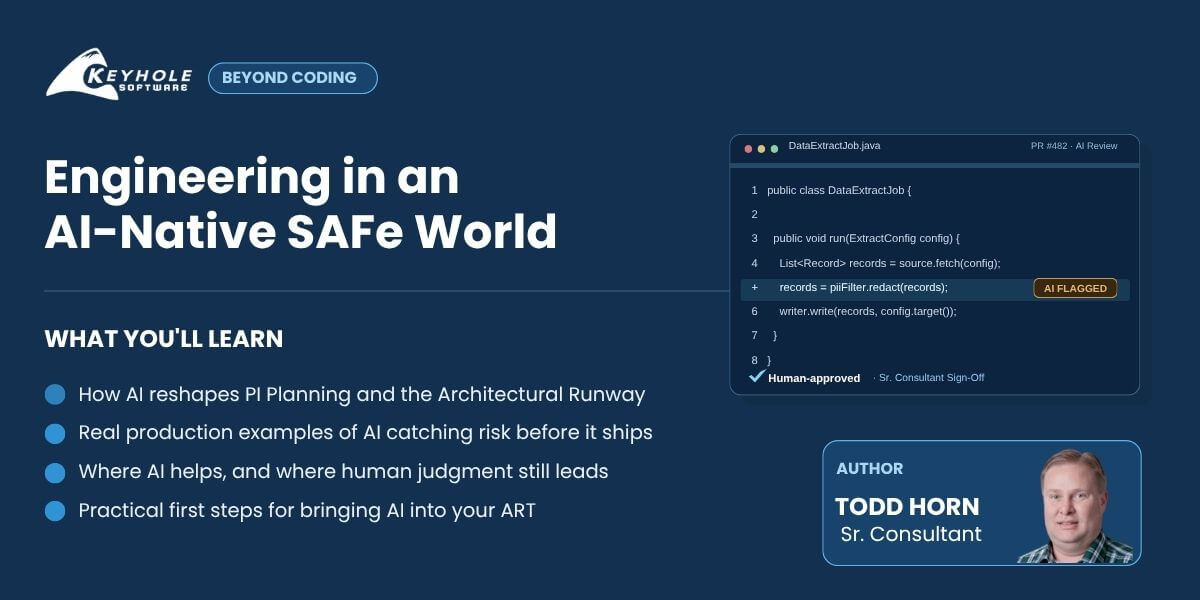
Beyond Coding: Engineering in an AI-Native SAFe World
Artificial Intelligence is changing where engineering value is created: less in producing artifacts by hand, and more in making better technical decisions. In SAFe, that change extends well beyond code generation. It affects how Agile Release Trains prepare for PI Planning, how architects manage the Architectural Runway, how teams validate quality, and how organizations learn from delivery data.
Going into a recent PI Planning session, my team was leaning toward prioritizing new policy workflow enhancements. Before we finalized the plan, we used AI to review six months of production support tickets, grouped by workflow, severity, customer impact, and frequency.
It surfaced a recurring cluster of high-impact issues tied to failures in the policy-binding process, right where downstream policy documents and underwriting data needed to stay in sync. That changed our plan. We added a stabilization item, prioritized root-cause analysis on the bind transaction, and created backlog items for logging, error handling, and regression coverage on that path, deferring a lower-value feature to make room. The PI plan that came out the other side was more data-driven and focused on reducing production failures, not just shipping new functionality.
In my earlier three-part series on the Foundations of SAFe, I covered its values, core principles, benefits, drawbacks, and practical application. As SAFe evolves, the next question is how AI will change the way those principles are practiced in real engineering organizations.
This article looks at what AI practices mean for engineering work inside SAFe. Rather than just faster coding, the real gains are in better planning, stronger architecture, faster feedback, and more accountable engineering decisions across the Scaled Agile Framework.
Defining AI-Empowered Agility, AI-Native SAFe, and AI-Augmented Engineering
Three terms come up consistently throughout this article:
- AI-Empowered Agility refers to the use of AI to strengthen learning, experimentation, and team execution across Lean-Agile practices.
- AI-Native SAFe is Scaled Agile’s emerging operating model for embedding AI into strategy, delivery, governance, and continuous learning while preserving Lean-Agile principles.
- For engineers, architects, developers, platform teams, DevSecOps teams, and quality engineers, the practical expression of these ideas is AI-Augmented Engineering, which means using AI to improve decisions, accelerate feedback, and strengthen engineering discipline without replacing human judgment or accountability.
What AI-Native SAFe Means for Engineers, Architects, and Developers
Software engineering has always advanced through abstraction: from assembly to high-level languages, from monoliths to microservices, from waterfall to Agile, and from manual deployments to automated DevSecOps pipelines. Each shift changed what engineers needed to master. AI continues that pattern by moving more routine work into tools while making systems thinking, context, and judgment more important.
In AI-Native SAFe, engineers are not less central to delivery, rather they are responsible for shaping intent, validating outputs, and ensuring that AI-assisted work aligns with architecture, quality, security, and business outcomes. The teams that benefit most will be those that combine AI fluency with strong engineering fundamentals: understanding complex systems, evaluating trade-offs, validating generated outputs, and applying domain expertise beyond programming syntax.
Practically, this means engineers spend less time searching for context, drafting repeatable artifacts, or manually assembling delivery evidence, and more time framing problems, testing assumptions, reviewing AI-generated options, and making trade-offs visible to the team. The work becomes less about producing every artifact from scratch and more about improving the quality of decisions that shape delivery.
Engineering in an AI-Empowered Agile Release Train
The Agile Release Train (ART) is the engineering engine of SAFe. Cross-functional teams deliver value through PI Planning, iterative development, System Demos, and Inspect and Adapt workshops. Those ceremonies stay exactly as they are. What changes is the quality of information engineers bring into them.
Before PI Planning, teams often spend weeks gathering context from work item tracking systems, source repositories, ADRs, production dashboards, dependency maps, and previous PI objectives. AI assistants can turn that scattered history into planning insight, such as identifying a Feature that depends on a service with recent escaped defects or spotting two teams planning similar work against the same API.
Before one PI Planning cycle finalized, we used AI to compare feature descriptions, team objectives, and dependency notes across the ART:
- It surfaced that two teams had planned overlapping work: one building document-generation logic into an endorsement workflow, the other building a similar update into the renewal workflow, both depending on the same document template service without realizing it.
- Because the work was listed under different features, the overlap hadn’t been obvious during normal planning.
- Once we saw it, we agreed to build one shared document-generation capability owned by a single team, with the other team consuming it instead of building a parallel path.
During refinement, the same assistant could compare a new Feature with prior implementations and highlight known constraints such as authentication patterns, data retention rules, performance expectations, or downstream system dependencies. It might also suggest initial acceptance criteria for the team to review. Engineers still decide what to build, but they begin the conversation with more complete context.
The same principle applies throughout the PI. By analyzing delivery trends, dependencies, escaped defects, telemetry, and Flow Metrics, AI can surface risk patterns earlier, such as slowing deployment frequency combined with rising defect reopen rates on a dependency-heavy Feature.
The ceremonies remain unchanged, but engineering decisions become better informed.
AI Strengthens the Architectural Runway
Most conversations about AI begin with code generation, but in SAFe the larger opportunity may be architectural. The Architectural Runway enables teams to deliver new Features without excessive redesign or disruption, which requires visibility into dependencies, technical debt, Enabler work, and whether today’s decisions still support tomorrow’s business capabilities.
Maintaining that visibility has traditionally required architects to piece together information from repositories, dependency graphs, deployment topologies, Solution Intent, Architecture Decision Records, and changes across multiple Agile Release Trains. As systems grow more complex, that review becomes harder to sustain and easier to delay.
AI can make architecture more continuous by analyzing source code, dependencies, deployment metadata, telemetry, and implementation patterns to detect architectural drift, cyclic dependencies, excessive coupling, and modernization opportunities before they become delivery constraints.
In one architecture review, we used AI-assisted analysis to compare backlog items, design notes, and recent integration changes across the ART. It surfaced that two teams were planning different approaches to the same problem: one proposing a direct service-to-service call from the policy administration system, the other planning to publish a separate event from a workflow.
- Both were solving the same business need, but the approaches would have created duplicate integration patterns and left downstream systems open to inconsistent updates.
- We paused before either team committed to the work, standardized on a single domain event owned by the policy administration service, and had both workflows consume it. That became an Enabler in our next PI and left the ART with a cleaner, more consistent pattern for future policy lifecycle events.
There are Solution Intent benefits as well. AI can help keep Architecture Decision Records, C4 diagrams, API documentation, sequence diagrams, and dependency maps aligned with source code and deployment information as the system evolves.
The architect’s role becomes less about producing static documentation and more about evaluating trade-offs, mentoring teams, governing technology strategy, and improving the system continuously.
Built-In Quality in an AI-Empowered Pipeline
Built-In Quality is central to SAFe: quality is engineered into every stage of delivery, not inspected at the end. AI strengthens this principle by expanding feedback across the Continuous Delivery Pipeline.
- During Continuous Exploration, AI can analyze customer feedback, production incidents, feature usage, and telemetry to identify opportunities, risks, and quality concerns before implementation begins.
- Within Continuous Integration, AI can generate scaffolding, recommend design patterns, create tests, review pull requests, detect security vulnerabilities, and suggest refactoring opportunities. Human reviewers remain responsible for architecture, business logic, maintainability, and security.
For example, on a commercial insurance platform, AI flagged a change to a rating engine that calculated premiums across class codes, state rules, endorsements, deductibles, audits, and renewals.
- That logic was complex because configurable rating tables, effective dates, policy terms, legacy integrations, and conditional workflows had to run in the right sequence, and a small change could cascade into minimum premiums, policy documents, accounting entries, and renewal projections.
- AI recommended additional unit and regression tests for multi-state policies, mid-term endorsements, retroactive rate changes, cancellations, reinstatements, and audit adjustments, and flagged missing controls for premium overrides, suggesting reviewers from underwriting, policy administration, compliance, and claims.
- Engineers and their team still owned the decision, but the complexity and risk were visible much earlier.
In another code review, AI-assisted analysis flagged a change to a scheduled file extract that looked routine but touched sensitive data.
- The change added new fields to an outbound extract sent to a downstream reporting system, and one of those fields contained PII that didn’t go through the same masking and filtering rules used elsewhere in the application.
- The file would have generated successfully in testing, since the layout, delimiters, and delivery process were all valid; the risk wasn’t a technical failure, it was data exposure.
- We stopped the merge, removed the restricted field, added validation to block unapproved fields from extracts, and added a regression test around data classification. That likely kept us from creating a late-stage compliance issue in a high-impact batch process.
Additionally, during Continuous Deployment, AI can help generate deployment manifests, pipeline configuration, rollback checklists, and environment-specific validation steps. It can also compare configurations against known-good baselines and highlight operational risks before changes reach production.
After deployment, AI-assisted observability can correlate logs, metrics, traces, deployment history, and infrastructure telemetry to identify anomalies and likely root causes. Engineers spend less time searching dashboards and more time improving resilience.
Across the pipeline, AI strengthens Built-In Quality by moving feedback closer to the decision point, where engineers can still act on it.
Enterprise Knowledge Becomes an Engineering Capability
One of AI’s biggest engineering opportunities is making enterprise knowledge easier to find and use. SAFe organizations accumulate years of knowledge across work item tracking systems, collaboration platforms, source repositories, DevOps platforms, document repositories, ADRs, Solution Intent, runbooks, and incident reports. Each PI adds new Features, Enablers, decisions, and lessons, but that knowledge often becomes difficult to reuse as the organization grows.
Retrieval-Augmented Generation, often called RAG, is the pattern of grounding AI responses in trusted enterprise repositories instead of relying only on public training data. Engineers can ask questions in natural language and receive answers tied to source code, ADRs, Solution Intent, operational history, and documentation.
For example, an engineer refining a Feature could ask whether a similar integration was built before, which ADRs shaped the design, what incidents affected the related service, and whether an approved reusable component already exists. The value depends on the quality, freshness, and trustworthiness of the repositories, metadata, and operational history the assistant can access.
I’ve seen engineers and architects assume AI is only useful for writing code or generating documentation, which leads some teams to treat it as a developer productivity tool and nothing more.
- What changed that on my team was using AI to review engineering inputs before a planning conversation: comparing recent pull requests, defect history, test failures, and known technical debt against the features being proposed for the next PI.
- It surfaced that several planned features touched the same aging integration layer that already had repeated defects and low test coverage.
- Once the team saw AI connect delivery work to actual engineering evidence, rather than just generating a file, they got comfortable using it as part of SAFe planning instead of dismissing it as a coding shortcut.
Emerging technologies such as the Model Context Protocol (MCP) extend this capability by allowing AI systems to connect securely with multiple enterprise tools through a consistent interface. For engineers, the impact is practical: faster ramp-up, fewer repetitive questions, less duplicate implementation, easier discovery of reusable services, and knowledge that becomes part of the workflow instead of an obstacle to it.
The Rise of the AI-Augmented Engineer
As AI becomes integrated into software delivery, engineering shifts from producing every artifact manually to defining intent, constraints, and outcomes.
Instead of creating every deployment script, configuration file, unit test, or documentation artifact by hand, engineers will specify business objectives, architectural constraints, security requirements, operational expectations, and quality characteristics. AI can generate candidate implementations. Engineers remain responsible for evaluating alternatives, validating assumptions, and ensuring alignment with enterprise standards.
This elevates the work. Architects spend more time governing architecture, developers refine business logic, platform engineers improve delivery platforms, and DevSecOps and quality engineers focus on resilience, security, and customer outcomes.
Programming languages and frameworks still matter, but the greatest value will come from engineers who understand distributed systems, cloud-native architecture, security, observability, integration patterns, and the business domain.
Traditional SAFe vs. AI-Empowered SAFe Practices
AI does not replace SAFe. But it does change how teams execute SAFe practices. Lean thinking, customer centricity, Built-In Quality, and decentralized decision-making remain the foundation. What changes is how quickly teams gather information, evaluate alternatives, and make technical decisions.
The differences are clearest in daily engineering work.
| Engineering Practice | Traditional SAFe | AI-Empowered SAFe |
|---|---|---|
| PI Planning | Teams manually gather dependencies, historical context, and implementation details before planning. | AI prepares dependency analysis, summarizes previous PI objectives, identifies risks, and provides engineering insights before planning begins. |
| Feature Refinement | Teams manually analyze requirements and identify implementation considerations. | AI recommends acceptance criteria, identifies similar Features, highlights dependencies, and suggests implementation patterns for team review. |
| Architectural Runway | Architects periodically review systems and prioritize Enabler work. | AI continuously evaluates architecture, detects technical debt, and recommends Enablers before delivery is affected. |
| Solution Intent | Documentation is updated manually and often falls behind implementation. | AI assists in generating and synchronizing architecture documentation with the evolving system. |
| Built-In Quality | Testing, security reviews, and code analysis rely primarily on engineers and automation scripts. | AI augments testing, code review, security analysis, deployment validation, and operational monitoring throughout the delivery lifecycle. |
| Inspect and Adapt | Teams periodically analyze metrics and identify improvements manually. | AI continuously analyzes Flow Metrics, production telemetry, escaped defects, and delivery trends to identify systemic improvement opportunities. |
| Knowledge Discovery | Engineers search multiple repositories and documentation sources. | Enterprise AI assistants provide conversational access to trusted engineering knowledge across the organization. |
Across these practices, AI reduces information discovery and repetitive artifact creation so engineers can spend more time applying expertise.
How Engineers Can Prepare for AI-Native SAFe
Teams do not need to wait for a full enterprise AI rollout to begin. When I talk to teams starting out, I tell them to start narrow: pick a single use case where AI reduces engineering risk rather than rolling it out everywhere at once.
On my team, that meant using AI during refinement and code review to analyze recent production defects, pull requests, and testing gaps, asking it to flag files that change often, missing test coverage, repeated defect patterns, or places where multiple teams touch the same shared component. That gives you something concrete to validate and act on before work starts or code merges, not just a general sense that AI could help.
Engineers can start by applying AI to well-defined, reviewable workflows where the inputs, outputs, risks, and accountability are clear.
- Use AI to prepare for PI Planning and refinement by summarizing prior Features, dependencies, incidents, ADRs, and reusable services.
- Validate AI-generated code, tests, deployment scripts, and architecture recommendations before they become production changes.
- Strengthen systems thinking, domain modeling, observability, security, and architecture trade-off analysis.
- Write prompts as engineering intent, including goals, constraints, quality expectations, security requirements, and acceptance criteria.
- Favor source-grounded AI connected to trusted enterprise repositories.
- Require human review for decisions involving architecture, security, compliance, customer impact, or operational risk.
Responsible AI Governance in Engineering
AI can accelerate engineering work, but speed without governance creates risk. Responsible AI use in SAFe requires guardrails that preserve human accountability, protect enterprise data, and keep delivery safe, secure, and valuable.
AI-generated code, tests, documentation, architectural recommendations, and deployment changes should remain subject to human review and validation against source-of-truth repositories, security standards, regulatory requirements, and established architecture patterns.
The mistake I’d tell any team to avoid is treating AI like an automated reviewer or approver. AI shouldn’t be the reason a design gets accepted, a pull request gets approved, or a deployment moves forward.
Developers still need to review the code, understand the system’s behavior, and make the call. The best early use is letting AI surface issues, like duplicated logic, fragile integration points, thin test coverage, or risky dependencies, and then having engineers decide what to do about them.
Governance should address hallucination, sensitive data exposure, intellectual property, auditability, and technical debt, including what data AI can access, how recommendations trace to trusted sources, and which decisions require architecture, security, legal, or compliance review.
SAFe already includes governance mechanisms that can guide responsible AI adoption. Lean Portfolio Management, Architectural Runway management, Built-In Quality, DevSecOps, and Inspect and Adapt provide natural checkpoints for assessing whether AI is improving flow and outcomes without compromising safety, quality, or long-term system health.
Measuring Engineering Success Beyond Velocity
AI also changes how engineering organizations should evaluate performance. Traditional Agile metrics such as Story Points and Velocity remain useful for team planning, but they become less representative when AI generates increasing portions of implementation code, documentation, and automated tests.
If two teams deliver the same customer value but one automates much of its repetitive engineering work through AI, should the team with fewer Story Points be considered less productive? Clearly not.
As implementation becomes less expensive, organizations should emphasize metrics that reflect engineering-system health rather than the amount of work produced.
- Flow Metrics, including Flow Time, Flow Velocity, Flow Efficiency, and Flow Load, provide insight into how effectively work moves through the value stream.
- DORA metrics such as Deployment Frequency, Lead Time for Changes, Change Failure Rate, and Mean Time to Recovery (MTTR) provide objective measures of engineering performance regardless of how implementation was produced.
Technical debt also becomes increasingly important. AI can accelerate delivery, but without governance it can also accelerate inconsistent implementations, duplicated patterns, and architectural complexity.
Customer value was always the actual target. Engineering activity was just a proxy for it. AI is starting to expose the gap between the two.
Conclusion
AI-Empowered Agility builds directly on Lean-Agile principles, sharpening them with better information, faster feedback, responsible governance, and more capable engineering teams.
For organizations practicing SAFe, the opportunity extends beyond coding assistants. AI can improve planning preparation, strengthen the Architectural Runway, reinforce Built-In Quality, support DevSecOps, keep Solution Intent aligned with implementation, and make enterprise knowledge easier to use.
The real transformation is the shift in where engineering value is created. As AI takes on more repetitive implementation work, engineers can focus more deeply on architecture, systems thinking, quality, resilience, security, and business outcomes. That shift still requires human review, technical judgment, and accountable decision-making.
That’s what happened on my team’s ART, when a PI Planning conversation shifted from new features to fixing a recurring failure in the policy-binding process. Nobody caught that pattern by memory alone. Six months of ticket data made it visible, and the team acted on it.
That’s what AI-Native SAFe actually looks like in practice: better questions asked earlier, and more accountable decisions because of it.
References & SAFe Learning
- Scaled Agile Framework. AI-Empowered Agility
- Scaled Agile Framework. Achieving AI-Empowered Agility
- Scaled Agile Framework. Staying SAFe with AI
- DORA. DORA’s Software Delivery Performance Metrics
- Thoughtworks Technology Radar. Lightweight Architecture Decision Records
- C4 Model. The C4 Model for Visualising Software Architecture
- Lewis et al. Retrieval-Augmented Generation for Knowledge-Intensive NLP Tasks
- Model Context Protocol. What is the Model Context Protocol?
More From Todd Horn
About Keyhole Software
Expert team of software developer consultants solving complex software challenges for U.S. clients.
Share This Post
Join The Thousands Of Devs Who Subscribe
Discuss This Article
Subscribe
Login
0 Comments
Oldest