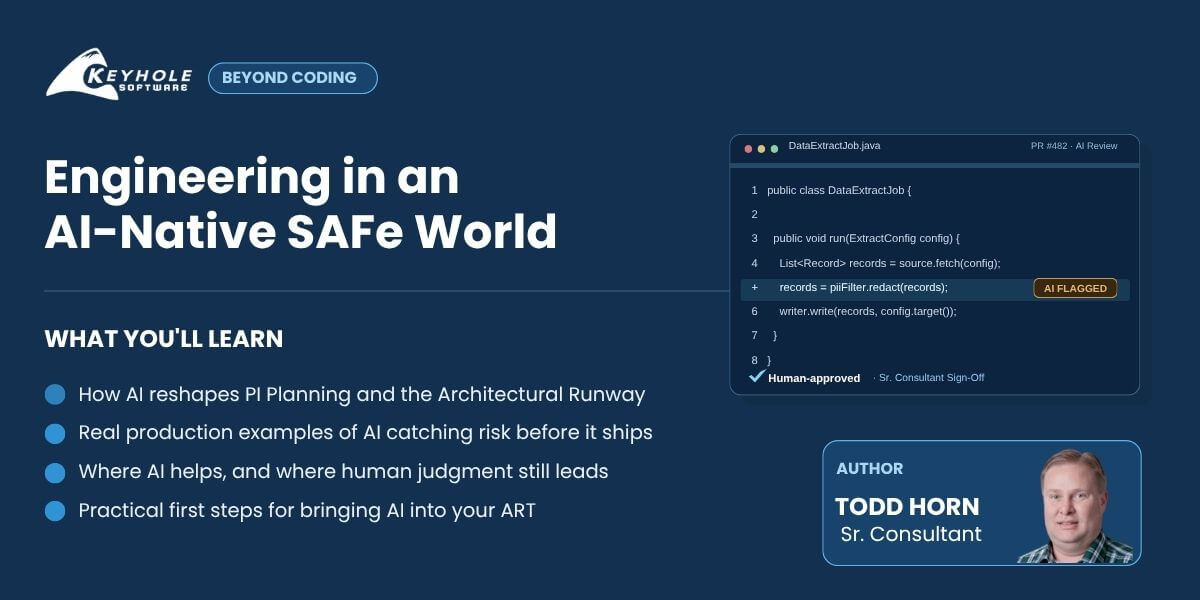
Header graphic for Todd Horn's article on AI in SAFe, showing a code editor with an AI-flagged change and a human-approved sign-off.

Beyond Coding: Engineering in an AI-Native SAFe World

Todd Horn Agentic AI & AI-Accelerated Development, Agile, All Industries, Articles, Artificial Intelligence, Project Management Leave a Comment

Artificial Intelligence is changing where engineering value is created: less in producing artifacts by hand, and more in making better technical decisions. In SAFe, that change extends well beyond code generation. It affects how Agile Release Trains prepare for PI Planning, how architects manage the Architectural Runway, how teams validate quality, and how organizations learn from delivery data.

In my earlier three-part series on the Foundations of SAFe, I covered its values, core principles, benefits, drawbacks, and practical application. As SAFe evolves, the next question is how AI will change the way those principles are practiced in real engineering organizations.

This article looks at what AI practices mean for engineering work inside SAFe. Rather than just faster coding, the real gains are in better planning, stronger architecture, faster feedback, and more accountable engineering decisions across the Scaled Agile Framework.
Intent-Driven Development: A Modern SDLC for AI-Accelerated Teams

Dallas Monson Agentic AI & AI-Accelerated Development, Agile, All Industries, Articles, Artificial Intelligence, Development Technologies & Tools, Insurance Leave a Comment

The traditional SDLC wasn’t designed for AI-accelerated delivery. When features ship in hours instead of weeks, detailed upfront documentation becomes the bottleneck in an AI-assisted software development lifecycle. As organizations accelerate delivery with AI, most software documentation strategies haven’t kept pace. Practices built for slower, predictable releases struggle with rapid iteration. Modern software delivery teams need a lighter approach that …

Bridging the Communication Gap Between Software Teams and Business Stakeholders

Evan Sanning Agile, Articles, Consulting, Development Technologies & Tools, Project Management, Soft Skills Leave a Comment

Miscommunication between technical and non-technical teams leads to wasted effort, missed opportunities, and damaged customer trust. This blog breaks down why the gap persists, the real organizational cost, and practical ways to create shared language, aligned incentives, and value-driven collaboration. Learn how teams can transform communication into a strategic advantage.

Best Practices for Proposing Improvements to Your Development Team

Jake Everhart Agile, Articles, Consulting, Project Management, Soft Skills Leave a Comment

Working within a software development team has tremendous benefits, but it also comes with its share of complications. One of those complications is inertia – the more people who get used to a process or a certain set of tools, the more difficult it can be to introduce changes. Maybe this manifests in a positive way, where repetition and familiarity …

From Chaos to Clarity: How We Bring Structure to Struggling Development Teams

Kent Lautenschlager All Industries, Consulting, Financial, Healthcare, Insurance, Keyhole, Manufacturing, Project Management, Supply Chain & Logistics, Videos Leave a Comment

Struggling development teams often find themselves stuck in patterns that seem hard to break. These challenges can slow progress and make it tough to regain focus. We’ve seen this many times and know that real improvement starts by looking at how the team’s systems and processes can be better aligned to support them. In this post, we’ll share how we …