
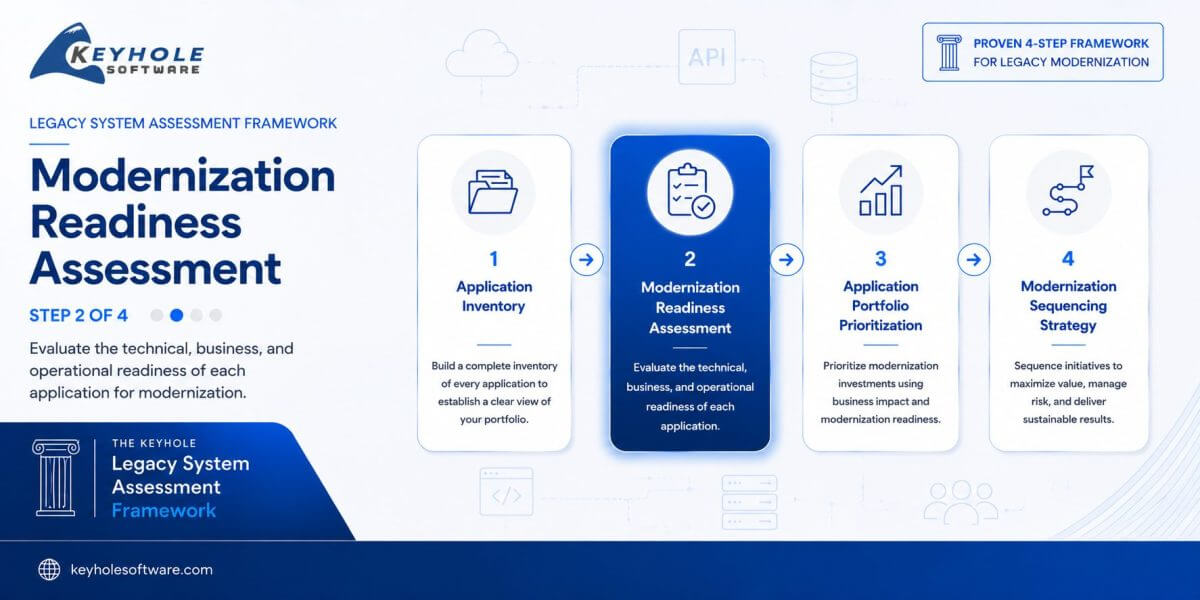
Legacy System Assessment Checklist: Evaluate Readiness Across 5 Key Areas
Once you have portfolio visibility, the second step is to perform a structured modernization readiness assessment for each system.
This is where many teams make assumptions. A system may seem stable because it still runs every day, but that does not mean it is ready to move to the cloud, integrate with modern APIs, support new features, or scale with the business.
A structured legacy system readiness assessment helps replace guesswork with measurable insight. This checklist is a core part of a comprehensive application assessment framework, helping teams evaluate technical readiness before building a modernization strategy.
This article is Step 2 of a complete legacy system assessment framework, covering application inventory, readiness assessment, prioritization, and modernization sequencing. Each step builds toward a practical modernization roadmap.
By the end of this guide you’ll know how to:
- Evaluate modernization readiness consistently
- Score applications across five assessment pillars
- Interpret readiness scores
- Identify modernization constraints
- Prepare for portfolio prioritization
How to Run a Legacy System Readiness Assessment
A modernization readiness assessment evaluates whether a system is prepared for cloud migration, refactoring, replatforming, API enablement, or broader modernization initiatives. Rather than focusing on a single technology concern, it examines the infrastructure, code, data, delivery processes, and team capabilities that influence modernization success.
Before evaluating each pillar, establish a consistent scoring approach.
Run this step as a structured working session with stakeholders who understand the system from different angles. This should include enterprise architects, senior developers, operations or infrastructure leads, data owners, QA leads, and business stakeholders when appropriate.
For each system, score readiness across five pillars:
- Infrastructure Readiness
- Application Code Readiness
- Data Readiness
- DevOps Readiness
- Team Readiness
Use a simple 1 to 5 scoring model to evaluate each system consistently across all five pillars.
- 1–2: Significant risk or limitation
- 3: Moderate readiness with known gaps
- 4–5: Strong foundation for modernization
If your team cannot confidently assign a score, treat that as a signal of risk or missing knowledge.
How to Interpret the Scores
The goal is not to find the “best” system. It is to understand risk and readiness across your portfolio.
| Total Readiness Score | Readiness Level | Typical Modernization Approach |
|---|---|---|
| 5–12 | Low Readiness | Stabilize the application, reduce technical risk, or consider API encapsulation, replacement, or retirement before significant modernization. |
| 13–17 | Moderate Readiness | Good candidate for phased modernization, with known constraints that should be addressed during planning. |
| 18–25 | High Readiness | Technically well-positioned for modernization, subject to business priorities and architectural review. |
Do not use the score alone to decide what happens next. A low technical score does not always mean “modernize first.” For example:
- A low-scoring payroll or compliance system may be too risky to rewrite immediately.
- A higher-scoring customer portal may be a better early modernization candidate because it has lower technical risk and clearer business value.
Readiness scores should always be viewed as diagnostic rather than prescriptive. They help teams understand technical condition and modernization risk, but they do not determine modernization priority or implementation strategy. Those decisions require business context and architectural judgment, which are introduced in Step 3.
The score reflects condition. Business impact determines priority.
Follow Along with the Workbook
The easiest way to complete this assessment is by using the free Legacy System Assessment Toolkit. It includes:
- The complete five-pillar assessment
- Scoring worksheets
- Example assessments
- Portfolio prioritization calculator
- Modernization planning templates
→ Download the Free Legacy System Assessment Toolkit
How to Analyze Modernization Readiness Assessment Results
Once each system is scored, patterns become visible across the application portfolio. Look for:
- Systems with consistently low scores across multiple pillars
- Applications with strong business value but high technical risk
- Systems that are technically manageable but low value
- Areas where infrastructure, data, or team readiness consistently lag
- Candidates for API wrapping, replatforming, refactoring, replacement, or retirement
In our consulting experience, patterns often become clear.
- Low scores across multiple areas indicate high-risk systems that require careful planning or alternative approaches
- Mixed scores highlight specific constraints that need to be addressed before modernization
- Higher scores identify systems that can move forward with less friction
This structured view helps technical and business stakeholders have a more productive conversation, allowing teams to move beyond opinion-based decisions and focus on clear constraints, risks, and tradeoffs.
How Long Does a Readiness Assessment Take?
For most organizations, a readiness assessment workshop takes approximately 60–90 minutes per application depending on complexity. Complex business-critical systems may require follow-up sessions to validate dependencies, architecture, data flows, and operational risks.
For large portfolios, organizations often start by assessing a representative set of high-value or high-risk applications before expanding the process across the entire portfolio.
What Organizations Typically Discover During Readiness Assessment
When organizations score systems across all five pillars, several patterns emerge:
- Infrastructure is often more modern than application architecture
- Data dependencies are frequently undocumented
- DevOps maturity varies significantly between systems
- Team readiness is often the limiting factor rather than technology
- Business-critical applications frequently have lower readiness scores than expected
These patterns help explain why modernization efforts stall and where risk must be addressed first.
This is often the moment organizations realize modernization priorities are different from modernization assumptions.
In many organizations, systems that generate the most business value have accumulated years of integrations, customizations, and operational dependencies. As a result, they are often among the most difficult systems to modernize. Teams are often surprised to discover that the applications they most want to modernize are frequently the least prepared for modernization.
The Five Assessment Pillars
Every application should be evaluated across the same five readiness pillars. Scoring each pillar independently creates a consistent, repeatable assessment that can be compared across the entire application portfolio.
Pillar 1: Infrastructure Readiness
Core question: Can this system run reliably in a modern, scalable environment?
Infrastructure readiness evaluates whether the underlying environment can support cloud migration, containerization, scalability, resiliency, and long-term growth. This is a foundational part of any modernization readiness assessment, as infrastructure constraints often determine what is possible in later phases.
Legacy System Assessment Checklist
Ask the following questions to assess infrastructure readiness:
Environment and Platform
- Is the system tied to specific physical servers, operating systems, or network configurations?
- Is the workload running on aging hardware, unsupported operating systems, or outdated middleware?
- Are there upcoming risks such as expiring data center contracts or vendor end-of-life timelines?
Scalability and Architecture
- Can the application scale horizontally, or only by adding resources to a single server?
- Are performance bottlenecks caused by infrastructure, application design, database constraints, or a combination?
- Does the system rely on shared servers, shared file paths, or undocumented infrastructure assumptions?
Environment Consistency and Provisioning
- Are development, test, staging, and production environments consistent?
- How are environments provisioned today: manually, through scripts, or using infrastructure as code?
- Are environments reproducible on demand?
Resiliency and Recovery
- Are backups automated and regularly tested?
- What happens during a system failure? Is recovery automated, documented, or dependent on specific individuals?
- Are high availability and failover mechanisms in place?
Observability and Operations
- Are monitoring, logging, and alerting in place?
- Are metrics available to diagnose performance and reliability issues?
- Can the team detect and respond to incidents quickly?
Cloud and Container Readiness
- Can the system run in containers, or are there constraints such as stateful processing, licensing restrictions, OS dependencies, or local file storage?
- Are there dependencies that limit cloud portability or introduce hybrid complexity?
- Are there licensing, networking, latency, or data residency requirements that could impact cloud migration?
Scoring Infrastructure Readiness
| Score | Readiness Level | Characteristics |
|---|---|---|
| 1–2 | Critical | Aging hardware, unsupported platforms, manual recovery, limited monitoring, significant environment drift |
| 3 | Moderate | Virtualized infrastructure, partial monitoring, some automation, limited cloud or container readiness |
| 4 | Good | Stable environments, automation in place, container potential, documented recovery processes |
| 5 | Ready | Elastic infrastructure, infrastructure as code, strong automation, mature monitoring, reliable recovery |
Infrastructure Modernization Implications
This pillar surfaces operational fragility and infrastructure constraints that can block modernization. It helps determine whether:
- infrastructure stabilization must happen first
- cloud or container adoption is feasible
- operational risk is acceptable for modernization
If infrastructure readiness is low, modernization efforts will be constrained regardless of application or data improvements.
Common Signals of Infrastructure Risk
In practice, the following patterns indicate higher risk:
- Environments that cannot be reproduced consistently
- Recovery processes dependent on specific individuals
- Limited or reactive monitoring and alerting
- Tight coupling to physical infrastructure or legacy platforms
- Hidden dependencies between systems and shared infrastructure
These signals often point to the need for infrastructure-first stabilization before any application-level changes.
If your team cannot confidently answer these questions, that is often a signal of undocumented infrastructure dependencies that will surface later in modernization.
Pillar 2: Application Code Readiness
Core question: How difficult is it to safely change, extend, or modernize this system?
Application code readiness evaluates the structure, maintainability, testability, and integration capability of the application itself. This pillar is a critical part of any modernization readiness assessment, as code quality and architecture directly determine how much effort, risk, and time modernization will require.
Legacy System Assessment Checklist
Ask the following questions to assess application code readiness:
Architecture and Design
- Is the application monolithic, modular, service-based, or a mix of patterns?
- Where are the tightest coupling points in the system?
- Are business rules clearly separated, or embedded throughout the codebase?
- Does the application rely on stateful sessions that limit scalability or containerization?
Code Maintainability
- Is the source code complete, accessible, and stored in version control?
- Are there areas of the code developers avoid changing because they are too risky?
- Are there hardcoded business rules, credentials, file paths, or environment-specific assumptions?
- Are there vendor-specific dependencies or legacy constraints that limit flexibility?
Integration and APIs
- Are APIs available for integration, or do other systems rely on direct database access, flat files, or manual processes?
- Are APIs documented and actively maintained?
- Are integration patterns consistent, or do they vary across the system?
Technology Stack and Dependencies
- What languages, frameworks, and libraries are in use?
- Are any frameworks, runtimes, or dependencies deprecated or unsupported?
- How tightly coupled is the application to specific platforms or vendors?
Testing and Change Risk
- How much automated test coverage exists?
- Are there unit, integration, regression, and end-to-end tests?
- How often is the application changed, and how often do changes introduce defects?
- Are there known performance issues caused by application design?
- Can the application be effectively analyzed, tested, or accelerated using modern AI-assisted development tools?
Background Processing and Hidden Complexity
- Are there batch jobs, scheduled tasks, or background processes tied directly to the application?
- Are these processes documented and understood?
- Do they introduce dependencies that could complicate modernization?
Scoring Application Code Readiness
| Score | Readiness Level | Characteristics |
|---|---|---|
| 1–2 | Critical | Highly coupled monolith, poor documentation, limited source control, unsupported technologies, little or no test coverage |
| 3 | Moderate | Some modularity, partial API coverage, mixed legacy and modern components, inconsistent documentation |
| 4 | Good | Clear structure, usable APIs, manageable dependencies, reasonable test coverage |
| 5 | Ready | Modular architecture, mature API contracts, strong automated testing, clean dependency management, well-documented codebase |
Application Modernization Implications
This pillar determines how risky it is to change the application and which modernization approaches are viable. It helps answer questions like:
- Can this system be safely refactored?
- Should it be wrapped with APIs instead of rewritten?
- Is replatforming feasible, or is replacement more practical?
In practice, application code readiness drives decisions such as:
- Refactoring for moderately structured systems
- API wrapping for tightly coupled or high-risk systems
- Replatforming for systems with manageable dependencies
- Replacement when code complexity outweighs business value
- Strangler pattern approaches for gradual modernization
Common Signals of Code Risk
In real-world environments, the following patterns often indicate higher risk:
- Codebases that only a small number of developers understand
- Lack of automated testing, making changes unpredictable
- Tight coupling between components and external systems
- Direct database access instead of service-based integration
- Deprecated frameworks or unsupported technologies
- Hidden business logic embedded across the codebase
These signals often point to the need for incremental modernization approaches rather than large-scale rewrites.
Pillar 3: Data Readiness
Core question: Can the data support modernization without creating operational, compliance, or integration risk?
Data readiness evaluates the structure, quality, ownership, security, and accessibility of data across systems. This is often the most complex part of any modernization readiness assessment, as data dependencies, compliance requirements, and integration patterns can significantly constrain modernization options.
Legacy System Assessment Checklist
Ask the following questions to assess data readiness:
Data Location and Architecture
- Where does the system’s data live?
- Is data stored in a single database, multiple databases, flat files, spreadsheets, mainframe datasets, or external systems?
- Are reporting and analytics workloads separated from transactional workloads?
Data Ownership and Source of Truth
- Are there multiple sources of truth for key business entities such as customers, orders, products, policies, claims, or accounts?
- Is ownership of data clearly defined across systems and teams?
- Are data domains or boundaries understood and documented?
- Are data stewardship and governance responsibilities clearly defined?
Data Access and Integration
- Do applications access data through services, or connect directly to production databases?
- Are there direct database dependencies between systems?
- Can data be migrated independently of the application?
- What downstream systems depend on this data today?
Data Quality and Structure
- Is the data model documented?
- Are there duplicate records, missing values, inconsistent formats, or unclear field definitions?
- Are business rules embedded in stored procedures, triggers, batch jobs, ETL processes, or reports?
Security and Compliance
- What sensitive data exists in the system?
- Is PII, PHI, financial data, or other regulated information encrypted at rest and in transit?
- Are there compliance requirements such as HIPAA, SOC 2, GDPR, PCI, or industry-specific regulations?
- How is data backed up, archived, retained, and deleted?
Data Movement and Dependencies
- Are there batch jobs, ETL pipelines, file transfers, or integrations that must be preserved?
- Are these processes documented and understood?
- Do they introduce hidden dependencies that could complicate migration?
Scoring Data Readiness
| Score | Readiness Level | Characteristics |
|---|---|---|
| 1–2 | Critical | Siloed databases, direct production database access, poor data quality, unclear ownership, security or compliance gaps |
| 3 | Moderate | Some duplication, partial documentation, mixed access patterns, limited service abstraction |
| 4 | Good | Clean master data, known dependencies, documented data flows, partial abstraction through services |
| 5 | Ready | Clear domain model, strong data governance, service-based access, documented integrations, compliance controls in place |
Data Modernization Implications
This pillar exposes migration risk, compliance exposure, and data dependencies that must be addressed before modernization. It helps determine:
- Whether data can be migrated independently or must be coordinated with application changes
- Whether compliance requirements will constrain modernization timelines
- Whether integration patterns will need to be redesigned
- Whether data quality issues will introduce risk during migration
In practice, data readiness often becomes the critical path for modernization efforts.
Common Signals of Data Risk
In real-world environments, the following patterns indicate higher risk:
- Multiple conflicting sources of truth for key business entities
- Direct database access between systems instead of service-based integration
- Poor data quality or inconsistent data definitions
- Undocumented data flows or hidden dependencies
- Business logic embedded in database layers or ETL processes
- Sensitive data without clear governance or compliance controls
These signals often require data-first planning and remediation before application changes can proceed safely.
Pillar 4: DevOps Readiness
Core question: Can this system be delivered, tested, deployed, and operated efficiently?
DevOps readiness evaluates whether the organization can deliver changes safely, repeatedly, and with minimal risk. This is a critical part of any modernization readiness assessment, as even well-designed systems will struggle if deployments are manual, inconsistent, or difficult to validate.
Legacy System Assessment Checklist
Ask the following questions to assess DevOps readiness:
Deployment and Release Process
- Are deployments manual, scripted, or fully automated?
- Can the application be deployed without manual server changes?
- Are releases frequent and incremental, or large and infrequent?
- How long does it take to move from code commit to production?
CI/CD and Automation
- Is a CI/CD pipeline in place?
- How consistently is it used across environments and teams?
- Are automated tests part of the build and release process?
- Can code changes be deployed independently of database schema changes?
Testing and Quality Assurance
- What test coverage exists across unit, integration, regression, and end-to-end testing?
- Are tests reliable and executed automatically as part of the pipeline?
- Are quality gates in place to prevent risky changes from reaching production?
Infrastructure and Environment Management
- Is infrastructure managed through code or configured manually?
- Are environments reproducible on demand?
- Are development, test, and production environments consistent?
Security and Configuration Management
- Are secrets, configuration, and environment variables managed securely?
- Are access controls and deployment permissions clearly defined?
- Are security scans, dependency checks, or compliance validations integrated into the delivery pipeline?
Observability and Operations
- Are logs, metrics, and traces available for troubleshooting?
- How are incidents detected, triaged, and resolved?
- Are monitoring and alerting integrated into operational workflows?
Delivery Metrics and Performance
Does the team track key metrics such as:
- deployment frequency
- lead time for changes
- change failure rate
- mean time to recovery (MTTR)?
Scoring DevOps Readiness
| Score | Readiness Level | Characteristics |
|---|---|---|
| 1–2 | Critical | Manual deployments, limited testing, long release cycles, high downtime, unclear rollback processes |
| 3 | Moderate | Basic CI/CD, partial automation, inconsistent test coverage, coupled releases |
| 4 | Good | Reliable pipelines, automated testing, repeatable deployments, documented rollback procedures |
| 5 | Ready | Mature CI/CD, infrastructure as code, automated quality gates, strong observability, low-risk, frequent releases |
DevOps Modernization Implications
This pillar determines whether the organization can deliver changes safely and repeatedly at scale. It helps answer:
- Can modernization work be delivered incrementally, or only in large, high-risk releases?
- Will deployment processes slow progress or introduce risk?
- Can the team validate changes before they reach production?
In practice, DevOps readiness determines whether modernization efforts will move steadily or stall due to delivery constraints.
Common Signals of DevOps Risk
In real-world environments, the following patterns indicate higher risk:
- Manual or partially manual deployment processes
- Infrequent, high-risk release cycles
- Limited or unreliable automated testing
- Tight coupling between application and database releases
- Environments that cannot be reproduced consistently
- Lack of observability or delayed incident detection
These signals often require DevOps and delivery improvements before modernization can scale effectively.
Pillar 5: Team Readiness
Core question: Does the team have the knowledge, capacity, and alignment to execute modernization successfully?
Team readiness evaluates whether the organization has the skills, capacity, and alignment required to deliver modernization work.
This is a critical part of any modernization readiness assessment, and it is often the most underestimated. A strong technical plan will still fail if the team lacks experience, capacity, or shared understanding of the work ahead.
Legacy System Assessment Checklist
Ask the following questions to assess team readiness:
System Knowledge and Continuity
- Who understands the system today?
- Is knowledge distributed across the team, or concentrated with one or two individuals?
- Are there retired employees, former vendors, or long-tenured staff who hold critical system knowledge?
- Is system behavior documented, or primarily understood through experience?
Skills and Modern Platform Experience
- Does the team have experience with cloud platforms, containers, APIs, modern frameworks, or distributed systems?
- Has the team delivered similar modernization efforts before?
- Are there skill gaps that require training, hiring, or external support?
Capacity and Focus
- Does the team have enough capacity to modernize while supporting production systems?
- Are there competing initiatives that may reduce availability?
- Can the team sustain modernization work over time, or only in short bursts?
Stakeholder Engagement and Alignment
- Are business stakeholders available to clarify rules, workflows, and priorities?
- Are product owners, QA, security, infrastructure, and data teams aligned?
- Is there a shared understanding of goals and success criteria?
Leadership Expectations and Governance
- Does leadership understand the likely timeline and sequencing of modernization work?
- Are expectations realistic, or is the organization expecting transformation on an unrealistic timeline?
- Is there a clear decision-making process for tradeoffs, scope, and risk?
- Is the organization prepared for the operational and process changes that modernization may introduce?
Scoring Team Readiness
| Score | Readiness Level | Characteristics |
|---|---|---|
| 1–2 | Critical | Tribal knowledge, limited modern platform experience, unrealistic expectations, low capacity |
| 3 | Moderate | Some modern experience, known skill gaps, limited delivery history at scale |
| 4 | Good | Capable team, some modernization experience, clear leadership support |
| 5 | Ready | Experienced team, realistic roadmap, strong cross-functional alignment, proven delivery capability |
Team Modernization Implications
This pillar surfaces execution risk and determines whether the organization can realistically deliver modernization internally. It helps answer:
- Can the current team execute this effort, or will delivery stall due to skill or capacity gaps?
- Are expectations aligned with the actual complexity of the work?
- Is additional support needed to accelerate or de-risk the effort?
In practice, team readiness often determines whether modernization progresses steadily or slows due to coordination, capacity, or experience constraints.
Common Signals of Team Risk
In real-world environments, the following patterns indicate higher risk:
- Critical system knowledge concentrated with a small number of individuals
- Limited experience with modern architectures or platforms
- Teams already operating at or near full capacity
- Misalignment between leadership expectations and technical reality
- Lack of coordination across engineering, data, infrastructure, and business teams
- Unclear ownership or decision-making processes
These signals often require additional planning, skill development, or external support before modernization can proceed effectively.
If key decisions depend on a small number of individuals, or if timelines are driven by expectations rather than constraints, modernization risk is significantly higher.
Example Modernization Readiness Assessment
The example below shows how a modernization readiness assessment can be summarized after evaluating an application across the five readiness pillars. Each pillar contributes to an overall readiness score that helps teams understand technical risk before making modernization decisions.
| Assessment Field | Result |
|---|---|
| Application | Customer Portal |
| Business Purpose | Customer Self-Service |
| Total Readiness Score | 18 / 25 |
| Overall Readiness | Strong Readiness |
| Architect Notes | The Customer Portal has a strong modernization foundation with cloud-ready infrastructure, mature deployment processes, and well-understood data architecture. Improvements to application modularity and broader knowledge distribution would further reduce modernization risk, but the system is well positioned for incremental modernization. |
Notice that this assessment measures modernization readiness—not modernization priority. Business impact is introduced in Step 3, where readiness scores are combined with business value to prioritize modernization investments across the application portfolio.
Portfolio Readiness Summary
Once every application has been assessed, the results can be compared across the portfolio to identify modernization opportunities, technical risk, and systems that require additional planning before modernization begins.
| Application | Total Readiness Score | Readiness Level | Assessment Summary |
|---|---|---|---|
| Customer Portal | 18 | Strong Readiness | Well-positioned for incremental modernization with manageable technical risk. |
| ERP Platform | 14 | Moderate Readiness | Complex integrations and vendor constraints require a phased modernization approach. |
| Payroll COBOL | 7 | Critical Risk | Legacy platform requiring stabilization before significant modernization. |
| CRM Custom Reports | 22 | Strong Readiness | Technically healthy, but business value should be evaluated before modernization investment. |
| Inventory Scanner | 11 | Critical Risk | Aging hardware and unsupported mobile platform create elevated modernization risk. |
This portfolio view helps teams identify which applications are technically prepared for modernization and which require stabilization, replacement, or additional planning. In Step 3, these readiness scores are combined with business impact to create an objective application portfolio prioritization model.
Why These Five Modernization Pillars Matter:
Most modernization efforts do not fail because of a single technical issue. They fail because constraints across infrastructure, code, data, delivery processes, or team capability are discovered too late.
- You cannot modernize code running on unstable infrastructure.
- You cannot migrate data that is poorly understood.
- You cannot accelerate delivery without reliable DevOps practices.
This framework helps organizations identify those constraints early and build modernization plans based on reality rather than assumptions.
Where AI Adds Value in Assessment
AI-assisted tools can help accelerate parts of a legacy system assessment, especially when systems are poorly documented or difficult to understand. Used within a governed workflow, AI can support:
- Codebase analysis for undocumented applications
- Dependency identification across services, databases, and batch jobs
- Summaries of legacy business logic
- Test case generation for critical workflows
- Identification of unused, redundant, or duplicated code paths
AI should not replace architectural judgment. It should support the assessment process by helping teams move faster while senior architects validate the findings, risks, and modernization path.
When to Consider External Support
In some cases, organizations benefit from bringing in experienced support to complement internal teams. This is especially valuable when:
- critical knowledge gaps exist
- modernization experience is limited
- timelines require acceleration
- internal teams are fully allocated to production support
External support can provide:
- Independent assessment of technical risk
- Experience with similar modernization efforts
- Facilitation of cross-functional workshops
- Acceleration without overloading internal teams
Ready for the Next Step?
Now that you’ve evaluated modernization readiness, the next step of the Legacy System Assessment Framework is combining readiness scores with business value to determine where modernization efforts will deliver the greatest return.
Rather than relying on opinion or urgency, you’ll use a repeatable scoring framework to identify where modernization investments will deliver the greatest business value.
→ Continue to Step 3: Application Portfolio Prioritization
Need an Outside Perspective?
Modernization readiness assessments often uncover hidden dependencies, architectural constraints, and delivery risks that aren’t immediately obvious from documentation alone.
Keyhole Software helps organizations:
- Facilitate architect-led readiness workshops
- Validate assessment findings
- Identify modernization risks and constraints
- Recommend modernization strategies
- Build executable modernization roadmaps
→ Schedule a Legacy System Assessment Workshop
Prefer to Start on Your Own?
Download the free Legacy System Assessment Toolkit to perform the same five-pillar readiness assessment, portfolio scoring, and modernization planning process our architects use during client engagements.
More From Keyhole Software
About Keyhole Software
Expert team of software developer consultants solving complex software challenges for U.S. clients.
Share This Post
Join The Thousands Of Devs Who Subscribe
Discuss This Article
Subscribe
Login
0 Comments
Oldest