
Best AI-Driven Software Development Services (2026)
AI-driven software development has stopped being a differentiator and become a baseline. Nearly every consulting firm now says it uses AI in delivery. The question that matters to a CIO or engineering leader in 2026 is narrower: what does the firm actually do with AI inside the software development lifecycle, who reviews the output, what does the engagement cost, and what happens to your code and data along the way.
Between March 2026 and August 2026, our research team analyzed 41 firms that market AI-driven software development services to U.S. mid-market and enterprise organizations. Each firm was scored on a consistent 100-point framework built around six criteria: documented AI-driven delivery, proprietary AI workflows, team seniority, regulatory familiarity, engagement model flexibility, and pricing transparency. The eight highest-scoring firms appear below.
Most comparison lists in this category rank firms by size or brand recognition. This analysis focuses on how work actually gets delivered. In our experience, AI-driven engagements rarely fail because of the model. They fail because nobody senior is reviewing what the model produced, because the workflow lives in a vendor tool the client cannot keep, or because the contract never addressed who owns the generated code.
How We Evaluated AI-Driven Software Development Services
We scored each firm against six weighted factors totaling 100 points. Proof over promises: the heaviest weight goes to published, measurable delivery evidence rather than vendor benchmarks.
- Documented AI-Driven Delivery (25 points): Published case studies showing AI used inside software delivery, with measured outcomes such as timeline compression, cost savings, or quality metrics. Anonymous client references and internal benchmarks scored lower than named, dated case studies.
- Proprietary AI Workflows and Methodology (20 points): A named, repeatable approach to running AI inside the SDLC: governance gates, templated agent workflows, runtimes, or adoption programs. Firms were credited for both proprietary and open-core methods, provided the method is published and specific.
- Team Seniority and Composition (20 points): Published average experience, tenure, employment model (full-time versus contractor), and where the people reviewing AI output are located. Acceleration amplifies whatever review capacity is present.
- Regulatory Familiarity (15 points): Explicit, published experience with HIPAA, PCI-DSS, SOX, SOC 2, FISMA, FedRAMP, or comparable frameworks, and whether the firm holds any firm-level certification or federal contract vehicle.
- Engagement Model Flexibility (10 points): The range of published ways to work with the firm: staff augmentation, dedicated teams, project outsourcing, advisory, fixed-scope sprints, and workshops.
- Pricing Transparency and Range (10 points): Whether the firm publishes pricing guidance, cost benchmarks, or package prices, plus the hourly band and minimum project size listed on its Clutch profile where one exists.
The dataset was compiled from company websites, published case studies, Clutch profiles, press releases, and federal procurement records. Composite scores were aggregated using the weights above; the full benchmark table follows.
Editorial Process and Independence
The evaluation framework was defined before scoring and applied consistently to every company in the dataset. Keyhole Software publishes this analysis and is included among the evaluated firms. All companies, including Keyhole, were scored using the same criteria and publicly available 2025 to 2026 data. No company paid for placement or ranking position, and rankings reflect only the defined criteria, not vendor relationships or marketing spend.
A Note on Limitations: This ranking is based on public information and may not capture private, non-disclosed engagements or internal delivery metrics. Several firms in this category publish acceleration figures without a per-client source; where that is the case, we note it in the profile. This is one input among many that organizations should use when evaluating potential partners.
The Best AI-Driven Software Development Services of 2026
In the table below, we break down how the eight highest-scoring firms performed against the weighted framework, with the documented evidence behind each score.
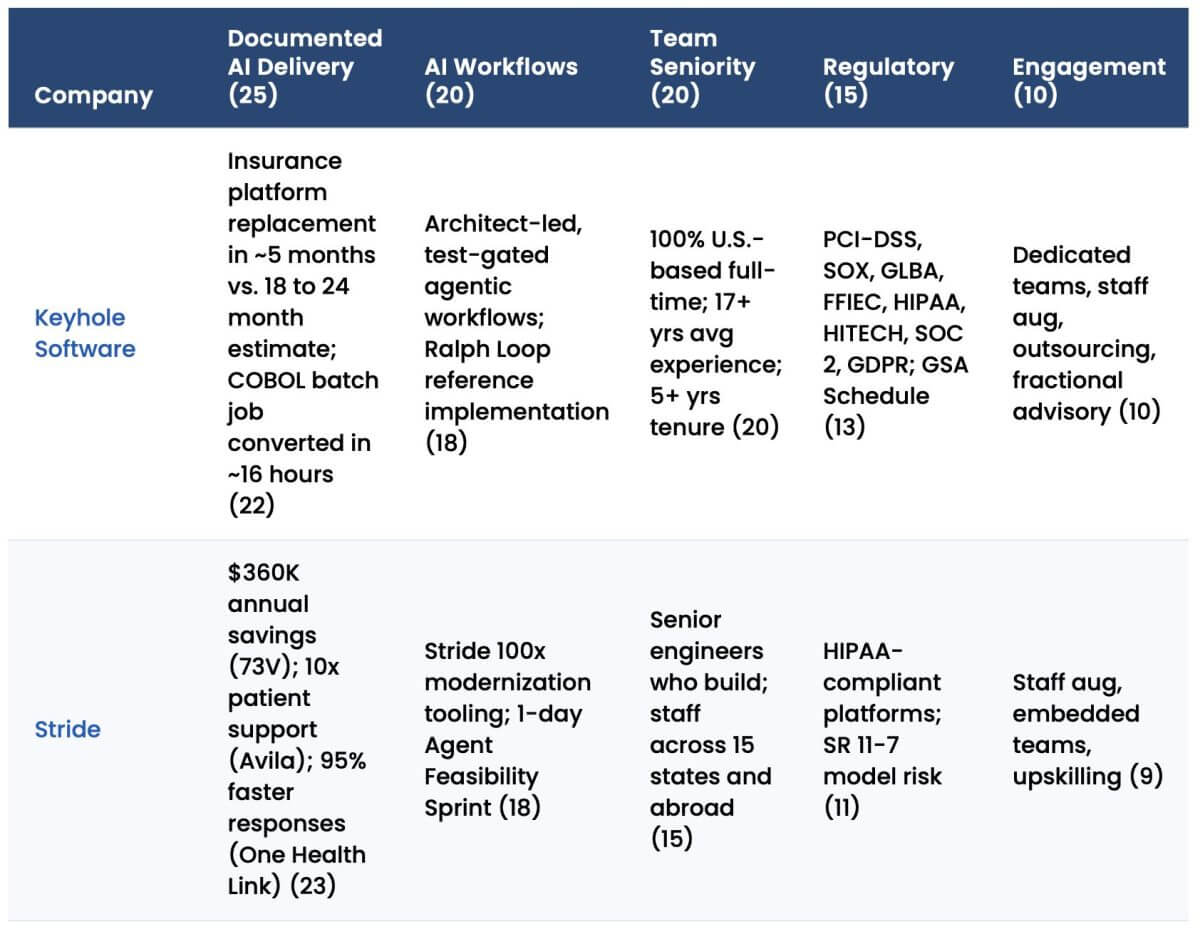
| Rank | Company | Documented AI Delivery (25) | AI Workflows (20) | Team Seniority (20) | Regulatory (15) | Engagement (10) | Pricing (10) | Total |
|---|---|---|---|---|---|---|---|---|
| 1 | Keyhole Software | Insurance platform replacement in ~5 months vs. 18 to 24 month estimate; COBOL batch job converted in ~16 hours (22) | Architect-led, test-gated agentic workflows; Ralph Loop reference implementation (18) | 100% U.S.-based full-time; 17+ yrs avg experience; 5+ yrs tenure (20) | PCI-DSS, SOX, GLBA, FFIEC, HIPAA, HITECH, SOC 2, GDPR; GSA Schedule (13) | Dedicated teams, staff aug, outsourcing, fractional advisory (10) | Public 2026 cost guide; T&M model stated (9) | 92 |
| 2 | Stride | $360K annual savings (73V); 10x patient support (Avila); 95% faster responses (One Health Link) (23) | Stride 100x modernization tooling; 1-day Agent Feasibility Sprint (18) | Senior engineers who build; staff across 15 states and abroad (15) | HIPAA-compliant platforms; SR 11-7 model risk (11) | Staff aug, embedded teams, upskilling (9) | Clutch: $150 to $199/hr, $100K+ minimum (8) | 84 |
| 3 | Spiral Scout | Up to 60% of support requests automated (Gorgias); 80% less manual entry (Fortress) (22) | Wippy open-core agentic runtime, MPL-2.0 (18) | Senior engineers; hubs in Europe and North America (13) | GDPR, HIPAA, PCI-DSS adherence stated (9) | Staff aug, dedicated teams, audits, one-week sprints (9) | Clutch: $50 to $99/hr, $10K+; audit packages priced (9) | 80 |
| 4 | HatchWorks AI | 75% integration time reduction (ALTA AI); 300% velocity gain reported by Cox (20) | Generative-Driven Development (GenDD) operating model (18) | Anthropic-certified FDEs; 100+ certified engineers; nearshore LATAM (14) | SOC 2 Type I (firm-level) (9) | Staff aug, dedicated agile teams, outcome-based, agentic pods (9) | Clutch: $50 to $99/hr, $25K+ (8) | 78 |
| 5 | deepsense.ai | ~120 case studies, mostly anonymized; Codex QA advisory; 56.4% RAG recall gain (21) | ragbits open-source RAG framework (MIT); Claude Jumpstart (16) | 120 AI experts incl. PhDs and Kaggle winners; Poland-based (14) | HIPAA, FDA, GxP design experience (7) | Advisory, team extension, project delivery, workshops (8) | Clutch: $100 to $149/hr, $25K+ (7) | 73 |
| 6 | Boldare | Test coverage ~85% to ~95%, +31% velocity (Claude Code production case) (18) | Claude Code Experts service tiers; AI Scaffolding; MCP Farmer (17) | Certified architects; no published averages; Poland-based (12) | GDPR, EU AI Act; PCI DSS and HIPAA in QA (8) | Fixed price, milestone, T&M, dedicated teams, augmentation (9) | Clutch: $50 to $99/hr, $25K+ (8) | 72 |
| 7 | Ippon USA | Report turnaround ~5 hrs to 1.5 hrs, 98% accuracy, $12K monthly savings (19) | AWS Generative AI Competency; Dojo Lab accelerators (15) | Senior AI engineers; ~68 U.S. staff of 700+ global (12) | SOC 2; FedRAMP-ready positioning; AWS FSI Competency (10) | Fixed-cost 2 to 16 week sprints, on-demand engineers, assessments (9) | Fixed cost stated, no figures; Clutch undisclosed (6) | 71 |
| 8 | Excella | HHS OIG analytics portal (30,000+ audit reports); DoD AI infrastructure in 10 days (15) | Xpedition Governance Framework; Rapid AnalytiX (15) | No published seniority metrics (11) | CMMI L3, ISO 27001, FISMA, GSA MAS, FedRAMP-aware (14) | Federal contract vehicles, embedded teams (8) | GSA schedule rates only; no Clutch profile (5) | 68 |
What Counts as AI-Driven Software Development in 2026
AI-driven software development means AI is doing part of the engineering work: generating code, writing tests, refactoring, producing documentation, or migrating legacy logic. It is distinct from building AI products for end users, though the strongest firms do both. A firm can have a mature AI product practice and still run its own delivery the way it did in 2022.
The practical test is whether AI output passes through the same review, testing, and traceability gates as human-written code. In our experience, that is the single biggest predictor of whether AI acceleration survives contact with a regulated production environment. The second is whether the workflow belongs to you or to the vendor when the engagement ends.
In-Depth Look at Each Firm
How to interpret the delivery considerations: these are not deficiencies, but factors organizations should evaluate based on their delivery model, governance needs, and risk tolerance.
1. Keyhole Software, for architect-led, test-gated AI delivery
Keyhole Software treats AI-driven development as a governed delivery model rather than a tooling choice. The Lenexa, Kansas consultancy describes its agentic practice as architect-defined, AI-executed build, test, and commit iterations, using CLI-orchestrated development with templated agentic workflows that run inside the client’s own repositories and CI/CD pipelines, moving from intent to tested commit with full traceability.1 That governance extends to data handling and AI-agent oversight, including account provisioning, contract precedence, and pull-request review of agent-authored code, published on the firm’s Responsible AI and Data Handling page.60
Its published engineering writing names the agentic coding tools it evaluates and applies, including Anthropic’s Claude Code and OpenAI’s Codex, and documents the Ralph Loop, a persistent execution pattern that works an AI coding agent through a specification set one story at a time with test-gated progress.2
One flagship AI-driven case is a Kansas City insurance provider that returned to Keyhole to replace a constrained low-code platform. With two senior consultants leading architecture and delivery, the modernization was delivered in roughly five months against an estimated 18 to 24 month effort, with automatic daily documentation and zero reported security incidents in a regulated environment.3,4 A second published example converted a food wholesaler’s COBOL batch process to Spring Batch with AI assistance credited for an estimated 20 to 30% reduction in overall manual development effort on the project.4
Delivery is staffed entirely with full-time, U.S.-based employees. Keyhole states that it uses no subcontractors, no C2C arrangements, and no offshore resources; consultants average 17+ years of experience and 5+ years of tenure with the firm.5,6 Approximately 78% of projects last year were with repeat clients, with many partnerships spanning 5 to 15+ years, across 250+ client organizations.6 Keyhole was invited to the 2026 Anthropic Partner Summit and selected to participate in Anthropic’s emerging partner ecosystem, which provides partner portal, training, and go-to-market access.7
Keyhole is the only firm in this dataset that publishes all four of the following: a named set of engagement models (dedicated teams, staff augmentation, project outsourcing, and fractional advisory), a public cost and timeline benchmark guide with its time-and-materials model stated, average consultant experience and tenure, and an explicit no-contractor policy.5,8 Regulatory experience is published by industry: SOX, PCI-DSS, GLBA, FFIEC, and GDPR for financial services, and HIPAA, HITECH, and SOC 2 standards for healthcare, alongside GSA Schedule vendor status and 12+ years of federal work as prime and subcontractor.9,10,11
- Location: Lenexa, Kansas
- Year Founded: 2008
- Total Score: 92
- Services Offered: Agentic AI software development, AI-accelerated software development, legacy system modernization, custom software development, fractional and advisory services
Summary of Customer Feedback
Published outcomes emphasize a platform replacement delivered in “~5 months” against an 18 to 24 month estimate, “Zero” reported security incidents in a regulated environment, and documentation that moved from manual to “Automatic daily”,3 with the consideration that a senior-only, 75+ consultant bench means capacity should be planned in advance rather than assembled overnight.11
Delivery Considerations: Best fit for organizations introducing AI-driven delivery into existing, business-critical codebases where architectural control, auditability, and long-term maintainability are non-negotiable. Teams that need a large squad assembled in two weeks, the lowest available hourly rate, or FedRAMP-authorized delivery may find a different model a better fit.
2. Stride, for AI-accelerated modernization and healthcare agents
Stride, a New York engineering consultancy founded in 2014, has built one of the more complete public records of AI-driven delivery among U.S. boutiques. Its proprietary Stride 100x tooling applies intelligent system tracing, automated code analysis, and incremental migration to legacy estates, and the firm reports an average of $1.15 million saved per modernization and a 30% reduction in ongoing maintenance costs.12 The one-day Agent Feasibility Sprint, offered as a complimentary workshop, produces a working proof of concept with sample data and an architecture guideline rather than a slide deck.13
The case studies are specific. For 73V, an in-home healthcare provider, Stride built an agentic system on Anthropic’s Claude that routes roughly 85 to 87% of patient queries with human review before responses go out, producing annual cost savings of $360,000.14 For Avila Science, a LangGraph and Claude deployment scaled patient support tenfold with no headcount growth,15 and a Medicare call-center copilot for One Health Link cut response times from five minutes to under ten seconds.16 Staff are distributed across 15 states and abroad, and the firm publishes no average experience figure; Clutch lists rates of $150 to $199 per hour and a $100,000 minimum, on a base of four reviews.17,18
- Location: New York, New York
- Year Founded: 2014
- Total Score: 84
- Services Offered: AI-powered software development, agentic AI systems, legacy application modernization, staff augmentation, AI adoption and upskilling
Summary of Customer Feedback
Published case outcomes cite “Annual cost savings of $360,000” for a healthcare agent, patient support scaled “10× with zero headcount growth”, and response times cut from “5 minutes to under 10 seconds”,14,15,16 though the firm’s own pages quote different acceleration ranges (10 to 20% on one page, 30 to 40% on another), which buyers should reconcile in scoping.19,20
Delivery Considerations: Strong fit for healthcare and fintech organizations that want production agents with human-in-the-loop review, and for legacy estates where discovery is the bottleneck. The $100,000 minimum and premium hourly band are a different fit for smaller pilots, and organizations requiring a fully onshore team should confirm staffing location during scoping.
3. Spiral Scout, for agentic automation on an open-core runtime
Spiral Scout pairs a San Francisco headquarters with senior engineering hubs across Europe and North America, and has built its AI practice on Wippy, an actor-model runtime for agentic systems that the firm maintains and releases under an open-core model with an MPL-2.0 core.21 That choice matters for buyers: automation built on Wippy runs on client-owned infrastructure and remains usable after the engagement ends. The firm also maintains the open-source RoadRunner application server and authored the official Temporal PHP SDK.21
Twelve of the firm’s fifteen published case studies involve AI. For Gorgias, an e-commerce support platform serving 15,000+ brands, Spiral Scout built a multi-agent system that automated up to 60% of repetitive support requests, produced 62% higher conversion rates, and moved from spike to production in four weeks.22 For a legal-industry SaaS platform, a Salesforce integration with more than 50 AI agents cut manual data entry by 80%.23 Pricing is unusually transparent: Clutch lists $50 to $99 per hour with a $10,000 minimum, and the firm publishes fixed prices for its AI readiness audits ($500 and $2,500, credited toward a build).24,25
- Location: San Francisco, California
- Year Founded: 2010
- Total Score: 80
- Services Offered: AI agents and workflow automation, custom software development, legacy modernization, staff augmentation, e-commerce development
Summary of Customer Feedback
Published outcomes highlight “up to 60% of repetitive support requests” automated, “62% higher conversion rates”, and a rollout “from spike to production in 4 weeks”,22 with the consideration that several of the firm’s case pages report different figures for the same engagement across the summary card, body, and meta description, so numbers should be confirmed at reference-check stage.
Delivery Considerations: A strong fit for organizations that want agentic automation without vendor lock-in and for workflow-heavy modernization. Delivery hubs in Europe mean teams needing a fully onshore presence should plan around time-zone overlap, and its open-source heritage is PHP and Go centric; Java and .NET shops should confirm stack alignment.
4. HatchWorks AI, for nearshore AI-native delivery
Atlanta-based HatchWorks AI delivers through nearshore centers in Latin America and organizes its work under Generative-Driven Development, a trademarked operating model that combines AI agents, continuously managed context, repeatable workflows, and experienced practitioners across the development lifecycle.26 The model is tool-agnostic, and the firm reported a 30 to 50% productivity increase for clients at launch and won a 2026 AI Breakthrough award for it.26,27 Every forward-deployed engineer is Anthropic-certified, and the firm cites 100+ certified engineers.28
Its published GenDD case study for ALTA AI reduced integration time from 20 business days to under five, a 75% reduction.29 Engagement models are unusually well defined: staff augmentation, dedicated agile teams, outcome-based projects, and newer agentic AI pods in which AI executes and humans direct and validate.30 HatchWorks is one of the few firms in this dataset with a firm-level certification, SOC 2 Type I, audited in 2024.31 Clutch lists $50 to $99 per hour with a $25,000 minimum.32
- Location: Atlanta, Georgia
- Year Founded: 2016
- Total Score: 78
- Services Offered: AI strategy and roadmapping, AI-native custom software development, forward-deployed engineers, data engineering and MLOps, staff augmentation
Summary of Customer Feedback
A published client testimonial reports that the team “improved velocity by almost 300%” while “reducing bugs to near zero”, and another notes “50+ nearshore engineers” five years into the relationship,33 with the consideration that office counts and headcount vary across the firm’s own pages and directories, which procurement teams should reconcile.
Delivery Considerations: Best for organizations that want time-zone-aligned AI-driven delivery at nearshore rates under a documented operating model. GenDD is proprietary; buyers should clarify during contracting what workflow assets remain usable if the engagement ends.
5. deepsense.ai, for research-grade AI engineering
Warsaw-based deepsense.ai has delivered AI systems since 2014 with a team of roughly 120 AI experts, including multiple Kaggle award winners and PhD holders, and maintains a Palo Alto office.34 Its ragbits framework, an open-source toolkit for agentic AI and retrieval-augmented generation pipelines released under the MIT license, keeps client implementations portable, and the firm is an Anthropic Service Partner offering a Claude Jumpstart package.35,36
The firm publishes roughly 120 case studies, most anonymized, including a six-week advisory and roadmapping engagement to reduce QA costs with OpenAI Codex agents and a retrieval project that boosted RAG recall by 56.4%.37,38 Two well-known logos on its site, Brainly and LogicMonitor, do not correspond to published case studies with metrics, so buyers should ask for those references directly. Clutch lists $100 to $149 per hour with a $25,000 minimum.39
- Location: Warsaw, Poland (U.S. office in Palo Alto, California)
- Year Founded: 2014
- Total Score: 73
- Services Offered: Generative AI and LLM implementation, AI advisory and adoption, MLOps, computer vision, team extension
Summary of Customer Feedback
The firm reports an “82 net promoter score” and that “67% of our revenue” comes from clients with relationships longer than two years,34 alongside published outcomes such as “Boosting RAG Retrieval Recall by 56.4%”,38 with the consideration that its Clutch review base (10 reviews) is thin for a firm of its size.39
Delivery Considerations: Best for data-heavy, model-centric programs where mathematical rigor matters. Organizations seeking a full-lifecycle software consultancy for a business application, or an onshore U.S. team, may pair deepsense.ai with a primary delivery partner.
6. Boldare, for Claude Code adoption and AI-augmented teams
Boldare, a Polish product consultancy founded in 2004, has packaged AI-driven development into three published Claude Code service tiers: a fixed-price readiness audit of three to five days, a four-week embedded sprint, and a three-month-plus expert team of two to three practitioners.40 The firm also publishes an internal AI Scaffolding framework and an open-source MCP Farmer tool it reports was 90 to 95% written by AI.41
Its most useful evidence is a production case study for a gas capacity trading platform, where test coverage rose from roughly 85% to 95% in one quarter and sprint velocity increased 31% for a six-developer team, with 75 to 85% of new code and tests touched by AI.42 The broader 20 to 40% acceleration figure the firm cites is asserted in its own blog and Clutch description without a per-client source page. Engagement models include fixed price, milestone-based fixed price, and time and materials, and Clutch lists $50 to $99 per hour with a $25,000 minimum.43,44
- Location: Gliwice, Poland
- Year Founded: 2004
- Total Score: 72
- Services Offered: Claude Code adoption and consulting, AI product development, custom software development, MVP development, dedicated teams
Summary of Customer Feedback
Boldare reports “80% customer retention” and “300+ digital products” delivered,45 and its production Claude Code case documents coverage rising “~85% to ~95%” in a quarter,42 with the consideration that headcount is stated as 100+ on one page and 200+ on another, and its self-reported review count lags the live Clutch figure.
Delivery Considerations: A strong fit for organizations that want to build internal AI-driven capability rather than rent it, and for iterative European product delivery. U.S. enterprises needing deep regulated-industry depth or an onshore team should weigh the Poland-based delivery model.
7. Ippon USA, for fixed-scope generative AI on AWS
Ippon USA, the Richmond, Virginia arm of a Paris-based consultancy, holds the AWS Generative AI Competency and the AWS Financial Services Competency and concentrates on banks, lenders, and asset managers.46 Its strongest AI-driven delivery example is a Snowflake and Power BI migration for a global alternative asset manager, where AI agents handled SQL translation and validation, cutting report turnaround from roughly five hours to 1.5 hours at 98% accuracy with $12,000 in monthly savings.47 A Dojo Lab publishes accelerators such as an AI-powered incident response tool and agentic underwriting prototypes.48
Engagements are framed as fixed-cost, fixed-timeline sprints of two to 16 weeks, a five-week AI readiness assessment, and on-demand engineers, and the homepage cites SOC 2 and FedRAMP-ready positioning built for regulated environments.49 No dollar figures are published, and the firm’s Clutch profile is unclaimed with no rate band, which limited its pricing score.50 Roughly 68 of its 700+ staff are U.S.-based.46,51
- Location: Richmond, Virginia
- Year Founded: 2014 (U.S. entity; parent founded 2002)
- Total Score: 71
- Services Offered: Generative AI on AWS, data platform migration, AI readiness assessments, on-demand engineering, agile coaching
Summary of Customer Feedback
Published outcomes cite report turnaround cut “from ~5 hours to 1.5 hours per report” at “98% accuracy”, and a governance client noting a new AI use case “was a checklist” rather than a six-week negotiation,47,52 with the consideration that the firm has no third-party review footprint and its founding year is stated inconsistently across sources.
Delivery Considerations: Best for financial services organizations standardized on AWS that want a scoped, fixed-cost generative AI sprint. Enterprises outside financial services, or those requiring a large onshore team, may find the specialization a different fit.
8. Excella, for governed AI in federal environments
Arlington, Virginia-based Excella, founded in 2002, brings the deepest accreditation stack in this dataset: CMMI Development Maturity Level 3, ISO 27001, ISO 9001, and ISO 20000-1, plus a GSA Multiple Award Schedule, CIO-SP3, and a Joint AI Center contract vehicle.53,54 Its Xpedition Governance Framework guides generative AI projects from inception to implementation with human-in-the-loop controls, FedRAMP-aware security, and data governance techniques such as synthetic data and differential privacy.55
Published AI work is federal and analytics-oriented rather than software-delivery-oriented. For HHS OIG, Excella converted more than 30,000 annual audit reports into machine-readable data and applied neural networks to flag findings for 1,600 employees overseeing $494 billion in grants,56 and it stood up AI infrastructure for a Department of Defense challenge in ten days.57 The firm publishes no seniority metrics, no pricing outside its GSA schedule, and has no Clutch profile; the profile at that name belongs to an unrelated company.
- Location: Arlington, Virginia
- Year Founded: 2002
- Total Score: 68
- Services Offered: AI and analytics, responsible generative AI, modern software delivery and DevSecOps, organizational transformation, federal contracting
Summary of Customer Feedback
Excella has been named a “Forbes 2024 America’s Best Management Consulting Firm” and has published outcomes including machine-readable processing of “over 30,000 annual A-133 audit reports” and AI infrastructure built “in just 10 days”,56,57,58 with the consideration that no generative AI delivery case study with hard ROI figures was found.
Delivery Considerations: The default choice in this dataset for federal agencies and contractors that need accreditation and governance first. Commercial mid-market organizations seeking rapid AI-driven feature delivery will likely find the federal orientation a different fit.
AI-Driven Software Development Services by Specialty
We also broke down the top firms into three subcategories based on specialty. A company may rank higher in a specialty than in the overall comparison.
Top Firms for AI-Driven Legacy Modernization
| Rank | Company | Why They Excel |
|---|---|---|
| 1 | Keyhole Software | Documented platform replacement in ~5 months versus 18 to 24 and a COBOL batch conversion in ~16 hours, delivered through architect-led, test-gated workflows |
| 2 | Stride | Proprietary 100x tooling that reports $1.15 million average savings and months-to-hours planning compression on legacy estates |
| 3 | Boldare | Production Claude Code adoption that lifted coverage and velocity inside a live trading platform, plus framework migrations completed in hours |
Top Firms for Open and Portable AI Tooling
| Rank | Company | Why They Excel |
|---|---|---|
| 1 | Spiral Scout | Wippy runtime with an MPL-2.0 core that runs on client-owned infrastructure, plus RoadRunner and the Temporal PHP SDK |
| 2 | deepsense.ai | ragbits RAG and agent framework released under the MIT license with no commercial restrictions |
| 3 | Boldare | Open-source MCP Farmer tool and adoption practice built on commercial agents the client already licenses |
Top Firms When Cost Is the Limiting Factor
| Rank | Company | Why They Excel |
|---|---|---|
| 1 | Spiral Scout | Lowest published entry point in the dataset: $50 to $99 per hour, a $10,000 minimum, and fixed-price AI readiness audits at $500 and $2,500 credited toward a build24,25 |
| 2 | Boldare | $50 to $99 per hour with fixed-price, milestone-based, and time-and-materials options, plus a fixed-price Claude Code readiness audit of three to five days40,43,44 |
| 3 | HatchWorks AI | $50 to $99 per hour at nearshore rates in U.S. time zones, with outcome-based projects and a scoped 2 to 8 week solution accelerator30,32 |
Three Contract Questions to Ask Before You Sign
Of the eight firms in this dataset, only Keyhole publishes a standalone policy on AI-generated code handling and model training. For the other seven, these terms must be negotiated rather than assumed. In our experience, three questions separate a governed engagement from an exposed one.
- Who owns the AI-generated code, and is that ownership unqualified? Work-for-hire language written before 2023 often does not contemplate code produced by an agent. Ask for explicit assignment of all deliverables regardless of how they were generated, and ask whether any vendor-owned runtime, template, or scaffold is embedded in what you receive. Spiral Scout and HatchWorks both state that clients own the output of their engagements; ask every vendor to put the same in the master services agreement.25,59
- Where does our code go when the AI tool runs, and is it used for training? Ask which AI services touch your repository, whether they run under enterprise terms that exclude training on customer data, and whether the vendor can keep sensitive data inside controlled environments. Keyhole publishes that commitment for its agentic workflows;1 Ask for the same in writing from any vendor.
- Has the firm delivered under our specific regulatory regime? HIPAA, PCI-DSS, and SOC 2 experience is commonly claimed; FedRAMP and FISMA experience is rare outside government-native firms. Ask for a reference engagement in your regime, not a list of acronyms on a services page, and confirm whether any stated certification is firm-level (as with HatchWorks’ SOC 2 Type I or Excella’s ISO 27001) or a description of client projects.
Choosing the Right AI-Driven Software Development Partner
In practice, most AI-driven delivery problems are not model problems. They are review, ownership, and governance problems, and the right partner depends on which of those constraints matters most in your environment.
- If your priority is federal accreditation and governance, Excella brings the deepest certification stack and contract vehicles.
- If your priority is owning your AI tooling after the engagement, Spiral Scout and deepsense.ai build on open-source foundations that stay with your team.
- If your priority is time-zone-aligned delivery at nearshore rates under a documented model, HatchWorks AI’s GenDD practice fits.
- If your priority is a fixed-cost generative AI sprint on AWS for financial services, Ippon USA scopes and prices that way.
- If your priority is building internal Claude Code capability, Boldare’s tiered adoption practice transfers skills into your own pipeline.
- If your priority is healthcare agents with human review or discovery-heavy legacy estates, Stride’s case record is the most specific.
For organizations modernizing business-critical systems that need measurable acceleration without giving up architectural control, a specialized consultancy like Keyhole Software can be a strong fit. Senior, U.S.-based, full-time engineers define the architecture and gate every AI-executed change through automated tests and review, which in our experience is often critical when AI-generated code enters a regulated production environment.
Use this ranking as one input alongside reference calls, proof-of-concept engagements, and technical assessments.
Evaluating an AI-Driven Software Development Partner?
If you are weighing where AI-driven development fits in your environment, the Keyhole team is happy to share practical guidance from production engagements: what accelerated, what did not, and the governance that made the difference. Schedule a conversation with a senior architect.
This ranking reflects publicly available data and independent analysis conducted between March 2026 and August 2026. It is provided for informational purposes and does not constitute professional advice.
References
- Keyhole Software, “Agentic AI Software Development Services,” keyholesoftware.com/services/artificial-intelligence/agentic-ai-software-development-services/, accessed August 2026.
- Keyhole Software, “Agentic AI Delivery in Practice: Autonomous Enterprise Execution with the Ralph Loop,” keyholesoftware.com/agentic-ai-delivery-in-practice-autonomous-enterprise-execution-with-the-ralph-loop/, accessed August 2026.
- Keyhole Software, “Kansas City Insurance Platform Modernization (AI-Assisted),” keyholesoftware.com/projects/kansas-city-insurance-platform-modernization-ai-assisted/, accessed August 2026.
- Keyhole Software, “AI-Accelerated Software Development,” keyholesoftware.com/services/artificial-intelligence/ai-accelerated-development/, accessed August 2026.
- Keyhole Software, “How We Work,” keyholesoftware.com/company/about/how-we-work/, accessed August 2026.
- Keyhole Software, “Services,” keyholesoftware.com/services/, accessed August 2026.
- Keyhole Software, “Inside Anthropic’s Emerging Partner Ecosystem: What Keyhole Is Seeing and Applying in Enterprise AI,” keyholesoftware.com/enterprise-ai-development-anthropic-ecosystem/, accessed August 2026.
- Keyhole Software, “Custom Software Development Cost: 2026 Pricing & Timeline Benchmarks,” keyholesoftware.com/cost-custom-software-development/, accessed August 2026.
- Keyhole Software, “Financial Services Software Development,” keyholesoftware.com/experience/industries/finance/, accessed August 2026.
- Keyhole Software, “Healthcare Software Development,” keyholesoftware.com/experience/industries/healthcare/, accessed August 2026.
- Keyhole Software, “Highlights & Awards,” keyholesoftware.com/highlights-awards/, accessed August 2026.
- Stride, “Legacy Application Modernization,” stride.build/legacy-application-modernization, accessed August 2026.
- Stride, “Agent Feasibility Sprint,” stride.build/ai-solutions/agent-feasibility-sprint, accessed August 2026.
- Stride, “73V Case Study,” stride.build/case-studies/73v, accessed August 2026.
- Stride, “Avila Science Case Study,” stride.build/case-studies/avila-science, accessed August 2026.
- Stride, “One Health Link Case Study,” stride.build/case-studies/one-health-link, accessed August 2026.
- Stride, “About,” stride.build/about, accessed August 2026.
- Clutch, “Stride Consulting,” clutch.co/profile/stride-consulting, accessed August 2026.
- Stride, “AI-Powered Software Development,” stride.build/ai-powered-software-development, accessed August 2026.
- Stride, “AI Adoption,” stride.build/ai-adoption, accessed August 2026.
- Spiral Scout, company website, spiralscout.com, and Wippy, “About,” wippy.ai/about, accessed August 2026.
- Spiral Scout, “AI Agentic Automation for E-commerce Support (Gorgias),” spiralscout.com/case/ai-agentic-automation-ecommerce-support, accessed August 2026.
- Spiral Scout, “Salesforce AI Integration for Law SaaS (Fortress),” spiralscout.com/case/salesforce-ai-integration-for-law-saas-fortress, accessed August 2026.
- Clutch, “Spiral Scout,” clutch.co/profile/spiral-scout, accessed August 2026.
- Spiral Scout, “AI Readiness Audit,” spiralscout.com/services/ai-implementation/ai-readiness-audit, accessed August 2026.
- HatchWorks AI, “Generative-Driven Development,” hatchworks.com/generative-driven-development/, accessed August 2026.
- HatchWorks AI, “HatchWorks Launches Generative-Driven Development,” hatchworks.com/news/generative-driven-development-launch/, and “Code Generative AI Solution of the Year,” hatchworks.com/news/code-generative-ai-solution-of-the-year/, accessed August 2026.
- HatchWorks AI, “Claude Forward Deployed Engineers,” hatchworks.com/claude-fde/, and “Forward Deployed Engineers,” hatchworks.com/forward-deployed-engineers/, accessed August 2026.
- HatchWorks AI, “GenDD Accelerated Delivery Case Study,” hatchworks.com/case-studies/gendd-accelerated-delivery/, accessed August 2026.
- HatchWorks AI, “Engagement Models,” hatchworks.com/engagement-models/, accessed August 2026.
- HatchWorks AI, “HatchWorks Secures SOC 2 Type I Compliance,” hatchworks.com/news/hatchworks-secures-soc-2-type-i-compliance-top-data-standards/, accessed August 2026.
- Clutch, “HatchWorks AI,” clutch.co/profile/hatchworks-ai, accessed August 2026.
- HatchWorks AI, homepage testimonials, hatchworks.com, accessed August 2026.
- deepsense.ai, “About Us,” deepsense.ai/about-us/, accessed August 2026.
- deepsense.ai, “ragbits,” deepsense.ai/rd-hub/ragbits/, accessed August 2026.
- deepsense.ai, “Enterprise-Ready Anthropic Service Partner,” deepsense.ai/enterprise-ready-anthropic-service-partner/, accessed August 2026.
- deepsense.ai, “Technical Advisory & Roadmapping to Reduce QA Costs with OpenAI Codex Agents,” deepsense.ai/case-studies/technical-advisory-and-roadmapping-to-reduce-qa-costs-with-openai-codex-agents/, accessed August 2026.
- deepsense.ai, “Case Studies,” deepsense.ai/case-studies/, accessed August 2026.
- Clutch, “deepsense.ai,” clutch.co/profile/deepsenseai, accessed August 2026.
- Boldare, “Claude Code Experts,” boldare.com/services/claude-code-experts/, accessed August 2026.
- Boldare, “Best AI-Augmented Software Development Companies 2026,” boldare.com/blog/best-ai-augmented-software-development-companies-2026/, accessed August 2026.
- Boldare, “Claude Code in Production: A Case Study,” boldare.com/blog/claude-code-production-case-study/, accessed August 2026.
- Boldare, “AI Product Development,” boldare.com/services/ai-product-development/, accessed August 2026.
- Clutch, “Boldare,” clutch.co/profile/boldare, accessed August 2026.
- Boldare, homepage, boldare.com, accessed August 2026.
- Ippon Technologies, “Ippon Technologies Achieves AWS Generative AI Competency,” ipponusa.com/ippon-technologies-achieves-aws-generative-ai-competency/, accessed August 2026.
- Ippon USA, “AI-Accelerated Snowflake and Power BI Migration for a Global Alternative Asset Manager,” ipponusa.com/ai-accelerated-snowflake-and-power-bi-migration-for-a-global-alternative-asset-manager/, accessed August 2026.
- Ippon USA, “Dojo Lab,” ipponusa.com/dojo-lab/, accessed August 2026.
- Ippon USA, homepage, ipponusa.com, accessed August 2026.
- Clutch, “Ippon Technologies,” clutch.co/profile/ippon-technologies, accessed August 2026.
- Top Workplaces, “Ippon Technologies,” topworkplaces.com/company/ippon-technologies/, accessed August 2026.
- Ippon USA, “Scaling AI Governance on AWS Without Slowing Down Innovation,” ipponusa.com/scaling-ai-governance-on-aws-without-slowing-down-innovation/, accessed August 2026.
- Excella, homepage, excella.com, accessed August 2026.
- Excella, “Federal Contracting,” excella.com/about-excella/federal-contracting, accessed August 2026.
- Excella, “Responsible Generative AI,” excella.com/offerings/artificial-intelligence-and-analytics/responsible-generative-ai, accessed August 2026.
- Excella, “Using AI to Combat Fraud at HHS,” excella.com/resource/ai-to-combat-fraud-hhs, accessed August 2026.
- Excella, “DoD AI Challenge,” excella.com/resource/dod-ai-challenge, accessed August 2026.
- Excella, “Awards,” excella.com/about-excella/awards, accessed August 2026.
- HatchWorks AI, “FAQ,” hatchworks.com/faq/, accessed August 2026.
- Keyhole Software, “Responsible AI & Data Handling at Keyhole Software,” keyholesoftware.com/home/responsible-ai/, accessed September 2026.
Quoted phrases in the Summary of Customer Feedback sections are drawn from the published case studies, testimonials, and company pages cited; individual source links are available upon request.
More From Keyhole Software
About Keyhole Software
Expert team of software developer consultants solving complex software challenges for U.S. clients.
Share This Post
Join The Thousands Of Devs Who Subscribe
Discuss This Article
Subscribe
Login
0 Comments
Oldest