
Top Agentic AI Software Development Services (2026)
Between April 2026 and September 2026, our research team reviewed 39 firms that market agentic AI software development services, then scored the eight strongest against a consistent framework. The analysis draws on each firm’s service pages, published case studies, compliance disclosures, partner announcements, published pricing, and stated staffing practices, to compare how these firms actually deliver agentic systems rather than how they describe them.
The phrase agentic AI software development services now covers two different kinds of work, and buyers conflate them at their own risk.
- The first is building agents: software that reads context, decides on an action, and carries it out inside a business workflow, whether that is triaging underwriting submissions or answering citizen calls.
- The second is agentic delivery: using coding agents to plan, write, test, and document software inside an existing repository.
In our experience, both share one failure mode. An agent that works in a demo and an agent that works in production are separated not by the model but by the engineering around it: the approval gates, the tests, the traceability, and the people accountable for all three. This ranking scores both kinds of work on that engineering.
This comparison is scoped deliberately and is written for organizations that need agents integrated into systems they already run, in industries where an unreviewed action has consequences. Firms that excel at greenfield consumer chatbots or pure data-science modeling serve segments this framework does not measure, and several strong firms in those segments are absent here for that reason.
How We Evaluated Agentic AI Software Development Firms
We scored each firm against six weighted factors totaling 100 points. Every factor is scored on published evidence, meaning something a buyer can read for themselves: a case study with a named client, a certification stated on the record, a documented approval gate, a published rate band. We excluded aggregated star ratings from the framework. Review volume in this category is thin and uneven, two firms in this set have no rated profile at all, and most reviews that do exist predate the firms’ agentic offerings entirely. Scoring what firms publish about how they build and govern agents produces a more useful comparison than scoring what a handful of reviewers posted about unrelated work.
The weighting reflects the scope above. Guardrails and reliability engineering carry more weight than technical breadth because, in our experience, agentic programs rarely fail for lack of a framework. They fail because nobody defined what the agent was not allowed to do, or because a change reached production with no test and no human who could explain it. Team seniority is weighted because agent-generated output amplifies whatever review capacity exists; a senior reviewer catches an architectural drift that a junior one commits.
- Proven Production Deployments (25%): published case studies showing agentic or AI-accelerated systems running in production with a named client or a measurable outcome, rather than prototypes, gated summaries, or internal demonstrations. Weighted toward specificity about what was deployed, for whom, and what changed.
- Enterprise Readiness: Security and Compliance (15%): certifications the firm itself holds (SOC 2, ISO 27001, ISO 42001, CMMI), documented data handling such as deployment inside client-controlled infrastructure, and formal partner tiers with the platforms the agents run on.
- Guardrails and Reliability Engineering (20%): documented human approval gates, test-gated execution, evaluation harnesses, observability, fallback paths, and traceability from every agent action back to intent and commit history. Firms that publish a specific mechanism score higher than firms that publish a principle.
- Integration and Technical Depth (15%): named languages, clouds, agent frameworks, and protocols such as MCP, plus evidence of integrating agents with enterprise and legacy systems rather than standing them up beside them.
- Team Seniority (15%): published average experience, tenure, employment model (full-time employees versus contractors or subcontracted delivery), and U.S.-based versus nearshore versus offshore composition. Firms that publish nothing about who does the work score lower, because that opacity is itself a procurement risk.
- Engagement Models (10%): named engagement structures, published pricing or rate bands, minimum project sizes, and any public cost guidance. Firms that publish how they engage and how they price score higher than firms that disclose neither.
Editorial Process and Independence
This ranking was compiled using publicly available information, published client feedback, verified project case studies, and each firm’s own disclosures. The evaluation framework was defined before scoring and applied consistently to every company in the dataset.
Keyhole Software publishes this analysis and is included among the evaluated firms. All companies, including Keyhole, were scored using the same criteria and the same public 2026 data. No company paid for placement or ranking position, and rankings reflect only the defined criteria.
A Note on Limitations: This ranking is based on public information and may not capture private, non-disclosed engagements, internal tooling built under confidentiality, or delivery metrics firms choose not to publish. Because the framework rewards published evidence, it necessarily rewards firms that disclose. A firm that does excellent work quietly will score lower here than one that documents comparable work openly, and buyers should treat a low score on team composition or guardrails as a prompt to ask the firm directly rather than as a finding about capability. Case-study figures are self-reported by each firm unless otherwise noted. Agentic tooling is changing month to month, and a firm’s public positioning may lag its actual practice. This is one input among many that organizations should use when evaluating potential development partners.
Top Agentic AI Software Development Services (2026)
In the table below, we break down how the highest-scoring firms performed against the weighted framework described above. Scores reflect documented public evidence as of September 2026.
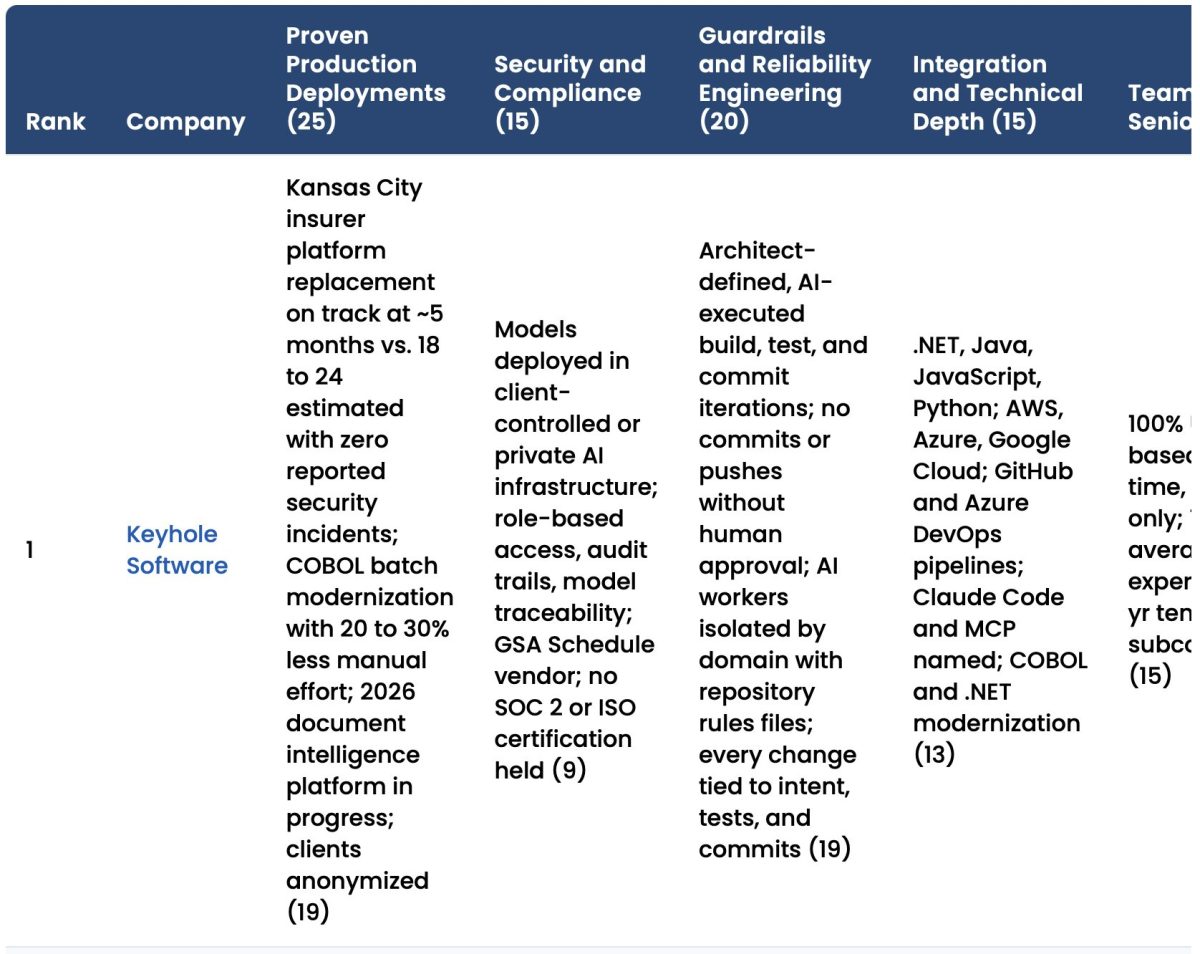
| Rank | Company | Proven Production Deployments (25) | Security and Compliance (15) | Guardrails and Reliability Engineering (20) | Integration and Technical Depth (15) | Team Seniority (15) | Engagement Models (10) | Total |
|---|---|---|---|---|---|---|---|---|
| 1 | Keyhole Software | Kansas City insurer platform replacement on track at ~5 months vs. 18 to 24 estimated with zero reported security incidents; COBOL batch modernization with 20 to 30% less manual effort; 2026 document intelligence platform in progress; clients anonymized (19) | Models deployed in client-controlled or private AI infrastructure; role-based access, audit trails, model traceability; GSA Schedule vendor; no SOC 2 or ISO certification held (9) | Architect-defined, AI-executed build, test, and commit iterations; no commits or pushes without human approval; AI workers isolated by domain with repository rules files; every change tied to intent, tests, and commits (19) | .NET, Java, JavaScript, Python; AWS, Azure, Google Cloud; GitHub and Azure DevOps pipelines; Claude Code and MCP named; COBOL and .NET modernization (13) | 100% U.S.-based, full-time, senior-only; 17+ yr average experience; 5+ yr tenure; no subcontractors (15) | Four named engagement models; public cost guide; time-and-materials stated; no rate card (9) | 84 |
| 2 | Provectus | Convex underwriting agents in production on client AWS (100x more risk reports triaged); Citation compliance agents in production; Mad Mobile 91% accuracy at prototype stage (22) | ISO 27001, SOC 2; AWS Premier Tier; Anthropic Select partner, inaugural cohort (14) | Every agent decision reviewable; kill-switch and override logging on every workflow; provenance on every action; LLM-as-judge evaluations; enterprise guardrails track (16) | Amazon Bedrock, Claude models, Claude Code, Salesforce; spec-driven AWOS framework; languages and MCP not named (11) | Half the team senior or above; 80+ Claude Certified Architects; delivery hubs in Europe, Latin America, Canada; tenure and employment model not published (8) | Sprint (fixed fee), Enable (milestone), Realize (outcome-priced); $50 to $99/hr; $25K+ minimum (9) | 80 |
| 3 | Azumo | Angle Health RFP-to-quote automation in production (90% cycle time reduction, humans verify quotes); Meta supplier search (40%+ precision gain); own AI receptionist since early 2026 (19) | SOC 2 Type I (2023); no ISO; no formal partner tiers; 20%+ of team Claude Certified Architects (8) | Configurable autonomy levels with human-in-the-loop above thresholds; supervisor-agent patterns; observability, guardrails, and fallback paths in every deployment; LLM evaluation practice; daily code audits (17) | LangGraph, CrewAI, AutoGen; Bedrock, Azure OpenAI, Vertex AI; custom MCP servers to CRMs, ERPs, and databases; no legacy modernization evidence (12) | Senior by default, tested before placement; Latin American delivery; average experience and tenure not published; 3.2+ yr typical customer life (7) | Staff augmentation, dedicated team, project delivery, embedded AI pod, fixed price, virtual CTO; $25 to $49/hr; $10K+ minimum (9) | 72 |
| 4 | DataArt | Four-agent SDLC for an unnamed insurer (74% faster delivery); Care Management Platform chatbot (30% faster queries); Fiberplane ($60K annual savings); named agent-in-production case not published (18) | HIPAA, GDPR, ISO 27001 adherence stated, certifications not itemized; AWS Premier, GCP Premier, Microsoft Solutions Partner; Anthropic Select partner (11) | Artisyn platform: role-based agents within policy guardrails with human oversight at every critical decision point; access control, audit logging, escalation thresholds; red-teaming and LLMOps drift monitoring (15) | Claude, OpenAI, Azure OpenAI, Gemini, Bedrock, Amazon Q; AWS Strands and AgentCore; Azure AI Foundry accelerator; .NET modernization; MCP not named (13) | 6,000+ staff; 80% senior or mid-level; 87% retention; offshore R&D centers; average experience not published (8) | No named engagement models; $50 to $99/hr; $100K+ minimum (4) | 69 |
| 5 | Sparq | Mortgage document validation in production for an unnamed financial institution (99% cost and time reduction); fleet resale decisioning ($90M margin, classic ML); Cerbo modernization projected, not complete (17) | SOC 2 (A-LIGN); AWS Advanced Services Partner; Snowflake Elite; no Anthropic tier despite Claude-centered offering (10) | The Shop stress-tests agentic workflows under production load before release; failure modes mapped across latency, exceptions, execution, accountability; exceptions routed to humans with reasoning (16) | Claude Agent SDK, Claude Code, MCP servers, Playwright, Docker, PHP, Azure AI Vision, Snowflake; embedded into existing systems (12) | Senior U.S. leaders; 800+ engineers, largely nearshore after 2024 Octobot acquisition; no experience or tenure figures (6) | No named engagement models; $50 to $99/hr; $50K+ minimum (5) | 66 |
| 6 | Quantiphi | State of Utah Treasurer virtual agent live on Amazon Connect and Claude Sonnet 4.5 (20% call reduction at launch); insurer SAS-to-PySpark migration (3x faster); Riva Engine outcomes projected (19) | Certifications attach to baioniq product (SOC 2, HIPAA, ISO 27001, 27701, 9001), not stated firm-wide; AWS Premier; Google Cloud Diamond; NVIDIA Elite (13) | Five-point playbook: governance first, phased L1 to L5 autonomy rollout; no published approval gates, evaluation, or observability mechanism (10) | Bedrock, Lex, Connect, EKS; NVIDIA NIM and NeMo; Google Cloud; Snowflake; Salesforce; SAS and PySpark; MCP not named (13) | No experience, tenure, or employment model published; U.S., Canada, and India delivery (4) | No named models; rates and minimums undisclosed (2) | 61 |
| 7 | Tribe AI | MyFitnessPal Voice Log in production with Claude on Bedrock (no outcome metric); vendor classification engine for an unnamed consultancy (97% accuracy, 9 to 12 days to 45 minutes); Follett prototype (17) | SOC 2 Type II; Microsoft SSPA; Anthropic, OpenAI, Google, AWS listed as partners without tiers (10) | Confidence scoring and thresholding for human review; feedback loops; evaluations and controls described, no published methodology page (11) | Python, FastAPI, Django, React; Bedrock, Azure OpenAI, Gemini; LangGraph; MSSQL integration; no MCP or legacy evidence (10) | Full-time, U.S.-only roles; 5+ yr minimum posted; earlier 500-engineer network model; averages not published (8) | Map, Build, Activate; no pricing; no Clutch profile (4) | 60 |
| 8 | Kanerika | All AI case studies anonymized; ERP provider CRM assistant (22% KPI accuracy gain); investment bank retrieval (43% faster); production status not stated (14) | ISO 27001, SOC 2 Type II, CMMI Level 3; Microsoft Solutions Partner for Data and AI; OpenAI Select; Anthropic partner (14) | Governed from day one: access controls, audit trails, explainability; agents tested in controlled environments before rollout; limited human-in-the-loop detail (11) | Azure AI, Copilot Studio, Microsoft Fabric, Databricks, Snowflake, AWS; SAP data integration; agent frameworks and MCP not named (10) | No experience, tenure, or employment model published; India delivery with U.S. front office (4) | Four-phase delivery model; $100 to $149/hr; $10K+ minimum (5) | 58 |
Scores are assigned on the weighted framework described above and reflect publicly available information as of September 2026. Keyhole and Provectus finish four points apart and separate on different factors: Provectus has the deeper library of named agent deployments and holds the certifications Keyhole does not, while Keyhole is the only firm in the set that publishes the mechanics of its approval gates alongside average consultant experience, tenure, and employment model.
1. Keyhole Software, best for architect-led agentic delivery inside governed enterprise codebases
Keyhole Software is a custom software consultancy founded in 2008 and headquartered in Lenexa, Kansas, with consultants working remotely across the United States4. Its agentic AI practice is built around a specific claim about how agents should enter a software organization: inside the software development lifecycle, under the direction of senior engineers and architectural guardrails, rather than beside it1. Senior engineers define domain boundaries, integration patterns, security controls, and repository guardrails before AI is applied. Agents then execute build, test, and commit iterations inside the client’s own governed repositories and CI/CD pipelines, with every generated change tied to intent, tests, and commits1. Keyhole describes this as architect-defined, AI-executed delivery, and it applies the same approach whether the work is a new agentic system, a RAG platform, or a modernization program that uses agentic tools like Claude and Codex to accelerate execution6.
The firm’s most detailed published evidence is an AI-assisted platform replacement for a Kansas City insurer. Two Keyhole consultants working alongside nine client team members are replacing the full platform, including UI, services, database, and administrative tooling, on track for roughly five months against an 18 to 24 month estimate that assumed 26 or more developers3. The case study documents the mechanics rather than just the result: parallel AI workers isolated by domain (database, authentication, services, UI), repository safety guardrails enforced through rules files, security validation before schema changes, continuous compile-and-test validation after each phase, and no commits or pushes without human approval3. The agentic services page adds that the engagement ran with zero reported security incidents in a regulated environment1. Other documented work includes a COBOL batch modernization to Spring Batch that reduced manual effort by 20 to 30 percent6 and a 2026 document intelligence and regulatory compliance platform built by a four-person team on .NET, React, Azure, and RAG2.
Where Keyhole separates from the field is disclosure about who does the work and how the guardrails operate. Every consultant is a full-time, U.S.-based employee rather than a subcontractor or offshore resource; consultants average 17 or more years of experience and 5 or more years of tenure, and 78 percent of project work last year came from repeat clients, with the average client relationship exceeding four years4,8. Models are deployed in client-controlled or private AI infrastructure, and the AI service pages describe role-based access controls, audit trails, model traceability, and compliance-ready documentation as design requirements1,2. Keyhole was invited to the 2026 Anthropic Partner Summit and selected to participate in Anthropic’s emerging partner ecosystem6, is a GSA Schedule vendor5, and publishes a cost guide stating that it operates primarily on a time-and-materials model for architecture-heavy work, although it does not publish a rate card7.
Two gaps matter for procurement. Keyhole holds no SOC 2 or ISO certification of its own, so organizations that require a vendor attestation rather than architecture-level controls will need to address that contractually2. And its published case studies name industries rather than clients and describe delivery approach rather than quantified business outcomes, which is a materially different evidence base from the named-client agent deployments others publish.
- Location: Lenexa, Kansas (teams in St. Louis, Denver, and Dallas; consultants nationwide)
- Year Founded: 2008
- Total Score: 84
- Delivery Model: 100% U.S.-based, senior-only, full-time employees; no subcontractors or offshore resources
- Team Composition: Consultants average 17+ years of experience and 5+ years of tenure; 75+ full-time consultants
- Agentic Focus: Architect-led agentic software delivery inside client repositories, agentic and RAG system development, AI-accelerated legacy modernization
Summary of Customer Feedback
Named clients describe a team that “integrated seamlessly with our existing team,” that “listened to our requirements,” and whose members were “instrumental” in a major product release8. None of Keyhole’s published testimonials are specific to an agentic engagement, and its agentic case studies describe architecture and delivery mechanics rather than quantified business outcomes.
Delivery Considerations: Keyhole fits mid-size to enterprise organizations that want agents working inside codebases and workflows they already run, in environments where every change must be reviewable, testable, and attributable to a named senior engineer. The onshore, senior-only model carries higher rates than nearshore or offshore alternatives, and the firm’s compact size means large multi-team programs require advance planning. Teams that want a vendor-held SOC 2 report, a packaged agent platform, or a low-cost pilot to test feasibility may find a different model a better fit.
2. Provectus, best for Claude-centered agentic programs with named production agent case studies
Provectus is an AI engineering firm founded in 2010 and headquartered in San Francisco, with more than 400 staff across engineering hubs in Canada, Europe, Latin America, and Armenia9. It packages agentic work as fixed-scope programs rather than open-ended services. Its Agentic SDLC program runs five stackable two-week tracks on the client’s own codebase, pairing client engineers with Provectus forward-deployed engineers on spec-driven development, on the principle that agents need specs, not prompts; the fourth track is devoted to enterprise-grade guardrails, permissions, and audit controls for agentic development9. Its Blueprint Activation program states the governance position plainly: every agent decision is reviewable, every action is logged with provenance, and kill-switch and override logging run on every workflow9. Provectus holds ISO 27001 and SOC 2, is an AWS Premier Tier partner with a Strategic Collaboration Agreement, and was named to the inaugural cohort of Anthropic’s Select partner level in June 20269.
Its published agent deployments are the most specific in this set. For Convex, a specialty insurer, Provectus built underwriting triage agents that run in production on the client’s AWS account using Claude models on Amazon Bedrock, with LLM-as-judge evaluations and every generated claim traced to a source region of the document; the case study reports 100 times more risk reports triaged and a 100-page risk report summarized in ten minutes9. For Citation, a UK compliance firm, agents handling repetitive certification checks are in production across two assessment workflows, with assessors retaining judgment9. A customer service agent for Mad Mobile reached 91 percent response accuracy but is described at prototype stage9. The tradeoffs are staffing disclosure and delivery footprint: Provectus states that half its team is senior or above and counts 80 or more Claude Certified Architects, but publishes no average experience, tenure, or employment model, and its engineering hubs are entirely outside the United States9. Its Clutch profile appears to be a legacy mobile-studio listing, so its 4.9 rating should be read with caution9.
- Location: San Francisco, California; engineering hubs in Vancouver, Toronto, London, Warsaw, Kyiv, Novi Sad, Yerevan, San Jose (Costa Rica), Bogota, and Medellin
- Year Founded: 2010
- Total Score: 80
- Delivery Model: 400+ staff; forward-deployed engineers paired with client teams; offshore and nearshore engineering hubs
- Team Composition: Half the team senior or above; 80+ Claude Certified Architects; average experience and tenure not published
- Agentic Focus: Agentic SDLC programs with Claude Code, production agents on Amazon Bedrock, spec-driven development, legacy modernization
Summary of Customer Feedback
Clutch reviewers call Provectus “by far one of my best experiences with an offshore company,” describe the team as “very professional and easy to work with,” and say “the team is excellent”9. Some reviewers report resource availability challenges during high-demand periods and room to improve cost estimation, and the reviews predate the firm’s agentic programs.
Delivery Considerations: Provectus is a strong match for organizations standardizing on AWS and Claude that want a defined, fixed-price path from agent pilot to production, backed by named case studies and vendor-held certifications. Organizations that require U.S.-based engineering, want to know the experience level of each engineer assigned, or prefer time-and-materials flexibility over milestone pricing should confirm those points during scoping.
3. Azumo, best for nearshore agentic AI pods with published guardrail and fallback design
Azumo is a San Francisco-headquartered nearshore software firm founded in 2016 with engineers across Latin America10. Its AI agent development page is unusually explicit about operating design. Agents are built with configurable autonomy levels: fully autonomous for low-risk tasks, human-in-the-loop above defined thresholds, and supervisor-agent patterns for complex processes. Every deployment includes observability (what the agent is doing and why), guardrails (what it cannot do), and fallback paths (what happens when it fails)10. The firm builds custom Model Context Protocol servers to give Claude governed access to CRMs, ERPs, databases, and internal APIs, runs an LLM evaluation practice that benchmarks models against client data on accuracy, latency, and cost, and reports that more than 20 percent of its team are Certified Claude Architects10.
Its named outcomes are concrete. For Angle Health, an LLM system automating RFP-to-quote generation cut cycle time by 90 percent, from 45 minutes to 5 minutes per RFP, with humans verifying generated quotes before underwriting10. For Meta, a generative semantic supplier search across 3.5 million records improved search precision by more than 40 percent10. The firm’s most detailed agent metrics, including a 1.7-second median response time and zero downtime events, come from its own AI receptionist rather than a client deployment10. Azumo’s compliance posture is a SOC 2 Type I from 2023 with no Type II or ISO certification published, it claims no formal cloud or model partner tiers, and Clutch lists it at $25 to $49 per hour with a $10,000 minimum, the lowest published band in this set10. It states that it hires senior by default and tests for it, but publishes no average experience or tenure10.
- Location: San Francisco, California; delivery across Latin America (Argentina, Colombia, Mexico, Brazil, Costa Rica, and others)
- Year Founded: 2016
- Total Score: 72
- Delivery Model: Nearshore Latin American engineers; embedded AI pods and forward-deployed AI engineers
- Team Composition: Senior by default; 20%+ Certified Claude Architects; average experience and tenure not published; 3.2+ year typical customer life
- Agentic Focus: Custom AI agents with configurable autonomy, MCP server development, Claude and multi-model applications, LLM evaluation
Summary of Customer Feedback
Clutch reviewers say they have been “wildly impressed with them,” that the team “delivers quality, on time, with a smile,” and that “the entire team is there to support us”10. Some reviewers note turnover on the team mid-project and advise the firm to keep bringing on new talent.
Delivery Considerations: Azumo fits organizations that want a cost-efficient, embedded agent team with clearly stated autonomy and fallback design, particularly for customer-facing and back-office workflows. Organizations that require U.S.-based staffing, a current SOC 2 Type II, or agents integrated into legacy mainframe or .NET estates should confirm capability, since the firm publishes no modernization evidence.
4. DataArt, best for governed agentic software delivery at global enterprise scale
DataArt is a New York-founded engineering firm dating to 1997 with more than 6,000 staff across 20 or more countries and research and development centers concentrated in Eastern Europe, Latin America, and Asia11. Its agentic positioning runs through Artisyn, an AI-enabled delivery platform in which role-based AI agents operate within policy guardrails that support human oversight at every critical decision point across the SDLC, with security, compliance, observability, and auditability embedded from day one11. An Azure agentic accelerator built on Azure AI Foundry adds audit trails, role-based access controls, content safety measures, and a runtime-agnostic architecture supporting multiple agent frameworks11. The firm’s guidance on scaling agents to production describes red-teaming beyond standard software testing and runtime human-in-the-loop controls on actions that carry meaningful risk11.
Its strongest agentic case is anonymous: a four-agent delivery team (business analysis, design, QA, deployment) built on AWS Strands with Amazon Q and Claude Sonnet for an unnamed insurer cut delivery time by 74 percent, from seven weeks to ten days, with humans reviewing and approving outputs11. Named GenAI outcomes include a 30 percent reduction in query processing time for a care management platform and $60,000 in annual savings for Fiberplane, though production status is not stated11. DataArt is an AWS Premier Tier and Google Cloud Premier partner and joined Anthropic’s Claude Partner Network as a Select partner in June 202611. It states adherence to HIPAA, GDPR, and ISO 27001 but does not itemize certifications it holds, publishes that 80 percent of its staff are senior or mid-level with 87 percent retention, names no engagement models, and carries a $100,000 minimum on Clutch11.
- Location: New York, New York; offices in London, Munich, Zug, and Dubai; R&D centers across Eastern Europe, Latin America, and Asia
- Year Founded: 1997
- Total Score: 69
- Delivery Model: 6,000+ staff; integrated global delivery; offshore and nearshore engineering
- Team Composition: 80% senior or mid-level; 87% employee retention; average experience and tenure not published
- Agentic Focus: Artisyn agentic delivery platform, Azure agentic accelerator, AWS agent builds on Strands and AgentCore, AI-accelerated .NET modernization
Summary of Customer Feedback
Clutch reviewers say that with DataArt “we always have guaranteed quality,” that the team will “solve problems in challenging times,” and praise its “ability to support a company through its lifecycle journey”11. Some reviewers describe pricing as higher than competitors and note difficulty sourcing specialized skills in certain technologies.
Delivery Considerations: DataArt suits large enterprises that want agentic delivery governance applied across multi-team programs with hyperscaler partner depth on all three major clouds. Mid-market buyers with narrower scope, or those who need a named agent-in-production reference, an itemized certification list, or U.S.-based delivery, should weigh the $100,000 minimum and the anonymized evidence base during evaluation.
5. Sparq, best for stress-tested agentic workflows on a blended onshore and nearshore model
Sparq is an Atlanta-headquartered digital engineering firm, formerly Rural Sourcing, with more than 800 engineers and a blended onshore and nearshore delivery model following its 2024 acquisition of Montevideo-based Octobot12. Its enterprise AI and agentic offering is built around Claude: Claude for Enterprise rollout and governance, Claude Code adoption across engineering organizations, MCP servers wired into the systems where client data already lives, and production agents built with the Claude Agent SDK12. The distinctive mechanism is The Shop, which stress-tests AI and agentic workflows under production load before they touch client systems, maps failure across latency, exceptions, execution, and accountability, and certifies only workflows that meet performance thresholds for production12. Its Verify.IQ pattern surfaces exceptions with reasoning and routes them to humans with context intact12.
Published results are strong but mostly anonymized. A mortgage document validation deployment for an unnamed financial institution cut validation time and cost by 99 percent, to eight seconds and two cents per document, with specialists remaining in the workflow for exceptions12. A fleet resale decisioning engine for an unnamed car rental company automates 1.2 million resale decisions annually and reports a $90 million annual gross margin increase, though no LLM is named and it reads as classic machine learning12. The one named case, an AI-accelerated modernization for Cerbo using Claude Code, is projected to complete by the end of 2026 rather than finished12. Sparq holds SOC 2 and is an AWS Advanced Services Partner and Snowflake Elite partner, but lists no Anthropic partnership despite its Claude-centered positioning, names no engagement models, and publishes no consultant experience or tenure figures12.
- Location: Atlanta, Georgia; nearshore delivery in Uruguay, Argentina, and Colombia
- Year Founded: 2004 (per company press releases; Clutch lists 2009)
- Total Score: 66
- Delivery Model: 800+ engineers; senior U.S. leaders with nearshore engineering scale
- Team Composition: Average experience, tenure, and employment model not published
- Agentic Focus: Claude Agent SDK production agents, MCP server integration, Claude Code adoption, pre-production stress testing, AI-accelerated modernization
Summary of Customer Feedback
Clutch reviewers report “great communication with them,” say “the constant feedback cycles were great,” and describe the experience as “like managing the already self-managed”12. Some reviewers wanted better project visibility and tracking of estimates against actuals, and the most recent reviews date to early 2024, before the firm’s agentic offerings existed.
Delivery Considerations: Sparq fits organizations adopting Claude across an engineering organization that want agentic workflows load-tested before release and a nearshore cost profile with U.S. leadership. Buyers requiring named agent references, a formal Anthropic partner tier, or disclosure of who specifically will staff the work should confirm those points, since the firm’s public evidence is anonymized and its staffing model is not published.
6. Quantiphi, best for hyperscaler-partnered agents in contact center and public sector settings
Quantiphi is an AI-first engineering firm founded in 2013 with U.S. offices in Marlborough, Massachusetts, Princeton, and San Jose, and delivery centers in Canada and India13. Its agentic AI page organizes adoption around a five-point playbook for a hybrid human and AI workforce: start with governance rather than technology, build a centralized agent-ready platform, roll out in phases from copilots to full automation, master total cost of ownership, and run a parallel talent and change program13. Its baioniq platform deploys inside the client’s cloud tenant and carries SOC 2, HIPAA, ISO 27001, ISO 27701, and ISO 9001 certifications, although those certifications are stated for the product rather than the consultancy13. Partner depth is the firm’s clearest differentiator: AWS Premier Tier Services Partner, Google Cloud Diamond partner and 2026 Partner of the Year in four categories, and NVIDIA Elite partner13.
Its best-documented deployment is public sector. For the State of Utah Office of the Treasurer, Quantiphi built a generative AI virtual agent on Amazon Connect, Amazon Bedrock, and Claude Sonnet 4.5 that produced an immediate 20 percent reduction in agent call volume at launch13. A generative AI-assisted migration of SAS actuarial models to PySpark for an unnamed insurer reports a threefold reduction in migration timelines13, and a Salesforce email-generation deployment for Riva Engine reports outcomes worded as projections rather than measured results13. What Quantiphi does not publish is anything about approval gates, evaluation, or observability for agents in production, any engagement model, any rate or minimum, or any figure on consultant experience or tenure, and its Clutch profile is unreviewed13.
- Location: Marlborough, Massachusetts; Princeton, New Jersey; San Jose, California; Toronto and Fredericton, Canada; Mumbai, Bengaluru, and Trivandrum, India
- Year Founded: 2013
- Total Score: 61
- Delivery Model: Global delivery across U.S., Canada, and India; headcount not published on company site
- Team Composition: Average experience, tenure, and employment model not published
- Agentic Focus: baioniq enterprise agentic platform, contact center virtual agents, generative AI-assisted code migration, hyperscaler and NVIDIA partnerships
Summary of Customer Feedback
Named clients say the team “was always very responsive & very prompt,” credit Quantiphi with “integrating an AI layer into our platform,” and describe rethinking technology “in an A.I.-first world”13. Quantiphi has no rated Clutch or G2 profile, so no independent critique is available, and buyers should request references directly.
Delivery Considerations: Quantiphi fits large organizations building agents on a hyperscaler stack, particularly contact center and public sector workflows, where partner-backed architecture and a self-hosted agent platform matter. Organizations that want published guardrail mechanics, transparent pricing, or clarity on who staffs the engagement will need to obtain all three in conversation, since none is published.
7. Tribe AI, best for forward-deployed engineers shipping agents into consumer-scale products
Tribe AI, founded in 2019 with offices in New York, San Francisco, and Lisbon, embeds forward-deployed engineers inside client organizations under a Map, Build, Activate model, working against real systems and constraints until the system is running in production14. The firm began as a network of more than 500 AI engineers and now advertises full-time, U.S.-only remote roles requiring five or more years of experience, though it publishes no average experience or tenure and the balance between employed and network delivery is not stated14. It is SOC 2 Type II certified and Microsoft SSPA compliant, lists Anthropic, OpenAI, Google, and AWS as strategic partners without tiers, and was named among the launch partners for Google Cloud’s Gemini Enterprise for Financial Services in August 202614.
Its production evidence spans consumer and enterprise. Tribe built and shipped MyFitnessPal’s Voice Log feature on Claude 3.5 Sonnet via Amazon Bedrock, now in production for premium users on iOS and Android, with users confirming entries before they are logged14. For an unnamed global consulting firm, a vendor classification engine on Azure OpenAI categorized more than 18,000 vendors at 97 percent accuracy and cut a 9 to 12 day process to 45 minutes, using confidence scoring and thresholding to route low-confidence cases to human review14. A text-to-SQL prototype for Follett Software remained a proof of concept14. Tribe publishes no dedicated agentic methodology page, no pricing, and no engagement rate band, and has no Clutch profile14.
- Location: New York, New York; San Francisco, California; Lisbon, Portugal
- Year Founded: 2019
- Total Score: 60
- Delivery Model: Forward-deployed engineers embedded in client teams; U.S.-only full-time roles alongside an engineer network
- Team Composition: 5+ years of experience required for posted roles; average experience and tenure not published
- Agentic Focus: Production LLM features in consumer products, document and classification agents, evaluations and controls for high-stakes workflows
Summary of Customer Feedback
Follett Software’s VP of Engineering said the prototype was “like an ‘aha’ moment for our team” and that Tribe “walked us through all that”14. Tribe publishes no other attributable client testimonial and has no rated review profile, so no independent critique is available; buyers should ask for references from the firm’s named financial services and consulting clients.
Delivery Considerations: Tribe AI suits organizations that want senior engineers physically embedded in a product team to take an LLM feature or agent from idea to production quickly, especially on AWS or Google Cloud. Organizations that need a documented guardrail methodology, published pricing, or a track record in regulated legacy environments should confirm those areas, since the firm’s public evidence is thin outside its case studies.
8. Kanerika, best for Microsoft-stack agentic AI under a certified security program
Kanerika is a data and AI consultancy founded in 2015 with a U.S. office in Austin, Texas, and delivery primarily from Hyderabad, India15. Its agentic AI offering promises autonomous agents that execute complex workflows, make context-aware decisions, and operate with minimal human oversight, delivered through its IMPACT methodology and a four-phase model of scope, build and integrate, test and govern, and scale and support15. Governance is stated as built in from day one, with access controls, audit trails, and explainability designed into the architecture before the first agent goes live, and agents are tested in controlled environments before production rollout15. The firm’s certification list is the strongest among the smaller firms here: ISO 27001, SOC 2 Type II, and a 2025 CMMI Level 3 appraisal, alongside Microsoft Solutions Partner for Data and AI designation, OpenAI Select partner status, and participation in Anthropic’s partner program15.
Its weakness is evidence. Every AI case study is anonymized: a generative AI assistant inside a CRM dashboard for an ERP provider reports a 22 percent gain in KPI identification accuracy and a 14 percent revenue increase, an investment bank retrieval agent reports 43 percent faster document retrieval, and none states whether the system is in production15. The firm publishes nothing about average experience, tenure, employment model, or the U.S. share of delivery, and its human-in-the-loop design is described in a single product line rather than a documented mechanism15. Clutch lists Kanerika at $100 to $149 per hour with a $10,000 minimum and a 5.0 rating across 19 reviews15.
- Location: Austin, Texas; Hyderabad, India; Singapore
- Year Founded: 2015
- Total Score: 58
- Delivery Model: India-based delivery with U.S. front office; headcount not published
- Team Composition: Average experience, tenure, and employment model not published
- Agentic Focus: Azure AI and Copilot Studio agents, Microsoft Fabric and Databricks data platforms, generative AI workflow automation
Summary of Customer Feedback
Clutch reviewers say the team was “responsive and clear, always explaining things in plain terms,” that “technical skills and project management were impressive,” and that “they’re very proactive” in fixing data flaws15. Some reviewers wanted stronger training and post-implementation support so internal teams could become self-sufficient.
Delivery Considerations: Kanerika fits organizations standardized on Microsoft data and AI services that need a certified offshore delivery partner for agent and automation work at a moderate price. Organizations that require named production references, U.S.-based engineering, or a detailed published approach to human oversight should verify those areas before committing.
Agentic AI Software Development Firms by Specialty
We also broke down the field into three specialty areas. Rankings within each area reflect documented capability and published evidence in that specific area, so a firm may rank higher in a specialty than in the overall comparison, and the overall leader does not appear in every list.
Top Firms for Agentic Delivery Inside Existing Enterprise Codebases
Rankings based on documented use of coding agents inside a client’s own repositories and pipelines, with published approval gates, test gates, and traceability, and senior engineers accountable for the result.
| Rank | Company | Why They Excel |
|---|---|---|
| 1 | Keyhole Software | Architect-defined, AI-executed build, test, and commit iterations with no commits without human approval, documented on an insurer platform replacement tracking roughly 4 to 5 times faster than the traditional estimate. |
| 2 | Provectus | Two-week Agentic SDLC tracks on the client’s codebase with a dedicated enterprise guardrails track and reviewable, logged agent decisions. |
| 3 | DataArt | Artisyn platform puts role-based agents inside policy guardrails across the SDLC, with a documented four-agent delivery team that cut cycle time 74 percent. |
Top Firms for Production Workflow and Customer-Facing Agents
Rankings based on named agent deployments running in production business workflows with measured outcomes and a stated human-review design.
| Rank | Company | Why They Excel |
|---|---|---|
| 1 | Provectus | Underwriting and compliance agents in production for named clients on client-owned AWS, with LLM-as-judge evaluations and source-level traceability. |
| 2 | Quantiphi | State of Utah virtual agent live on Amazon Connect and Claude Sonnet 4.5 with a 20 percent call-volume reduction at launch. |
| 3 | Azumo | Angle Health RFP automation in production with a 90 percent cycle-time reduction and human verification before underwriting. |
Top Firms When Cost Is the Limiting Factor
Rankings based on published rate bands and minimums, delivery model, and evidence that the lower price still comes with documented guardrail design.
| Rank | Company | Why They Excel |
|---|---|---|
| 1 | Azumo | $25 to $49 per hour with a $10,000 minimum, and the most explicit published autonomy, observability, and fallback design in the set. |
| 2 | Sparq | $50 to $99 per hour nearshore delivery with U.S. leadership and pre-production stress testing of every agentic workflow. |
| 3 | Provectus | $50 to $99 per hour with fixed-fee sprint and milestone-priced programs, each phase priced in writing with exit criteria. |
Choosing the Right Agentic AI Software Development Partner
Selecting an agentic AI partner has longer consequences than most software vendor decisions, because an agent keeps acting after the engagement ends. The right partner for one organization can be a poor fit for another. Whether the goal is agents inside a business workflow or agents inside the delivery pipeline, the regulatory and audit profile, the maturity of internal engineering review, and whether the buyer wants a contained pilot or a sustained program all shape that decision.
In practice, agentic programs rarely fail because of the model chosen. They fail because nobody wrote down what the agent could not do, or because a change reached production that no human could explain. One pattern stands out across this dataset: the firms with the most impressive named deployments are frequently the least specific about who staffed them, while the firm most transparent about staffing and approval mechanics publishes the fewest named outcomes. Very few do both. That gap is worth probing directly in diligence, and three questions expose it quickly: Can you show two agent deployments where a human approval gate blocked an action, and what happened next? Who on the proposed team has personally reviewed agent-generated code in production, and for how long? What is logged when the agent acts, and who can read it six months later?
Which Firms Fit Which Scenario
- For organizations standardizing on AWS and Claude that want a fixed-price path from pilot to production with named references, Provectus brings the deepest agent case library here and vendor-held certifications.
- For cost-constrained programs that still need explicit guardrail design, Azumo offers the lowest published rate band with the clearest autonomy and fallback documentation.
- For global enterprises running multi-team programs across all three clouds, DataArt provides agentic delivery governance at scale.
- For Claude adoption across an engineering organization, Sparq adds pre-production stress testing on a nearshore model; for contact center and public sector agents on a hyperscaler stack, Quantiphi carries unmatched partner depth; for embedding senior engineers directly into a product team, Tribe AI moves quickly; and for Microsoft-stack agents under a certified offshore program, Kanerika is a moderate-cost option.
- For organizations that need agents working inside codebases and workflows they already run, where every action must be reviewable, every change tested and attributable, and the people doing the work known by name, a senior-only, U.S.-based consultancy such as Keyhole Software is a strong fit.
That model emphasizes architects who own the boundaries while agents accelerate execution under human approval, backed by multi-year client relationships and an unusual degree of transparency about both staffing and mechanics. We recommend using this ranking as one input in a broader process that includes direct conversations, reference checks, and a scoped pilot engagement.
Ready to Evaluate an Agentic AI Software Development Partner?
If you are scoping agents that have to operate inside the systems you already run, Keyhole’s senior, U.S.-based consultants are happy to provide perspective on repository guardrails, approval gates, integration patterns, and delivery approach, whether or not Keyhole turns out to be the right fit for the engagement. Talk to Keyhole about your agentic AI project.
References
This analysis incorporated publicly available information from the following sources. Quoted phrases in the Summary of Customer Feedback sections are drawn from named testimonials, case studies, and Clutch reviews published for each firm; where a firm publishes no attributable client feedback, that is stated directly rather than substituted.
- Keyhole Software, “Agentic AI Software Development Services” (AI inside the software development lifecycle under senior engineers and architectural guardrails; architect-defined, AI-executed build, test, and commit iterations; repository-integrated execution in governed repositories and CI/CD; GitHub, Azure DevOps, AWS; models deployed in client-controlled or private AI infrastructure; 5 months vs. projected 18 to 24; 3 to 4x acceleration; zero reported security incidents). keyholesoftware.com/services/artificial-intelligence/agentic-ai-software-development-services/ (accessed September 2026).
- Keyhole Software, “Artificial Intelligence Software Development Services” and “AI-Powered Document Intelligence and Regulatory Compliance Platform” (agentic AI, RAG, generative AI and LLM integration; .NET, Java, JavaScript, Python; AWS, Azure, Google Cloud; role-based access controls, audit trails, model traceability, compliance-ready documentation; 2026 four-person document intelligence engagement in progress). keyholesoftware.com/services/artificial-intelligence/ and keyholesoftware.com/projects/ai-powered-document-intelligence-regulatory-compliance-platform/ (accessed September 2026).
- Keyhole Software, “Kansas City Insurance Platform Modernization, AI-Assisted” (18 to 24 months estimated vs. roughly 5 months; 2 Keyhole consultants plus 9 client team members vs. 26+ developers; parallel AI workers isolated by domain; repository rules files; security validation before schema changes; no commits or pushes without human approval; page last updated February 4, 2026, status on track for launch). keyholesoftware.com/projects/kansas-city-insurance-platform-modernization-ai-assisted/ (accessed September 2026).
- Keyhole Software, “How We Work” and “About” (founded 2008; Lenexa, Kansas; St. Louis, Denver, and Dallas teams; 100 percent U.S.-based full-time employee consultants; no subcontractors or contract-to-hire; 17+ years average developer experience; 5+ years average tenure; 78 percent repeat client work last year; Dedicated Software Development Teams, Staff Augmentation, Software Project Outsourcing, Fractional and Advisory Services). keyholesoftware.com/company/about/how-we-work/ (accessed September 2026).
- Keyhole Software, “Highlights and Awards” (75+ full-time consultants; GSA Schedule vendor; AWS Consulting Partner, APN Standard Tier; Microsoft Partner; Anthropic Partner Ecosystem Participation). keyholesoftware.com/highlights-awards/ (accessed September 2026).
- Keyhole Software, “Enterprise AI Development in the Anthropic Ecosystem” (April 3, 2026; invited to the 2026 Anthropic Partner Summit; selected to participate in Anthropic’s emerging partner ecosystem; Claude Code, Model Context Protocol, agent-based development workflows; legacy modernization in approximately 5 months vs. 18 to 24 estimated; mainframe modernization with a 20 to 30 percent reduction in manual effort). keyholesoftware.com/enterprise-ai-development-anthropic-ecosystem/ (accessed September 2026).
- Keyhole Software, “Custom Software Development Cost: 2026 Pricing and Timeline Benchmarks” (operates primarily on a time-and-materials model for architecture-heavy projects; no published rate card). keyholesoftware.com/cost-custom-software-development/ (accessed September 2026).
- Keyhole Software, “Clients and Partners” (named testimonials from Brightway Insurance, Foresite Cybersecurity and Compliance, and Northwell Health; 78 percent of project work last year from repeat clients; average client relationship exceeding four years). keyholesoftware.com/company/clients-and-partners/ (accessed September 2026).
- Provectus, homepage, About, Contact, Programs, “Agentic SDLC with Claude Code,” “Blueprint Activation,” and “Legacy Modernization” pages; Convex, Citation, and Mad Mobile case studies; “Provectus Named Select Partner in Anthropic’s Claude Partner Network” (June 10, 2026); careers site; Clutch profile (founded 2010; San Francisco headquarters; 400+ AI builders; engineering hubs in Vancouver, Toronto, London, Kyiv, Odesa, Novi Sad, Warsaw, Yerevan, San Jose, Bogota, Medellin; ISO 27001, SOC 2; AWS Premier Tier with Strategic Collaboration Agreement; Anthropic Select partner, inaugural cohort; half the team senior or above; 80+ Claude Certified Architects; Sprint, Enable, and Realize program pricing; Clutch 4.9 with 27 reviews, $50 to $99/hr, $25,000+ minimum). provectus.com, provectus.com/programs/agentic-sdlc/, provectus.com/case-studies/convex-risk-underwriting, and clutch.co/profile/provectus (accessed September 2026).
- Azumo, U.S. office page, “AI Agent Development Company,” “Claude Development,” “Forward-Deployed AI Engineers,” nearshore development, and security pages; Angle Health, Meta, and AI Receptionist case studies; “Azumo Achieves SOC 2 Compliance” (August 28, 2023); Clutch profile (founded 2016; San Francisco; developers across Latin America; configurable autonomy levels; observability, guardrails, and fallback paths in every deployment; custom MCP servers; LLM evaluation practice; 20%+ Certified Claude Architects; SOC 2 Type I; Angle Health 90 percent cycle time reduction; Meta 40%+ precision improvement; 3.2+ year typical customer life; Clutch 4.9 with 27 reviews, $25 to $49/hr, $10,000+ minimum). azumo.com/artificial-intelligence/ai-services/ai-agent-development-company, azumo.com/case-study/angle-health-2, and clutch.co/profile/azumo (accessed September 2026).
- DataArt, About Us, Legal Information, Artisyn, Azure Agentic Accelerator, AI Hub, AI-Accelerated Engineering, Generative AI Services, and Healthcare pages; “Agentic AI in the Wild” and “Scaling Enterprise AI Agents to Production” blog posts; “DataArt Joins Anthropic’s Claude Partner Network” (June 30, 2026); Clutch profile (founded 1997; New York headquarters; 6,000+ experts across 20+ countries; Artisyn policy guardrails with human oversight at every critical decision point; four-agent insurer delivery with 74 percent reduction; Care Management Platform 30 percent; Fiberplane $60K; HIPAA, GDPR, ISO 27001 adherence; AWS Premier Tier, GCP Premier, Microsoft Solutions Partner, Anthropic Select; 80 percent senior or mid-level; 87 percent retention; Clutch 4.9 with 26 reviews, $50 to $99/hr, $100,000+ minimum). dataart.com/artisyn, dataart.com/blog/agentic-ai-in-the-wild, and clutch.co/profile/dataart (accessed September 2026).
- Sparq, homepage, About, Enterprise AI and Agentic Solutions, The Shop, Intelligence Studio, What We Do, and Partnerships pages; Cerbo, mortgage document validation, and fleet resale decisioning results pages; Business Wire releases “Atlanta-Based Rural Sourcing Changes Name to Sparq” (March 20, 2023) and “Sparq Acquires Fast-Growing Nearshore Digital Engineering Firm” (February 27, 2024); Clutch profile (Atlanta headquarters; founded 2004 per press release; 800+ engineers; Claude for Enterprise, Claude Code, MCP servers, Claude Agent SDK; The Shop stress testing; SOC 2 via A-LIGN; AWS Advanced Services Partner; Snowflake Elite; mortgage validation 99 percent reduction; fleet resale $90M and 1.2M decisions; Clutch 4.9 with 31 reviews, $50 to $99/hr, $50,000+ minimum). teamsparq.com/enterprise-ai-agentic-solutions/, teamsparq.com/the-shop/, and clutch.co/profile/sparq-1 (accessed September 2026).
- Quantiphi, About Us, Contact Us, Agentic AI, Google Cloud, and NVIDIA partner pages; State of Utah Office of the Treasurer, Riva Engine, and large insurer migration case studies; baioniq product site; “Quantiphi Achieves AWS Premier Tier Services Partner Status” release; Clutch profile (founded 2013; Marlborough, Massachusetts; U.S., Canada, and India offices; five-point playbook; baioniq SOC 2, HIPAA, ISO 27701, ISO 27001, ISO 9001; AWS Premier Tier; Google Cloud Diamond and 2026 Partner of the Year; NVIDIA Elite; Utah 20 percent call reduction on Amazon Connect, Bedrock, Claude Sonnet 4.5; 3x migration timeline reduction; Clutch not yet reviewed, rates undisclosed). quantiphi.com/applications/agentic-ai/, quantiphi.com/case-studies/driving-citizen-centric-innovation-how-the-state-of-utahs-office-of-the-treasurer-modernized-its-contact-center-with-genai/, and clutch.co/profile/quantiphi (accessed September 2026).
- Tribe AI, homepage, About Us, Press, Careers, and job posting pages; MyFitnessPal, vendor classification engine, and Follett case studies; “Tribe AI Joins Google Cloud’s Gemini Enterprise for Legal and Financial Services”; “Tribe’s First Fundraise” (2024); Google Cloud press release (August 25, 2026) (founded 2019; offices in New York, San Francisco, Lisbon; Map, Build, Activate model; SOC 2 Type II; Microsoft SSPA; MyFitnessPal Voice Log in production on Claude 3.5 Sonnet via Amazon Bedrock; 18,000+ vendors at 97 percent accuracy, 9 to 12 days to 45 minutes; Follett prototype; U.S.-only full-time roles; no Clutch profile). tribe.ai, tribe.ai/case-studies/myfitnesspal, and tribe.ai/case-studies/follett-case-study (accessed September 2026).
- Kanerika, About Us, Agentic AI, Generative AI, and Partners pages; “Kanerika 2025 Recap”; CRM dashboard and shipping case studies; Clutch profile (founded 2015; Austin, Texas; Hyderabad, India; Singapore; IMPACT methodology; four-phase delivery model; governed from day one; ISO 27001, SOC 2 Type II, CMMI Level 3; Microsoft Solutions Partner for Data and AI; OpenAI Select; Anthropic partner program; 22 percent KPI accuracy and 14 percent revenue gains; 43 percent faster retrieval; Clutch 5.0 with 19 reviews, $100 to $149/hr, $10,000+ minimum). kanerika.com/services/agentic-ai/, kanerika.com/partners/, and clutch.co/profile/kanerika (accessed September 2026).
This ranking reflects publicly available data and independent analysis conducted between April 2026 and September 2026. It is provided for informational purposes and does not constitute professional advice. Company-specific claims, including case-study metrics and any partner or platform affiliations referenced above, should be verified by the relevant teams before publication.
More From Keyhole Software
About Keyhole Software
Expert team of software developer consultants solving complex software challenges for U.S. clients.
Share This Post
Join The Thousands Of Devs Who Subscribe
Discuss This Article
Subscribe
Login
0 Comments
Oldest