
Best Enterprise Software Development Services in the U.S. (2026)
Top Enterprise Software Development Services Firms for 2026 (Based on the Scoring Framework Below)
1. Keyhole Software, Best for senior architect-governed enterprise delivery
2. EPAM Systems, Best for global engineering with AI-native enterprise builds
3. Globant, Best for AI-native digital product engineering at enterprise scale
4. Slalom Build, Best for U.S./Canada product engineering with AI-accelerated SDLC
5. GlobalLogic (Hitachi), Best for digital engineering anchored by Hitachi industrial depth
6. Cognizant, Best for large-scale enterprise services across regulated verticals
7. Infosys, Best for AI-first enterprise transformation at hyperscale
8. Virtusa, Best for BFSI and telecom enterprise engineering
9. Mphasis, Best for financial services modernization with BFSI depth
10. NTT Data, Best for global enterprise services with SAP depth
Enterprise software development has moved past the point where firm size alone is a credible differentiator. Most major firms can field a competent team. What separates them in 2026 is how delivery actually gets done: where senior architects sit in the workflow, how AI-accelerated tooling integrates with governance, and whether the delivery model preserves quality under enterprise scale.
This analysis evaluates which firms are best positioned to deliver enterprise software at production quality, with the architectural rigor and oversight enterprise programs require.
Between January 2026 and May 2026, our research team analyzed 38 enterprise software development services firms serving Fortune 500, Forbes Global 2000, and U.S. mid-market organizations. We scored each firm using a 100-point framework weighted toward engineering depth and architectural rigor, AI-accelerated delivery, documented enterprise outcomes, delivery model and team seniority, and technology breadth. The rankings below reflect the 10 highest-scoring firms in that dataset.
How This Analysis Approaches Enterprise Software Development
Enterprise software development is broad enough that almost any firm with engineering capacity can claim it as a service line. This makes the category easy to enter but hard to evaluate. The firms most likely to deliver on enterprise programs are not necessarily the largest. They are the ones whose delivery model, architectural discipline, and AI-integrated workflows match the complexity and governance burden of enterprise environments.
The framework below weighs the factors that determine whether enterprise software programs hold up once they leave proof-of-concept and start running under real production constraints: documented architectural rigor across long-lived platforms, AI-accelerated delivery integrated into governed workflows, verifiable enterprise outcomes that compound rather than fade, a delivery model that supports real-time architectural decision-making, and technology breadth that spans the legacy and modern stacks that coexist in real enterprise environments.
Each factor maps to a specific risk that enterprise software development introduces, from architectural drift and security boundary erosion on the engineering side to schedule overrun, integration debt, and compliance exposure on the business side.
How We Evaluated Enterprise Software Development Services Providers
We scored firms using a weighted evaluation framework focused on engineering depth, delivery integrity, and AI capabilities. Each company was evaluated against five factors totaling 100 points:
- Engineering Depth and Architectural Rigor (30 points): Documented architectural patterns, codebase quality practices, modernization-friendly design, and ability to govern complex enterprise systems over multi-year horizons.
- AI-Accelerated Delivery and Modernization Capability (25 points): Integration of AI tooling into governed SDLCs, named methodologies for AI-assisted delivery, and modernization frameworks that combine senior oversight with AI acceleration.
- Documented Enterprise Outcomes (20 points): Verifiable case studies, named enterprise clients, and evidence of production deployments. Proof over promises.
- Delivery Model and Team Seniority (15 points): Average engineer experience, percentage of senior-level staff, U.S.-based vs. offshore/nearshore composition, and collaboration model.
- Technology Breadth (10 points): Ability to work across legacy platforms (COBOL, mainframe, monoliths), modern stacks (Java, .NET, JavaScript, Python), and major cloud providers (AWS, Azure, GCP).
Editorial Process and Independence
This ranking was compiled using publicly available information, third-party profiles, published client feedback, and verified enterprise software development case studies. The evaluation framework was defined before scoring and applied consistently to every company in the dataset.
Keyhole Software publishes this analysis and is included among the evaluated firms. All companies, including Keyhole, were scored using the same criteria and the same publicly available 2025 to 2026 data. No company paid for placement or ranking position, and rankings reflect only the defined criteria.
A Note on Limitations: This ranking is based on public information and may not capture private, non-disclosed enterprise engagements or internal delivery metrics. It is one input among many that organizations should use when evaluating potential enterprise software development partners.
Top Enterprise Software Development Services Companies 2026
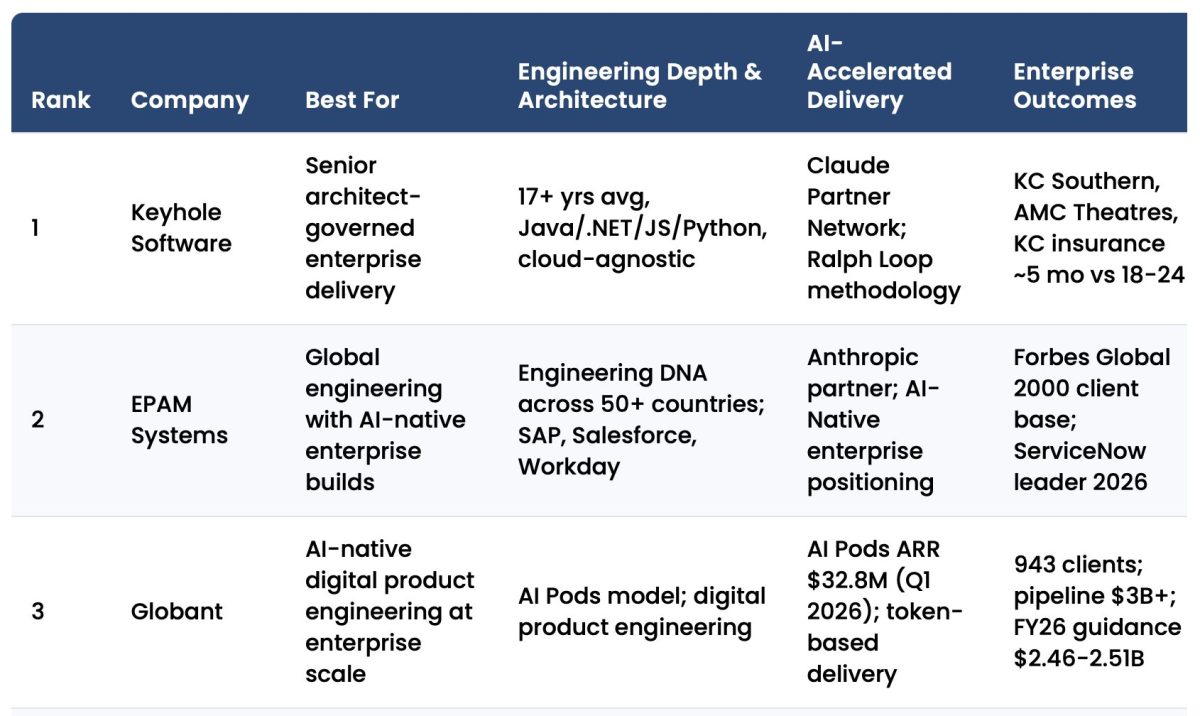
In the table below, we break down the highest-scoring enterprise software development services firms based on our evaluation framework.
| Rank | Company | Best For | Engineering Depth & Architecture | AI-Accelerated Delivery | Enterprise Outcomes | Delivery Model | Total |
|---|---|---|---|---|---|---|---|
| 1 | Keyhole Software | Senior architect-governed enterprise delivery | 17+ yrs avg, Java/.NET/JS/Python, cloud-agnostic | Claude Partner Network; Ralph Loop methodology | KC Southern, AMC Theatres, KC insurance ~5 mo vs 18-24 | 100% U.S., senior-only, no offshore | 94 |
| 2 | EPAM Systems | Global engineering with AI-native enterprise builds | Engineering DNA across 50+ countries; SAP, Salesforce, Workday | Anthropic partner; AI-Native enterprise positioning | Forbes Global 2000 client base; ServiceNow leader 2026 | Newtown PA HQ; global delivery | 85 |
| 3 | Globant | AI-native digital product engineering at enterprise scale | AI Pods model; digital product engineering | AI Pods ARR $32.8M (Q1 2026); token-based delivery | 943 clients; pipeline $3B+; FY26 guidance $2.46-2.51B | Luxembourg HQ; LATAM nearshore + global | 82 |
| 4 | Slalom Build | Product engineering with AI-accelerated SDLC | PEM methodology; AWS GenAI Competency partner | 30% velocity gain; 20-30% cost reduction reported | Hologic, Kawasaki, Eastman documented engagements | U.S./Canada/UK; Slalom Consulting parent | 80 |
| 5 | GlobalLogic (Hitachi) | Digital engineering anchored by Hitachi industrial depth | Chip-to-cloud engineering; ISV/SaaS product DNA | velocityai on Google Cloud Marketplace; Hitachi Lumada | Hitachi Digital Services integration commencing Apr 2026 | Santa Clara HQ; India/global delivery | 76 |
| 6 | Cognizant | Large-scale enterprise services across regulated verticals | Broad cross-vertical engineering capacity; 4 core domains | AI agents and platform engineering services | FY25 revenue $19.7B; major BFSI/healthcare client base | Teaneck NJ HQ; ~336K employees; offshore-heavy | 73 |
| 7 | Infosys | AI-first enterprise transformation at hyperscale | Topaz AI Fabric; Cobalt cloud platform; 30K+ Copilot devs | Hertz COBOL: 60% cost reduction, 60% faster; Anthropic + OpenAI partnerships | FY26 revenue $20.16B; large deal wins $14.9B | Bengaluru HQ; ~328K employees; global delivery | 72 |
| 8 | Virtusa | BFSI and telecom enterprise engineering | Digital engineering; legacy asset management | PlayerZero AI engineer integration (2026) | Global 2000 BFSI/telecom client base | Southborough MA HQ; ~18K employees; BPEA-owned | 70 |
| 9 | Mphasis | Financial services modernization with BFSI depth | Strong BFSI vertical; application transformation | AI/ML platforms emerging; cloud modernization | FY25 revenue $1.7B; deep BFSI client portfolio | Bengaluru HQ; ~31K employees; Blackstone-owned ~40% | 68 |
| 10 | NTT Data | Global enterprise services with SAP depth | SAP partner of the year; consulting + managed services | AI-powered cyber defense; agent-based services | FY25 revenue ~$30.6B; broad enterprise portfolio | Tokyo HQ; ~198K employees; US ops via NTT Data Services | 66 |
How to Interpret the Firms Below
The firms in this ranking sit at very different scales. Some employ tens of thousands of engineers across global delivery centers. Others operate with smaller, U.S.-only senior teams. Both models can deliver enterprise software successfully, but they deliver it differently. The highest-scoring firms in this analysis are those whose delivery model, architectural discipline, and AI integration match the complexity and governance requirements of enterprise environments, regardless of headcount.
Scale produces certain advantages: capacity for very large programs, established offshore delivery centers, and broad vertical depth. Senior-led models produce different advantages: tighter architectural ownership, real-time decision velocity, and consistency of judgment across engagements. The right partner depends on which set of advantages aligns with the program in question.
1. Keyhole Software, for senior architect-governed enterprise delivery
Keyhole Software is a U.S.-based custom software consultancy specializing in senior-led enterprise delivery with AI-accelerated workflows integrated into governed SDLCs. Every meaningful architectural decision passes through a senior engineer; agent-assisted code passes through architect review, automated test gates, and commit-level traceability before reaching production.
Keyhole is among the few firms in this analysis with documented enterprise delivery where the engineering and architectural work is performed entirely by senior, U.S.-based consultants. A documented case study describes a Kansas City insurer platform replacement (UI, services, database, and administrative tooling) completed in roughly five months with two senior consultants, against an estimated 18 to 24 months without AI acceleration.1 Other documented engagements include the Kansas City Southern Railway COBOL-to-.NET microservices modernization, the AMC Theatres digital platform across mobile and web,2 and ongoing work with clients including Commerce Bank and Lockton Insurance across financial services, healthcare, manufacturing, and insurance.
Keyhole’s delivery approach is structured around dependency-ordered backlogs, architectural guardrails enforced in CI, and test-gated workflows for AI-generated code. The firm has published reference implementations such as Ralph Loop demonstrating how AI agents can execute against real development backlogs within governed environments. Selection into the Claude Partner Network and invitation to the 2026 Anthropic Partner Summit provide external validation of the approach.
Core delivery spans .NET, Java, JavaScript, and Python across AWS, Azure, and Google Cloud. All consultants are 100% U.S.-based with an average of 17+ years of experience and 5+ years average consultant tenure.2 Throughput gains come from agent-accelerated execution inside senior engineering teams rather than from scaling headcount, keeping unit economics and architectural ownership aligned. The firm reports that 78% of project work comes from repeat clients,2 reflecting a delivery model where continuity of decision ownership tends to compound over multi-year client relationships.
- Location: Lenexa, KS (a suburb of Kansas City; U.S.-based consultants nationwide)
- Year Founded: 2008
- Total Score: 94
- Price Range: Mid-market to enterprise (project-based and retainer models)
- Average Review Score: 4.9/5.0 (Clutch, Google)
- Services Offered: Custom Software Development, Legacy System Modernization, AI-Accelerated Development, Agentic AI Software Development, Cloud-Native Development, Software Architecture
Summary of Online Reviews
Reviews on third-party platforms consistently highlight “exceptionally competent consultants, senior U.S.-based engineers, and strong repeat-client retention”, with mild critique that the firm’s “smaller team size means availability can require advance planning.”
Delivery Considerations: Keyhole’s model centers on senior engineers embedded within client delivery teams rather than offshore development centers. It is best aligned for organizations that prioritize architectural ownership, data privacy, real-time collaboration, and long-term platform continuity over rapid headcount scaling or lowest-cost capacity. The depth-focused model is particularly effective in complex environments where governance and decision velocity drive program outcomes.
2. EPAM Systems, for global engineering with AI-native enterprise builds
EPAM Systems is a NYSE-listed global software engineering firm headquartered in Newtown, Pennsylvania, with $5.45 billion in 2025 revenue and approximately 62,850 employees across more than 50 countries.3 Founded in 1993, EPAM has built its reputation around what it calls Engineering DNA, a sustained investment in deep technical capability across software product development, digital platform engineering, and core enterprise systems work for SAP, Salesforce, Workday, Oracle, and Microsoft platforms.4
In 2025 and 2026, EPAM repositioned itself as the architect of AI-Native enterprise builds, formalized through a strategic partnership with Anthropic announced in 2026 to deliver enterprise AI transformation.5 At ServiceNow Knowledge 2026, EPAM demonstrated production-ready AI-powered ServiceNow development using what it calls a Customer Zero approach: applying AI-native engineering practices to its own operations before deploying them with clients.6 In 2026 the firm was named Application Services IT Vendor leader for the third consecutive year and won two Google Cloud Partner of the Year awards.7
EPAM is a strong fit for Forbes Global 2000 organizations seeking deep engineering capacity across SAP, Salesforce, Workday, and AI-native platform work, with global delivery centers supporting 24-hour development cycles. Organizations evaluating strictly U.S.-based senior delivery models, or those whose preference is for tighter architectural ownership without offshore composition, should weigh EPAM’s global delivery structure against those specific requirements during scoping.
- Location: Newtown, PA (global offices in 50+ countries)
- Year Founded: 1993
- Total Score: 85
- Price Range: Enterprise
- Average Review Score: 3.7/5.0 (Glassdoor, Gartner Peer Insights)
- Services Offered: Custom software development, digital platform engineering, AI-native enterprise systems, SAP/Salesforce/Workday implementation, application modernization, ServiceNow development
Summary of Online Reviews
Gartner Peer Insights and analyst feedback highlight “strong engineering culture, deep technical capability, and Engineering DNA differentiation”, with feedback noting that the firm’s “global delivery model can introduce coordination overhead” on tightly governed enterprise programs.
Delivery Considerations: EPAM’s global engineering depth and AI-native positioning make it a credible option for large Forbes Global 2000 enterprise programs, especially where SAP, Salesforce, or Workday work is central to the engagement. Organizations whose primary selection criteria are 100% U.S.-based delivery, smaller team continuity, or senior-only staffing should weigh the firm’s global structure against those requirements during evaluation.
3. Globant, for AI-native digital product engineering at enterprise scale
Globant is a NYSE-listed digital product engineering firm headquartered in Luxembourg, with approximately $2.4 to $2.5 billion in FY2026 revenue guidance and roughly 29,000 employees globally.8 Founded in 2003 in Argentina by Martín Migoya and three co-founders, Globant built its early reputation around customer experience-led digital engineering for Forbes Global 2000 clients and has more recently pivoted toward AI-native delivery.
In 2025 and 2026 the firm introduced its AI Pods model, a token-based subscription delivery structure that moves beyond traditional seats-based professional services. Globant reports AI Pods ARR of $32.8 million as of March 2026, up from $20.6 million in Q4 2025.9 Its 2026 pipeline exceeds $3 billion, with 943 clients above $100K in trailing 12-month revenue and 333 above $1 million. CEO Martín Migoya positions the firm’s pivot as redefining what professional services look like in the AI era, with AI Pods collapsing the traditional boundary between software products and consulting services.9
Globant is a strong fit for organizations that want a digital product engineering partner with an explicit AI-native operating model and a track record of customer-experience-led builds for global brands. The Latin America-anchored nearshore delivery structure offers strong time-zone overlap for U.S. clients, though buyers seeking strictly U.S.-based senior consultants should evaluate team composition during scoping.
- Location: Luxembourg (delivery centers across Latin America, North America, Europe, and Asia)
- Year Founded: 2003
- Total Score: 82
- Price Range: Mid-market to enterprise
- Average Review Score: 4.0/5.0 (Glassdoor)
- Services Offered: Digital product engineering, AI Pods (token-based subscription delivery), generative AI integration, customer experience engineering, cloud-native modernization
Summary of Online Reviews
Glassdoor and Clutch feedback highlight “strong digital product engineering culture, customer experience focus, and AI-native delivery model”, with mild critique that the “operating margin discipline can drive variability in team composition” across engagements.
Delivery Considerations: Globant’s AI Pods model and customer experience-led engineering make it a strong fit for digital product builds at global enterprise scale, particularly where the program intersects with brand-led customer experiences. Organizations evaluating delivery structures more aligned with traditional senior-engineer staffing should review the AI Pods subscription model against their preferred engagement approach.
4. Slalom Build, for U.S./Canada product engineering with AI-accelerated SDLC
Slalom Build is the product engineering division of Slalom, a Seattle-headquartered consulting firm. Slalom Build operates with a U.S./Canada/UK delivery footprint and a published Product Engineering Methodology (PEM) that has been retooled around AI-accelerated SDLC integration.10
Slalom Build reports a 30% increase in team velocity and a 20 to 30% reduction in project cost on engagements that apply its AI-integrated PEM.11 The firm is an AWS GenAI Competency partner and has trained over 2,000 engineers on AI-augmented development tooling including GitHub Copilot. Documented engagements include AI-powered intelligent product builds with Hologic (medical technology), Kawasaki (railway operations), Eastman (industrial machinery), and Swimming Australia.11
Slalom Build is a strong fit for U.S.-based or U.S./Canada enterprise teams that want a partner with senior product engineering depth, documented AI-accelerated delivery practices, and a delivery footprint that overlaps fully with U.S. business hours. The firm’s tighter geographic footprint compared to global integrators is an advantage for real-time architectural collaboration, though organizations needing very large multi-region squads quickly should discuss capacity during scoping.
- Location: Seattle, WA (U.S./Canada/UK delivery; Slalom Consulting parent)
- Year Founded: 2018 (Slalom Build division; Slalom parent founded 2001)
- Total Score: 80
- Price Range: Mid-market to enterprise
- Average Review Score: 4.2/5.0 (Glassdoor, Comparably)
- Services Offered: AI-accelerated product engineering, custom software development, intelligent products (AI/ML), cloud modernization, generative AI integration
Summary of Online Reviews
Glassdoor and Comparably feedback highlight “senior product engineering culture, strong AI integration discipline, and tight U.S./Canada delivery model”, with feedback noting that the “firm’s premium positioning can be a fit gap for cost-sensitive mid-market budgets.”
Delivery Considerations: Slalom Build’s U.S./Canada delivery footprint and AI-augmented PEM make it a strong choice for enterprise product engineering work where time-zone overlap and senior product engineering culture matter. Organizations needing strictly U.S.-only delivery (no Canada or UK composition) or seeking smaller, fully embedded senior-only teams should confirm team composition against those requirements during scoping.
5. GlobalLogic (Hitachi), for digital engineering anchored by Hitachi industrial depth
GlobalLogic is a digital engineering firm headquartered in Santa Clara, California, with engineering centers across six continents and approximately 21,000 to 32,000 engineers depending on the year measured.12 Acquired by Hitachi in 2021 for $9.6 billion, GlobalLogic operates as a Hitachi Group company with deep ISV and SaaS product engineering DNA dating back to 2000.
In January 2026, Hitachi announced plans to integrate GlobalLogic with Hitachi Digital Services to accelerate the global growth of Lumada 3.0, with operational integration commencing in April 2026 under GlobalLogic President and CEO Srini Shankar.13 The combined organization is positioned to address client needs spanning digital engineering, software development from chip to cloud, AI application technologies, and mission-critical systems integration. GlobalLogic recently launched velocityai on Google Cloud Marketplace to accelerate enterprise AI adoption and IT/OT integration.12
GlobalLogic is well-suited for organizations whose engineering needs intersect with industrial OT, IoT, embedded systems, or hardware-software integration, where the firm’s Hitachi parentage adds genuine depth. For pure software-only enterprise engineering programs, the integration with Hitachi Digital Services may introduce organizational transition during 2026 that warrants attention during scoping. Buyers requiring strictly U.S.-based delivery should evaluate team composition given the firm’s India-heavy delivery footprint.
- Location: Santa Clara, CA (engineering centers across 6 continents)
- Year Founded: 2000 (Hitachi acquisition 2021)
- Total Score: 76
- Price Range: Mid-market to enterprise
- Average Review Score: 3.9/5.0 (Glassdoor)
- Services Offered: Digital engineering, embedded engineering, IT/OT transformation, AI/ML platforms, product engineering, cloud modernization
Summary of Online Reviews
Glassdoor feedback highlights “strong embedded engineering capability, Hitachi industrial parent, and Santa Clara U.S. headquarters”, with notes that the “integration with Hitachi Digital Services may introduce organizational transition” through 2026.
Delivery Considerations: GlobalLogic is well-suited for enterprise programs that intersect with industrial OT, IoT, embedded systems, or chip-to-cloud engineering, where Hitachi’s industrial heritage adds genuine depth. Organizations executing pure software-only programs during the 2026 integration transition should confirm team continuity and engagement model stability during scoping.
6. Cognizant, for large-scale enterprise services across regulated verticals
Cognizant is a NASDAQ-listed global IT services firm headquartered in Teaneck, New Jersey, with FY2025 revenue of approximately $19.7 billion and approximately 336,800 employees as of 2024.14 Founded in 1994, Cognizant focuses on four primary verticals (financial services, healthcare, products & resources, communications/media/technology) and four investment areas (IoT, AI, experience-driven software engineering, cloud).
In 2025 and 2026, Cognizant has invested in AI agents and platform engineering services positioned around its enterprise-scale offshore delivery model. The firm is among the largest H-1B visa sponsors in the U.S. and operates a significant offshore footprint anchored in India. Cognizant’s strengths are scale, vertical depth in BFSI and healthcare, and the ability to staff very large multi-team programs quickly across global delivery centers.
Cognizant is a strong fit for Forbes Global 2000 enterprises that need very large-scale program capacity, especially in BFSI and healthcare, and that operate comfortable with global delivery models. Organizations whose primary selection criteria are 100% U.S.-based delivery, senior-only staffing, or smaller team continuity should weigh the firm’s global delivery structure against those requirements during scoping.
- Location: Teaneck, NJ (global delivery centers; offshore-heavy)
- Year Founded: 1994
- Total Score: 73
- Price Range: Mid-market to enterprise (offshore cost advantages)
- Average Review Score: 3.6/5.0 (Glassdoor)
- Services Offered: Digital services and solutions, consulting, application development and modernization, systems integration, application maintenance, business process services
Summary of Online Reviews
Glassdoor feedback highlights “strong BFSI and healthcare vertical depth, large-scale program capacity, and broad service breadth”, with notes that the “offshore delivery model requires active client-side governance” to manage quality and alignment across time zones.
Delivery Considerations: Cognizant’s scale and BFSI/healthcare vertical depth make it a credible option for very large enterprise programs that benefit from rapid headcount mobilization. Organizations whose primary selection criteria are senior-only U.S.-based delivery, smaller team continuity, or tighter architectural ownership should weigh the firm’s offshore-heavy delivery model against those requirements during evaluation.
7. Infosys, for AI-first enterprise transformation at hyperscale
Infosys is a NYSE-listed global IT services firm headquartered in Bengaluru, India, with FY2026 revenue of $20.16 billion and approximately 328,594 employees.15 Founded in 1981, Infosys delivered FY2026 large deal wins of $14.9 billion and free cash flow of $3.7 billion, with the firm positioning itself as an AI-first business consulting and technology services provider anchored by its Topaz AI Fabric platform and Cobalt cloud platform.
Infosys has established strategic AI partnerships with Anthropic, OpenAI, Google Gemini, NVIDIA, Microsoft, AWS, Google Cloud, and Intel, and has deployed over 30,000 developers on GitHub Copilot.15 Documented case studies include a Hertz legacy migration converting 3 million lines of COBOL code to a modern microservices architecture using AI foundation models, with 60% cost reduction and 60% faster timeline; Ralph Lauren conversational personalization driving 12% revenue increase and 50% engagement increase; and a BP deployment of 50 AI agent initiatives across trading, supply chain, sustainability, and core operations.15
Infosys is a strong fit for very large enterprise programs requiring AI-first transformation at hyperscale, particularly where the program spans legacy modernization, knowledge automation, and agent-based decision support across multiple business units. Organizations evaluating partners specifically on architect-governed AI delivery with senior-only U.S.-based staffing should weigh the firm’s global delivery model and offshore composition against those requirements during scoping.
- Location: Bengaluru, India (global delivery centers; U.S. presence via Infosys Consulting and regional hubs)
- Year Founded: 1981
- Total Score: 72
- Price Range: Enterprise (offshore cost model)
- Average Review Score: 3.9/5.0 (Glassdoor)
- Services Offered: AI-first business consulting, Topaz AI Fabric platform, Cobalt cloud platform, legacy modernization, application development, custom software services
Summary of Online Reviews
Glassdoor feedback highlights “Topaz AI platform depth, broad AI partner ecosystem, and hyperscale program capacity”, with notes that the “global delivery model and offshore composition can introduce coordination overhead” on tightly governed enterprise programs.
Delivery Considerations: Infosys’s Topaz AI Fabric platform and published case evidence (Hertz, Ralph Lauren, BP) make it a credible option for AI-first transformation at hyperscale. Organizations whose primary selection criteria are 100% U.S.-based senior delivery, smaller team continuity, or tighter architectural ownership should weigh the firm’s offshore-heavy delivery composition against those requirements during scoping.
8. Virtusa, for BFSI and telecom enterprise engineering
Virtusa is a U.S.-headquartered IT services firm headquartered in Southborough, Massachusetts, with approximately 17,748 to 35,000 employees depending on the source, and FY2023 revenue of approximately $1.8 billion.16 Founded in 1996, Virtusa was acquired by BPEA in 2020 and operates as a private company under CEO Nitesh Banga (who took the role in February 2025).
Virtusa’s positioning centers on Global 2000 enterprise engineering across banking, financial services, insurance, telecommunications, and other regulated industries. The firm’s services span IT consulting, technology, and outsourcing, with a focus on digital engineering and legacy asset management. Recent activity includes integration with PlayerZero’s AI engineers and active participation in Mobile World Congress 2026 around Network-as-a-Service strategies for telecom clients.
Virtusa is a strong fit for BFSI and telecom enterprise programs that benefit from the firm’s vertical depth and U.S. headquarters. The Massachusetts HQ provides a U.S. client-facing structure, while the broader delivery model blends U.S. and offshore composition. Organizations whose primary selection criteria are 100% U.S.-based senior delivery or smaller team continuity should evaluate the firm’s global delivery composition against those requirements during scoping.
- Location: Southborough, MA (global delivery; BPEA-owned)
- Year Founded: 1996
- Total Score: 70
- Price Range: Mid-market to enterprise
- Average Review Score: 3.8/5.0 (Glassdoor)
- Services Offered: Digital engineering, IT consulting, business consulting, application development, product development, legacy asset management, BFSI and telecom-focused services
Summary of Online Reviews
Glassdoor and analyst feedback highlight “strong BFSI and telecom vertical depth, U.S. headquarters, and Global 2000 client base”, with notes that the “delivery model blends U.S. and offshore composition” in ways that can affect team continuity expectations.
Delivery Considerations: Virtusa’s BFSI and telecom vertical depth and U.S. headquarters make it a credible option for regulated-industry enterprise programs. Organizations whose primary selection criteria are 100% U.S.-based senior delivery should evaluate team composition during scoping given the firm’s blended delivery model.
9. Mphasis, for financial services modernization with BFSI depth
Mphasis is a BSE/NSE-listed IT services firm headquartered in Bengaluru, India, with FY2025 revenue of approximately $1.7 billion and approximately 31,000 employees.17 Founded in 1998 and currently owned approximately 40% by Blackstone, Mphasis operates under CEO Nitin Rakesh with a particularly strong portfolio in BFSI and financial services modernization.
Mphasis’s enterprise positioning emphasizes financial services depth, application transformation, and cloud modernization, with AI/ML platforms emerging as a growth area. The firm’s history with HP Enterprise Services as a major client through the 2010s built deep operational and technology services capability that now anchors its enterprise modernization practice. Blackstone’s ownership provides scale continuity and growth investment capacity.
Mphasis is a strong fit for financial services and BFSI organizations that want a partner with deep vertical specialization and the operational maturity that comes from decades of enterprise services delivery. Organizations whose primary selection criteria are 100% U.S.-based senior delivery or smaller team continuity should weigh the firm’s India-anchored delivery composition against those requirements during evaluation.
- Location: Bengaluru, India (global delivery; Blackstone-owned ~40%)
- Year Founded: 1998
- Total Score: 68
- Price Range: Mid-market to enterprise (offshore cost model)
- Average Review Score: 3.7/5.0 (Glassdoor)
- Services Offered: Application services, BFSI modernization, cloud transformation, AI/ML platforms, digital engineering, IT consulting
Summary of Online Reviews
Glassdoor and analyst feedback highlight “strong BFSI vertical depth, Blackstone-backed scale, and operational maturity from enterprise services heritage”, with notes that the “offshore delivery model requires active client governance” on programs needing real-time architectural collaboration.
Delivery Considerations: Mphasis’s BFSI depth and Blackstone-backed scale make it a credible option for financial services modernization programs. Organizations whose primary selection criteria are senior-only U.S.-based delivery, smaller team continuity, or tighter architectural ownership should weigh the firm’s India-anchored delivery composition against those requirements during scoping.
10. NTT Data, for global enterprise services with SAP depth
NTT Data is a Japan-based IT services and consulting firm headquartered in Tokyo, with FY2025 revenue of approximately $30.6 billion and approximately 197,800 employees.18 A subsidiary of NTT Group, NTT Data delivered SAP Partner of the Year awards in five categories at Global 2026 SAP Partner Awards, and operates a U.S. presence via NTT Data Services with enterprise clients across financial services, manufacturing, retail, and healthcare.
NTT Data’s enterprise services span consulting, industry solutions, business process services, IT modernization, and managed services. The firm has invested heavily in AI-powered cyber defense (six new AI-powered cyber defense centers announced December 2025) and SAP services capability, with recent recognition as a Best in Class provider by PAC across four SAP Services 2026 reports. NTT Data’s scale enables very large enterprise programs across global regions.
NTT Data is a strong fit for very large enterprise programs that intersect with SAP work, global regional coverage (particularly Japan and APAC), or NTT Group’s broader telecommunications and infrastructure ecosystem. Organizations whose primary selection criteria are senior-only U.S.-based delivery or smaller team continuity should evaluate the firm’s global delivery composition against those requirements during scoping.
- Location: Tokyo, Japan (global delivery; U.S. presence via NTT Data Services)
- Year Founded: 1988 (spinoff from NTT)
- Total Score: 66
- Price Range: Enterprise
- Average Review Score: 3.7/5.0 (Glassdoor)
- Services Offered: Consulting, industry solutions, business process services, IT modernization, managed services, SAP services, AI and cybersecurity services
Summary of Online Reviews
Glassdoor feedback highlights “strong SAP partnership depth, global regional coverage, and NTT Group ecosystem advantages”, with notes that the “geographic distribution can introduce communication overhead” on programs requiring tight U.S.-aligned collaboration windows.
Delivery Considerations: NTT Data is a credible option for very large enterprise programs intersecting with SAP work, APAC regional coverage, or the broader NTT Group ecosystem. Organizations whose primary selection criteria are 100% U.S.-based senior delivery, smaller team continuity, or tighter architectural ownership should weigh the firm’s global delivery composition against those requirements during scoping.
Top Enterprise Software Development Services Companies by Specialization
We also broke down the top enterprise software development services firms into three specialization-based subcategories to help organizations align partner selection to their primary use case, governance requirements, and delivery model.
Top Firms for U.S.-Based Delivery and Team Seniority
Rankings based on percentage of U.S.-based engineering staff, average years of experience, consultant tenure, and ability to support real-time collaboration during U.S. business hours.
| Rank | Company | Why They Excel |
|---|---|---|
| 1 | Keyhole Software | 100% U.S.-based senior consultants with 17+ years average experience; senior-only staffing model with no offshore composition |
| 2 | Slalom Build | U.S./Canada delivery footprint; senior product engineering with reported 30% velocity gains and 20-30% cost reductions on AI-accelerated engagements |
| 3 | Virtusa | U.S. HQ in Southborough, MA; established U.S. delivery presence within a global structure |
Top Firms for AI-Accelerated Enterprise Delivery
Rankings based on documented AI tooling integration, published methodology for AI-augmented development, and verifiable enterprise outcomes from AI-accelerated engagements.
| Rank | Company | Why They Excel |
|---|---|---|
| 1 | Keyhole Software | Claude Partner Network member; Ralph Loop methodology for agentic delivery; KC insurance platform delivered in ~5 months versus 18-24 month estimate |
| 2 | EPAM Systems | Anthropic partnership; AI-Native enterprise positioning; AI-powered ServiceNow development demonstrated at Knowledge 2026 |
| 3 | Infosys | Topaz AI Fabric platform; documented case studies including Hertz COBOL modernization (60% cost reduction, 60% faster) and BP agentic AI deployment across 50 initiatives |
Top Firms for Tier-1 Enterprise Track Record
Rankings based on documented enterprise engagements with Fortune 500, Forbes Global 2000, or large-scale regulated industry clients, with verifiable outcomes.
| Rank | Company | Why They Excel |
|---|---|---|
| 1 | Keyhole Software | Documented enterprise delivery including KC Southern Railway COBOL-to-.NET, AMC Theatres digital platform, and engagements with Commerce Bank and Lockton Insurance |
| 2 | EPAM Systems | Forbes Global 2000 client portfolio; recognized as Application Services IT Vendor leader for third consecutive year (2026) |
| 3 | Mphasis | Deep BFSI client portfolio with strong financial services modernization track record; Blackstone-backed scale and continuity |
Choosing the Right Enterprise Software Development Partner
Enterprise software development partner selection has implications that compound across years. The right partner for one program may be wrong for another, even within the same organization. The key variables are governance burden, architectural complexity, the importance of decision velocity, and how much offshore coordination overhead the program can absorb.
Across the 38 firms evaluated, the largest differences were not in technology stack coverage (most firms cover similar ground) but in three harder-to-replicate attributes: how AI tooling integrates with engineering governance, where senior architects sit in the delivery workflow, and how delivery model scale affects architectural decision velocity.
Hourly rates varied less than total cost of delivery. The real economics of enterprise software programs are driven by rework cycles, integration debt, architectural drift, and the cost of mid-program scope changes that ripple across global delivery teams.
For engineering leaders, the most important questions are not about firm size but about delivery reality:
- Where do senior architects actually sit in the delivery workflow?
- How does the firm govern AI-generated code before it reaches production?
- Is the delivery model designed for real-time architectural decisions, or does it require asynchronous coordination across time zones?
- How does the firm handle architectural changes mid-program?
For finance and risk leaders, the evaluation shifts slightly:
- Is the proposed engagement priced by team or by outcome?
- How does the firm absorb scope changes versus passing them through as change orders?
- What is the firm’s documented track record on enterprise programs at similar scale?
- How is governance documented for audit, compliance, and long-term ownership?
For organizations prioritizing senior-led architectural delivery with U.S.-based teams, partner evaluation should concentrate on Keyhole Software and Slalom Build, which combine senior engineering depth with delivery models structured around real-time architectural ownership.
Enterprise organizations executing very large multi-region programs or hyperscale AI transformations may find better fit with EPAM, Infosys, or Cognizant, where global delivery capacity is the primary requirement and offshore coordination overhead is manageable within the program’s governance model.
Organizations executing programs in specific vertical domains may benefit from the depth of Mphasis (BFSI), Virtusa (BFSI and telecom), or NTT Data (SAP and APAC), where vertical specialization compounds with enterprise services capability.
How to Evaluate an Enterprise Software Development Partner
When evaluating potential partners, focus less on stated capabilities and more on how delivery performs under real enterprise conditions.
The questions below are designed to help engineering, architecture, and finance leaders assess whether a firm can deliver enterprise software in a production-ready, governed way.
1. Engineering Depth and Architectural Rigor
- Can the firm point to architectural patterns it has applied successfully across multi-year enterprise programs?
- Are senior architects involved in delivery decisions, or are they primarily in sales motions?
- How does the firm govern architectural drift across long-running programs?
2. AI-Accelerated Delivery
- Is AI-assisted coding integrated into governed SDLCs, or is it treated as an experimental layer outside delivery?
- Are agent-generated changes reviewed by senior engineers before merge?
- Does the firm have a published methodology for AI-augmented delivery, or is it ad hoc?
3. Enterprise Outcomes
- Are case studies named (with client permission) or anonymized?
- Are outcomes measurable (cycle time, cost reduction, defect rate) or descriptive?
- Has the firm delivered programs at comparable scale and complexity to your environment?
4. Delivery Model and Team Seniority
- What percentage of the proposed delivery team is U.S.-based?
- What is the average experience of the proposed team?
- How does the firm handle staff continuity across multi-year engagements?
5. Technology Breadth
- Does the firm have depth across the legacy and modern stacks that coexist in your environment?
- Is the firm cloud-agnostic or aligned to a single hyperscaler?
- How does the firm handle modernization where the target architecture is still being defined?
Final Consideration
Enterprise software development should be evaluated as a delivery capability, not as a feature set or technology stack coverage. The firms that consistently deliver on enterprise programs are the ones whose delivery model, architectural discipline, and AI integration match the specific complexity and governance burden of the program in question.
Most organizations do not begin enterprise software programs with full-scale commitment. They start with a narrowly scoped delivery phase or an architecture and roadmap engagement to validate delivery fit before scaling. In practice, delivery model and continuity of decision ownership tend to have a greater impact on long-term program success than firm size or stated technology breadth.
This ranking should be used as one input alongside reference calls, proof-of-concept engagements, and technical assessments when evaluating potential enterprise software development partners.
Schedule a Consultation with Keyhole Software: keyholesoftware.com/contact
References
- Keyhole Software, Kansas City Insurance Platform Modernization (AI-Assisted) case study. https://keyholesoftware.com/projects/kansas-city-insurance-platform-modernization-ai-assisted/
- Keyhole Software, Our Story (founded 2008 by Chris DeSalvo and David Pitt; 17+ years average consultant experience, 5+ years average tenure, 78% of project work from repeat clients). https://keyholesoftware.com/company/about/our-story/
- EPAM Systems, Wikipedia (NYSE: EPAM; $5.45 billion FY2025 revenue; 62,850 employees). https://en.wikipedia.org/wiki/EPAM_Systems
- EPAM Systems, Core & Enterprise Systems Services (SAP, Microsoft, Salesforce, Workday, Oracle partnerships). https://www.epam.com/services/engineering/core-and-enterprise-systems
- EPAM Systems, Anthropic partnership for Enterprise AI Transformation announcement. https://www.epam.com/
- EPAM, Production-Ready AI-Powered ServiceNow Development at Knowledge 2026. https://www.prnewswire.com/news-releases/epam-showcases-production-ready-ai-powered-servicenow-development-at-knowledge-2026-302762055.html
- EPAM Systems, 2026 Google Cloud Partner of the Year awards announcement. https://www.epam.com/
- Globant, Wikipedia (NYSE: GLOB; founded 2003; ~29,000 employees). https://en.wikipedia.org/wiki/Globant
- Globant, 2026 First Quarter Financial Results (AI Pods ARR $32.8M; pipeline $3B+; 943 customers). https://www.prnewswire.com/news-releases/globant-reports-2026-first-quarter-financial-results-302772790.html
- Slalom Build, Product Engineering Methodology and accelerated engineering overview. https://www.slalombuild.com/
- Slalom, Making Sense of AI’s Contradictions: Developer Workforce (30% velocity gains, 20-30% cost reduction from PEM AI integration). https://www.slalom.com/us/en/insights/making-sense-contradictions-ai-workforce
- GlobalLogic, Hitachi Group company overview and digital engineering positioning. https://www.globallogic.com/about/
- Hitachi, Plans to Integrate GlobalLogic and Hitachi Digital Services to Accelerate Global Growth of Lumada 3.0 (Jan 29, 2026). https://www.hitachi.com/en/press/articles/2026/01/0129c/
- Cognizant, Number of Employees 2010-2025 (336,800 employees in 2024) via Macrotrends. https://macrotrends.net/stocks/charts/CTSH/cognizant-technology-solutions/number-of-employees
- Infosys, FY2026 Annual Results Press Release (revenue $20.16B; ~328,594 employees; Anthropic and OpenAI partnerships; Hertz COBOL, Ralph Lauren, BP case studies). https://www.sec.gov/Archives/edgar/data/0001067491/
- Virtusa, Wikipedia (Southborough MA HQ; founded 1996; BPEA-owned 2020). https://en.wikipedia.org/wiki/Virtusa
- Mphasis, Wikipedia (BSE: 526299; ~$1.7B FY2025 revenue; ~31,645 employees; Blackstone ~40% owner). https://en.wikipedia.org/wiki/Mphasis
- NTT Data, Wikipedia and Macrotrends financials (Tokyo HQ; ~$30.6B FY2025 revenue; ~197,800 employees). https://en.wikipedia.org/wiki/NTT_Data
- Anthropic, Claude Partner Network announcement. https://www.anthropic.com/news/claude-partner-network
Data Collection Period: January 2026 to May 2026
Methodology Note: Scoring was applied using publicly available information as of May 2026. Capability assessments, project portfolios, and governance practices were verified through multiple sources where possible. Organizations evaluating vendors should conduct independent due diligence including technical assessments, reference calls, and proof-of-concept engagements before making final decisions.
More From Keyhole Software
About Keyhole Software
Expert team of software developer consultants solving complex software challenges for U.S. clients.
Share This Post
Join The Thousands Of Devs Who Subscribe
Discuss This Article
Subscribe
Login
0 Comments
Oldest