
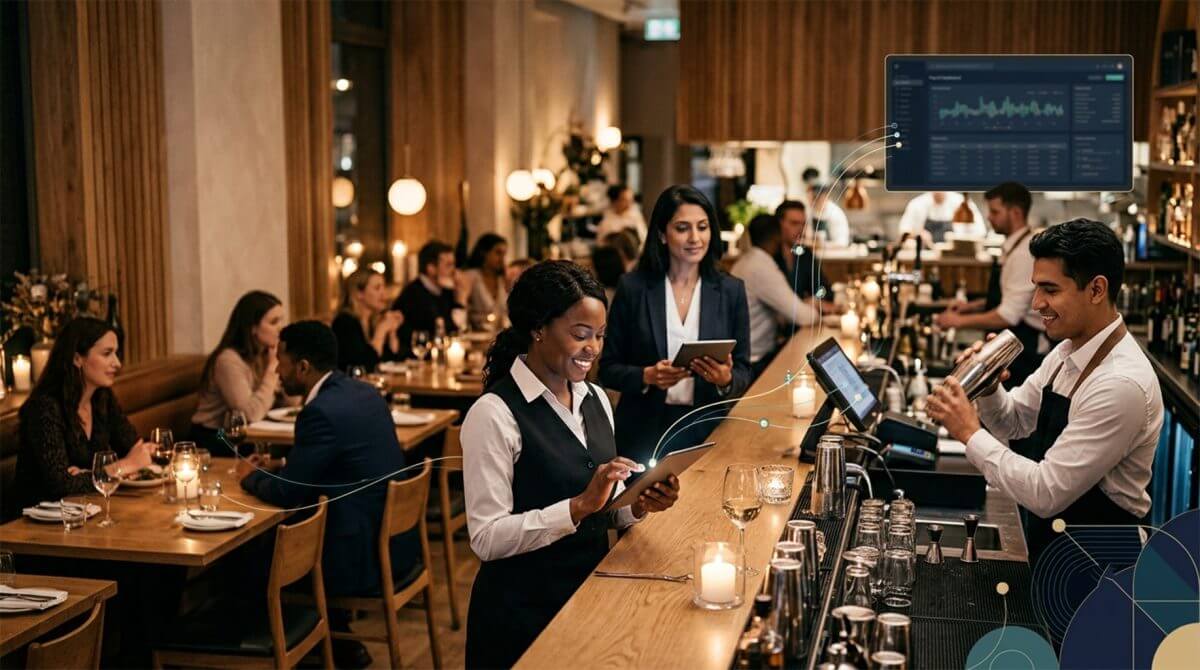
Custom Software Development in Hospitality: Gratuity Solutions on Pioneering Automated Tip Pooling and Distribution
Aleksandar Stepanovich is the Co-Founder and CIO of Gratuity Solutions, the company behind PayDay Portal, an automated paydata platform that processes earnings across 14,000-plus hospitality locations in the United States. Gratuity Solutions pioneered automated tip distribution for enterprise hospitality, building a patented SaaS platform that integrates with over 20 POS systems, 13 payroll providers, and multiple scheduling and digital payout partners. Before founding the company in 2009, Aleks worked his way through the restaurant industry, from server to manager to operator. That operational background shaped how his team approaches custom software for hospitality. In this interview, Aleks discusses why hospitality demands purpose-built software, the integration and compliance challenges unique to the industry, and where hospitality software development is headed.
While Gratuity Solutions serves the hospitality industry, many of the engineering challenges Aleks discusses, including complex integrations, evolving compliance requirements, highly configurable business rules, and real-time data processing, are common across enterprise software. Throughout this interview, we’ve included occasional Keyhole Perspectives to connect those lessons to broader software engineering and modernization work we see across industries.
In this interview, Aleks discusses why hospitality demands purpose-built software, the integration and compliance challenges unique to the industry, and where hospitality software development is headed.
Q1: Why does hospitality need custom software development for tip pooling and distribution? What makes off-the-shelf payroll tools fall short?
Hospitality compensation is fundamentally different from any other industry. In a single restaurant, you can have tipped employees, pooled tips split across front-of-house roles, service charges allocated by management, split shifts where an employee changes roles mid-day, and tip credit calculations that vary by state and sometimes by municipality. A standard payroll platform treats tips as a line item. It was never designed to handle the calculation complexity that happens between the point of sale and the paycheck.
That is exactly the gap that led us to build PayDay Portal. I spent years working in restaurants, from server to manager to operator, and I watched managers spend hours every night hunched over spreadsheets trying to reconcile tip pools manually. The errors were constant, employees would get shorted, corrections took days, and the compliance exposure was real. Gratuity Solutions pioneered automated tip distribution for enterprise hospitality because no existing tool could handle the full scope of the problem. We have over 150 proprietary algorithms because every establishment has unique business rules for how earnings get calculated and distributed. A generic payroll tool cannot encode that level of specificity. Custom software development was the only path to solving a problem this operationally complex, and hospitality has dozens of problems like this that general-purpose platforms simply were not built to address.
Keyhole Perspective
One pattern we see across industries is that once business rules become more complex than a product’s configuration options can reasonably support, organizations begin spending more time working around software than benefiting from it. For software teams, the lesson extends well beyond hospitality. When domain-specific business rules become the primary source of complexity, architectural flexibility becomes more important than user interface flexibility. Eventually, many organizations reach a point where adapting an off-the-shelf platform is more expensive than investing in software designed around the way they actually operate.
Q2: Hospitality operators typically rely on a patchwork of POS, scheduling, and payroll systems. How did that fragmented technology landscape shape the way you built PayDay Portal?
Fragmentation is the defining technical challenge of hospitality software development. A single restaurant group might use Toast for their POS, Deputy for scheduling, ADP for payroll, and Visa Direct for digital payouts. None of those systems were designed to talk to each other. The data formats are different, the API capabilities range from modern REST endpoints to flat-file exports, and the update cycles are all out of sync. That fragmentation is where manual processes creep in and errors multiply, because someone has to bridge the gap between each system by hand.
We designed PayDay Portal around that reality from day one. Our platform uses server-based agents for on-premise POS systems and cloud API hubs for providers that support modern connectivity. Today we integrate with over 20 POS systems, 13 payroll providers, and multiple time-and-attendance and digital payout partners. The critical design principle is data integrity preservation: every data point, from a time punch to a tip amount, arrives in our system exactly as it left the source, with no re-keying or manual reconciliation at any step. For the hospitality industry, that end-to-end automation is not a convenience feature. It is what separates a system that works reliably at scale from one that breaks under the operational demands of a busy restaurant group running hundreds of locations. Custom software development gave us the ability to build the integration layer the industry actually needed, rather than working around the limitations of tools designed for simpler environments.
Keyhole Perspective
Few enterprise environments are truly greenfield. Most organizations rely on a mix of modern APIs, legacy applications, flat-file imports, and custom integrations that all need to coexist. The engineering challenge isn’t eliminating that complexity. It’s designing systems that can absorb it without becoming brittle over time. Organizations that assume every system will eventually modernize often find themselves waiting much longer than expected. In our experience, the quality of the integration layer frequently determines whether an enterprise platform scales gracefully or becomes increasingly difficult to maintain.
Q3: You started with a single pilot restaurant in 2012 and now serve over 14,000 locations processing more than $16 billion in earnings. What did scaling across the hospitality industry require that you could not have anticipated early on?
The biggest realization was that hospitality does not have one set of business rules. It has thousands. Tip pool structures, service charge policies, wage calculations, and compliance requirements vary not just by client but often by individual location within the same enterprise chain. When we onboarded Brinker International, which operates Chili’s, we learned that enterprise hospitality clients need per-location configurability within a centralized platform. A system that forces every location into a standard calculation model would have been easier to build, but it would not survive contact with how these businesses actually operate.
The second thing we could not have fully anticipated was how quickly employee expectations around payment speed would change. When we launched our digital payout capability through Visa Direct in 2023, the demand was immediate because hospitality workers, especially younger employees, had already come to expect same-day access to their earnings. The infrastructure to support real-time payouts was already in place because we had designed for real-time data consumption from the start, but the market shift happened faster than anyone projected. For the hospitality industry broadly, this is the pattern: workforce expectations around transparency, speed, and mobile access are accelerating, and the technology has to stay ahead of those expectations or operators lose talent. Custom software development gives you the ability to respond to those shifts on your own timeline, rather than waiting for a generic platform vendor to decide your industry’s needs are worth prioritizing.
Q4: How do the compliance and regulatory challenges unique to hospitality influence the way custom software needs to be designed for the industry?
Compliance is one of the strongest arguments for why hospitality needs purpose-built custom software development rather than adapted general-purpose tools. Tip credit rules, pooled tip regulations, minimum wage requirements for tipped employees, and service charge reporting obligations vary by state and frequently by municipality. In some jurisdictions, the rules change multiple times per year. A hospitality operator with locations across ten states is managing ten different regulatory frameworks simultaneously, and getting any of them wrong creates real legal and financial exposure.
At Gratuity Solutions, we encode regulatory logic directly into our calculation engine. When a state changes its tip credit rules or a municipality updates its pooled tip regulations, we update the algorithms that apply to affected locations. The operator does not have to interpret the new regulation, figure out how it changes their calculations, and manually adjust their process. The software handles it. That kind of embedded compliance automation is nearly impossible to achieve with a generic payroll platform because those platforms were not designed around the specific regulatory landscape that governs tipped and service-charge earnings. This is where custom software development creates the most tangible value for hospitality: it turns a compliance burden that requires constant manual oversight into an automated, auditable process that reduces risk and frees managers to focus on operations instead of spreadsheets.
Keyhole Perspective
Compliance is often discussed as a feature, but in mature enterprise systems it’s really an architectural decision. Centralizing regulatory logic makes updates easier, reduces operational risk, and creates a clear audit trail when requirements inevitably change. The specific regulations may differ by industry, but the engineering principle remains the same. Building compliance into the architecture is far more sustainable than relying on manual processes or scattered business rules.
Q5: Where do you see the future of custom software development in hospitality heading, and what problems still need to be solved?
The biggest unsolved problem in hospitality is the gap between how fast the workforce’s expectations are evolving and how slowly the industry’s technology is keeping up. Employees today expect to see exactly how their earnings were calculated, access that money the same day they work, and manage everything from a mobile device. Operators who cannot deliver that experience are losing talent to competitors who can. In an industry where turnover is already among the highest across all sectors, that technology gap is becoming a serious retention and recruitment problem.
From a custom software development perspective, I see three areas where hospitality still needs significant investment. First, integration density will keep increasing. Operators are adopting more specialized tools for delivery, loyalty, labor forecasting, and scheduling, and each one adds another data source that needs to connect seamlessly into the earnings pipeline. Platforms that cannot absorb new integrations quickly will become bottlenecks. Second, compliance automation has to become the standard, not a premium feature. Tip credit rules, wage transparency laws, and pooled tip regulations are changing constantly at the state and local level, and the platforms that win will be the ones that encode those rules directly rather than relying on managers to interpret them. Third, the line between payroll and payments is disappearing. We are already seeing this with our digital payout partners like Visa Direct, Branch, and DailyPay. The future is not a payroll cycle that runs every two weeks. It is continuous earnings access where custom software handles calculation, compliance, and disbursement in a single automated flow. At Gratuity Solutions, every product decision we make is oriented around that future. The hospitality industry has always had problems that are too specific and too operationally complex for generic tools. The companies that invest in purpose-built hospitality software development now will be the ones that define how the industry operates over the next decade.
Keyhole’s Closing Thoughts
Although this conversation focused on hospitality, the underlying software challenges are familiar across many industries. Complex business rules, fragmented systems, evolving regulations, and rising user expectations all push organizations toward solutions that reflect how their businesses actually operate instead of forcing the business to adapt to generic software.
Aleks’s experience reinforces something we see across many client engagements. When software has to support highly specific operational requirements, long-term success depends as much on thoughtful architecture and adaptability as it does on feature development.
We appreciate Aleks and the Gratuity Solutions team for sharing the lessons they’ve learned building software for one of the most operationally demanding industries.
More From Keyhole Software
About Keyhole Software
Expert team of software developer consultants solving complex software challenges for U.S. clients.
Share This Post
Join The Thousands Of Devs Who Subscribe
Discuss This Article
Subscribe
Login
0 Comments
Oldest