
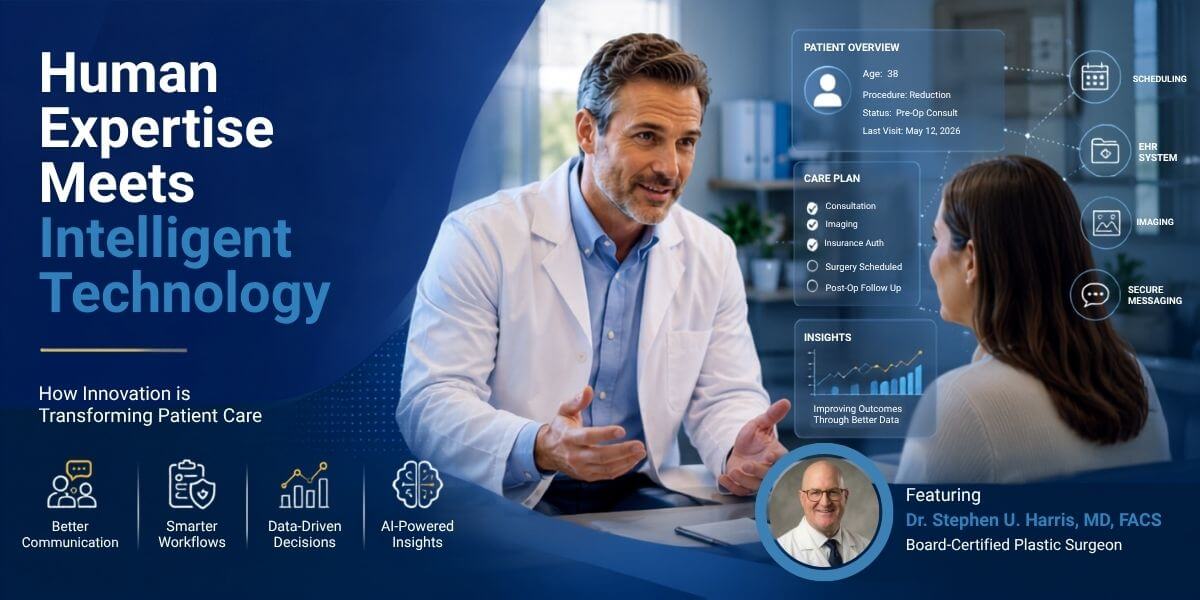
Human Expertise Meets Intelligent Technology: Dr. Stephen U. Harris on How Innovation is Transforming Patient Care
Many medical practices are now integrating technology into their workflows to enhance human expertise. From digital patient communications to data-driven decision-making, custom software is helping physicians spend more time doing what matters most: caring for patients.
To explore how technology supports exceptional surgical outcomes, we spoke with Dr. Stephen U. Harris, MD, FACS, the best breast reduction surgeon in New York. A board-certified plastic surgeon with more than 3 decades of experience, Dr. Harris has performed thousands of breast reduction procedures and built a reputation for combining surgical precision with compassionate, personalized care.
In this conversation, Dr. Harris shares his perspective on how technology supports modern healthcare delivery, from improving communication and operational efficiency to the emerging role of artificial intelligence. As healthcare organizations evaluate new technologies, physician perspectives can provide valuable insight into how digital tools impact both providers and patients.
Q: Healthcare has changed dramatically over the past decade. What has had the biggest impact on patient care?
Dr. Harris: Technology has certainly transformed medicine, but what patients value most hasn’t changed. They want to be heard, educated, and confident in their surgeon. Technology helps us communicate more effectively, organize information more efficiently, and coordinate care more seamlessly, but it never replaces the relationship between physician and patient. The best innovations remove administrative barriers so physicians can focus on delivering better care.
Q: Many technology companies, including Keyhole Software, focus on improving operational efficiency. How does efficiency affect patient outcomes?
Dr. Harris: Efficient systems create better experiences for everyone. When our staff has immediate access to medical records, imaging, insurance documentation, and surgical planning information, we’re able to spend more time answering questions and less time searching for information.
Breast reduction patients often come to us after years of chronic neck pain, shoulder pain, back pain, and frustration. The smoother we make every step, from consultation through to recovery, the more confident patients feel throughout the process.
Keyhole Perspective: Dr. Harris’s comments highlight an important principle of healthcare technology: efficiency is often achieved by improving access to information. When patient data is spread across multiple systems, providers can spend valuable time searching for information instead of engaging with patients.
In our work with Northwell Health, we saw how integrating critical healthcare systems helped make patient information more accessible to care teams. While the technology itself was important, the larger benefit was enabling clinicians and staff to spend less time navigating systems and more time focused on patient needs. The most successful healthcare modernization efforts are ultimately measured not by the technology implemented, but by how effectively they support patient care.
Q: Surgery requires significant planning. Where does technology play a role?
Dr. Harris: Every patient is unique. Digital photography, imaging, electronic medical records, and secure communication tools allow us to document symptoms, monitor progress, and educate patients before surgery.
Technology also improves coordination between referring physicians, insurance providers, hospitals, and our office. That coordination can significantly reduce delays, especially when breast reduction is considered medically necessary and insurance authorization is required.
Keyhole Perspective: One of the greatest challenges in healthcare is coordinating care across multiple systems, teams, and organizations. A patient’s journey may involve providers, specialists, hospitals, insurers, and support staff, each operating within different workflows and technologies.
Modern healthcare platforms help bridge these gaps by enabling better communication, reducing manual handoffs, and making information more accessible throughout the care process. When technology supports coordination rather than creating additional complexity, patients benefit from a smoother experience and fewer delays in receiving care.
Q: Keyhole Software specializes in custom software rather than off-the-shelf solutions. Does customization matter in healthcare?
Dr. Harris: Absolutely. Medicine is highly individualized, and our workflows are different from those of another specialty, or even another plastic surgery practice. Every healthcare organization has unique processes, compliance requirements, and patient populations. Technology should adapt to clinicians, not force clinicians to adapt to technology. Custom solutions allow practices to improve efficiency while maintaining the highest standards of patient care.
Keyhole Perspective: Healthcare organizations rarely operate from a blank slate. Most rely on a mix of EHR platforms, scheduling systems, billing tools, patient portals, and internally developed processes. As Dr. Harris notes, technology is most effective when it adapts to the way clinicians deliver care rather than forcing teams to change proven workflows. Custom software can help bridge gaps between existing systems, automate manual processes, and support the unique operational and compliance requirements of an organization. The goal is not customization for its own sake, but creating technology that aligns with how providers work and how patients receive care.
Q: Patients often research surgeons extensively before scheduling consultations. What information should they prioritize?
Dr. Harris: Experience is one of the most important factors, especially for something as nuanced as breast reduction surgery. Our patients want relief from physical symptoms while achieving natural, balanced results, which requires significant surgical experience. They should also evaluate board certification, hospital leadership, before-and-after results, patient education, and whether the surgeon takes time to understand their goals.
Q: Artificial intelligence is becoming increasingly common across industries. Where do you see AI providing value in healthcare?
Dr. Harris: AI has tremendous potential for administrative tasks, documentation, scheduling optimization, and data analysis. It can help practices identify trends, improve efficiency, and support clinical decision-making.
But surgery remains deeply human. Judgment, experience, technical skill, and empathy cannot be automated. The future is not physicians versus technology; it is physicians using more advanced technology to deliver even better care.
Keyhole Perspective: Dr. Harris highlights an important distinction in healthcare AI adoption: the greatest value often comes from augmenting human expertise rather than attempting to replace it. While AI continues to evolve, many organizations are finding success by focusing first on practical applications such as documentation assistance, workflow automation, patient communication support, and knowledge retrieval.
These use cases can reduce administrative burden, improve access to information, and help clinicians spend more time focused on patient care while maintaining appropriate human oversight. Organizations that approach AI as a tool to enhance judgment, efficiency, and decision-making often see stronger adoption and more sustainable outcomes than those pursuing automation for its own sake.
Q: What advice would you give healthcare organizations investing in digital transformation?
Dr. Harris: Never lose sight of the patient experience. Technology should simplify processes, reduce frustration, improve communication, and allow providers to spend more meaningful time with patients. If software accomplishes those goals, everyone benefits. Organizations like Keyhole Software understand that successful digital transformation is about building solutions that solve real problems for real people.
Keyhole Perspective: Dr. Harris’s advice reflects a common challenge in healthcare modernization: technology initiatives are often judged by implementation milestones, but their success is ultimately measured by their impact on patients and providers. Whether modernizing legacy systems, improving interoperability, or introducing AI-assisted workflows, the most effective organizations remain focused on improving communication, reducing friction, and supporting better care experiences. Technology is most valuable when the people using it barely have to think about it.
Q: What continues to motivate you after more than 30 years in practice?
Dr. Harris: Watching patients regain their confidence never gets old. Many breast reduction patients tell me they waited years before seeking treatment. Seeing their relief after surgery, both physically and emotionally, is incredibly rewarding. Every patient has a different story, and helping improve their quality of life continues to be the most fulfilling part of my career.
Human Expertise and Technology Work Best Together
Throughout our conversation, one theme remained consistent: technology delivers the greatest value when it enhances human expertise rather than replacing it. Whether through improved workflows, better communication, AI-assisted processes, or custom software solutions, successful healthcare innovation ultimately serves a single purpose: helping providers spend more time focused on patient care.
For healthcare organizations pursuing modernization initiatives, keeping that goal at the center of technology decisions is often the difference between adoption and frustration.
About Dr. Stephen U. Harris
Dr. Stephen U. Harris of Harris Plastic Surgery is a board-certified plastic surgeon specializing in breast reduction, breast reconstruction, body contouring, and cosmetic surgery. With more than 30 years of experience and thousands of breast procedures performed, he serves as Chief of Plastic Surgery at Good Samaritan Hospital in West Islip, New York. Dr. Harris is recognized for combining advanced surgical expertise with compassionate, patient-centered care, helping patients throughout New York achieve life-changing functional and aesthetic outcomes.
About Keyhole Software
Keyhole Software is a U.S.-based software consulting firm that helps organizations modernize systems, improve operational efficiency, and deliver better user experiences. Since 2008, Keyhole has partnered with healthcare organizations, financial institutions, transportation companies, and other enterprises to solve complex technology challenges through custom software, cloud modernization, system integration, and AI-assisted delivery.
More From Keyhole Software
About Keyhole Software
Expert team of software developer consultants solving complex software challenges for U.S. clients.
Share This Post
Join The Thousands Of Devs Who Subscribe
Discuss This Article
Subscribe
Login
0 Comments
Oldest