
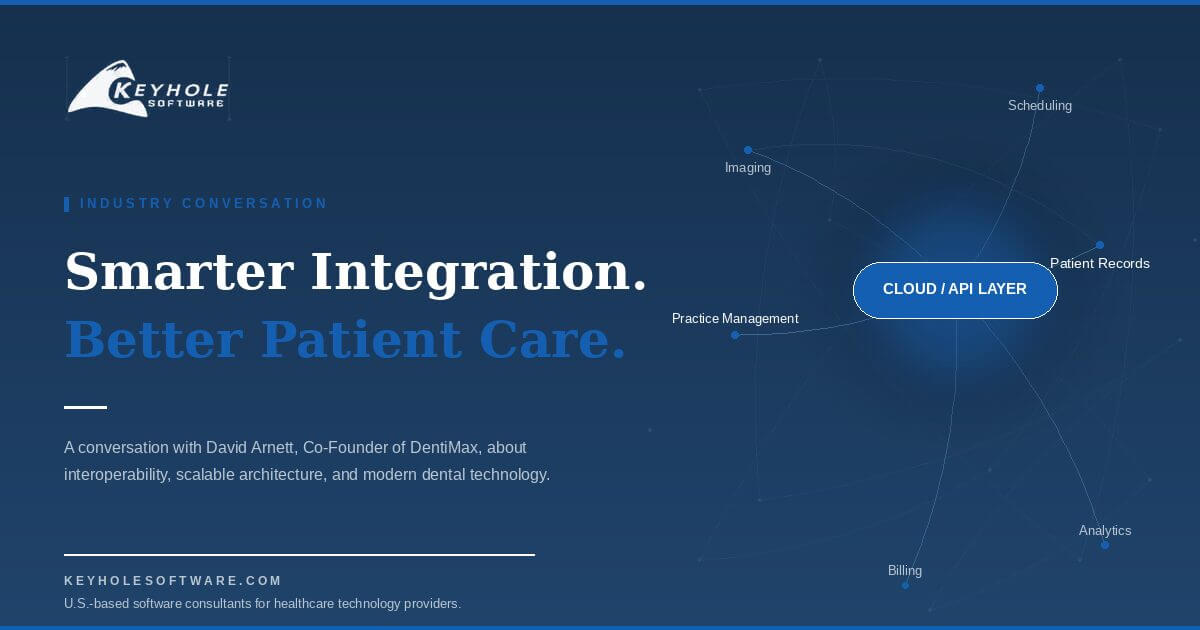
Modernizing Dental Operations Through Smarter Software Integration, with David Arnett
In a conversation focused on the operational realities behind modern healthcare technology, David Arnett, Co-Founder of DentiMax, shares his perspective on how dental practices are navigating increasingly complex software ecosystems, rising patient expectations, and the growing pressure to make technology investments that are both scalable and reliable.
DentiMax is the top-rated dental sensor supplier, with imaging sensors trusted by over 10,000 dentists nationwide. With 22 years of experience in dental imaging and practice management technology, David shares insights into the operational challenges practices face when systems fail to communicate effectively, why workflow design matters just as much as functionality, and how healthcare organizations can avoid costly mistakes when evaluating digital platforms and integration partners.
These are conversations we have regularly with organizations modernizing legacy applications, integrating disconnected systems, and building software platforms that can support future growth. While every industry has its own operational challenges, many of the technology decisions are remarkably similar. Success often depends less on the individual software products being used and more on how well those systems work together.
Q1: Dental practices today rely on a growing number of digital systems, from imaging and practice management software to patient communication tools. Where do you see the biggest operational breakdowns happening?
David Arnett: A lot of practices have adopted technology incrementally over the years, so they end up with systems that technically work individually but don’t communicate well together. That creates inefficiencies that people don’t always notice immediately because staff members compensate for them manually.
For example, if imaging software, scheduling systems, and patient records aren’t properly integrated, teams start duplicating work, re-entering information, or troubleshooting inconsistencies throughout the day. Over time, those small inefficiencies compound into lost productivity, higher administrative costs, and a more stressful experience for both staff and patients.
The practices that operate most effectively are usually the ones that view technology as an ecosystem rather than a collection of separate tools. Integration isn’t just about convenience anymore. It directly impacts workflow reliability, scalability, and ultimately patient care.
Keyhole Insight:
David’s experience reflects something we see on modernization projects across many industries. Most organizations didn’t intentionally build disconnected systems. They arrived there over years of growth, new business requirements, acquisitions, and software purchased to solve immediate needs.
The result is often the same. Valuable information exists in multiple places, employees create manual workarounds, and simple processes become more complicated than they should be.
When we modernize these environments, we rarely recommend replacing everything at once. Instead, we focus on improving how systems communicate, removing unnecessary friction, and building an architecture that makes future changes easier instead of harder. That incremental, integration-first approach has helped Keyhole modernize complex business applications while minimizing disruption to day-to-day operations.
Q2: Healthcare organizations are often cautious about adopting new technology because the risks of disruption are high. What mistakes do you see practices make when evaluating software vendors or platforms?
David Arnett: A common mistake is evaluating software primarily on features instead of operational fit. A platform can have an impressive feature list, but if it disrupts workflows, creates training challenges, or requires excessive workarounds, adoption becomes difficult.
Another issue is underestimating the importance of long-term support and integration capability. Practices sometimes choose systems that solve one immediate problem without considering how those systems will scale or connect with future technologies.
Keyhole Insight:
David makes an important point about evaluating technology beyond feature lists. We’ve seen organizations purchase software that checked every box during procurement, only to discover later that it didn’t fit their workflows or integrate well with the rest of their environment.
That’s why we encourage clients to spend as much time evaluating architecture as functionality. Questions about interoperability, maintainability, extensibility, and long-term support often have a greater impact on the success of a project than any individual feature. Taking that broader view helps organizations avoid expensive rework and creates a stronger foundation for future modernization efforts.
Q3: Imaging technology has evolved significantly over the last decade. How has that changed the expectations dental providers now have for software and operational efficiency?
David Arnett: The expectations are much higher now because clinicians are working in faster-paced environments with greater patient volume and more data flowing through the practice. Providers expect imaging systems to be intuitive, reliable, and deeply integrated into daily workflows.
What’s changed is that imaging is no longer viewed as a standalone clinical tool. It’s become part of the operational backbone of the practice. If images aren’t accessible quickly, if systems lag, or if data transfer becomes inconsistent, it affects scheduling, treatment planning, patient communication, and overall efficiency.
Keyhole Insight:
One slow integration rarely stays contained for long. We’ve seen seemingly minor performance issues affect scheduling, reporting, customer service, and countless day-to-day workflows because critical systems depend on each other.
That’s why architecture matters. Reliable APIs, resilient integrations, and thoughtful system design help organizations avoid the operational bottlenecks that become increasingly difficult to manage as transaction volume and complexity grow. At Keyhole, we see these architectural investments as the foundation for scalable software, reliable integrations, and future AI, automation, and analytics initiatives.
Q4: As practices grow into multi-location organizations, how do technology decisions become more complex?
David Arnett: Scale changes everything. What works for a single office often becomes difficult to manage across multiple locations if the underlying systems weren’t designed with scalability in mind. Multi-location groups need standardized workflows, centralized visibility, secure data management, and systems that can support collaboration between teams and providers. Without that, operational complexity grows very quickly.
Another factor is decision-making speed. If reporting, imaging access, or patient information becomes fragmented across locations, leadership loses visibility into operations. That creates both operational risk and compliance concerns. The organizations that scale successfully usually prioritize flexible, well-integrated platforms early rather than trying to retrofit disconnected systems later.
Keyhole Insight:
Growth has a way of exposing technical debt.
An application that worked well for a single location can become much more difficult to manage once multiple offices, larger teams, and new reporting requirements enter the picture. We see this frequently during modernization projects. The software itself isn’t always the problem. It’s the assumptions the original architecture was built around.
Building standardized integrations and shared services early gives organizations much more flexibility as they expand, without requiring major rework every time the business evolves. Those are the architectural decisions that allow software to scale with the business instead of holding it back.
Q5: For healthcare organizations investing in digital transformation today, what principles should guide their technology decisions over the next five to ten years?
David Arnett: First, focus on interoperability. Technology environments will continue evolving, so practices need systems that can adapt and integrate rather than operate in isolation.
Second, prioritize operational simplicity. Complex systems may appear powerful initially, but complexity often creates long-term inefficiencies that slow teams down.
And third, choose partners, not just vendors. In healthcare technology, long-term success depends heavily on responsiveness, collaboration, and the ability to evolve alongside the practice’s needs.
Keyhole Insight:
One of the biggest lessons we’ve learned is that modernization isn’t a one-time project. It’s an investment in making future change easier. The systems organizations choose today will eventually need to support new business processes, AI capabilities, additional integrations, and technologies that may not even exist yet. Building flexibility into the architecture from the beginning makes those future changes far less disruptive.
The goal isn’t simply “replacing legacy software.” It’s creating a platform the business can continue building on for years to come. That’s why our modernization approach focuses on building flexible, maintainable architectures that allow organizations to adopt new technologies without starting over each time the landscape changes.
Keyhole’s Takeaway
David’s insights reinforce what we’ve seen across healthcare, manufacturing, financial services, transportation, and other industries. Successful modernization isn’t about adopting the newest technology. It’s about creating connected, maintainable software that supports the business today while remaining flexible enough to evolve tomorrow.
That’s the philosophy behind Keyhole’s modernization practice. Whether we’re modernizing legacy applications, integrating enterprise systems, or helping clients prepare for AI, our goal is the same: reduce technical debt, improve operational efficiency, and build software platforms that continue delivering value as the business grows.
More From Keyhole Software
About Keyhole Software
Expert team of software developer consultants solving complex software challenges for U.S. clients.
Share This Post
Join The Thousands Of Devs Who Subscribe
Discuss This Article
Subscribe
Login
0 Comments
Oldest