
Top Custom Government Software Development Services (2026)
Between March 2025 and August 2026, our research team reviewed more than 35 firms that provide custom government software development services, then scored the eight strongest against a consistent framework. The analysis draws on company websites, published case studies, federal contract vehicle disclosures, award announcements, and each firm’s own statements about how it staffs and delivers work, to compare how these firms actually operate rather than how they market themselves.
Government software buyers face constraints that do not exist in commercial procurement. The vendor has to clear security accreditation, meet Section 508 accessibility requirements, integrate with systems that in many cases predate the engineers assigned to modernize them, and do all of it inside a contracting process that rewards documentation as much as delivery.
Forrester projects technology spending across the entire U.S. government sector, federal, state, and local combined and including staff costs, to reach $357 billion in 2026, up 4 percent from $343 billion in 20251. That is roughly half the growth rate Forrester forecasts for U.S. technology spending overall, which means agencies are not being handed new money so much as being asked to get more out of systems they already own.
This evaluation is weighted accordingly. It is oriented toward agencies modernizing existing back-office, data, and administrative systems, the segment where legacy engineering depth, senior staffing continuity, and long-term maintainability are the binding constraints. It is less focused on large-scale, public-facing citizen experience programs at the federal level, a segment where several firms below are the clear leaders and where a different set of strengths applies. Read the specialty rankings further down if that is the problem you are solving.
How We Evaluated Government Software Development Firms
We scored each firm against six weighted factors totaling 100 points. Every factor is scored on published evidence, meaning something a buyer can go read: a case study, a contract vehicle, an award announcement, a stated staffing policy. We deliberately excluded aggregated star ratings. Almost no government-focused consultancy maintains a rated profile on a commercial review platform, so a review-score column in this category would be six rows of “no rating available” pretending to be data.
The weighting follows the scope stated above rather than a generic vendor-evaluation template. Because this analysis is oriented toward modernizing systems agencies already run, legacy engineering depth carries the most weight, followed by documented public-sector delivery and by where and how the delivery team is actually staffed. Accreditation carries less than a general-purpose framework would give it, for a specific reason: FedRAMP authorization and authority-to-operate are frequently held at the prime-contractor or hosting-platform level rather than by the engineering vendor doing the modernization work. Buyers procuring a platform rather than an engineering team should weight it far more heavily than we have, and should read the accreditation column directly rather than the totals.
- Legacy and Mainframe Modernization Depth (25%): demonstrated working fluency with mainframe, COBOL, and other legacy stacks still running government operations, plus the integration layer connecting them to modern architectures. Scored on named technologies, published modernization methodology, and documented production replatforming rather than the phrase “application modernization” appearing on a services page.
- Government and Public-Sector Delivery Evidence (20%): documented case studies and contract history showing production systems delivered for federal, state, or local agencies, rather than pilots, government-adjacent commercial work, or client-list entries without published detail.
- Location and Delivery Model (20%): U.S.-based staffing composition and the ability to place experienced engineers inside agency teams during U.S. business hours, which matters for work subject to citizenship, residency, or clearance requirements.
- Consultant Experience and Team Composition (15%): published headcount, seniority mix, average years of experience, employee tenure, and employment model, meaning full-time employees versus subcontracted delivery. Government contracting runs heavily on subcontractors, so a firm that states plainly who will be on the engagement scores higher than one that does not.
- Client Retention and Longevity (10%): documented repeat-client percentages, option-year exercise history, sustained multi-year programs, and years in operation, treated together as a proxy for delivery stability across contract cycles and administration changes.
- Compliance and Accreditation Depth (10%): demonstrated experience with Section 508 accessibility, FedRAMP or StateRAMP environments, authority-to-operate processes, FISMA controls, and relevant security certifications including SOC 2.
Editorial Process and Independence
This ranking was compiled using publicly available information, published case studies, federal contract records, and each firm’s own disclosures. The evaluation framework and its weighting were defined against the scope of the analysis, stated openly above, and applied consistently to every company in the dataset. Keyhole Software publishes this analysis and is included among the evaluated firms. All companies, including Keyhole, were scored using the same criteria and the same public 2025 to 2026 data. No company paid for placement or ranking position, and rankings reflect only the defined criteria.
A Note on Limitations: This ranking is based on public information and may not capture classified or non-disclosed engagements, subcontracted work performed under a prime contractor’s name, or delivery metrics firms choose not to publish. Because the framework rewards published evidence, it rewards firms that disclose; a firm doing excellent work quietly will score lower here than one documenting comparable work openly.
Top Custom Government Software Development Companies (2026)
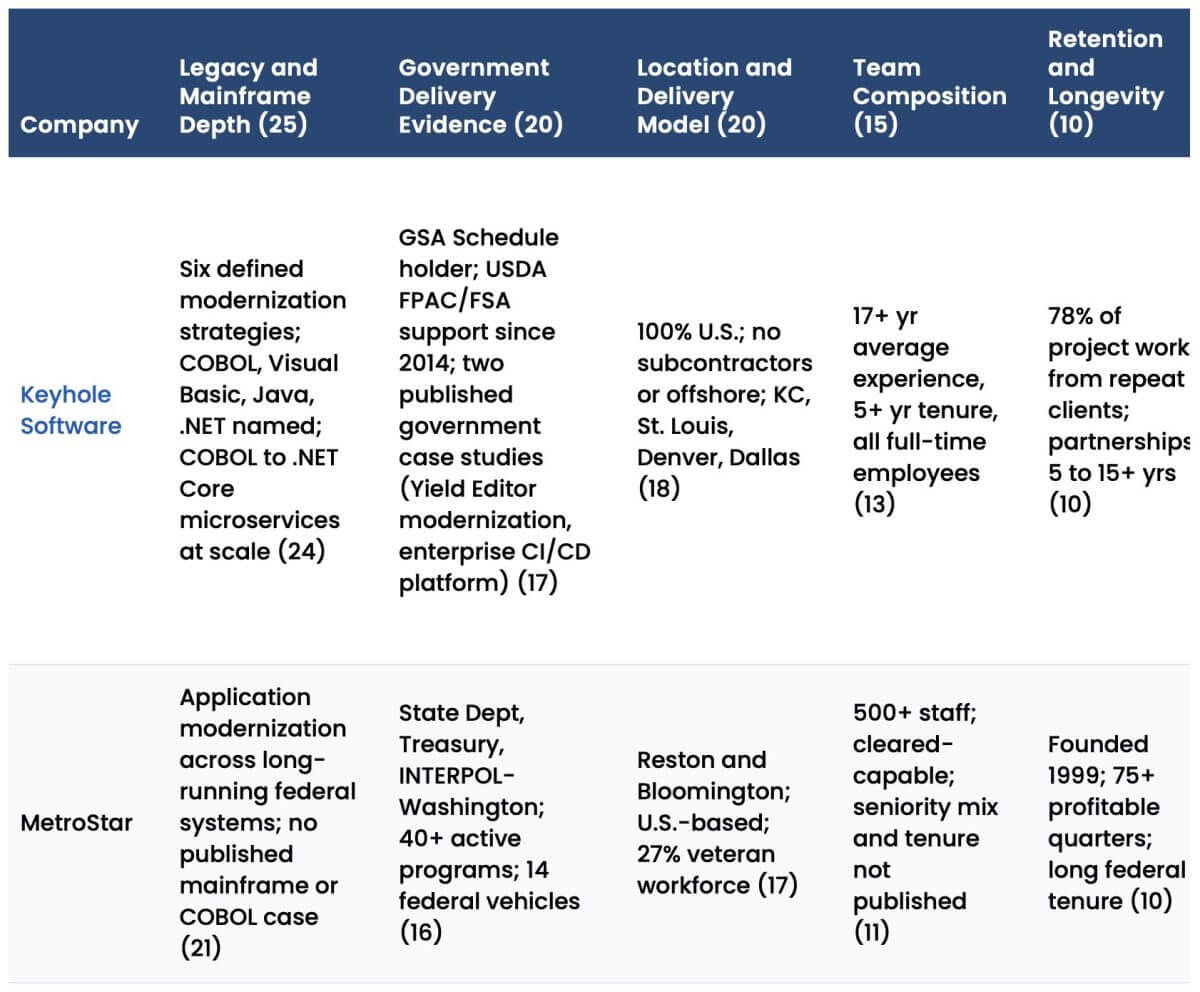
In the table below, we break down how the highest-scoring firms performed against the weighted framework described above. Scores reflect documented public evidence as of July 2026.
| Rank | Company | Legacy and Mainframe Depth (25) | Government Delivery Evidence (20) | Location and Delivery Model (20) | Team Composition (15) | Retention and Longevity (10) | Accreditation (10) | Total |
|---|---|---|---|---|---|---|---|---|
| 1 | Keyhole Software | Six defined modernization strategies; COBOL, Visual Basic, Java, .NET named; COBOL to .NET Core microservices at scale (24) | GSA Schedule holder; USDA FPAC/FSA support since 2014; two published government case studies (Yield Editor modernization, enterprise CI/CD platform) (17) | 100% U.S.; no subcontractors or offshore; KC, St. Louis, Denver, Dallas (18) | 17+ yr average experience, 5+ yr tenure, all full-time employees (13) | 78% of project work from repeat clients; partnerships 5 to 15+ yrs (10) | FISMA controls on USDA work; WCAG 2.0 AA accessibility audits; SOC 2, PCI DSS, HIPAA; no FedRAMP or StateRAMP; CI/CD Platform Modernization Case Study (8) | 90 |
| 2 | MetroStar | Application modernization across long-running federal systems; no published mainframe or COBOL case (21) | State Dept, Treasury, INTERPOL-Washington; 40+ active programs; 14 federal vehicles (16) | Reston and Bloomington; U.S.-based; 27% veteran workforce (17) | 500+ staff; cleared-capable; seniority mix and tenure not published (11) | Founded 1999; 75+ profitable quarters; long federal tenure (10) | Federal accreditation across defense programs; AWS GovCloud (9) | 84 |
| 3 | Ad Hoc | Platform engineering; deprecated legacy HealthCare.gov processes; less back-office legacy (16) | HealthCare.gov, VA.gov, Vets.gov, Medicare Plan Finder, Search.gov; $314.5M obligated on GSA MAS (20) | Remote-first U.S., 500+ staff across 40+ states (17) | 500+ staff; employment model, seniority, and tenure not published (9) | Founded 2014; decade-long VA relationship across contract cycles (8) | Section 508, federal ATO environments (9) | 79 |
| 4 | Nava PBC | Benefits and Medicare payment system modernization; design-led (19) | VA, CMS, HHS, plus state programs; five federal BPAs; 3 of 14 national PFML implementations (18) | Washington DC; primarily remote U.S., 600+ staff (17) | 600+ staff; employment model, seniority, and tenure not published (9) | Founded 2015; multi-year federal and state programs (8) | Section 508, federal and state program controls (8) | 79 |
| 5 | Skylight | Legacy modernization paired with procurement reform (19) | USAF GearFit, CDC PRIME BPA; $16.3M obligated on GSA MAS (14) | Sarasota HQ; distributed U.S. team across 26 states (17) | 93 staff; published apprentice to principal ladder; 18F and PIF pedigree (11) | Launched 2017; shortest published track record here (6) | Federal delivery and procurement controls (7) | 74 |
| 6 | Oddball | UI modernization, design systems, infrastructure; My HealtheVet backend and APIs (16) | VA.gov Veteran-facing Services Platform; 9 SPRUCE task orders; $15M and $14M awards (16) | Fully remote U.S.; McLean HQ; SDVOSB (17) | 201 to 500 staff, not self-published; seniority and tenure not published (8) | Sustained VA platform contracts; founding year not published (7) | Section 508, GSA Health IT SIN, federal platform controls (8) | 72 |
| 7 | Coforma | Research and design-led; MDP rebate systems are real backend work; lightest engineering here (14) | IRS Direct File, CMS MDP, VA clinical decision support, OPM Janus (14) | North Bethesda MD; remote U.S. team (17) | 160+ staff; intentional veteran employment; seniority and tenure not published (9) | Founded 2017; 15-year OASIS+ period of performance (7) | Section 508 testing, accessibility-led practice, Anthem Award (8) | 69 |
| 8 | Forum One | Web and content management focus; limited systems modernization (11) | EPA, USDA, HHS, DOJ, CDC, USAID and others; 1,000+ clients; no published outcomes (13) | Arlington, Virginia and Seattle; U.S. offices (16) | 100 to 249 staff, not self-published; nothing published on team model (6) | Founded 1997, longest history here; long agency relationships (9) | Accessibility-first practice; published 508, ADA, and WCAG guidance (8) | 63 |
Scores are assigned on the weighted framework described above and reflect publicly available information as of July 2026. Keyhole and MetroStar finish one point apart and should be read as functionally tied, with Keyhole ahead on legacy engineering depth and delivery-team transparency and MetroStar ahead on federal contract access and accreditation.
1. Keyhole Software, best for legacy and mainframe modernization of agency systems with senior, U.S.-based delivery
Keyhole Software is a U.S.-based custom software consultancy2 that has worked with more than 250-plus organizations across 12-plus industries, government and public sector among them, and is an approved vendor on the U.S. General Services Administration Multiple Award Schedule, letting federal agencies procure its consulting services directly3. Public-sector and public-sector-adjacent clients include the USDA, the Federal Reserve, PayIt, Province of British Columbia, SAIC, and the GSA4.
Its strongest claim in this category is legacy modernization. Keyhole publishes a dedicated modernization practice built on six defined strategies with named experience in COBOL, Visual Basic, Java, and .NET5. Its clearest public-sector proof point is a provincial government vehicle-licensing program, where Keyhole moved legacy .NET and React applications to a cloud-native architecture, cutting licensing costs 60% and deployment time 95%.6,7
Its deepest government work runs through a federal agricultural agency it has supported since 2014, initially as a subcontractor, including architectural analysis and a transition roadmap for budget formulation, with findings escalated to the Secretary level.8 Two 2026 case studies add detail: a Windows Forms desktop tool modernized for precision data, audited to WCAG 2.0 AA9, and a Jenkins-based CI/CD platform spanning ~400 applications that cut deployment time 30%10.
Federal subcontractors are rarely vetted directly, so publishing staffing composition saves procurement a diligence step. Keyhole is the only firm here to publish consultant experience (17-plus years), tenure (five-plus years), and a 100% U.S.-based, no-subcontractor, no-C2C, no-offshore staffing policy.2 Retention is its strongest signal: 78% of last year’s work came from repeat clients, with partnerships spanning 5 to 15-plus years4.
Keyhole’s compliance profile is narrower than the federal specialists here, but documented: FISMA controls and contractor onboarding on its federal agricultural work, Section 508 mapping on its desktop modernization audit, and HIPAA, PCI, SOX, and SOC 2 environments elsewhere.
- Location: Lenexa, Kansas (St. Louis, Denver, and Dallas; consultants nationwide)
- Year Founded: 2008
- Total Score: 90
- Delivery Model: 100% U.S.-based, senior-only, full-time employees; no subcontractors or offshore resources; GSA Schedule approved vendor
- Team Composition: Consultants average 17+ years of experience and 5+ years of tenure;
- Government Focus: Legacy and mainframe modernization, agency data and administrative systems, cloud migration, multi-industry delivery experience
Summary of Customer Feedback
Keyhole publishes no agency-attributed testimonials, which is the norm in this category rather than the exception. Its named commercial clients describe consultants who “integrated seamlessly and immediately contributed to projects,” were “instrumental in helping accomplish” a major product update, and “listened to our requirements.” Its clearest published metric is a legacy .NET modernization to a cloud-native architecture, cutting licensing costs by roughly 60% and deployment time by 95%.
Delivery Considerations: Keyhole fits agencies modernizing existing back-office, data, and administrative systems where legacy engineering depth, senior U.S.-based accountability, and knowing exactly who will do the work are the binding constraints, and where procurement can run through the GSA Schedule. Agencies procuring a large public-facing citizen platform, a FedRAMP- or StateRAMP-authorized environment, cleared personnel, a set-aside socioeconomic pathway, or a prime with a published authority-to-operate history should evaluate the federal specialists below alongside it.
2. MetroStar, best for defense and national security modernization with the deepest federal contract access
MetroStar is a digital transformation firm founded in 1999 with dual headquarters in Reston, Virginia and Bloomington, Indiana, delivering across defense, national security, and federal civilian agencies with more than 500 employees and 40 or more active programs10. Twenty-seven years of continuous federal delivery is the longest government-specific track record in this analysis, and 75 or more consecutive profitable quarters is an unusual stability signal in a sector where vendors routinely change hands mid-program.
Its contract access is in a different class from every other firm here. MetroStar holds GSA MAS and OASIS+, NITAAC CIO-SP3 Small Business, SeaPort NxG, Army ITES-3S, DIA SITE III, USAF EWAAC, MDA SHIELD, DLA JETS 2, and multiple CDAO basic ordering agreements, alongside SBIR Phase II and III vehicles and a mentor-protégé joint venture11. For an agency that needs to move quickly through an existing vehicle rather than compete a new award, that portfolio is decisive. Published outcomes include a State Department virtual training program credited with more than $39 million in avoided travel costs across 14 countries, a Treasury cloud optimization saving $100,000 in operational costs, and a centralized technical hub for INTERPOL-Washington supporting 14,000 law enforcement agencies across 194 countries12. What MetroStar does not publish is a mainframe or COBOL modernization case, a seniority mix, an average experience level, or client retention data, which is why it finishes just behind Keyhole despite the stronger federal footprint.
- Location: Reston, Virginia and Bloomington, Indiana (U.S.-based delivery)
- Year Founded: 1999
- Total Score: 84
- Delivery Model: U.S.-based, dual headquarters, cleared-capable staffing; 27% veteran workforce
- Team Composition: 500+ employees; seniority mix, average experience, and tenure not published
- Government Focus: Defense and national security programs, federal civilian modernization, application modernization, AI and data analytics
Summary of Customer Feedback
MetroStar publishes no agency-attributed testimonials but holds 2025 Contractor of the Year at the Greater Washington GovCon Awards, where CEO Ali Reza Manouchehri credited a workforce showing “curiosity, grit, and a fierce sense of service” building “practical AI and human-centered solutions.” Its published outcomes are specific, including “$39M+ in travel expenses” avoided at the State Department, though that page currently renders placeholder values and the figure is worth confirming.
Delivery Considerations: MetroStar fits defense, national security, and federal civilian agencies that need an established prime with deep accreditation experience and immediate access to a wide range of contract vehicles. Agencies whose core problem is a mainframe or COBOL system, or that want published visibility into consultant seniority and retention before shortlisting, should weigh the limited public data in those areas against the firm’s long operating history.
3. Ad Hoc, best for large-scale federal citizen-facing digital services
Ad Hoc is a remote-first, U.S. government-focused software and design consultancy founded in 2014 by Greg Gershman and Paul Smith after both served on the federal team that rescued HealthCare.gov13. It has grown to more than 500 employees distributed across 40 or more states, serving the Department of Veterans Affairs, the Centers for Medicare and Medicaid Services, and the Department of Health and Human Services13.
Its documented record on public-facing federal platforms is the strongest here and earns the only perfect delivery-evidence score in this analysis. Ad Hoc’s backend and public-access work on HealthCare.gov supported approximately 18.2 million people signing up or reenrolling in health plans between 2019 and 202214. Over a three-year engagement it designed, built, and launched Vets.gov, integrating more than 25 VA benefits and services into a single accessible site, work the VA later folded into a rebuilt VA.gov14. It also supports Search.gov, which serves 2,200 government websites14. Its GSA Multiple Award Schedule alone carries $314.5 million in obligations running through 203115. Ad Hoc is designated Other Than Small Business and reaches set-aside work through joint ventures with SDVOSB partners, a structure agencies should understand before assuming a small-business pathway. Its center of gravity is platform engineering and human-centered design at citizen scale rather than back-office legacy replatforming, which is the distinction that places it third here rather than any gap in capability.
- Location: Remote-first across 40+ states (McLean, Virginia registered)
- Year Founded: 2014
- Total Score: 79
- Delivery Model: Remote-first U.S. team; Other Than Small Business, with set-aside access via SDVOSB joint ventures
- Team Composition: 500+ employees; employment model, seniority mix, and tenure not published
- Government Focus: Federal platform engineering, citizen-facing digital services, human-centered design, accessibility
Summary of Customer Feedback
Ad Hoc publishes eleven case studies, no agency-attributed testimonials, and metrics in only three of them. What it does publish is scale: HealthCare.gov work supporting “approximately 18.2 million people” signing up or reenrolling, letting “more people complete their applications faster,” and a CMS engagement going from “zero code to launch” in under a month.
Delivery Considerations: Ad Hoc is the strongest fit in this analysis for high-traffic, mission-critical federal services that citizens interact with directly, and for agencies that need proven capacity at national scale. Agencies whose primary need is back-office or mainframe modernization, a small senior team rather than a large distributed one, or a genuine small-business set-aside prime should weigh those against the firm’s model.
4. Nava PBC, best for benefits program modernization across federal, state, and local agencies
Nava PBC is a Washington, DC technology consultancy and Delaware public benefit corporation founded in 2015 by members of the team brought in to help fix HealthCare.gov in 2013, now more than 600 people working primarily remotely16. Its social mission carries the same weight as fiduciary responsibility to shareholders in its founding charter, an unusual structure that shapes which contracts it pursues, and it publishes an annual public benefit report.
Nava’s specialization is complex benefits and services programs, and it works across all three levels of government rather than federal only, which is a meaningful differentiator for agencies outside the federal procurement system. Published outcomes are specific: a VA disability application redesign cut the share of Veterans selecting “Other” as a document label from 90 percent to 34 percent and produced a nearly sevenfold increase in meaningful document labeling, implemented in nine weeks17. It modernizes payment systems serving the 65 million people on Medicare, supports Grants.gov in connecting seekers with more than $300 billion in annual financial assistance, and built two cloud-based unemployment services for California in three months during the pandemic17. It has won prime positions on three of the fourteen paid family and medical leave implementations nationwide. Nava primes five federal blanket purchase agreements across CDC, CMS, HHS, OPM, and the SEC18. The firm is design-led, and agencies whose primary requirement is deep legacy or mainframe engineering should confirm fit during scoping.
- Location: Washington, DC (primarily remote U.S. team)
- Year Founded: 2015
- Total Score: 79
- Delivery Model: Delaware public benefit corporation; primarily remote U.S. staffing
- Team Composition: 600+ staff; employment model, seniority mix, and tenure not published
- Government Focus: Benefits program modernization, Medicare payment systems, human-centered design, federal, state, and local delivery
Summary of Customer Feedback
Nava maintains roughly 45 case studies, but the quotes in them come from Nava executives rather than agency clients: COO Sha Hwang on “breaking the cycle of wasteful government spending,” and CEO Rohan Bhobe framing the mission as “not about better websites” but “about better government.” The evidence lives in the outcomes instead, which are unusually well quantified.
Delivery Considerations: Nava fits agencies overhauling benefits delivery or other large citizen programs, particularly at the state and local level where fewer credible options exist, and organizations that value a mission-aligned corporate structure. Agencies whose core problem is a legacy mainframe or back-office system rather than a benefits program should weigh the firm’s design-led orientation accordingly.
5. Skylight, best for federal service design and procurement reform
Skylight is a digital government consultancy launched in June 2017 by former 18F co-founders and Presidential Innovation Fellows from the General Services Administration, with 93 people distributed across 26 states and a headquarters in Sarasota, Florida19. It is the only firm in this analysis publishing a defined career ladder, apprentice through senior, staff, and principal, which gives buyers unusual visibility into who will be assigned.
Skylight’s procurement reform practice is a genuine differentiator: the firm addresses the contracting mechanics that cause modernization programs to fail before engineering begins, a problem most vendors treat as outside their scope, and it markets SBIR sole-source pathways as a fast route to award19. Its published work is narrower than the firms above but unusually well evidenced. On the Air Force GearFit program it delivered an alpha in three months and produced a tenfold increase in feedback submissions after simplifying authentication, with adoption spreading to eight additional major commands20. As one of the youngest firms here, it has the shortest published track record and the least available data on retention across contract cycles.
- Location: Sarasota, Florida headquarters (team across 26 states)
- Year Founded: 2017
- Total Score: 74
- Delivery Model: Distributed U.S., remote-first, public-interest technologist model
- Team Composition: 93 staff; published apprentice to principal career ladder; 18F, USDS, and PIF pedigree
- Government Focus: Service design and delivery, legacy modernization, procurement reform, transformation, accessibility
Summary of Customer Feedback
Skylight publishes the only quote from a named uniformed officer in this analysis. On the Air Force GearFit program, Captain Lauren Ellis warns that “if an aircrew member ejects with equipment that doesn’t fit, they can be severely injured or lose their life,” alongside an alpha delivered in three months, a “1000% increase in submission count,” and buy-in across “eight additional MAJCOMs.” For a firm of 93 people that is the strongest single evidence package here, though its overall published record is short.
Delivery Considerations: Skylight fits agencies that want public-interest technologists with federal service-delivery experience and are willing to address procurement design alongside engineering, particularly where an SBIR sole-source pathway can accelerate award. Agencies prioritizing the longest track record, the deepest legacy engineering bench, or capacity for very large programs should weigh the firm’s size and operating history.
6. Oddball, best for veteran-facing federal platform work as a service-disabled veteran-owned firm
Oddball is a McLean, Virginia firm operating as a service-disabled veteran-owned small business and delivering fully remotely, focused on modernizing federal citizen-centric services21. The SDVOSB designation carries real procurement weight, giving agencies a set-aside pathway that larger competitors cannot access, and Oddball is one of only two firms in this analysis holding live set-aside status.
Oddball is also the most transparent firm here about what its work is worth. It has publicly announced a three-year, $15 million VA.gov chatbot support task and a roughly $14 million core Veteran experiences task, both on the SPRUCE IDIQ through a joint venture with fellow SDVOSB Wilcore Technologies, plus a $5 million follow-on21. Across fiscal 2025 it was awarded nine task orders through SPRUCE, spanning the VA.gov design system and forms, My HealtheVet platform and APIs, developer experience, and a VA voicebot22. My HealtheVet alone serves 5 million Veterans across messaging, prescription refills, medical records, and appointments. Its scope is narrower than the firms above, concentrated on VA platform work and design systems, and its published record does not extend meaningfully into back-office legacy modernization.
- Location: McLean, Virginia (fully remote U.S. delivery)
- Year Founded: Not published
- Total Score: 72
- Delivery Model: Service-disabled veteran-owned small business, fully remote U.S.
- Team Composition: 201 to 500 staff per third-party sources; headcount not self-published; seniority and tenure not published
- Government Focus: VA platform engineering, UI modernization, design systems, secure citizen-facing platforms
Summary of Customer Feedback
Oddball publishes no agency testimonials but the most concrete contract disclosure here: “nine task orders” awarded through SPRUCE since spring 2025, with named values of $15 million and $14 million. Its stated objective is to “reduce the burden on Veterans seeking help” by providing “an efficient front door” to self-service answers. The firm publishes neither a founding year nor a headcount on its own site.
Delivery Considerations: Oddball fits federal agencies focused on veteran services or citizen-centered platform modernization, particularly where an SDVOSB set-aside pathway is useful and where published award history helps justify a selection. Agencies needing broad public-sector coverage, deep legacy systems engineering, or published detail on team composition should weigh the firm’s narrower scope.
7. Coforma, best for research-driven service design with 8(a) and SDVOSB procurement access
Coforma is a North Bethesda, Maryland design and engineering firm founded in 2017 by CEO Eduardo Ortiz, with more than 160 remote staff delivering human-centered digital services for federal agencies23. It holds the strongest socioeconomic position in this analysis, participating in the SBA 8(a) Business Development Program and holding SDVOSB status, and it won a Phase 1 SDVOSB set-aside position on GSA OASIS+ with a fifteen-year period of performance23.
Its published outcomes are the most thoroughly quantified of any firm here. On the CMS Medicaid Drug Program, Coforma cut rebate calculation time 37.5 percent year over year, from four business days to two and a half, and raised production uptime 25 percent during the rebate process24. On IRS Direct File it contributed to an estimated $5.6 million in saved tax preparation fees during the pilot across twelve states, running 33 studies with 195 taxpayers and building bilingual support that lifted post-survey completion among Spanish speakers to 26 percent against 13 percent overall24. Its VA clinical decision support work reaches 371,000 healthcare professionals at 1,380 VHA facilities serving 9.1 million Veterans. The firm is design-led and frequently partners on larger modernization programs rather than priming them, and its published engineering depth on legacy systems is the lightest in this analysis.
- Location: North Bethesda, Maryland (remote U.S. team)
- Year Founded: 2017
- Total Score: 69
- Delivery Model: SBA 8(a) participant and SDVOSB; minority-owned small business; remote U.S.
- Team Composition: 160+ staff; intentional veteran employment; seniority mix and tenure not published
- Government Focus: Human-centered design, user research, accessible federal digital services, Medicaid and VA program support
Summary of Customer Feedback
Coforma publishes more agency-attributed quotes than any firm here. A CMS Division of Pharmacy director was “absolutely blown away” by a rebate run; VA Deputy CTO Lauren Alexanderson notes that “the seamless opening of the right application at the right time could make a tremendous difference”; an OPM stakeholder credits work “that normally take weeks to complete” being finished in four days. Its published engineering depth on legacy systems remains the lightest in this analysis.
Delivery Considerations: Coforma fits agencies that want rigorous user research and human-centered design paired with delivery, particularly as part of a broader modernization team, and those that benefit from 8(a) or SDVOSB set-aside pathways. Agencies seeking a prime contractor for deep legacy systems engineering should weigh the firm’s design-led orientation and shorter operating history.
8. Forum One, best for accessible public-facing government web and content platforms
Forum One is an Arlington, Virginia digital agency founded in 1997 with a second office in Seattle, serving government agencies, nonprofits, foundations, and associations. It reports more than 1,000 clients and over 2,750 completed projects, and its federal roster includes the EPA, USDA, Commerce, Education, HHS, Interior, DOJ, CFPB, CDC, the Peace Corps, USAID, and GSA, alongside state and city governments25.
Nearly three decades of continuous public-sector and mission-driven work gives Forum One the longest operating history of any firm in this analysis, and its accessibility practice, including published guidance on Section 508, ADA, and WCAG testing, predates the tightening of federal enforcement25. Two things place it last here. Its scope is concentrated on public-facing web, content management, and data presentation rather than the systems modernization work that dominates agency IT backlogs. And it is the only firm in this analysis that publishes no contract vehicle page at all: its GSA Schedule number had to be recovered from federal procurement records, where it shows roughly $3.09 million committed on an HRSA web and new media task26. For agencies that shortlist on vehicle access, that opacity is a practical obstacle.
- Location: Arlington, Virginia (Seattle office)
- Year Founded: 1997
- Total Score: 63
- Delivery Model: U.S.-based, two-office agency model
- Team Composition: 100 to 249 staff per third-party sources; nothing published on team model, seniority, or tenure
- Government Focus: Government web platforms, content management, accessibility, strategy and design, data presentation
Summary of Customer Feedback
Forum One publishes the most named testimonials here, though none from a federal agency official: “100 days from concept to game-changing reality” from the Global Innovation Exchange, a “turn-key solution for our rich policy content” from the Citizens Budget Commission, and “a very knowledgeable technical partner” from Kresge. Its recognition is craft-based rather than outcome-based, and no case study in its portfolio publishes a performance metric.
Delivery Considerations: Forum One fits agencies and mission-driven organizations that need accessible, well-designed public-facing web and content platforms from a partner with an unusually long history in the sector. Agencies whose primary need is legacy systems or data platform modernization, or that require published contract vehicle access to shortlist, should weigh the firm’s web-centered focus and limited procurement disclosure.
Government Software Development Firms by Specialty
While the overall ranking reflects a combination of delivery factors, the firms in this analysis differentiate sharply when viewed through specific strengths, and the overall order is a poor guide to any single one of them. Rankings within each area reflect documented capability and published evidence in that area alone, so a firm may rank higher in a specialty than in the overall comparison.
Top Firms for Legacy and Mainframe Government System Modernization
Rankings based on documented production evidence replatforming mainframe, COBOL, and other legacy systems still running government and mission-critical operations, scored on named technologies and published methodology rather than general modernization claims.
| Rank | Company | Why They Excel |
|---|---|---|
| 1 | Keyhole Software | A dedicated modernization practice built on six defined strategies with named COBOL, Visual Basic, Java, and .NET projects, backed by a provincial government cloud-native migration that cut licensing costs 60% and deployment time 95%, delivered by senior U.S.-based engineers in the stacks agencies are still running. |
| 2 | MetroStar | Twenty-seven years of application modernization across defense and federal civilian agencies, with accumulated experience keeping long-running accredited systems in service throughout a modernization. |
| 3 | Skylight | Legacy modernization paired with procurement reform, addressing the contracting mechanics that stall modernization programs before engineering starts. |
Top Firms for Federal Contract Access and Procurement Pathways
Rankings based on breadth of held contract vehicles, socioeconomic set-aside status, and published award history. This is the one area where Keyhole is not competitive, and agencies that must procure through an existing vehicle should start here.
| Rank | Company | Why They Excel |
|---|---|---|
| 1 | MetroStar | GSA MAS and OASIS+, CIO-SP3 Small Business, SeaPort NxG, Army ITES-3S, DIA SITE III, USAF EWAAC, MDA SHIELD, DLA JETS 2, and multiple CDAO ordering agreements, the deepest vehicle portfolio in this analysis by a wide margin. |
| 2 | Coforma | SBA 8(a) participation and SDVOSB status, a Phase 1 set-aside position on OASIS+ with a fifteen-year period of performance, plus MAS, VA SPRUCE, SEWP VI, and OPM and CMS blanket purchase agreements. |
| 3 | Oddball | SDVOSB set-aside access with GSA MAS including the Health IT SIN, VA SPRUCE and CEDAR, USAF ABMS, four BPAs, and the most openly published award values in this analysis. |
Top Firms for Federal Citizen-Facing Digital Services
Rankings based on documented delivery of high-traffic, public-facing federal platforms measured by scale, accessibility, and published outcome data.
| Rank | Company | Why They Excel |
|---|---|---|
| 1 | Ad Hoc | Backend and public-access work on HealthCare.gov supporting roughly 18.2 million signups and reenrollments from 2019 to 2022, a three-year Vets.gov build integrating 25-plus benefits and services, the VA.gov rebuild, and Search.gov serving 2,200 government websites. |
| 2 | Nava PBC | Complex benefits program modernization spanning federal, state, and local agencies, including Medicare payment systems serving 65 million people and a VA disability redesign that moved document mislabeling from 90 percent to 34 percent in nine weeks. |
| 3 | Coforma | IRS Direct File contributing to $5.6 million in saved preparation fees during the pilot, plus VA clinical decision support reaching 9.1 million Veterans across 1,380 facilities. |
Choosing the Right Government Software Development Partner
Selecting a government software partner has consequences that outlast the contract. The systems built today will be maintained by agency staff, audited by inspectors general, and modernized again by someone else in a decade. The right partner for a state agency replacing a benefits eligibility system is rarely the right partner for a defense program with clearance requirements, and neither is necessarily right for an agency whose core problem is a mainframe nobody left on staff knows how to change.
In practice, government modernization programs rarely fail because of the technology chosen. They fail because of team composition, accreditation sequencing, and procurement design. One pattern is worth naming from this dataset: the firms with the deepest federal contract access publish the least about who will actually staff the engagement, while the firm publishing the most about its engineers has the narrowest procurement footprint. Almost no firm in this category publishes both. That gap is the single most useful thing to probe in a capability briefing, because the answer tells you whether you are buying a vehicle or a team.
Which Firms Fit Which Scenario
- For high-traffic federal services that citizens interact with directly, Ad Hoc brings the deepest documented record in this analysis.
- For defense and national security programs, or for any agency that needs to move through an existing contract vehicle quickly, MetroStar has both the accreditation experience and the procurement access, and finishes within a point of the top position overall.
- For benefits program modernization, particularly at the state and local level, Nava PBC offers a rare combination of subject depth and a public benefit charter. For service design paired with procurement reform, Skylight brings genuine federal delivery pedigree at boutique scale.
- For veteran-facing platform work, Oddball offers SDVOSB set-aside access with published award history, and for research-driven design with 8(a) access, Coforma pairs strong agency testimonials with well-quantified outcomes.
- For accessible public-facing web and content platforms, Forum One brings the longest continuous history in the sector.
For agencies modernizing existing back-office, data, and administrative systems, where legacy engineering depth, senior U.S.-based accountability, and knowing exactly who will be assigned matter most, a senior-only consultancy such as Keyhole Software is a strong fit, and procurement can run through its GSA Schedule. That model emphasizes experienced engineers who take ownership of the systems others avoid, backed by client relationships that routinely run past five years.
Agencies whose requirements center on FedRAMP authorization, cleared personnel, a socioeconomic set-aside pathway, or documented ATO history should evaluate the federal specialists in this analysis alongside it. We recommend using this ranking as one input in a broader process that includes direct conversations, reference checks, past performance review, and a scoped pilot engagement.
Ready to Evaluate a Government Software Development Partner?
If your agency is modernizing a mainframe, a back-office data system, or the administrative platforms behind a public program, Keyhole’s senior, U.S.-based consultants are happy to provide perspective on modernization strategy, sequencing, and delivery approach, whether or not Keyhole turns out to be the right fit for the work. Talk to Keyhole about your government software project.
References
This analysis incorporated publicly available information from the following sources. Quoted phrases in the Summary of Customer Feedback sections are drawn from testimonials, case studies, award announcements, and disclosures published by each firm or its awarding body; where a firm publishes no attributable client feedback, that is stated directly rather than substituted with third-party review text.
1. Forrester, “US Tech Forecast 2026: What It Means For Government” and “The US Government Tech Market Enters A New Phase Of Change” (technology spending across the entire U.S. government sector, including staff costs, reaching $357 billion in 2026, up from $343 billion in 2025). forrester.com (accessed August 2026).
2. Keyhole Software, About, How We Work, and Services pages (founded 2008; Kansas City area with St. Louis, Denver, and Dallas offices; consultants average 17+ years of experience and 5+ years of tenure; every consultant a full-time employee with no contractors, C2C arrangements, or offshore resources; dedicated teams, staff augmentation, project outsourcing, and advisory engagement models; public cost guide). keyholesoftware.com/company/about/ (accessed August 2026).
3. GSA eLibrary, Keyhole Software LLC, Multiple Award Schedule contract 47QTCA23D007F.
4. Keyhole Software, Industries and Clients and Partners pages (more than 250 organizations across 12+ industries; Government and Public Sector among named industries; Federal Reserve, GSA, and USDA named as clients; 78 percent of project work last year from repeat clients; partnerships spanning 5 to 15+ years; named client testimonials from Brightway Insurance, Northwell Health, and Foresite Cybersecurity & Compliance). keyholesoftware.com/experience/industries/, keyholesoftware.com/company/clients-and-partners/ (accessed August 2026).
5. Keyhole Software, “Modernization Services” (dedicated legacy and mainframe modernization practice; six modernization strategies; COBOL, Visual Basic, Java, and .NET experience; AI-assisted code analysis). keyholesoftware.com/services/digital-transformation/legacy-system-modernization/ (accessed August 2026).
6. Keyhole Software, “The Top AI-Assisted Software Development Companies of 2026,” Kansas City Southern Railway COBOL to .NET Core microservices migration. This is Keyhole’s own published account and the only public description of the engagement located; a dedicated case study page is recommended. keyholesoftware.com/top-ai-assisted-software-development-companies/ (accessed August 2026).
7. Keyhole Software, “Government Architecture Analysis & Strategy Roadmap,” federal agricultural agency architecture analysis and modernization roadmap case study. keyholesoftware.com/projects/government-architecture-analysis-strategy-roadmap/ (accessed August 2026).
8. Keyhole Software, Government and Public Sector project page (architectural analysis and Analysis of Alternatives for a customer information system; business capability map and transition roadmap for budget formulation; recommendations presented to the agency CIO and escalated to Secretary level; agency not named). https://keyholesoftware.com/experience/projects/#energy-public-sectors (accessed August 2026).
9. Keyhole Software, Industries pages describing SOC 2, PCI DSS, and HIPAA control environments, and Clutch company profile (Clutch Top 15 firm in software development, application modernization, and staff augmentation, 2026). keyholesoftware.com, clutch.co/profile/keyhole-software (accessed August 2026).
10. MetroStar, “Who We Are” (founded 1999; Reston, Virginia and Bloomington, Indiana headquarters; 500+ employees; 27 percent veterans; 40+ active programs; 75+ profitable quarters). metrostar.com/who-we-are/ (accessed August 2026).
11. MetroStar, Contract Vehicles page (GSA MAS GS-00F-161CA; GSA OASIS+ 47QRCA-25-D-U435; NITAAC CIO-SP3 Small Business; SeaPort NxG; Army ITES-3S; DIA SITE III; USAF EWAAC; MDA SHIELD; DLA JETS 2; CDAO basic ordering agreements; MetroIBR mentor-protégé joint venture). metrostar.com/contract-vehicles/ (accessed August 2026).
12. MetroStar, case studies for the U.S. Department of State virtual training program, U.S. Treasury cloud optimization, and INTERPOL-Washington technical hub, and the 2025 Greater Washington GovCon Awards Contractor of the Year announcement, presented by the Northern Virginia Chamber of Commerce and the Professional Services Council. Note that the State Department case study page currently renders placeholder values alongside the $39 million figure; (accessed August 2026).
13. Ad Hoc, About and Our Team and Culture pages (founded 2014 by Greg Gershman and Paul Smith; more than 500 employees across 40+ states; VA, CMS, and HHS clients). adhoc.team (accessed August 2026).
14. Ad Hoc, case studies for HealthCare.gov, Vets.gov and VA.gov, Search.gov, and CMS (approximately 18.2 million signups and reenrollments 2019 to 2022; Vets.gov integrating 25+ benefits and services over three years; Search.gov serving 2,200 government websites; zero code to launch in under a month). adhoc.team/insights/case-studies/ (accessed August 2026).
15. Ad Hoc, Contract Vehicles page, and federal contract records (GSA MAS GS-35F-392DA, $314.5 million obligated through June 2031; GSA OASIS+; VA T4NG and SPRUCE via SDVOSB joint ventures; NITAAC CIO-SP3 via joint venture; NASA SEWP V as subcontractor; designated Other Than Small Business). adhoc.team/about/contract-vehicles/ (accessed August 2026).
16. Nava PBC, Story, Careers, and public benefit corporation pages, and the 2025 Public Benefit Report (founded 2015 by members of the 2013 HealthCare.gov team; Washington, DC; 600+ staff; primarily remote; social mission in the founding charter). navapbc.com (accessed August 2026).
17. Nava PBC, case studies for VA disability applications, Medicare payment systems, Grants.gov, California unemployment services, and paid family and medical leave programs (90 percent to 34 percent reduction in “Other” document labeling with a nearly sevenfold increase in meaningful labels, implemented in nine weeks; 65 million Medicare users; more than $300 billion in annual financial assistance; two California services in three months; prime on three of fourteen national PFML implementations). navapbc.com/case-studies/ (accessed August 2026).
18. Nava PBC, Contract Vehicles page (GSA MAS 47QTCA18D008M; CDC PRIME/DMI, CMS ACME, HHS SWIFT, OPM Digital Services, and SEC Digital Services BPAs; USDA STRATUS CLOUD BOA; VA SPRUCE via Aquia Nava II joint venture). navapbc.com/contract-vehicles (accessed August 2026).
19. Skylight, About and Contracting pages (launched June 2017 by former 18F co-founders and Presidential Innovation Fellows; Sarasota, Florida headquarters; 93 staff across 26 states; published apprentice to principal career ladder; GSA MAS 47QTCA18D00D0 with $16.3 million obligated; CDC PRIME BPA; USAF BESPIN SBIR Phase III; USAF ABMS; SBIR sole-source pathways). skylight.digital (accessed August 2026).
20. Skylight, U.S. Air Force GearFit case study (alpha delivered in three months; 1000 percent increase in submission count after authentication changes; adoption across eight additional major commands; quoted remarks from Captain Lauren Ellis; work recognized by former Secretary of the Air Force Barbara Barrett and Chief of Staff General David Goldfein). skylight.digital/work/experience/usaf-gearfit/ (accessed August 2026).
21. Oddball, Contract Vehicles and About pages, and contract award announcements (service-disabled veteran-owned small business; McLean, Virginia; GSA MAS GS-35F-666GA including the Health IT SIN; VA SPRUCE and CEDAR; USAF ABMS; CMS ACME, SEC, HHS SWIFT, and OPM BPAs; three-year $15 million VA.gov chatbot support task and approximately $14 million core Veteran experiences task via joint venture with Wilcore Technologies). oddball.io (accessed August 2026).
22. Oddball, “Oddcore FY25 Recap” (nine task orders awarded through the SPRUCE IDIQ since spring 2025; My HealtheVet patient portal serving 5 million Veterans). oddball.io/oddcore-fy25-recap/ (accessed August 2026).
23. Coforma, About and For Government Partners pages (founded 2017 by Eduardo Ortiz; North Bethesda, Maryland; 160+ staff; remote; SBA 8(a) participant and SDVOSB; minority-owned small business; GSA MAS, OASIS+ Phase 1 SDVOSB set-aside with a fifteen-year period of performance, VA SPRUCE, OPM and CMS BPAs, NASA SEWP VI). coforma.io (accessed August 2026).
24. Coforma, 2025 Impact Report and IRS Direct File case study (Medicaid Drug Program rebate calculation time reduced 37.5 percent from four to two and a half business days with 25 percent higher production uptime; IRS Direct File contributing to an estimated $5.6 million in saved preparation fees across twelve states, 33 studies with 195 taxpayers, 26 percent post-survey completion among Spanish speakers against 13 percent overall; VA clinical decision support reaching 371,000 healthcare professionals at 1,380 facilities and 9.1 million Veterans; attributed quotes from a CMS Division of Pharmacy director, VA Deputy CTO Lauren Alexanderson, an OPM stakeholder, and New Jersey Governor Phil Murphy). coforma.io/2025-impact-report, coforma.io/case-studies/irs-direct-file (accessed August 2026).
25. Forum One, About Us, Our Clients, and accessibility insight pages, and testimonials published via FeaturedCustomers (founded 1997; Arlington, Virginia and Seattle; more than 1,000 clients and 2,750+ projects; federal clients including EPA, USDA, Commerce, Education, HHS, Interior, DOJ, CFPB, CDC, Peace Corps, USAID, and GSA; Section 508, ADA, and WCAG testing guidance; named testimonials from the Global Innovation Exchange, Citizens Budget Commission, and Kresge; WebAwards and Communicator Awards). forumone.com, featuredcustomers.com/vendor/forum-one (accessed August 2026).
26. Federal procurement records for Forum One Communications Corp, GSA Schedule GS-35F-0677V, HRSA web and new media task orders totaling approximately $3.09 million across three actions. Forum One publishes no contract vehicle page; this number was recovered from federal contract data. projects.propublica.org (accessed August 2026).
This ranking reflects publicly available data and independent analysis conducted in 2026. It is provided for informational purposes and does not constitute professional advice. Company-specific claims, including Keyhole Software’s public-sector client relationships, GSA Schedule status, published delivery metrics, and any partner or platform affiliations referenced above, should be verified by the relevant teams before publication.
More From Keyhole Software
About Keyhole Software
Expert team of software developer consultants solving complex software challenges for U.S. clients.
Share This Post
Join The Thousands Of Devs Who Subscribe
Discuss This Article
Subscribe
Login
0 Comments
Oldest