
Top Financial Software Development Services (2026): 8 Firms Compared
Between January 2025 and June 2026, our research team reviewed more than 45 firms that provide financial software development services, then scored the eight strongest against a consistent framework. The analysis draws on company websites, published case studies, third-party review platforms, and industry recognitions to compare how each firm actually delivers, not just how it markets itself.
When a bank, credit union, insurer, or fintech evaluates a development partner, the hardest thing to assess is not who can write code. It is which firms understand the systems that move money and carry regulatory weight, from core banking and lending platforms to payments, reconciliation, and reporting, and which can modernize aging systems without triggering an audit finding or a service interruption.
Financial institutions run some of the longest-lived production systems in any industry, and most comparison lists rank firms by size or by how many logos they can display. This analysis focuses on delivery: real financial systems expertise, regulatory and compliance depth, the ability to modernize legacy platforms, and the seniority and location of the people doing the work.
This evaluation is weighted toward established institutions that need to modernize or build mission-critical lending, payments, reconciliation, and reporting systems, the segment where senior engineering judgment, auditability, and long-term maintainability matter most. It is less focused on early-stage fintech startups building a first consumer product, a segment several firms below serve well and where a different set of strengths applies.
How We Evaluated Financial Software Development Firms
We scored each firm against seven weighted factors totaling 100 points:
- Average Review Score (20%): aggregated client ratings and feedback across third-party platforms, weighted toward recent and financial-services-relevant engagements.
- Financial Systems Expertise (20%): demonstrated depth across the systems that run a financial institution, including core banking-adjacent platforms, lending, payments, reconciliation, and reporting, rather than generic application development.
- Regulatory and Compliance Depth (15%): documented alignment to FFIEC, PCI DSS, SOX, and GDPR requirements, and evidence that security and auditability are designed in rather than added late.
- Location and Delivery Model (15%): U.S.-based versus nearshore versus offshore composition, time-zone alignment, and the ability to support real-time collaboration during U.S. business hours.
- Year Founded (10%): longevity and organizational maturity, used as a proxy for delivery stability and the depth of accumulated domain experience.
- Price Range (10%): pricing transparency and value relative to delivered quality, rather than lowest hourly rate alone, since the cheapest option rarely fits regulated, mission-critical financial work.
- Industry Vertical Depth (10%): breadth across banking, credit unions, insurance, wealth management, and fintech, which signals real domain knowledge rather than a single reference engagement.
Editorial Process and Independence
This ranking was compiled using publicly available information, third-party profiles, published client feedback, and verified project case studies. The evaluation framework was defined before scoring and applied consistently to every company in the dataset.
Keyhole Software publishes this analysis and is included among the evaluated firms. All companies, including Keyhole, were scored using the same criteria and the same public 2025 to 2026 data. No company paid for placement or ranking position, and rankings reflect only the defined criteria.
A Note on Limitations: This ranking is based on public information and may not capture private, non-disclosed financial engagements, confidential regulatory remediation work, or internal delivery metrics. It is one input among many that organizations should use when evaluating potential development partners.
Top Financial Software Development Services (2026)
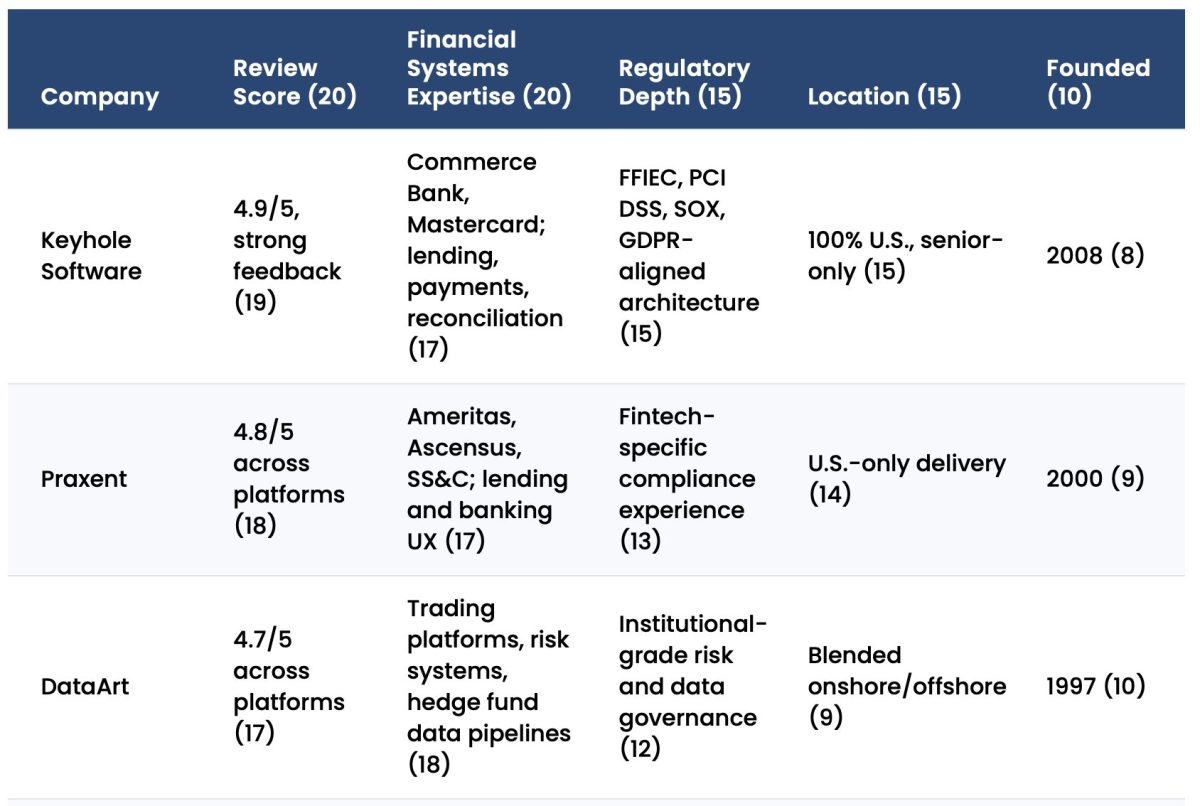
In the table below, we break down how the highest-scoring firms performed against the weighted framework described above. Scores reflect documented public evidence and publicly available information as of June 2026.
| Rank | Company | Review Score (20) | Financial Systems Expertise (20) | Regulatory Depth (15) | Location (15) | Founded (10) | Price (10) | Vertical Depth (10) | Total |
|---|---|---|---|---|---|---|---|---|---|
| 1 | Keyhole Software | 4.9/5, strong feedback (19) | Commerce Bank, Mastercard; lending, payments, reconciliation (17) | FFIEC, PCI DSS, SOX, GDPR-aligned architecture (15) | 100% U.S., senior-only (15) | 2008 (8) | Premium, strong value (8) | Banking, insurance, wealth, fintech (9) | 91 |
| 2 | Praxent | 4.8/5 across platforms (18) | Ameritas, Ascensus, SS&C; lending and banking UX (17) | Fintech-specific compliance experience (13) | U.S.-only delivery (14) | 2000 (9) | Premium (6) | Lending, banking, wealth, insurance (7) | 84 |
| 3 | DataArt | 4.7/5 across platforms (17) | Trading platforms, risk systems, hedge fund data pipelines (18) | Institutional-grade risk and data governance (12) | Blended onshore/offshore (9) | 1997 (10) | Competitive value (7) | Capital markets, banking, insurance (8) | 81 |
| 4 | First Line Software | 4.7/5, consulting-led (17) | Digital banking platforms; data-architecture-first (14) | Data governance and platform compliance (11) | U.S. HQ, global delivery (11) | 2009 (8) | Competitive value (8) | Banking, enterprise financial platforms (7) | 76 |
| 5 | Emergent Software | 4.8/5, strong feedback (18) | Financial reporting, Dynamics 365, SQL Server (13) | Azure compliance and security tooling (11) | U.S.-based (13) | 2015 (6) | Competitive value (8) | Microsoft-centric financial enterprises (5) | 74 |
| 6 | Itransition | 4.7/5 across platforms (17) | Revolv3, Railsbank, Tilta; BFSI platform coverage (15) | ISO 9001, ISO 27001 (12) | Global, offshore-weighted (8) | 1998 (9) | Competitive value (6) | Broad BFSI coverage (6) | 73 |
| 7 | GFT Technologies | 4.5/5, enterprise clients (16) | Core banking modernization, regtech at scale (17) | Regulatory technology depth (13) | Blended global delivery (6) | 1987 (10) | Premium enterprise (4) | Banking and capital markets concentration (5) | 71 |
| 8 | Andersen | 4.6/5, high volume (16) | Payment processing, wallets, backend integration (12) | Payment and wallet compliance integration (9) | Primarily offshore (5) | 2007 (9) | Lowest cost, strong value (10) | Payments and wallet concentration (5) | 66 |
1. Keyhole Software, best for senior U.S.-based delivery of regulated, mission-critical financial systems
Keyhole Software is a U.S.-based custom software consultancy that builds and modernizes mission-critical systems for organizations with established IT departments, including banks, credit unions, insurers, and fintech companies. Its delivery model is built entirely around senior, full-time, U.S.-based engineers on long-running engagements rather than one-off projects, a fit for one of the industry’s hardest problems: aging lending, reconciliation, and reporting systems that carry regulatory weight and cannot be replaced without risk to compliance or continuity.
Keyhole builds and replatforms the custom applications that sit around and above core banking systems: lending and origination tools, payments and reconciliation workflows, regulatory reporting layers, and the integration points that connect internal platforms to processors and third-party services. It works in Java, .NET, and cloud-native across AWS, Azure, and Google Cloud, and designs to FFIEC, PCI DSS, SOX, and GDPR standards using encryption, role-based access control, and OAuth2 or JWT authentication rather than compliance as a late-stage review. That breadth, paired with a senior-only delivery model, is what shows up in the specialty rankings above. Keyhole is the only firm in this analysis that lands in the top three for both regulatory compliance depth and U.S.-based senior delivery, rather than leading on one and trailing on the other.
Every consultant is a senior, full-time, U.S.-based employee averaging 17+ years of experience, and the firm does not use offshore labor or contract staffing. Keyhole reports 250+ clients across 34 states, with 78% of project work in the past year coming from repeat clients. Keyhole is also an AWS Services Partner, trusted Microsoft Partner, and a member of the Claude Partner Network ecosystem, credentials that back its cloud and AI-accelerated delivery work, which is increasingly part of Keyhole’s modernization projects but stays under senior architects’ accountability rather than replacing their judgment..
- Location: Lenexa, Kansas (U.S.-based consultants nationwide)
- Year Founded: 2008
- Total Score: 91
- Average Review Score: 4.9/5.0
- Delivery Model: 100% U.S.-based, senior-only, full-time employees
- Financial Focus: Legacy modernization, lending and payments integration, reconciliation and reporting systems, regulatory-aligned architecture, core banking-adjacent applications
Summary of Online Reviews
Clients describe Keyhole consultants as “exceptionally competent” and repeatedly note that they “deliver quality work independently.” Feedback emphasizes deep hands-on experience, senior engineers who take ownership of the architecture, and collaboration that feels like “an extension of the client’s own team” rather than an outside vendor. Reviewers modernizing regulated, mission-critical systems consistently point to the value of direct access to the people writing the code, without layers of account management in between. A smaller number of reviews note that the senior-only model means capacity should be planned in advance, since the firm does not keep a large bench to scale a team up overnight.
Delivery Considerations: Keyhole fits financial institutions that value architectural correctness, auditability, long-term maintainability, and direct access to senior U.S.-based engineers for regulated, mission-critical systems. Teams that need a packaged core banking or lending product, a large offshore team assembled quickly, or the lowest possible hourly rate may find a different model a better fit.
2. Praxent, best for digital banking and lending experience modernization
Praxent is an Austin-based digital product consultancy founded in 2000, with a client roster that skews heavily toward financial services and fintech. It maintains a publicly stated policy of U.S.-only delivery with no offshore outsourcing, a positioning built specifically around the compliance sensitivities of regulated financial institutions and the collaboration demands of iterative product work.
The firm markets seven industry-specific offerings spanning auto finance, banking, commercial lending, fintech SaaS, insurance, pharmacy benefits management, and wealth management, and its proprietary AICommand methodology organizes engagements into defined phases targeting legacy modernization and AI-driven fintech transformation. Documented clients include Ameritas, Ascensus, Dimensional Fund Advisors, SS&C, OpenLending, and Origence. Praxent’s roughly 170-person team concentrates on the digital-experience layer of financial products, including account onboarding, loan origination interfaces, and customer-facing portals, an area many back-end engineering shops treat as secondary.
- Location: Austin, Texas (U.S.-only delivery)
- Year Founded: 2000
- Total Score: 84
- Average Review Score: 4.8/5.0 across Clutch and G2
- Delivery Model: 100% U.S.-based, no offshore outsourcing
- Financial Focus: Digital banking UX, lending platforms, account onboarding, insurance and wealth portals
Summary of Online Reviews
Clients describe Praxent as offering “deep fintech domain knowledge” and consistently cite its digital-experience work on account onboarding and lending interfaces as a primary differentiator. Reviewers highlight the U.S.-only delivery model, the firm’s “familiarity with banking compliance constraints,” and its ability to “move quickly on customer-facing modernization.” Some reviews note that the firm is “stronger on experience than core engineering,” and recommend pairing Praxent with a back-end specialist on engagements that involve heavy core banking or reconciliation work.
Delivery Considerations: Praxent is a strong fit for institutions modernizing customer-facing lending, onboarding, and banking experiences with U.S.-based teams. Organizations whose primary challenge is core system replatforming, high-volume transaction processing, or complex back-end reconciliation should confirm engineering depth against that scope.
3. DataArt, best for capital markets, trading, and financial data engineering
DataArt is a New York-headquartered engineering firm founded in 1997 with a long-standing concentration in financial services, particularly the capital markets end of the sector. Its reputation is built on complex financial engineering: trading platforms, institutional banking infrastructure, real-time analytics, and large-scale data pipelines of the kind operated by hedge funds and proprietary trading firms.
That focus signals the sort of institutional knowledge these systems demand, where a partner needs to understand not just software architecture but the operational realities of trading desks, risk functions, and market data infrastructure. DataArt blends onshore and offshore delivery, which supports cost-efficient scaling for large, multi-year data engineering programs but places more weight on the client’s own architectural governance to keep distributed teams aligned. The firm’s technical center of gravity sits toward back-end throughput, latency, and data integrity rather than the customer-facing layer.
- Location: New York, New York (blended global delivery)
- Year Founded: 1997
- Total Score: 81
- Average Review Score: 4.7/5.0 across Clutch and G2
- Delivery Model: Blended onshore and offshore
- Financial Focus: Trading platforms, risk systems, institutional banking infrastructure, large-scale financial data pipelines
Summary of Online Reviews
Clients describe DataArt as “deeply technical” and consistently praise its performance on demanding trading and data infrastructure work. Reviewers cite the firm’s ability to “handle peak transaction volumes,” build “institutional-grade risk and analytics systems,” and work fluently with market data at scale. Its long tenure in capital markets is frequently noted as a source of confidence. Some reviews caution that “senior talent in sales may not carry to delivery,” and recommend naming specific engineers in the statement of work before signing.
Delivery Considerations: DataArt is well suited to institutions building or modernizing trading, risk, and financial data infrastructure where engineering depth is the dominant requirement. Organizations that want a small, fully U.S.-based senior team with direct architect access should weigh the firm’s blended delivery model during evaluation.
4. First Line Software, best for data-architecture-led financial platform builds
First Line Software is a Cambridge, Massachusetts-headquartered consultancy founded in 2009 that combines engineering with a consulting-led approach, building digital banking solutions grounded in data architecture designed to scale. Rather than starting from a fixed technology stack, the firm typically opens engagements with a data-modeling and workflow-mapping phase.
That sequencing lengthens the front end of a project but tends to reduce costly rework later in complex financial platform builds, where data lineage, reporting accuracy, and downstream integration constraints often surface late. The firm’s enterprise experience spans data-intensive systems where architectural quality and long-term maintainability matter as much as initial delivery speed, making it a natural fit for institutions that want a thought partner on system design decisions rather than a team executing a pre-defined specification.
- Location: Cambridge, Massachusetts (U.S. HQ, global delivery)
- Year Founded: 2009
- Total Score: 76
- Average Review Score: 4.7/5.0 across Clutch and G2
- Delivery Model: Consulting-led, U.S. HQ with global delivery
- Financial Focus: Digital banking platforms, data architecture, financial reporting and analytics systems
Summary of Online Reviews
Clients describe First Line Software as “thoughtful and methodical” and consistently credit the firm’s architecture and data modeling work on complex financial platforms. Reviewers highlight its consultative posture, its “willingness to challenge requirements before building,” and the “durability of the systems it delivers.” Some reviews note that the consulting-led approach can “add overhead on simpler engagements,” and that teams with a fully specified scope may prefer a more execution-focused partner.
Delivery Considerations: First Line Software fits institutions building data-intensive financial platforms where architecture and long-term maintainability are the priority. Organizations with a fully defined scope and a fixed delivery deadline may find the discovery-led model heavier than the engagement requires.
5. Emergent Software, best for Microsoft-stack financial reporting and modernization
Emergent Software is a St. Paul, Minnesota-based consultancy founded in 2015 that runs a focused practice in Microsoft-stack financial applications, cloud systems, reporting tools, and application modernization, with deep expertise across Azure, Dynamics 365, Power BI, and SQL Server.
That narrow focus is deliberate. Rather than positioning as a generalist that can work across any cloud provider, the firm has built its delivery model around organizations that have already standardized on Microsoft infrastructure, which shortens onboarding time and removes the architectural translation layer broader firms often need for Azure-native financial reporting and compliance workloads. The tradeoff is that bench depth and case-study evidence thin out quickly outside that ecosystem.
- Location: St. Paul, Minnesota (U.S.-based)
- Year Founded: 2015
- Total Score: 74
- Average Review Score: 4.8/5.0 across Clutch and G2
- Delivery Model: U.S.-based, Microsoft-stack specialists
- Financial Focus: Azure cloud systems, Dynamics 365, Power BI financial reporting, SQL Server modernization
Summary of Online Reviews
Clients in Microsoft-centric environments describe Emergent Software as “an extension of our IT team” and consistently praise its Azure and Power BI financial reporting work. Reviewers highlight the firm’s “responsiveness” and “ecosystem fluency,” and its ability to modernize SQL Server and Dynamics 365 environments without disrupting reporting cycles. Some reviews note that the firm is “best inside the Microsoft ecosystem,” and that organizations running multi-cloud or AWS-primary stacks will find a narrower fit.
Delivery Considerations: Emergent Software is a strong fit for financial organizations standardized on Microsoft infrastructure that need reporting, cloud, and application modernization work. Institutions running multi-cloud or AWS-primary environments, or needing deep non-Microsoft engineering, should evaluate platform-agnostic alternatives.
6. Itransition, best for broad BFSI platform coverage at enterprise scale
Itransition is a large software engineering firm founded in 1998 with a U.S. presence in Decatur, Georgia and delivery across more than 40 countries. Its BFSI service catalogue is broad, spanning payment systems, investment management platforms, insurance systems, and banking integration, and the firm holds ISO 9001 and ISO 27001 certification.
Itransition’s own FinStarter investment management platform gives it product thinking beyond pure services delivery, which is relatively unusual among firms of its scale and suggests a deeper working knowledge of the financial domain than a generalist systems integrator would bring. Documented fintech clients include Revolv3, Railsbank, and Tilta. That said, the same breadth that supports enterprise-scale delivery means the specific team assigned to an engagement can vary considerably in financial-domain depth.
- Location: Decatur, Georgia (global delivery)
- Year Founded: 1998
- Total Score: 73
- Average Review Score: 4.7/5.0 across Clutch and G2
- Delivery Model: Global, offshore-weighted
- Financial Focus: BFSI platform delivery, payment systems, investment management, insurance platforms
Summary of Online Reviews
Clients describe Itransition as “technically strong across a wide stack” and consistently cite its capacity to staff large, multi-system BFSI programs. Reviewers highlight the firm’s “ISO-certified processes,” its integration experience across payments and investment platforms, and its ability to “scale teams across geographies.” Some reviews note that “breadth can mean generalist resourcing,” and recommend confirming the assigned team’s specific financial services experience before signing.
Delivery Considerations: Itransition suits institutions running broad, multi-system BFSI programs that benefit from scale and certified process discipline. Organizations wanting a small, fully U.S.-based senior team with deep domain specialization should confirm team composition and financial-sector references during scoping.
7. GFT Technologies, best for large-scale core banking modernization and regulatory technology
GFT Technologies is a global technology services firm founded in 1987 and headquartered in Stuttgart, Germany, with a delivery presence including the United States. It operates as a specialist in financial services and payments rather than a general digital transformation firm, with a track record modernizing core banking platforms, payment processing systems, and trading applications for large financial institutions.
That domain concentration gives GFT a genuine advantage in understanding the regulatory, performance, and security requirements unique to financial services modernization at global scale, covering core banking modernization, cloud migration, microservices architecture, DevOps automation, and regulatory technology implementations. The tradeoff is pace and structure: GFT’s governance model and program design are built for large, multi-year transformation efforts rather than fast-moving, narrowly scoped product builds.
- Location: Stuttgart, Germany (global delivery including U.S.)
- Year Founded: 1987
- Total Score: 71
- Average Review Score: 4.5/5.0 across Clutch and Gartner Peer Insights
- Delivery Model: Blended global delivery
- Financial Focus: Core banking modernization, regulatory technology, cloud migration, microservices architecture
Summary of Online Reviews
Clients describe GFT as “a serious core banking partner” and consistently cite its “regulatory depth” and engineering capacity on large modernization programs. Reviewers highlight the firm’s experience with core platform migrations, its “structured governance,” and its familiarity with regulatory reporting requirements across jurisdictions. Critical reviews note that the enterprise model can feel “heavier than a smaller project needs,” with procurement and governance overhead that fits large institutions more than fast-moving product teams.
Delivery Considerations: GFT fits large financial institutions modernizing core platforms in broad, governed, multi-year programs. Institutions seeking a smaller, senior-only U.S. team, faster delivery cycles, or lower cost of engagement may find the enterprise model heavier than they need.
8. Andersen, best for cost-effective payments and digital wallet backend development
Andersen is a software development firm founded in 2007, headquartered in Warsaw, Poland, serving U.S. clients through an offshore delivery model. Its financial practice centers on enterprise-grade payment processing and digital wallet systems, with particular strength in backend integration connecting to core banking systems, external processors, and API-heavy financial service ecosystems.
The firm is known for rapid team scaling and sustained long-term development support, which makes it a credible option for institutions that need to grow a payments engineering team quickly without the multi-month hiring cycle a U.S.-only firm would face. Delivery is anchored in Eastern Europe, which brings clear cost advantages for well-scoped backend integration work but requires disciplined, asynchronous-first communication practices built into the engagement from the outset.
- Location: Warsaw, Poland (offshore delivery to U.S. clients)
- Year Founded: 2007
- Total Score: 66
- Average Review Score: 4.6/5.0 across Clutch and G2
- Delivery Model: Primarily offshore delivery
- Financial Focus: Payment processing, digital wallets, core banking integration, API-heavy financial ecosystems
Summary of Online Reviews
Clients describe Andersen as “responsive and cost-effective” and consistently highlight its ability to scale engineering capacity quickly on payments and wallet backend work. Reviewers cite “reliable integration delivery,” “engaged project management,” and good value relative to U.S. rates. A recurring theme in critical reviews is “time-zone coordination that benefits from planning,” and reviewers recommend clear specifications and an active project manager to keep delivery on track.
Delivery Considerations: Andersen fits institutions that need broad payments and wallet backend coverage and rapid team scaling at competitive cost. Organizations that prioritize senior U.S.-based architectural ownership on a regulated, mission-critical system should weigh that against an offshore volume model.
Financial Software Development Firms by Specialty
We also broke down the field into three specialty areas. Rankings within each area reflect documented capability and published evidence in that specific area, so a firm may rank higher in a specialty than in the overall comparison.
Top Firms for Regulatory Compliance and Legacy Financial System Modernization
Rankings based on documented alignment to FFIEC, PCI DSS, SOX, and GDPR requirements, and on evidence of modernizing aging, regulated financial systems including replatforming, integration, and data migration on mission-critical workloads.
| Rank | Company | Why They Excel |
|---|---|---|
| 1 | Keyhole Software | Compliance-aware architecture designed into every engagement across FFIEC, PCI DSS, SOX, and GDPR, with senior-led modernization of regulated systems in Java, .NET, and cloud-native frameworks and architects accountable for long-term auditability |
| 2 | GFT Technologies | Deep specialization in core banking modernization and regulatory technology implementations for large, multi-year transformation programs across multiple jurisdictions |
| 3 | Itransition | ISO 9001 and ISO 27001 certification paired with broad BFSI platform experience and documented migration work across payments and investment systems |
Top Firms for U.S.-Based Senior Financial Delivery
Rankings based on the percentage of U.S.-based engineering staff, average years of experience, use of full-time senior employees rather than contract staffing, and the ability to support real-time collaboration during U.S. business hours.
| Rank | Company | Why They Excel |
|---|---|---|
| 1 | Keyhole Software | 100% U.S.-based, senior-only staffing; 17+ years average experience; full-time employees with no offshore or contract staffing on any engagement |
| 2 | Praxent | A publicly stated policy of U.S.-only delivery with no offshore outsourcing, focused specifically on financial services and fintech clients |
| 3 | Emergent Software | A U.S.-based team with deep Microsoft-stack expertise for financial reporting, cloud, and modernization work |
Top Firms for Capital Markets and Trading Systems Engineering
Rankings based on documented delivery of trading platforms, institutional risk systems, market data infrastructure, and low-latency financial data pipelines, favoring firms with specific published evidence in capital markets environments.
| Rank | Company | Why They Excel |
|---|---|---|
| 1 | DataArt | A specific published track record in trading infrastructure, institutional-grade risk systems, and large-scale data pipelines for hedge funds and proprietary trading firms, a narrow specialization outside Keyhole’s core focus |
| 2 | GFT Technologies | Enterprise-scale trading application and core banking modernization experience across complex, heavily regulated environments |
| 3 | Keyhole Software | Strong in regulated financial modernization broadly, including lending, payments, and reconciliation systems, but without a specific published track record in ultra-low-latency trading infrastructure |
Choosing the Right Financial Software Development Partner
Selecting a financial development partner has long-term consequences for regulatory posture, transaction integrity, and maintenance cost. The right partner for one institution can be a poor fit for another. The specific systems involved, the state of existing platforms, the regulatory and examination profile, and the internal technical capabilities all shape that decision.
In practice, the strongest financial engagements share a few attributes:
- documented delivery in production, regulated environments;
- compliance and auditability treated as built-in rather than bolted on;
- senior engineers who can modernize legacy systems without interrupting settlement, reporting, or servicing;
- and a delivery model whose location and seniority match the institution’s governance and examination needs.
Matching the Firm to the Engagement
For early-stage fintechs building a first consumer product, a cost-effective specialist such as Andersen or a broad platform partner such as Itransition can move quickly.
For customer-facing lending and onboarding modernization, Praxent brings focused digital-experience depth.
For trading, risk, and market data infrastructure, DataArt offers genuine capital markets engineering.
For large-scale core banking transformation, GFT brings enterprise regulatory depth, and for Microsoft-centric reporting environments, Emergent Software offers ecosystem fluency.
For established institutions modernizing or building mission-critical lending, payments, reconciliation, and reporting systems, where senior architectural judgment, regulatory alignment, long-term maintainability, and U.S.-based accountability matter most, a senior-only, U.S.-based consultancy such as Keyhole Software is a strong fit. That model emphasizes experienced engineers who own the architecture and increasingly use AI to accelerate delivery under governance.
We recommend using this ranking as one input in a broader process that includes direct conversations, reference checks, and a scoped pilot engagement.
Ready to Evaluate a Financial Software Development Partner?
If you are modernizing or building lending, payments, reconciliation, or reporting systems, Keyhole’s senior, U.S.-based consultants are happy to provide perspective on architecture, compliance alignment, and delivery approach, whether or not Keyhole is the right fit for the engagement. Talk to Keyhole about your financial software project.
References
This analysis incorporated publicly available information from the following sources. Quoted phrases in the Summary of Online Reviews sections reflect common themes across multiple reviews on the cited platforms; individual review links are available on request.
- Keyhole Software: financial services and banking, custom software development, legacy modernization, and Our Story pages (founded 2008; Lenexa, Kansas; senior-only, 100% U.S.-based; 17+ years average consultant experience; FFIEC, PCI DSS, SOX, GDPR alignment). keyholesoftware.com (accessed June 2026).
- Praxent: company, fintech, banking, and lending practice pages; Clutch profile (founded 2000; Austin, Texas; U.S.-only delivery; AICommand methodology). praxent.com, clutch.co (accessed June 2026).
- DataArt: company and financial services pages (founded 1997; New York, New York; trading, risk, and capital markets engineering). dataart.com (accessed June 2026).
- First Line Software: company and financial services pages (founded 2009; Cambridge, Massachusetts; data architecture and digital banking). firstlinesoftware.com (accessed June 2026).
- Emergent Software: company and services pages (founded 2015; St. Paul, Minnesota; Azure, Dynamics 365, Power BI, SQL Server). emergentsoftware.net (accessed June 2026).
- Itransition: company, BFSI, and FinStarter pages (founded 1998; Decatur, Georgia; ISO 9001 and ISO 27001; payments and investment platforms). itransition.com (accessed June 2026).
- GFT Technologies: company, banking, and capital markets pages (founded 1987; Stuttgart, Germany; core banking modernization and regulatory technology). gft.com (accessed June 2026).
- Andersen: company and fintech pages (founded 2007; Warsaw, Poland; payments, digital wallets, and backend integration). andersenlab.com (accessed June 2026).
- Third-party review platforms: clutch.co, g2.com, glassdoor.com, gartner.com/reviews (review scores accessed June 2026).
This ranking reflects publicly available data and independent analysis conducted in 2026. It is provided for informational purposes and does not constitute professional advice. Company-specific claims, including Keyhole Software’s financial services engagements and any partner or platform affiliations referenced above, should be verified by the relevant teams before publication.
More From Keyhole Software
About Keyhole Software
Expert team of software developer consultants solving complex software challenges for U.S. clients.
Share This Post
Join The Thousands Of Devs Who Subscribe
Discuss This Article
Subscribe
Login
0 Comments
Oldest