
Top Enterprise AI Development Services (2026)
Between January 2025 and June 2026, our research team reviewed more than 35 firms that provide enterprise AI development services, then scored the eight strongest against a consistent framework. The analysis draws on company websites, published case studies, third-party review platforms, and industry recognitions to compare how each firm actually delivers, not just how it markets itself.
When an enterprise evaluates an AI development partner, the hardest thing to assess is not who can call a model API. It is which firms can run agents against real production repositories under architectural governance, and which are demonstrating capability through sandboxed prototypes and internal tooling experiments that never touch a regulated codebase. Gartner projects that 40 percent of enterprise applications will feature task-specific AI agents by 2026, up from less than 5 percent in 202511, and adoption is now outpacing most organizations’ ability to evaluate vendors on anything more rigorous than marketing claims.
This analysis focuses on delivery: documented production agentic evidence, technical depth across agents and supporting architecture, the governance that keeps agent-written code accountable, and the seniority and location of the people reviewing the output.
This evaluation is weighted toward established organizations introducing agentic and AI-accelerated delivery into existing, business-critical codebases, the segment where architectural control, auditability, and long-term maintainability matter most. It is less focused on greenfield AI product startups building a first model-native application, a segment several firms below serve well and where a different set of strengths applies.
How We Evaluated Enterprise AI Development Firms
We scored each firm against seven weighted factors totaling 100 points:
- Average Review Score (20%): aggregated client ratings and feedback across third-party platforms, weighted toward recent and AI-relevant engagements.
- Production Agentic Delivery (20%): documented case studies showing autonomous agents running against real repositories or workflows with measurable outcomes, rather than pilots and internal demonstrations.
- AI and Architecture Technical Depth (15%): working fluency across agentic coding agents, model context integration, retrieval architecture, and the supporting engineering required to run them safely.
- Location and Delivery Model (15%): U.S.-based versus nearshore versus offshore composition, and the ability to have senior engineers review agent output in real time during U.S. business hours.
- PAI Delivery Frameworks and Accelerators (10%): reusable workflow templates, published methodology, and governance scaffolding that make agentic delivery repeatable rather than dependent on individual practitioners. Purpose-built AI delivery frameworks score highest; general-purpose engineering frameworks and open-source stewardship earn partial credit as evidence of engineering depth rather than AI delivery capability.
- Year Founded (10%): longevity and organizational maturity, used as a proxy for delivery stability and the depth of accumulated engineering experience underneath the AI practice.
- Governance and Test-Gated Practices (10%): documented guardrails, architect review, continuous-integration-enforced architectural boundaries, and automated test gates applied to agent-written code.
Editorial Process and Independence
This ranking was compiled using publicly available information, third-party profiles, published client feedback, and verified project case studies. The evaluation framework was defined before scoring and applied consistently to every company in the dataset. Keyhole Software publishes this analysis and is included among the evaluated firms. All companies, including Keyhole, were scored using the same criteria and the same public 2025 to 2026 data. No company paid for placement or ranking position, and rankings reflect only the defined criteria.
A Note on Limitations: This ranking is based on public information and may not capture private, non-disclosed agentic engagements, internal AI tooling built under confidentiality, or delivery metrics firms choose not to publish. Agentic capability is also moving quickly, and a firm’s public positioning may lag its actual practice. This is one input among many that organizations should use when evaluating potential development partners.
Top Enterprise AI Development Services (2026)
In the table below, we break down how the highest-scoring firms performed against the weighted framework described above. Scores reflect documented public evidence and publicly available information as of June 2026.
| Rank | Company | Review Score (20) | Production Agentic Delivery (20) | AI & Architecture Depth (15) | Location (15) | AI Frameworks (10) | Founded (10) | Governance (10) | Total |
|---|---|---|---|---|---|---|---|---|---|
| 1 | Keyhole Software | 4.9/5, strong feedback (19) | KC insurance platform in ~5 months vs. 18-24 projected (19) | Claude Partner Network; MCP and agent orchestration (14) | 100% U.S., senior-only (15) | Ralph Loop; reusable agentic templates (10) | 2008 (7) | Test-gated, commit-level traceability (9) | 93 |
| 2 | Stride Consulting | 4.8/5 across platforms (18) | Clinical AI agent; healthcare and finance deployments (17) | Agent Feasibility Sprint; agentic architecture (13) | 100% U.S.-based senior engineers (14) | 100x agent for legacy modernization (9) | 2014 (6) | Human-in-the-loop with approval gates (8) | 85 |
| 3 | Excella | 4.7/5, federal and commercial (17) | Federal modernization; autonomous task systems (14) | Agentic AI, DevSecOps for AI, MLOps/LLMOps (13) | 100% U.S.-based (14) | Responsible AI First framework (8) | 2002 (8) | Responsible AI First; DevSecOps for AI (8) | 82 |
| 4 | Chariot Solutions | 4.8/5, strong feedback (18) | Enterprise Java and cloud with LLM apps and RAG (12) | AI and Intelligent Agents practice (12) | 100% U.S.-based senior consultants (14) | Custom LLM app and RAG patterns (6) | 2002 (8) | Senior-architect delivery with quality gates (8) | 78 |
| 5 | Object Computing | 4.7/5, long-tenure clients (17) | Enterprise Java; OpenDDS and Micronaut stewardship (10) | Deep Java; agentic AI not foregrounded (12) | U.S.-based, Midwest HQ (13) | OpenDDS, Micronaut (general-purpose open source) (5) | 1993 (9) | Architect-led delivery (7) | 73 |
| 6 | Ippon USA | 4.7/5 across platforms (17) | AWS GenAI Competency (2025); Java modernization (11) | Java/Spring; Bedrock, SageMaker, Amazon Q (13) | U.S. HQ; French parent (10) | JHipster (open source) (6) | 2014 (6) | Architect-led modernization (7) | 70 |
| 7 | SEP | 4.8/5, high satisfaction (18) | MedTech, industrial, fintech custom software (8) | Senior bench; agentic AI not a named practice (10) | 100% U.S.-based, employee-owned (14) | Internal engineering playbooks (non-AI) (3) | 1988 (10) | Agile delivery with quality gates (6) | 69 |
| 8 | Improving | 4.7/5, broad client base (17) | 20-plus offices; 3,000-plus consultants (8) | Agile engineering and training; agentic AI emerging (10) | U.S. and Canada (12) | Improving Method (general agile framework) (4) | 2007 (7) | Agile quality practices (8) | 66 |
1. Keyhole Software, best for governed, production-grade agentic delivery inside enterprise SDLCs
Keyhole Software is a U.S.-based custom software consultancy that builds and modernizes mission-critical systems for organizations with established IT departments. Its AI practice runs agentic coding workflows inside the same governed development lifecycle used across its non-AI delivery work, with every agent commit passing through architect review, automated test gates, and commit-level traceability before reaching the main branch.
A documented case study shows a Kansas City insurance platform replacement, covering the user interface, services, database, and administrative tooling, completed in roughly five months with two senior consultants against an 18 to 24 month estimate without AI tooling1. The firm’s Ralph Loop methodology, published as a reference implementation, demonstrates how agents execute against real development backlogs inside controlled environments rather than as isolated experiments. The same model shows up elsewhere: a legacy Delphi application for a healthcare and pharmacy client, its business logic undocumented outside the code itself, modernized 40 percent faster than estimate after the team used LLMs to reverse-engineer and document the system before touching it.
Keyhole’s selection into the Claude Partner Network and its invitation to the 2026 Anthropic Partner Summit provide external validation of the approach3. Delivery spans .NET, Java, JavaScript, and Python across AWS, Azure, and Google Cloud, and every consultant is a senior, full-time, U.S.-based employee averaging 17+ years of experience, with 78% of project work in the past year coming from repeat clients1. Throughput gains come from agent-accelerated execution inside senior teams rather than from scaling headcount, which keeps architectural ownership intact as delivery speed increases.
- Location: Lenexa, Kansas (U.S.-based consultants nationwide)
- Year Founded: 2008
- Total Score: 93
- Average Review Score: 4.9/5.0
- Delivery Model: 100% U.S.-based, senior-only, full-time employees
- AI Focus: Architect-governed agentic coding workflows, legacy modernization, LLM application development, AI-accelerated Java and .NET delivery
Summary of Online Reviews
Clients describe Keyhole consultants as “exceptionally competent” and repeatedly note that they “deliver quality work independently.” Feedback emphasizes senior engineers who take ownership of the architecture, disciplined use of AI tooling under human review, and collaboration that feels like “an extension of the client’s own team” rather than an outside vendor. Reviewers modernizing mission-critical systems consistently point to the value of direct access to the people writing and reviewing the code. A smaller number of reviews note that the senior-only model means capacity should be planned in advance, since the firm does not keep a large bench to scale a team up overnight.
Delivery Considerations: Keyhole fits enterprises introducing agentic delivery into existing, business-critical codebases where architectural control, auditability, and long-term maintainability are non-negotiable. Teams that need a packaged AI product, a large offshore team assembled quickly, or a low-cost prototype to test feasibility may find a different model a better fit.
2. Stride Consulting, best for agent-accelerated legacy modernization and rapid agentic proofs of concept
Stride Consulting is a New York-based boutique engineering consultancy founded in 2014 by Debbie Madden, with a senior-engineer delivery model and one of the more developed public agentic AI positions among scale-matched peers. Its differentiator is a proprietary 100x agent for legacy modernization that autonomously maps, documents, and refactors legacy monoliths while generating its own tests and tracing hidden dependencies.
The firm publishes a clinical AI agent case study alongside production-grade agentic deployments in regulated industries including healthcare, financial services, and operations. Stride’s agentic architecture is built around human-in-the-loop design, with confidence thresholds, approval gates, and escalation paths defined during the architecture phase rather than retrofitted after deployment. Its Agent Feasibility Sprint offering gives organizations a structured, short-duration path to test whether a specific workflow is a viable agentic candidate before committing to a full program, which is a meaningfully different entry point than a sustained modernization engagement.
- Location: New York, New York (U.S.-based delivery)
- Year Founded: 2014
- Total Score: 85
- Average Review Score: 4.8/5.0 across Clutch and G2
- Delivery Model: Remote onshore/nearshore hybrid teams, embedded pairing
- AI Focus: Autonomous legacy-monolith mapping and refactoring, agentic proofs of concept, human-in-the-loop agent architecture
Summary of Online Reviews
Clients describe Stride as delivering “predictable estimates every sprint” and consistently praise its senior-engineer pairing model on complex modernization work. Reviewers highlight the firm’s agentic AI focus, its “willingness to define approval gates up front,” and the “speed of its feasibility sprints.” Some reviews note the firm’s “premium pricing for a boutique team,” and organizations running large-scale enterprise programs should verify bench depth against the firm’s smaller footprint during scoping.
Delivery Considerations: Stride is a strong fit for organizations that want senior-engineer pairing and a fast, structured path to validating agentic use cases before committing to a larger program. Enterprises running multi-year, multi-team modernization programs should confirm the firm can resource sustained delivery at the required scale.
3. Excella, best for governance-first AI delivery for compliance-heavy organizations
Excella is a U.S.-based agile engineering consultancy headquartered in Arlington, Virginia, founded in 2002, with a delivery practice spanning federal government modernization and commercial enterprise platforms. Its federal-grade governance, security accreditation, and documentation discipline transfer directly to regulated commercial programs where audit trails and compliance overhead are already first-class concerns.
The firm’s Agentic AI offering deploys autonomous systems that plan, execute, and adapt complex tasks under human oversight, supported by DevSecOps principles applied to AI development, MLOps and LLMOps automation for governance and monitoring, and a Responsible AI First methodology that prioritizes safety, security, and compliance ahead of raw delivery speed. Documented engagements span U.S. civilian agencies, defense-adjacent programs, and commercial modernization. Excella’s public positioning is notably mature on responsible AI and enterprise machine learning operations, though a named agentic coding-agent framework with published software-delivery case studies is less prominent than its governance and operations work.
- Location: Arlington, Virginia (U.S.-based delivery)
- Year Founded: 2002
- Total Score: 82
- Average Review Score: 4.7/5.0 across Clutch and G2
- Delivery Model: 100% U.S.-based, federal and commercial delivery
- AI Focus: Responsible AI methodology, DevSecOps for AI, MLOps and LLMOps governance, autonomous task systems with human oversight
Summary of Online Reviews
Clients describe Excella as bringing “federal-grade rigor” to commercial programs and consistently cite its governance discipline as a differentiator. Reviewers highlight the Responsible AI methodology, its “strong DevSecOps practice,” and thorough “documentation that holds up under audit.” Some reviews note a “cost structure built for federal budgets,” and mid-market commercial buyers should confirm scope and pricing fit before engaging.
Delivery Considerations: Excella fits compliance-heavy organizations that need AI capability delivered under formal governance, documentation, and security controls. Organizations seeking a lean, fast-moving agentic coding practice or the lowest cost of delivery may find the governance-first model heavier than the engagement requires.
4. Chariot Solutions, best for intelligent agents layered onto senior Java and reactive systems work
Chariot Solutions is a Philadelphia-area consultancy founded in 2002 whose public positioning centers on senior Java, Spring, reactive systems, and cloud modernization, anchored by a long history of practitioner-led content including a technical podcast, conference talks, and open-source contributions that signal a firm built around hands-on engineering rather than broad digital transformation services.
The firm publishes a dedicated AI and Intelligent Agents offering covering custom LLM applications, retrieval-augmented knowledge bases, and domain-specific agents for enterprise clients, with documented engagements spanning financial services, pharmaceuticals, and enterprise technology. Chariot is best understood as a firm integrating intelligent agents into existing software delivery rather than operating a fully architect-governed agentic coding model with production case evidence, which makes it a credible option where senior architectural judgment on Java or reactive platforms is the primary requirement and intelligent-agent applications are a supporting goal.
- Location: Fort Washington, Pennsylvania (U.S.-based delivery)
- Year Founded: 2002
- Total Score: 78
- Average Review Score: 4.8/5.0 across Clutch and G2
- Delivery Model: 100% U.S.-based senior consultants
- AI Focus: Custom LLM applications, RAG-powered knowledge bases, domain-specific intelligent agents, Java and Spring modernization
Summary of Online Reviews
Clients describe Chariot as offering “deep Java and Spring expertise” and consistently praise its senior consultant model on complex platform work. Reviewers highlight the firm’s “engineering culture,” its practitioner-led technical community presence, and the “quality of its retrieval and LLM application builds.” Some reviews note that the firm’s “smaller scale suits focused engagements,” and organizations needing large-program capacity should confirm resourcing during scoping.
Delivery Considerations: Chariot fits organizations layering intelligent agents and LLM applications onto existing Java, Spring, or reactive systems platforms with senior U.S.-based engineers. Enterprises seeking a production agentic coding practice with published delivery metrics, or large multi-team program capacity, should weigh those requirements during evaluation.
5. Object Computing, best for AI acceleration on long-lived enterprise Java platforms
Object Computing is a Missouri-based software engineering consultancy founded in 1993 whose public positioning centers on enterprise Java, distributed systems, and open-source stewardship of projects including OpenDDS and Micronaut. Its reputation is built on architectural depth for long-lived, mission-critical platforms.
That foundation is directly relevant to introducing agentic workflows into existing codebases without destabilizing them, an important consideration for organizations wary of AI acceleration introducing silent regressions into systems that have run for decades. Documented engagements span financial services, manufacturing, healthcare, and public sector work, typically centered on enterprise Java modernization and distributed systems engineering. Agentic AI is not currently a flagship service line; it appears as a capability layered onto senior-engineer delivery rather than a dedicated practice with a named methodology or published agentic case studies.
- Location: Creve Coeur, Missouri (U.S.-based delivery)
- Year Founded: 1993
- Total Score: 73
- Average Review Score: 4.7/5.0 across Clutch and G2
- Delivery Model: U.S.-based, Midwest headquarters
- AI Focus: Enterprise Java and distributed systems, open-source stewardship, AI capability layered onto senior engineering delivery
Summary of Online Reviews
Clients describe Object Computing as delivering “rock-solid Java modernization” and consistently cite its open-source contributions as evidence of genuine engineering depth. Reviewers highlight its “architectural continuity,” long consultant tenure, and “reliability on distributed systems work.” Some reviews note that the firm’s “AI positioning is less prominent” than more AI-forward competitors, and organizations selecting primarily on agentic capability should confirm current practice maturity.
Delivery Considerations: Object Computing fits organizations with long-lived enterprise Java platforms that want AI acceleration introduced carefully, under architects who understand the existing system. Buyers whose primary selection criterion is a documented, production-proven agentic delivery framework should weigh that against the firm’s current public positioning.
6. Ippon USA, best for AWS-centered generative AI on Spring and Java platforms
Ippon USA is the U.S. arm of a French parent firm, established in the U.S. market since 2014, with enterprise Java, Spring, AWS, and data engineering as core capabilities. Its active maintainership of JHipster, a widely used open-source application generator for Spring Boot and modern JavaScript stacks, anchors its technical credibility in the Java ecosystem.
In July 2025 the firm achieved the AWS Generative AI Competency, a validated designation for firms with documented expertise designing, deploying, and managing large-scale generative AI solutions on services including Amazon Bedrock, SageMaker, and Amazon Q8. Ippon’s AI capabilities are strongest within that AWS ecosystem, with agentic delivery emerging as an extension of its cloud-native and data engineering practices rather than a standalone, production-governed delivery model. Teams requiring strictly U.S.-based senior delivery should factor the firm’s global structure into scoping, since the French parent and international offices can shape team composition and time-zone coverage in ways that affect the real-time review loops agentic workflows depend on.
- Location: Richmond, Virginia (U.S. HQ, French parent)
- Year Founded: 2014
- Total Score: 70
- Average Review Score: 4.7/5.0 across Clutch and G2
- Delivery Model: U.S. HQ with international offices
- AI Focus: AWS generative AI on Bedrock, SageMaker, and Amazon Q; Java and Spring modernization; data engineering
Summary of Online Reviews
Clients describe Ippon as strong on “AWS cloud and generative AI” and frequently credit its JHipster expertise with “accelerating Spring Boot delivery.” Reviewers highlight the firm’s Java depth, its AWS competency validation, and its “solid data engineering practice.” Some reviews note “variable team composition across offices,” and organizations requiring fully U.S.-based senior delivery should confirm staffing during scoping.
Delivery Considerations: Ippon USA fits organizations standardized on AWS and the Spring or Java ecosystem that want validated generative AI capability alongside modernization work. Teams requiring 100 percent U.S.-based senior staffing or a governed agentic coding practice should confirm both against the firm’s delivery structure.
7. SEP, best for regulated-industry product engineering with long team continuity
SEP, or Software Engineering Professionals, is an employee-owned custom software firm in Carmel, Indiana, founded in 1988, with documented delivery across medical device, industrial, and financial technology clients. Employee ownership since 2010 produces unusually long consultant tenure.
That continuity is a real advantage on multi-year platform programs and regulated-industry engagements, where vendor-side turnover shows up as rework and lost institutional knowledge rather than as a line item. The firm’s public service mix is product engineering, user experience, and agile delivery staffed by senior U.S.-based engineers. Agentic AI software development is not a named practice on the firm’s public site; it appears as an emerging capability applied within existing engagements rather than a differentiated offering with a published workflow framework or agentic case evidence.
- Location: Carmel, Indiana (U.S.-based delivery)
- Year Founded: 1988
- Total Score: 69
- Average Review Score: 4.8/5.0 across Clutch and G2
- Delivery Model: Employee-owned, 100% U.S.-based
- AI Focus: Medical device, industrial, and financial technology product engineering; agile delivery; AI as an emerging capability
Summary of Online Reviews
Clients describe SEP as “collaborative from kickoff to launch” and consistently praise its project management and regulated-industry delivery discipline. Reviewers highlight team stability, its “thorough requirements work,” and “quality that justifies the rate.” A recurring theme is that the firm “commands premium rates,” and buyers selecting primarily on agentic AI capability should confirm current practice maturity before engaging.
Delivery Considerations: SEP fits regulated-industry organizations that prioritize team continuity, product engineering rigor, and long-term partnership over rapid AI-first positioning. Organizations whose primary requirement is a documented production agentic delivery practice should weigh that against the firm’s current public offering.
8. Improving, best for multi-office delivery capacity paired with internal AI capability training
Improving is a multi-city U.S. and Canada consultancy founded in 2007, with custom software development, agile coaching, and professional training as its core practice areas, anchored by the internal Improving Method framework. Its footprint spans more than 20 offices across Dallas, Houston, Columbus, Atlanta, Toronto, and other cities, with over 3,000 consultants.
Documented engagements span fintech, insurance, energy, and commercial enterprise platforms. The firm’s training and coaching arm is a genuine differentiator for organizations that want to build internal AI capability alongside delivered work rather than depending indefinitely on an outside partner. Agentic AI is not a primary service line in Improving’s public positioning; coding agents appear as an accelerator layered inside existing agile engagements rather than as a defined offering with a published agentic methodology or production case studies.
- Location: Dallas, Texas (20+ offices across U.S. and Canada)
- Year Founded: 2007
- Total Score: 66
- Average Review Score: 4.7/5.0 across Clutch and G2
- Delivery Model: U.S. and Canada, multi-office
- AI Focus: Custom software development, agile coaching, professional training, coding agents as delivery accelerators
Summary of Online Reviews
Clients describe Improving as providing “multi-office capacity when we needed it” and frequently credit its training arm with raising internal team capability. Reviewers highlight its “agile coaching depth,” geographic coverage across the U.S. and Canada, and “consistent project management.” Some reviews note that the firm’s “breadth can dilute specialization,” and buyers selecting on agentic AI depth specifically should confirm the assigned team’s experience.
Delivery Considerations: Improving fits organizations that want broad multi-office delivery capacity across the U.S. and Canada plus structured training to build internal AI capability. Organizations selecting on documented agentic delivery evidence or a published agentic framework should confirm current investment against those requirements.
Enterprise AI Development Firms by Specialty
We also broke down the field into three specialty areas. Rankings within each area reflect documented capability and published evidence in that specific area, so a firm may rank higher in a specialty than in the overall comparison.
Top Firms for Governed Agentic Delivery in Regulated Environments
Rankings based on documented guardrails applied to agent-written code, including architect review, continuous-integration-enforced architectural boundaries, automated test gates, commit-level traceability, and evidence of production delivery inside regulated or business-critical codebases.
| Rank | Company | Why They Excel |
|---|---|---|
| 1 | Keyhole Software | Architect-governed, test-gated agentic workflows with commit-level traceability and published production delivery across financial services, healthcare, and insurance codebases |
| 2 | Excella | Responsible AI First methodology, DevSecOps for AI, and MLOps and LLMOps governance built to federal accreditation standards and transferable to regulated commercial programs |
| 3 | Stride Consulting | Human-in-the-loop agentic architecture with confidence thresholds, approval gates, and escalation paths defined during design, plus documented deployments in healthcare and financial services |
Top Firms for Java and .NET Modernization with AI-Accelerated Workflows
Rankings based on demonstrated depth in enterprise Java and .NET modernization combined with evidence that AI or agentic tooling is applied to that work under senior engineering supervision, rather than positioned as a separate practice.
| Rank | Company | Why They Excel |
|---|---|---|
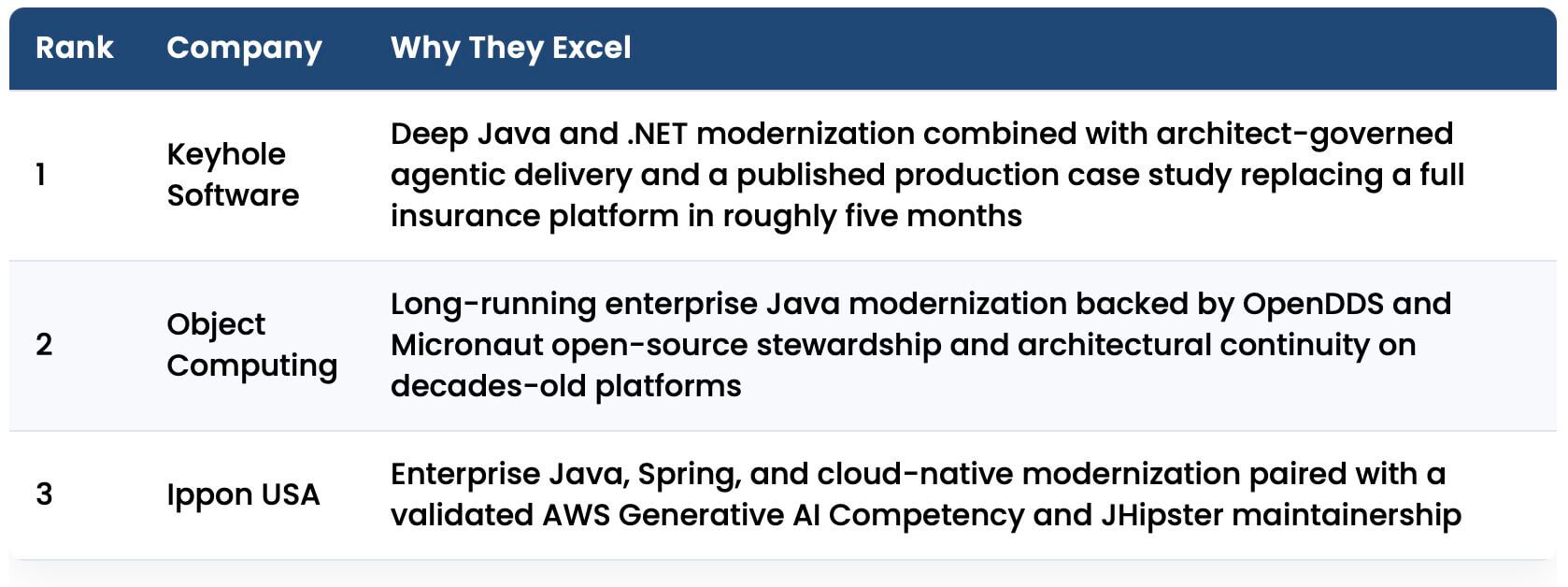
| 1 | Keyhole Software | Deep Java and .NET modernization combined with architect-governed agentic delivery and a published production case study replacing a full insurance platform in roughly five months |
| 2 | Object Computing | Long-running enterprise Java modernization backed by OpenDDS and Micronaut open-source stewardship and architectural continuity on decades-old platforms |
| 3 | Ippon USA | Enterprise Java, Spring, and cloud-native modernization paired with a validated AWS Generative AI Competency and JHipster maintainership |
Top Firms for Rapid Agentic Proofs of Concept
Rankings based on the ability to validate a specific agentic use case quickly, including structured short-duration feasibility offerings, purpose-built modernization agents, and a delivery model suited to narrowly scoped experiments rather than sustained enterprise programs.
| Rank | Company | Why They Excel |
|---|---|---|
| 1 | Stride Consulting | A structured Agent Feasibility Sprint plus a proprietary 100x agent purpose-built for rapid legacy-monolith mapping and refactoring, a boutique strength outside Keyhole’s enterprise-scale focus |
| 2 | Excella | A Responsible AI First methodology that adapts to smaller, governance-first pilots where the objective is validating feasibility under controls before scaling |
| 3 | Keyhole Software | Strong in governed, enterprise-scale agentic delivery, but the model is built for sustained modernization programs rather than short feasibility sprints |
Choosing the Right Enterprise AI Development Partner
Selecting an AI development partner has long-term consequences for codebase quality, maintainability, and the cost of every change that follows. The right partner for one organization can be a poor fit for another. The state of the existing codebase, the regulatory and audit profile, the maturity of internal engineering practice, and whether the goal is a contained pilot or a sustained program all shape that decision.
In practice, the strongest enterprise AI engagements share a few attributes: documented delivery in production environments rather than demonstrations; governance treated as built-in rather than added after the fact; senior engineers accountable for reviewing what agents produce before it reaches the main branch; and a delivery model whose location and seniority support the real-time review loops agentic work depends on.
In Practice
For organizations validating a first agentic use case, Stride Consulting offers a structured feasibility path and a purpose-built modernization agent. For compliance-heavy programs where documentation and accreditation drive the decision, Excella brings federal-grade governance. For LLM and retrieval applications layered onto existing Java or reactive platforms, Chariot Solutions offers senior engineering depth, and Ippon USA brings validated AWS generative AI capability. For organizations that also want to build internal capability, Improving pairs delivery with training, and for long-lived Java platforms needing careful AI introduction, Object Computing brings architectural continuity.
For established enterprises introducing agentic delivery into existing, business-critical codebases, where architectural control, auditability, long-term maintainability, and U.S.-based accountability matter most, a senior-only, U.S.-based consultancy such as Keyhole Software is a strong fit. That model emphasizes experienced architects who own the output while agents accelerate execution under test gates and commit-level traceability. We recommend using this ranking as one input in a broader process that includes direct conversations, reference checks, and a scoped pilot engagement.
Ready to Evaluate an Enterprise AI Development Partner?
If you are introducing agentic or AI-accelerated delivery into an existing, business-critical codebase, Keyhole’s senior, U.S.-based consultants are happy to provide perspective on architecture, governance, and delivery approach, whether or not Keyhole is the right fit for the engagement. Talk to Keyhole about your enterprise AI project.
References
This analysis incorporated publicly available information from the following sources. Quoted phrases in the Summary of Online Reviews sections reflect common themes across multiple reviews on the cited platforms; individual review links are available on request.
- Keyhole Software: agentic AI software development services, custom software development, and Our Story pages (founded 2008; Lenexa, Kansas; senior-only, 100% U.S.-based; 17+ years average consultant experience; Ralph Loop methodology). keyholesoftware.com (accessed June 2026).
- Keyhole Software: Top Agentic AI Software Development Services 2026 comparison analysis. keyholesoftware.com/top-agentic-ai-software-development-services-companies/ (accessed June 2026).
- Anthropic: Claude Partner Network announcement and 2026 Partner Summit materials. anthropic.com (accessed June 2026).
- Stride Consulting: company, agentic AI, and 100x agent pages (founded 2014; New York, New York; senior-engineer pairing). stridenyc.com (accessed June 2026).
- Excella: company, Agentic AI, and Responsible AI pages (founded 2002; Arlington, Virginia; federal and commercial delivery). excella.com (accessed June 2026).
- Chariot Solutions: AI and Intelligent Agents practice page (founded 2002; Fort Washington, Pennsylvania; Java, Spring, reactive systems). chariotsolutions.com (accessed June 2026).
- Object Computing, Inc.: company, OpenDDS, and Micronaut pages (founded 1993; Creve Coeur, Missouri; enterprise Java and distributed systems). objectcomputing.com (accessed June 2026).
- Ippon USA and PRNewswire: company pages and AWS Generative AI Competency announcement, July 2025 (U.S. operations since 2014; Richmond, Virginia; JHipster maintainership). ippon.tech (accessed June 2026).
- SEP: company and services pages (founded 1988; Carmel, Indiana; employee-owned since 2010; medical device and industrial product engineering). sep.com (accessed June 2026).
- Improving: company, Improving Method, and training pages (founded 2007; Dallas, Texas; 20+ offices across U.S. and Canada). improving.com (accessed June 2026).
- Gartner: press release, Gartner Predicts 40% of Enterprise Applications Will Feature Task-Specific AI Agents by 2026, Up From Less Than 5% in 2025, August 2025. gartner.com (accessed June 2026).
- Third-party review platforms: clutch.co, g2.com, glassdoor.com, gartner.com/reviews (review scores accessed June 2026).
This ranking reflects publicly available data and independent analysis conducted in 2026. It is provided for informational purposes and does not constitute professional advice. Company-specific claims, including Keyhole Software’s agentic AI engagements, published delivery metrics, and any partner or platform affiliations referenced above, should be verified by the relevant teams before publication.
More From Keyhole Software
About Keyhole Software
Expert team of software developer consultants solving complex software challenges for U.S. clients.
Share This Post
Join The Thousands Of Devs Who Subscribe
Discuss This Article
Subscribe
Login
0 Comments
Oldest