
Advantages of Custom Software Development: A Technical Decision Framework
The build-versus-buy decision represents one of the most consequential technology choices facing mid-size to enterprise organizations. When existing systems constrain operations, internal teams lack bandwidth, or off-the-shelf platforms cannot accommodate complex workflows, technical leaders evaluate custom software development against commercial alternatives.
Drawing on industry data indicating that 67% of failed software implementations stem from incorrect build versus buy decisions¹, this guide examines eight key advantages of custom software development through a technical and financial decision framework designed for engineering leaders, architects, and executives evaluating when custom solutions outperform commercial alternatives.
What this guide covers:
- Scalability advantages and architectural control that eliminate vendor pricing constraints
- Eight quantifiable advantages of custom software development, supported by ROI data, cost analysis, and real implementation examples
- Total cost of ownership comparison showing 24-36 month payback periods
- Decision framework with organizational, technical, and strategic evaluation criteria
- Implementation considerations for successful custom development partnerships
For organizations already exploring custom builds, see how Keyhole approaches custom software development and modernization.
Understanding the Custom Software Decision
Custom software development creates applications designed specifically for an organization’s workflows, data structures, and business requirements. COTS (commercial off-the-shelf) solutions serve broad markets with standardized features. Custom applications address unique operational needs that generic platforms cannot accommodate.
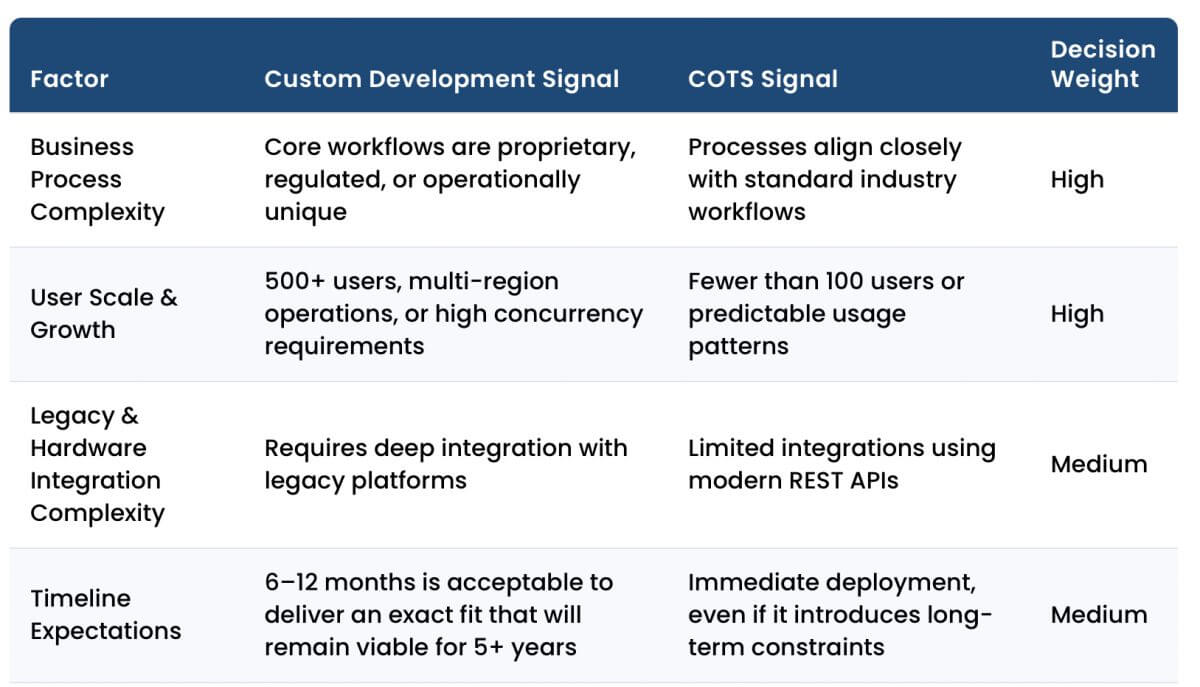
Build vs. Buy Decision Factors:
| Factor | Custom Development Signal | COTS Signal | Decision Weight |
|---|---|---|---|
| Business Process Complexity | Core workflows are proprietary, regulated, or operationally unique | Processes align closely with standard industry workflows | High |
| User Scale & Growth | 500+ users, multi-region operations, or high concurrency requirements | Fewer than 100 users or predictable usage patterns | High |
| Legacy & Hardware Integration Complexity | Requires deep integration with legacy platforms | Limited integrations using modern REST APIs | Medium |
| Timeline Expectations | 6–12 months is acceptable to deliver an exact fit that will remain viable for 5+ years | Immediate deployment, even if it introduces long-term constraints | Medium |
| Budget & Cost Structure | Ability to capitalize an upfront investment and treat as long-term asset | Preference for lower upfront costs, even if total cost is higher over time | High |
| Competitive Impact | The system directly supports how the organization competes | The system supports administrative or back-office functions | High |
Each industry will have individual constraints that need to be considered. For example, insurance organizations often require custom underwriting rule engines that encode proprietary risk models, while healthcare providers need intake workflows that comply with HIPAA and integrate with existing EHR systems—processes that rarely fit standard CRM platforms.
Conversely, organizations implementing standard accounting or employee onboarding workflows typically achieve faster deployment with COTS solutions as industry-standard processes provide adequate functionality. Custom development becomes essential when systems must support competitive differentiation—such as proprietary routing algorithms or real-time underwriting—rather than administrative functions where standardization delivers sufficient value.
Advantage 1: Scalability Without Vendor Constraints
Custom software scales according to business requirements rather than vendor pricing tiers. Organizations control architectural decisions, infrastructure choices, and capacity planning without negotiating license increases or hitting platform limitations.
Enterprise Scalability Comparison: Custom Applications vs COTS
| Scaling Factor | Custom Development | COTS Platforms |
|---|---|---|
| User Growth | Scales via infrastructure, not licensing | Per-seat fees increase annually |
| Data Volume & Growth | Optimized schemas and storage strategies | Tiered storage pricing |
| Transaction Capacity | Custom performance tuning for real workload patterns | Platform-enforced limits |
| Geographic Expansion | Deploy anywhere, multi-region control | Regional licensing or availability gaps |
| Feature Expansion | Add capabilities without vendor approval | Dependent on roadmap |
In a large-scale healthcare modernization initiative, Northwell Health—New York’s largest private employer serving more than 8 million people—has partnered with Keyhole Software since 2014 to evolve CareTool, a custom-built clinical platform designed to scale without per-user licensing constraints. What began as one of its first internal custom apps has grown to support 400+ daily users through a cloud-native, HIPAA compliant architecture built on .NET microservices and Azure, enabling growth without the escalating costs of COTS licensing. View the Case Study
CIOs managing fast-growing organizations consistently cite licensing scalability as a primary driver for custom development over COTS platforms. Organizations projecting significant growth benefit from architecture designed for their specific scaling requirements. Custom systems accommodate increased load through infrastructure adjustments rather than vendor tier upgrades.
Advantage 2: Competitive Differentiation
Software that mirrors unique business processes creates advantages that competitors using identical COTS platforms cannot replicate. Organizations whose operational approaches drive market differentiation benefit when proprietary software codifies those approaches.
Research from TechRepublic indicates that 75% of IT decision-makers believe custom software development leads to better business outcomes³. Organizations using custom platforms for core functions report 20-30% operational efficiency improvements compared to those relying on generic alternatives⁴.
Competitive Differentiation Comparison: Custom vs COTS
| Capability | Business Impact |
|---|---|
| Proprietary algorithms and business logic | Unique competitive advantages competitors cannot purchase |
| User experiences tailored to customer segments | Differentiated service delivery and engagement |
| Workflow automation reflecting actual processes | Operational efficiency without platform constraints |
| Independent development timelines | Market response without vendor roadmap dependency |
As a tangible enterprise example, Keyhole built Brightway Insurance’s custom insurance agent platform in .NET and React, delivering real-time policy and claims synchronization that generic CRM software could not achieve. By encoding Brightway’s proprietary workflows directly into the platform, the solution reduced agent friction, improved productivity, and created a competitive advantage competitors could not buy off the shelf. See the project.
Advantage 3: Integration Capabilities
Enterprise environments rarely consist of software alone. Mission-critical workflows often rely on a combination of legacy systems, modern platforms, and physical hardware or devices.
Unlike COTS platforms—typically limited to predefined integrations and approved hardware—custom software is designed to work within the reality of each environment. Developers can build APIs, data models, device interfaces, and communication protocols that integrate seamlessly across both software systems and physical infrastructure, eliminating silos and operational constraints.
Enterprise Integration Reality: Custom Software vs COTS
| Integration Factor | Custom Development | COTS Platforms |
|---|---|---|
| API Functionality | Can design APIs around existing systems | Limited to vendor-provided endpoints and payloads |
| Data Format | Native compatibility with legacy and modern systems | Often requires extra middleware to translate between formats |
| Hardware & Device Support | Direct integration with existing hardware: medical devices, POS terminals, warehouse scanners, IoT sensors, ATMs | Restricted to officially supported or certified devices |
| System Connectivity | Unlimited integration points across software and hardware | Vendor-imposed restrictions |
| Integration & Maintenance Cost | Controlled by organization; built once, owned forever | Third-party connector and licensing fees |
| Ongoing Change | Add new systems, devices, features on your enterprise’s timeline | Locked to vendor roadmap; limited recourse if features deprecate or change unexpectedly |
A healthcare provider modernizing their electronic health record system requires integration with insurance verification, lab systems, billing platforms, and state reporting databases. Custom development allowed native integration with all existing systems. This eliminates the data silos their previous COTS solution created⁵.
Similarly, Keyhole rebuilt a logistics provider’s warehouse app using Flutter to support legacy Honeywell CT40/CT47 scanners—hardware that would have required replacement under most off-the-shelf warehouse management platforms. By integrating directly with an AS400 backend and enabling offline-first operation, on-device barcode scanning, and Bluetooth printing, the custom solution modernized warehouse operations without requiring hardware investments. Link to project.
According to industry research, 74% of IT leaders prioritize integration capabilities when selecting software⁶. Custom development removes integration as a constraint by building connectivity into core architecture.
Advantage 4: Security and Compliance Control
Organizations with specific security requirements or regulatory obligations often find that COTS platforms provide generic security models that do not align with their risk profile. Custom development implements security measures tailored to actual threats and compliance frameworks.
Security & Compliance Control: Custom Software vs COTS
| Security Element | Custom Approach | COTS Limitation |
|---|---|---|
| Regulatory Compliance | Security designed to HIPAA, SOX, PCI, internal audit models | Can be one-size-fits-all |
| Attack Surface | Unique architecture reduces targeting | Widely-known vulnerabilities |
| Access Controls | Role-based permissions matching org structure | Generic permission models |
| Data Encryption | Custom protocols for sensitive data | Platform-defined encryption |
| Audit Capabilities | Detailed logging for specific compliance needs | Standard audit trails |
| Vulnerability Management | Controlled update and patch cycles | Vendor-dependent timelines |
For regulated enterprises, security architecture is not a feature — it is a foundational design requirement.
Financial institutions, healthcare providers, and government organizations frequently require security controls that exceed COTS capabilities. Custom development allows the architecture you design to align with specific compliance frameworks like HIPAA, SOX, or industry-specific regulations at its core.
Compliance benefits include security measures designed for specific regulatory requirements, audit trails configured for compliance documentation needs, data handling procedures built into system architecture, and update cycles aligned with organizational change management processes.
Organizations operating under stringent regulatory requirements benefit from security measures designed specifically for their compliance obligations rather than adapted from generic platforms.
Advantage 5: Complete Ownership and Control
Custom software provides full intellectual property ownership, eliminates vendor dependency, and ensures long-term system control. Organizations own the codebase, control the development roadmap, and maintain operational independence.
Ownership Implications: Custom Software vs COTS
| Ownership Aspect | Custom Software Development | COTS Platforms |
|---|---|---|
| Intellectual Property | Full ownership of source code, data models, and architecture. No licensing restrictions on use or modification. | Vendor retains IP; customers license usage with contractual limits |
| Vendor Dependency | No forced roadmap, pricing, or platform changes driven by third parties | Ongoing dependency on vendor roadmap, pricing models, and acquisition risk |
| Customization Control | Any functionality, workflow, or integration can be added as business needs evolve | Customization limited to configuration, plugins, or paid vendor extensions |
| Longevity & Stability | System lifespan is dictated by business value, not vendor strategy | Product sunsets, mergers, or licensing changes can force premature migrations |
| Speed to Initial Launch | Longer upfront investment to design and build the right solution | Faster initial deployment with prebuilt features |
| Ongoing Cost Predictability | Predictable operating costs once built; no per-user licensing escalations | Recurring licensing, per-seat costs, and feature-based pricing increases |
A manufacturing company using a custom production scheduling system maintained operations without disruption when three successive COTS vendors in their industry were acquired and platforms were deprecated⁷.
As an example, Keyhole helped a nationwide B2B technology services firm consolidate functionality from a costly COTS SaaS product and a legacy mobile web app into a single, custom-built, cross-platform mobile application. By replacing vendor-controlled software with a fully owned application, they eliminated licensing costs, regained roadmap control, and avoided dependency on third-party product decisions—while ensuring their internal team could evolve the platform through structured knowledge transfer. See the project.
Organizations that build custom systems avoid the risk of vendors discontinuing products, changing pricing models, or being acquired by competitors.
Advantage 6: Long-Term ROI and Total Cost of Ownership
Custom development requires higher initial investment. Total cost of ownership analysis over 3-5 year timeframes often favors custom solutions. Organizations eliminate recurring license fees, reduce integration costs, and avoid forced upgrades.
5-Year Total Cost of Ownership Comparison (Enterprise Scale)
| Cost Category | Custom Software Development | COTS Platform |
|---|---|---|
| Initial Investment | Higher up front; $400,000–$600,000 | Lower up front; $100,000–$150,000 |
| Annual Licensing | $0 | $80,000–$150,000 |
| Maintenance & Support | $80,000–$120,000 / year | $20,000–$40,000 / year |
| Integration | $30,000 initial; one-time build | $50,000–$100,000; ongoing connector fees |
| Customization | $0 | $75,000–$150,000 |
| Total 5-Year Cost | $750,000–$1,000,000 | $1,050,000–$1,250,000 |
Custom software typically achieves cost parity with COTS solutions within 24-36 months⁸. Organizations with 500+ users see 300% higher ROI with custom development compared to commercial alternatives⁹.
Financial considerations include break-even points typically occurring in year 2-3, no recurring per-user licensing fees, elimination of forced upgrade costs, and reduced integration and customization expenses over time.
The financial case for custom development strengthens as user count increases and deployment timeline extends beyond three years.
Advantage 7: Performance Optimization
Custom applications optimize for specific use cases, user volumes, and performance requirements. Developers tune database queries, caching strategies, and processing logic for actual workload patterns rather than generic scenarios.
Performance Advantages In Custom Software Development
| Performance Factor | Custom Optimization |
|---|---|
| Response Times | Tuned for specific user workflows and interaction patterns |
| Database Architecture | Designed for actual data relationships and query patterns |
| Caching Strategy | Aligned with access patterns and data update frequency |
| Infrastructure Scaling | Matched to precise capacity and growth projections |
A logistics company reduced route calculation time from 12 seconds to under 1 second by building custom algorithms optimized for their specific delivery patterns¹⁰. The performance improvement enabled real-time route adjustments that their COTS transportation management system could not support.
As another example, Keyhole built a real-time, event-driven platform with Python, Kafka, and AWS to process and route high-volume device alerts with minimal latency. Custom microservices normalized and streamed events across internal systems and third-party tools like Jira and Swimlane, delivering performance, scalability, and responsiveness that off-the-shelf platforms could not achieve under comparable load. See the project.
Organizations with specific performance requirements or unique workload patterns benefit from optimization tailored to their actual usage rather than generic performance targets.
Advantage 8: Alignment with Business Processes
COTS platforms require organizations to adapt their processes to fit software constraints. Custom development creates software that matches how the organization operates.
Process Alignment Benefits
| Alignment Area | Custom Software | COTS Platforms |
|---|---|---|
| Workflow Logic | Software reflects actual business processes | Requires adapting processes to platform constraints |
| User Interface | Designed for specific roles and task sequences | Generic interfaces optimized for broad audiences |
| Automation | Organization-specific processes automated | Limited to predefined workflow templates |
| Data Structure | Terminology and relationships match operations | Generic data models require mapping |
Organizations whose processes define competitive advantage find that custom software amplifies those advantages rather than constraining them to generic workflows.
A financial services firm built custom client onboarding software that automated their proprietary risk assessment methodology. The system reduced onboarding time from 14 days to 3 days. It maintained compliance requirements that their previous COTS solution could not accommodate.
As another example, Keyhole modernized a Midwest LTL transportation carrier’s legacy green-screen terminal UI to React with RESTful services—precisely replicating the look, feel, arrow-key navigation, hotkeys, and paste behavior warehouse users relied on for years — while adding modern capabilities like batch uploads, printing, and validation. Standard web components couldn’t match this familiar interface; custom software allowed for zero staff retraining. View the project.
Organizations whose processes define competitive advantage—like transportation dispatch efficiency—find custom software amplifies those edges rather than forcing adaptation to generic platforms.
Decision Framework: When Custom Development Makes Sense
When evaluating the advantages of custom software development, effective technical leaders assess fit across organizational readiness, technical constraints, and long-term strategic alignment. Custom development delivers the strongest outcomes when all three dimensions align.
Organizational Readiness (Team + Budget Fit)
| Factor | Custom Development Indicator |
|---|---|
| Company Size | Mid-market to enterprise (typically 500+ employees) |
| Technical Maturity | Internal development teams or leadership capable of owning architecture, governance, and long-term system evolution |
| Budget Structure | Ability to capitalize an upfront investment and treat software as a long-term business asset |
| Timeline Flexibility | Willingness to invest 6–12 months to build a system designed to last 5–10 years |
In our experience, organizations that succeed with custom software view it as core infrastructure, not a short-term tool or tactical purchase.
Technical Constraints (System + Hardware Fit)
| Factor | Custom Development Indicator |
|---|---|
| Business Requirements | Proprietary workflows, regulated processes, or operational models that COTS platforms cannot support without compromise |
| Integration Landscape | Multiple legacy systems (ERP, AS/400, EHR, CRM), hardware devices, or partner platforms requiring deep, reliable integration |
| Performance Needs | Throughput, latency, or real-time processing requirements that exceed generic platform capabilities |
| Security & Compliance | Industry-specific requirements (healthcare, financial services, critical infrastructure) beyond standard vendor security models |
Custom development is most effective when integration depth, performance, or compliance are first-order technical requirements.
Strategic Alignment (Business Impact Fit)
| Factor | Custom Development Indicator |
|---|---|
| Competitive Differentiation | The system directly supports how the organization competes (e.g., logistics optimization, claims processing, patient experience) |
| Ownership & Control | Long-term value in owning IP, roadmap decisions, and data without vendor dependency |
| Market Positioning | Competitive advantage depends on capabilities competitors cannot simply license |
| Financial Horizon | Total cost of ownership favors custom development over a 3–5 year horizon, especially as user count and integrations grow |
Organizations meeting criteria across all three dimensions—organizational, technical, and strategic—consistently achieve better outcomes with custom software development initiatives than those attempting to force complex needs into generic or off-the-shelf software platforms.
Implementation Considerations
Long-Term Planning Requirements:
| Planning Area | Typical Requirement |
|---|---|
| Annual Maintenance Budget | 15–20% of initial development cost |
| Knowledge Retention | Documentation, onboarding guides, cross-training |
| Evolution Planning | Roadmaps for technology, features, and integrations |
| Technical Succession | Continuity plans to avoid single points of failure |
Making the Build vs. Buy Decision
The custom software decision requires analyzing technical fit, financial implications, and strategic alignment. Organizations that systematically evaluate these factors make more confident decisions and achieve better outcomes.
Key Evaluation Steps
- Document requirements that commercial off-the-shelf (COTS) platforms cannot realistically support
- Compare total cost of ownership across both approaches over a 3–5 year horizon
- Assess internal capacity to maintain and evolve a custom system post-launch
- Evaluate how critical the system is to competitive differentiation or operational efficiency
- Identify risks related to timeline, budget, regulatory compliance, and system complexity
Final Perspective
Custom software development delivers the greatest advantage when organizations face:
- Unique or regulated workflows
- Complex integration environments
- Performance or scalability requirements beyond standard platforms
- Long-term strategic dependence on the system
When evaluation frameworks indicate strong fit, custom development delivers superior outcomes, long-term value, and competitive positioning that off-the-shelf solutions cannot match.
Keyhole Software works with organizations across Java, .NET, and JavaScript technologies, as well as cloud-native architectures on AWS, Azure, and Google Cloud. Our 100% U.S.-based senior consultants design and build custom software, modernize legacy systems, and strengthen internal engineering teams through hands-on collaboration and knowledge transfer.
Sources
¹ Forrester, “The State of Application Development 2024”
² Full Scale, “Custom Software vs. Off-the-Shelf Solutions: Cost-Benefit Analysis,” 2025
³ Baytech Consulting, “Why 75% of IT Leaders Are Choosing Custom Software for Competitive Edge,” 2025
⁴ Gartner and PwC operational efficiency studies, cited in Baytech Consulting research
⁵ Kodekx, “5 Real-World Case Studies That Show the Power of Custom Software,” 2025
⁶ Baytech Consulting, “Custom Software for Competitive Advantage,” 2025
⁷ Kodekx healthcare case study analysis
⁸ Full Scale, “Build vs. Buy Software Development Decision Guide,” 2025
⁹ Full Scale cost comparison analysis, 2025
¹⁰ Kodekx logistics platform case study
Last updated: December 31, 2025
More From Keyhole Software
About Keyhole Software
Expert team of software developer consultants solving complex software challenges for U.S. clients.
Share This Post
Join The Thousands Of Devs Who Subscribe
Discuss This Article
Subscribe
Login
0 Comments
Oldest