
AI Development Cost in 2026: What Businesses Actually Pay
AI development quotes routinely range from $5,000 to $2 million for what sounds, on paper, like the same project. Every project is fundamentally unique, and often it’s nuances that sound inconsequential which drastically alter the overall spend. Which is why it’s crucial to understand not just what’s being built but what the total estimated cost will be.
Project category sets the outer boundary of that range, but it doesn’t set the price by itself. Complexity tier, build-versus-buy approach, and multi-year total cost of ownership determine where a given project actually lands within it, and total cost of ownership is the variable most first-time AI buyers underbudget.
This report breaks down what AI development actually costs in 2026, using current vendor pricing, freelance and salary benchmarks, and cloud compute rates so you can see where a given project is likely to land and why.
Note on sourcing and methodology: Figures below are synthesized from published 2026 vendor pricing guides, freelance marketplace rate data, cloud provider pricing pages, and industry analyst commentary. Because quoted ranges vary significantly by vendor, region, and scope, we present cost tiers rather than single point estimates. See numbered references at the end of this article. Figures throughout are in U.S. dollars and reflect U.S. market pricing unless a table caveat notes otherwise.
AI Development Cost Trends Covered in This Report
- Average AI development cost by project type, from simple chatbots to enterprise computer vision systems
- Complexity-tier cost ranges for buyers who don’t yet know which category their project falls into
- Build-versus-buy-versus-fine-tune cost comparisons, and where the old buy-for-cost, build-for-control rule of thumb breaks down
- In-house team cost versus outsourced/agency cost, and how the two decisions compound
- Cost breakdown by component: data, model training/compute, talent, and integration
- Upfront build cost versus ongoing maintenance and multi-year total cost of ownership
- The cost drivers, data volume and quality, model size, accuracy requirements, and compute intensity, that explain most price variance
- Developer and ML engineer rate benchmarks by talent tier and their effect on project timeline
How Keyhole Software Uses These Statistics
Keyhole Software tracks these cost benchmarks as part of our ongoing work in custom AI and software development, legacy modernization, and enterprise delivery. As a U.S.-based custom software and consulting firm with senior consultants averaging 17+ years of experience, we apply these figures in real budgeting conversations with CTOs and engineering leaders, using them to sanity-check vendor quotes, scope build-versus-buy decisions, and set realistic multi-year budgets before a project starts.
The statistics in this report are not theoretical. They reflect the conditions we encounter in active engagements, including custom AI application development, RAG implementation, and legacy modernization work like this LLM-assisted Delphi migration delivered inside the Claude partner ecosystem. Where the data points to a cost pattern, we explain how that pattern shows up in real project budgets and what buyers should ask before signing a scope of work.
Key Finding
Most mid-market AI projects land between $40,000 and $500,000 to build, with basic single-purpose tools (simple chatbots, narrow classifiers) starting around $5,000-$25,000 and enterprise-grade, multi-system deployments running $500,000 to $2 million or more. Total cost of ownership over three years typically runs 1.5-2x the initial build cost once hosting, maintenance, and retraining are factored in.
Average AI Development Cost
The single biggest driver of AI development cost is project type. A rules-based FAQ chatbot and a custom computer vision system both fall under “AI development,” but they sit on opposite ends of a cost spectrum that spans three orders of magnitude. There are many accidental ways in which businesses can end up increasing their magnitude tier, both in not capping the amount of tokens a single use case can consume in a time period as well as not limiting the amount of tokens the development team will use to produce the product (colloquially referred to as “tokenmaxxing“).
Vendors quoting the same request can land tens of thousands of dollars apart simply because they’re scoping different underlying architectures: a rule-based bot versus an LLM-powered one, or a pre-trained model versus one trained from scratch. The table below lays out current 2026 build-cost ranges by project type, followed by a complexity-tier view for buyers who don’t yet know which category their project falls into.
Average Cost by Project Type
| Project Type | Typical Build Cost Range | Notes |
|---|---|---|
| Chatbot (rule-based to LLM-powered) | $5,000 – $150,000+ | Rule-based bots start near $5K; RAG-based LLM chatbots run $30K-$80K; enterprise multi-agent systems exceed $100K-$300K |
| Custom ML Model (predictive analytics, recommendation, fraud detection) | $60,000 – $400,000+ | Cost scales with data quality demands and accuracy targets more than model type |
| Computer Vision System | $40,000 – $250,000+ | Wide variance driven by image/video data volume and labeling requirements |
| Generative AI Application (LLM app, RAG pipeline, AI agent) | $30,000 – $300,000+ | AI agent builds range from $25K prototypes to $300K+ agentic enterprise systems |
Sources: 3, 5, 10
Caveat: These ranges reflect typical project scopes as quoted by vendors and agencies. Actual costs depend heavily on data readiness, integration complexity, and how tightly a given vendor scopes what counts as “done.”
What this means: Project type sets the outer boundary of the conversation, but it doesn’t set the price by itself. A chatbot and a computer vision system differ by an order of magnitude on average, but within each category the difference between the low and high end of the range is often just as large, driven by exactly the same factors: how much data has to be cleaned, how many systems the tool needs to talk to, and how tight the accuracy bar is.
Key Findings
- Chatbots span the widest range of any project type, from roughly $5,000 for rule-based bots to $300,000+ for enterprise multi-agent systems.
- Custom ML models (predictive analytics, recommendation, fraud detection) start at $60,000, reflecting the data engineering work required before a model can be trained at all.
- Computer vision systems show wide single-category variance, driven primarily by image and video data volume and labeling requirements.
- Generative AI applications range from $30,000 prototypes to $300,000+ agentic enterprise systems, the fastest-growing category in this report.
In Practice
We see the project-type table used most often as a starting point for a scoping conversation, not an ending point. A client who comes in asking “what does a chatbot cost” usually leaves that first conversation with a much narrower question: are we building a rule-based FAQ tool, or an LLM-powered assistant that needs to reason over proprietary data. Those two projects share a category label and almost nothing else in terms of cost, timeline, or team composition.
Computer vision and custom ML projects are where we most often see initial estimates move after discovery, and the reason is consistent: the client’s own data isn’t in the shape the estimate assumed. A model that was scoped assuming labeled, structured training data can double in cost once the discovery phase reveals that the labeling work hasn’t actually been done yet.
Strategic takeaway: Treat the project-type range as a starting point for scoping, not a quote. The single best predictor of where a project lands within its range is how much of the data and integration work is already done before the first line of code gets written, which is exactly what a real discovery phase is designed to surface.
Project type answers “what are we building,” but complexity tier answers “how hard is our version of it.” Two companies building the same category of tool, say, a generative AI application, can land in different tiers entirely depending on how many systems it needs to talk to, how clean their underlying data is, and how much accuracy the use case demands. Use the tier breakdown below as a sanity check against the project-type ranges above.
In general, Keyhole Software advises against creating custom ML models, and instead relying upon either frontier models for the most complex tasks or deferring to open source models when the ROI can be proven to be sufficient. The TCO (total cost of ownership) of custom ML models is usually much higher than most businesses anticipate, and thankfully the agentic AI ecosystem communicates by way of natural language so the amount of “vendor lock-in” is very minimal if a business does decide to go with a frontier or proprietary third-party model.
Average Cost by Complexity Tier
| Complexity Tier | Cost Range | What’s Included |
|---|---|---|
| Basic | $5,000 – $50,000 | Single use case, one data source, minimal integration, off-the-shelf model or API |
| Mid-Level | $50,000 – $200,000 | Multiple integrations, custom data pipeline, moderate accuracy requirements, dedicated QA |
| Enterprise | $200,000 – $2,000,000+ | Multi-system integration, compliance requirements, custom model training, ongoing MLOps |
Sources: 1, 3
Caveat: Tier boundaries are directional, not fixed. A project can start Basic in scope and drift into Mid-Level territory once integration and compliance requirements surface during discovery.
What this means: Complexity tier is a more reliable cost predictor than project type alone, because it captures the variables that actually drive labor: how many systems are involved, how much custom data engineering is required, and what level of ongoing operational support the use case demands.
Key Findings
- Basic-tier projects ($5,000-$50,000) typically involve a single use case, one data source, and an off-the-shelf model or API.
- Mid-Level projects ($50,000-$200,000) add multiple integrations, a custom data pipeline, and dedicated QA.
- Enterprise-tier projects ($200,000-$2,000,000+) require multi-system integration, compliance requirements, and ongoing MLOps.
- The tier a project lands in is driven more by integration and compliance scope than by the underlying AI capability itself.
In Practice
We use the complexity-tier framework as a second check against the project-type table in almost every early scoping conversation, because clients tend to describe their project by category (“we need a chatbot“) when the more useful classification is by tier (“we need a mid-level system with three integrations and a moderate accuracy bar“). The tier conversation surfaces the real cost drivers faster than the category conversation does.
The jump from Mid-Level to Enterprise is where we see the most client surprise, usually because compliance requirements weren’t part of the original scoping conversation. A healthcare or financial services client whose project would otherwise sit comfortably in the Mid-Level tier often lands in Enterprise territory purely on the strength of audit, logging, and data governance requirements layered on top of the same core AI capability. The more mature an organization’s cloud infrastructure is, the less friction there will be to get an existing AI model deployed within it.
Strategic takeaway: Ask which tier a project falls into before asking which project type it is. Compliance, integration count, and data governance requirements move a project between tiers more reliably than the underlying AI technique does, and they’re the variables most likely to be underscoped in an initial quote.
Cost by Approach
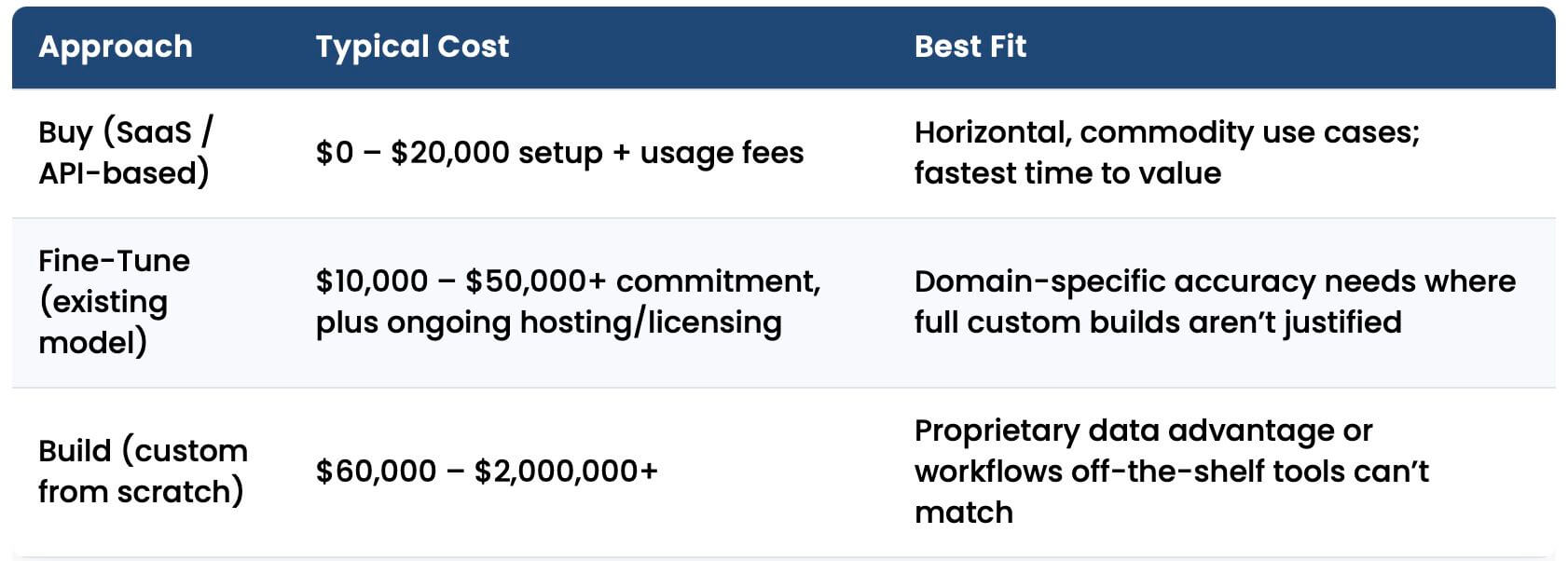
Beyond project type, the build-vs-buy-vs-fine-tune decision reshapes the cost picture entirely. As of 2026, the old rule of thumb, buy for cost, build for control, no longer holds cleanly: BenchLM.ai’s pricing data puts open-weight models at roughly 5.7x cheaper than frontier SaaS models on a median blended cost-per-token basis 16. That makes the calculus less about which approach is cheapest in isolation and more about where a business needs differentiation versus commodity infrastructure.
Most organizations don’t end up choosing one approach exclusively; they buy for horizontal, off-the-shelf use cases like productivity and document processing, then build or fine-tune where proprietary data or workflow logic creates a real competitive edge. That hybrid pattern is now the norm rather than the exception, which is why the cost comparison below is best read as a menu of options within a single project, not a single either/or decision.
Build vs. Buy vs. Fine-Tune Cost Comparison
| Approach | Typical Cost | Best Fit |
|---|---|---|
| Buy (SaaS / API-based) | $0 – $20,000 setup + usage fees | Horizontal, commodity use cases; fastest time to value |
| Fine-Tune (existing model) | $10,000 – $50,000+ commitment, plus ongoing hosting/licensing | Domain-specific accuracy needs where full custom builds aren’t justified |
| Build (custom from scratch) | $60,000 – $2,000,000+ | Proprietary data advantage or workflows off-the-shelf tools can’t match |
Sources: 6, 7, 8, 9 16
What this means: The buy-vs-build decision is no longer a simple cost trade-off; it’s a differentiation decision wearing a cost comparison. Buying is still the fastest and cheapest path for commodity capability, but the cost gap that used to make building expensive by default has narrowed enough that build is now a live option anywhere proprietary data or workflow logic creates real competitive value.
Key Findings
- Buying (SaaS/API-based) runs $0-$20,000 in setup plus usage fees, and remains the fastest path to value for horizontal, commodity use cases.
- Fine-tuning an existing model typically costs $10,000-$50,000+ upfront plus ongoing hosting and licensing, and fits domain-specific accuracy needs that don’t justify a full custom build.
- Building from scratch runs $60,000-$2,000,000+, reserved for cases where proprietary data or workflow creates a real competitive edge.
- Open-weight models now run roughly 5.7x cheaper than frontier SaaS at comparable capability tiers, changing the economics of the build decision.
In Practice
Almost every engagement we scope today ends up as a hybrid of these three approaches rather than a single choice, and that’s consistent with what the data shows. A client typically buys for the horizontal capability, document summarization, general chat, standard productivity tasks, and reserves build or fine-tune budget for the one or two workflows where their own data actually creates an advantage. Treating build-vs-buy as a single project-wide decision is one of the most common scoping mistakes we see in RFPs that come to us already drafted.
The narrowing cost gap between open-weight and frontier models has changed which conversations we have with clients. Two years ago, a client asking about a fully custom build was usually steered toward buying first and building later once value was proven. Today, for clients with a genuine proprietary-data advantage, we’re more likely to recommend building sooner, because the infrastructure cost of doing so has dropped enough that the main remaining cost is engineering time, not compute.
Strategic takeaway: Don’t scope build-vs-buy as one decision for the whole project. Buy the commodity capability, and reserve build or fine-tune spend for the specific workflow where proprietary data or domain logic creates value a vendor’s general-purpose product can’t replicate.
The build-vs-buy decision determines what you’re paying for; in-house vs. outsourced determines who’s doing the work. The two decisions compound. A fully custom build that’s done in-house carries the highest fixed cost but the most long-term control, while an outsourced team handling a fine-tuning engagement can be the fastest and cheapest path to a working system. Most companies land somewhere in between, using an outsourced partner to stand up the first version and an in-house team to own it once it’s in production. This works well in situations where the outsourced partner has experience in both deploying AI model usage at scale, as well as using AI to help develop the application itself.
In-House Team vs. Outsourced/Agency Cost
| Model | Typical Cost | Trade-off |
|---|---|---|
| In-house team (2-4 ML engineers, fully loaded) | $500,000 – $900,000+ annually | Highest long-term ownership and control; slowest to staff |
| Outsourced / agency (project-based) | $40,000 – $300,000+ per project; $50-$400/hr blended | Faster start, no hiring overhead; offshore partners can cut cost 40-60% |
Sources: 2, 11, 12
Caveat: In-house cost figures assume a fully loaded, fully staffed team; a partially staffed or ramping team will show lower spend but also lower output, which can understate true cost per delivered outcome.
What this means: In-house and outsourced cost figures aren’t directly comparable on a dollar-for-dollar basis, because they’re measuring different things: an annual capacity cost versus a per-project delivery cost. The organizations that get the most value out of either model are the ones that match the model to what they’re actually trying to build, ongoing capability versus a defined deliverable, rather than defaulting to whichever feels more familiar.
Key Findings
- A fully loaded in-house team of 2-4 ML engineers runs $500,000-$900,000+ annually, offering the highest long-term ownership but the slowest path to staffing.
- Outsourced or agency engagements run $40,000-$300,000+ per project, or $50-$400/hr blended, with no hiring overhead.
- Offshore outsourced partners can reduce cost by 40-60% relative to onshore rates, though often with trade-offs in communication overhead and time zone alignment.
- Most successful engagements combine both models: an outsourced partner for initial build, an in-house team for long-term ownership.
In Practice
A recent engagement shows how far this blended model can stretch. A repeat Kansas City insurance client brought two senior Keyhole consultants in to lead architecture and delivery, working alongside nine of the client’s own engineers rather than hiring a larger in-house team from scratch. That eleven-person blended team is on track to replace the platform’s UI, services, database, and administrative tooling in roughly five months, work a traditional approach would have estimated at 18-24 months with a team of 26 or more. The client didn’t choose outsourced versus in-house; they used an outsourced team to make their existing in-house team more effective.
The staffing timeline gap matters more than the headline cost figures in most decisions we’re part of. A client that needs a working system in three months functionally can’t choose the in-house path, regardless of budget, because hiring 2-4 specialized ML engineers rarely happens on that timeline even with an aggressive recruiting effort.
Strategic takeaway: Choose the delivery model based on your actual timeline and ownership goals, not just the headline cost comparison. If you need a working system in months, outsourced delivery is usually the only realistic path; if the system is core to your long-term differentiation, plan the transition to in-house ownership from the start rather than as an afterthought.
Cost Breakdown
Within any given project budget, cost splits across four recurring components: data, model training/compute, talent, and integration.
Talent and data preparation together typically consume the largest share. Data work alone often accounts for 40 to 60% of total project timeline, since messy, incomplete, or unlabeled data has to be cleaned and structured before a model can be trained on it at all. Integration is the most frequently underestimated line item, particularly for enterprises connecting AI systems to decades-old ERP, CRM, and compliance infrastructure; teams that scope integration as an afterthought are usually the ones whose final invoice comes in well above the original estimate.
Cost by Component
| Component | Typical Share of Budget | Notes |
|---|---|---|
| Data (collection, labeling, cleaning) | 20-30% | Often the largest hidden cost; consumes 40-60% of project timeline |
| Model training / compute | 15-25% | Simple models train for under $1,000; large custom models can exceed $100,000 per training run |
| Talent (engineering labor) | 35-50% | Largest line item on most projects; scales with seniority mix and specialization |
| Integration & deployment | 15-30% | Can exceed model development cost by 3-5x in complex enterprise environments |
Sources: 1, 5, 9
Caveat: These shares are budget allocations, not effort allocations. Data work consumes a disproportionate share of project timeline relative to its share of budget, since much of it is labor-intensive but comparatively low cost per hour.
What this means: The component breakdown is a useful reality check against how most first-time AI buyers mentally budget a project, which is to assume the majority of cost sits in model development. In practice, talent and data preparation dominate the budget, and integration is frequently the line item most likely to be underscoped in an initial estimate.
Key Findings
- Data collection, labeling, and cleaning typically consume 20-30% of budget but 40-60% of project timeline.
- Model training and compute account for 15-25% of budget; simple models train for under $1,000 while large custom models can exceed $100,000 per run.
- Talent is the largest line item on most projects at 35-50% of budget, scaling with seniority mix and specialization.
- Integration and deployment run 15-30% of budget but can exceed model development cost by 3-5x in complex enterprise environments.
In Practice
The gap between data’s share of budget and its share of timeline is one of the first things we walk new clients through, because it explains why a project can feel stalled for weeks with very little dollar spend to show for it. Data cleaning and labeling is genuinely time-intensive work performed by people, not compute, so it shows up as a timeline bottleneck well before it shows up as a major budget line.
Integration is where we see the biggest gap between what a client expects to pay and what a project actually costs, especially in enterprises connecting new AI systems to legacy ERP, CRM, or compliance infrastructure. A client who scopes “the AI part” carefully but treats integration as a footnote is describing almost exactly the profile of project that comes in well over its original estimate.
Strategic takeaway: Budget data preparation and integration with the same rigor as model development, not as supporting work around it. In our experience, projects that scope all four components, data, compute, talent, and integration, as first-class line items from day one are the ones least likely to blow through their original estimate.
The component breakdown covers what you pay to get to launch. It’s a smaller piece of the real financial picture than most first-time buyers assume, because AI systems keep incurring cost after deployment in a way traditional software often doesn’t. Models drift as real-world data shifts away from what they were trained on, which means retraining and monitoring are recurring line items, not one-time cleanup work.
Upfront Build vs. Ongoing Run/Maintenance Cost
| Cost Phase | Typical Cost | Notes |
|---|---|---|
| Upfront build | 100% of quoted project cost (baseline) | One-time development, testing, and deployment |
| Ongoing maintenance & retraining | 15-25% of initial build cost, annually | Covers model drift, retraining, monitoring, and updates |
| 3-year total cost of ownership | 1.5-2x initial build cost | Compliance industries (banking, healthcare, government) add 25-35% on top |
Sources: 3, 4
Caveat: Total cost of ownership figures assume the system remains in active use and is maintained on schedule; a system that’s built and then left unmonitored can accumulate drift-related risk without accumulating the maintenance spend that would normally offset it.
What this means: The initial build quote is the down payment, not the total price. A 3-year total cost of ownership of 1.5-2x the initial build cost means an organization budgeting only for the upfront build is routinely under-budgeting the true cost of the system by 50-100% over its useful life.
Key Findings
- Ongoing maintenance and retraining typically runs 15-25% of the initial build cost annually.
- Three-year total cost of ownership typically lands at 1.5-2x the initial build cost.
- Regulated industries, banking, healthcare, and government, add an estimated 25-35% on top of baseline total cost of ownership for compliance overhead.
- Model drift makes retraining and monitoring recurring costs rather than one-time cleanup work, unlike most traditional software maintenance.
In Practice
We build multi-year total cost of ownership into every project proposal, not just the initial build estimate, because clients who only budget for the build phase are the ones most likely to come back within a year asking why the system needs additional investment. Framing maintenance and retraining as a known, planned annual cost from the outset avoids that conversation feeling like scope creep later.
In regulated industries specifically, we’ve found that clients often underestimate the compliance overhead that persists after launch, audit logging, access controls, and periodic revalidation don’t stop being a cost center once a system passes its initial compliance review. The 25-35% premium for compliance industries in this data is consistent with what we see baked into ongoing support agreements for healthcare and financial services clients.
This is also where the build-versus-buy decision resurfaces. Buying commodity capability avoids most of the multi-year total cost of ownership risk that a custom build carries: a SaaS or API-based tool shifts retraining and infrastructure maintenance to the vendor, while a custom build keeps that cost, and that risk, in-house for the life of the system. Total cost of ownership is one of the more concrete ways to test whether a proposed build genuinely has enough proprietary-data or workflow advantage to justify carrying that ongoing cost internally rather than buying it.
Strategic takeaway: Budget in three-year total cost of ownership terms from the proposal stage, not just build cost. Organizations in regulated industries in particular should plan for maintenance to run at the higher end of the 15-25% range, and should treat compliance overhead as a permanent line item rather than a one-time launch cost. Organizations should also budget in periodically upgrading to the latest frontier models, and working with the third-party AI vendor to determine what the projected costs during that time will be.
Cost Drivers
Four variables explain most of the price variance within any given project type: data volume and quality, model size, accuracy requirements, and compute intensity. Enterprise projects chasing high accuracy frequently iterate through 20 to 100 model variants before deployment, and projects that iterate through more than 30 variants typically land at the high end of their cost range. None of these drivers act alone; a project with a large, messy dataset and a strict accuracy bar will push against all four at once, which is exactly the profile that tends to blow through an initial estimate.
What Drives AI Development Price
| Cost Driver | Impact on Price |
|---|---|
| Data volume & quality | Larger, messier, or unlabeled datasets sharply increase preparation and cleaning cost |
| Model size | Larger models require longer, more expensive training runs and pricier inference infrastructure |
| Accuracy requirements | Higher accuracy targets drive more iteration; enterprise projects often test 20-100 model variants |
| Compute intensity | Real-time or low-latency inference needs push toward premium GPU tiers and higher ongoing hosting cost |
Sources: 5, 14, 15
Caveat: These four drivers interact rather than stack independently; a project weak on multiple drivers at once tends to compound toward the high end of its range faster than the individual driver impacts would suggest on their own.
What this means: These four drivers are useful because they’re diagnostic, not just descriptive. A project that’s tracking toward the high end of its cost range is almost always doing so because of one or more of these four variables, which makes them a practical checklist for a buyer trying to understand why their quote came in where it did.
Key Findings
- Data volume and quality is the most consistently cited driver of cost variance within a project type.
- Model size drives both training cost and ongoing inference infrastructure cost.
- Enterprise projects chasing high accuracy often test 20-100 model variants before deployment; projects exceeding 30 variants typically land at the high end of their range. 5
- Real-time or low-latency inference requirements push projects toward premium GPU tiers and materially higher ongoing hosting cost.
In Practice
We use this four-driver framework directly in early scoping calls, because it turns an abstract cost range into a concrete set of questions: how clean is your data, how large a model do you actually need, what accuracy bar does the use case require, and does it need to run in real time. A client’s answers to those four questions predict where in the range a project will land more reliably than the project category does.
Accuracy requirements are the driver most often set without full awareness of its cost implications. Clients frequently ask for the highest achievable accuracy by default, without weighing whether the use case actually requires it. A fraud detection model and an internal document classifier can have very different accuracy needs, and pushing the classifier toward fraud-detection-grade accuracy multiplies iteration cost for marginal practical benefit.
Strategic takeaway: Set the accuracy bar to what the use case actually requires, not to the ceiling of what’s achievable. Projects that scope accuracy requirements deliberately, rather than defaulting to “as accurate as possible,” avoid a meaningful share of the iteration cost that pushes projects to the high end of their range.
Talent is where these cost drivers translate into an actual invoice. A project with high data-quality and accuracy demands doesn’t just cost more in compute, it requires more senior talent for longer stretches, which is why timeline and hourly rate move together more than buyers expect. A senior engineer at a premium rate who finishes in six weeks is often cheaper, start to finish, than a junior team taking four months to reach the same result.
Average Developer / ML Engineer Rates & Timeline Impact
| Talent Tier | Freelance Rate | Typical Timeline Impact |
|---|---|---|
| Junior (0-2 yrs) | $50 – $115/hr | Best for narrow, well-defined tasks; longer timelines on ambiguous scope |
| Mid-level | $118 – $195/hr | Handles most production-grade builds; 10-16 week timelines typical |
| Senior | $150 – $240/hr | Shortens timelines on complex builds; commands premium for proven deployment experience |
| Specialist (LLM, MLOps, distributed training) | $275 – $450+/hr | 30-50% premium over generalist rates; often shortens high-risk phases |
Sources: 2, 11, 13
Caveat: Freelance rate ranges reflect U.S. marketplace data and vary by region; blended agency rates and offshore rates can fall meaningfully below the figures shown here.
What this means: Hourly rate alone is a misleading way to compare talent options, because rate and timeline move together. The relevant comparison isn’t cost per hour, it’s total cost to reach a working, production-ready result, and on that measure a higher-rate senior or specialist engineer frequently comes out ahead of a lower-rate junior team on ambiguous or high-risk work.
These figures track closely with what we see across custom software development generally; see our broader 2026 custom software cost and timeline benchmarks for comparison outside the AI-specific talent pool.
For illustration: a senior engineer at $200/hour who reaches a working result in 6 weeks (240 hours) costs roughly $48,000 in labor. A junior engineer at $80/hour who needs 16 weeks (640 hours) to reach the same result costs roughly $51,200 in labor alone, before accounting for the cost of a four-month-longer time to value.
The hourly-rate comparison by itself would have pointed to the opposite conclusion. This is illustrative math, not a reported finding, but it’s the calculation worth running before defaulting to the lowest blended rate.
Key Findings
- Junior engineers ($50-$115/hr) are best suited to narrow, well-defined tasks; ambiguous scope tends to extend their timelines disproportionately.
- Mid-level engineers ($118-$195/hr) handle most production-grade builds, with typical timelines of 10-16 weeks.
- Senior engineers ($150-$240/hr) shorten timelines on complex builds and command a premium for proven deployment experience.
- Specialists in LLM, MLOps, or distributed training ($275-$450+/hr) carry a 30-50% premium over generalist rates but often shorten the highest-risk project phases.
In Practice
We staff engagements against this logic directly: junior and mid-level engineers on well-scoped, narrow tasks, and senior or specialist engineers on the ambiguous, high-risk phases where their experience compresses timeline the most. A team staffed entirely at junior rates on a project with real ambiguity in scope is, in our experience, one of the more reliable predictors of a timeline that runs long.
The specialist premium for LLM and MLOps talent is consistent with what we see in the market for AI-accelerated development work specifically. Clients evaluating a vendor purely on blended hourly rate, without weighing how much senior and specialist time is on the team, are often comparing two very different delivery risk profiles as though they were the same offer.
Strategic takeaway: Compare vendors and staffing plans on total cost to a working result, not blended hourly rate alone. A senior-heavy team at a higher rate is frequently the lower-risk, and sometimes the lower-total-cost, option on any project with real ambiguity in scope or a hard deadline.
Making Sense of AI Development Costs in 2026
There’s no single honest answer to “what does AI development cost.” Only a more useful question: which combination of project type, build approach, and talent model matches what you’re actually trying to accomplish. A narrow, well-scoped chatbot built on an existing API can be a five-figure investment measured in weeks; a custom enterprise system with compliance requirements and multiple integrations is a different order of project entirely, both in dollars and in the discipline it takes to run well. The teams that end up happy with what they spent are almost always the ones who priced in data preparation, integration, and post-launch maintenance from day one, rather than treating the initial build quote as the whole budget.
For a closer look at enterprise AI spending trends, ROI calculation, and where agentic AI fits in the delivery model, see our related analysis on AI software development costs.
Across every section of this report, the same practical pattern shows up: the projects that come in close to their original estimate are the ones that scoped data readiness, integration, and total cost of ownership as first-class parts of the plan, not as details to work out later. In our work, that’s the difference between a project that lands where it was quoted and one that needs a difficult conversation about scope in month four.
Use the ranges in this report as a starting point for that conversation, not a substitute for a scoped estimate against your own requirements.
Planning an AI Project? Get a Realistic Estimate First.
The ranges above reflect the market, not any single vendor’s price list. The fastest way to know where your project actually falls is a scoping conversation with a team that builds these systems daily. Talk to Keyhole Software about scoping your AI initiative and getting a cost estimate grounded in your actual requirements.
Frequently Asked Questions
Q: How much does it cost to build a custom AI application?
A: Most projects fall between $30,000 and $300,000+ depending on complexity. Basic, single-purpose tools can start around $5,000, and enterprise-grade, multi-system deployments can run $200,000 to $2 million or more.
Q: Is it cheaper to buy or build AI software?
A: Buying, through a SaaS or API-based tool, is typically the fastest and cheapest path for commodity use cases, running $0 to $20,000 in setup plus usage fees. Building from scratch costs more upfront, $60,000 to $2,000,000+, but can be worth it when proprietary data or workflow logic creates a competitive advantage that off-the-shelf tools can’t replicate.
Q: How much do AI developers cost per hour?
A: U.S. freelance and contract AI/ML talent typically runs $50-$115/hour for junior engineers, $118-$195/hour for mid-level engineers, $150-$240/hour for senior engineers, and $275-$450+/hour for specialists in LLM, MLOps, or distributed training.
References
1. Kellton, “Enterprise Custom AI Development Cost in 2026: Complete Breakdown.”
2. goLance, “Machine Learning Engineer Hourly Rate Guide 2026.”
3. AddWeb Solution, “AI Development Cost in 2026: Real Pricing by Project Type.”
4. Albiorix Technology, “AI Development Cost in 2026: Complete Pricing Guide.”
5. Uvik Software, “AI Development Cost in 2026: Full Pricing Breakdown.”
6. Digital Applied, “AI Build vs Buy in 2026: A Decision Framework for Agencies.”
7. Technobrave, “Build vs Buy AI Decision Framework for Enterprises (2026).”
8. The Negotiation Experts, “AI Fine-Tuning Costs & Contract Terms: 2026 Buyer Guide.”
9. Innovative AIs, “AI Procurement Guide: Build, Buy, or Fine-Tune Existing Models.”
10. Debutinfotech, “Cost To Hire AI Developers in 2026: Hourly and Full-Time Rates.”
11. HourlyDeveloper.io, “What Does It Cost to Hire a Machine Learning Engineer?”
12. BrainXTech, “How to Hire Machine Learning Developers: Skills & 2026 Rates.”
13. Second Talent, “Freelance ML Engineer Hourly Rate in United States [2026 Data].”
14. CloudZero, “Cloud GPU Pricing Comparison: AWS Vs Azure Vs GCP For AI Workloads (2026).”
15. Spendark, “Machine Learning Cloud Costs 2026: Training, Inference & GPUs.”
16. BenchLM.ai, “LLM Pricing” (median blended cost-per-token comparison, open-weight vs. frontier SaaS).
More From Keyhole Software
About Keyhole Software
Expert team of software developer consultants solving complex software challenges for U.S. clients.
Share This Post
Join The Thousands Of Devs Who Subscribe
Discuss This Article
Subscribe
Login
0 Comments
Oldest