
Agentic AI Enterprise Trends 2026: Market Size, Adoption, Capabilities, Use Cases, and Spend
From March through June 2026, our research team compiled enterprise agentic AI benchmarks from analyst firms, enterprise surveys, and market-intelligence providers. We reviewed data from Gartner, Deloitte, McKinsey, PwC, IDC, and Forrester, alongside market sizing from Grand View Research, Mordor Intelligence, MarketsandMarkets, and Precedence Research, to build a current baseline for 2026 planning.
Agentic AI, software in which autonomous or semi-autonomous agents plan and execute multi-step work across tools and systems, is the most hyped enterprise technology of 2026. Especially in the field of self-healing and self-directed agentic loops. It is also one of the least mature. This report pairs the industry numbers with the patterns we see in real enterprise delivery, so technology leaders can separate genuine signals from what analysts call agent-washing.
A note on the data: agentic AI is new, and definitions differ across sources. Market-size figures in particular vary widely depending on whether a firm counts “AI agents,” “agentic AI,” or “agentic AI platforms.” Throughout this report we present ranges with their sources and label directional figures rather than implying a precision the underlying data does not support.
How Keyhole Software Uses This Data
At Keyhole Software, these benchmarks complement what our architects see firsthand while modernizing enterprise applications, implementing AI-powered platforms, and helping engineering teams move from experimentation to production. We use industry data to validate business cases, benchmark adoption, and separate durable architectural trends from short-term market hype.
At Keyhole Software, we use these benchmarks to validate what our architects are seeing across enterprise modernization and AI delivery. Over the past year alone, we’ve helped organizations modernize legacy Delphi applications with AI-accelerated delivery, build enterprise document intelligence platforms using Retrieval-Augmented Generation (RAG), and implement governed AI solutions for highly regulated industries. Industry research helps us benchmark those experiences, while real delivery work helps us distinguish durable architectural trends from short-lived hype.
With 100% U.S.-based senior consultants averaging 17 or more years of experience, we help organizations move agentic initiatives from pilot to production with architecture, testing, and governance defined from day one, rather than discovering those gaps after a prototype stalls.
1. Market Size and Growth
Estimates of the agentic AI market vary widely because firms define the category differently. The table below presents 2025 and 2026 figures from several research providers so the range is visible, rather than implying a single authoritative number.
Agentic AI Market Size and Growth, by Source
| Research Source (category) | 2025 Value | 2026 Value | Forecast | CAGR |
|---|---|---|---|---|
| Grand View Research (AI agents) | $7.63B | $10.91B | $182.97B by 2033 | 49.6% |
| Precedence Research (AI agents) | $7.92B | $11.55B | $294.66B by 2035 | 43.6% |
| Mordor Intelligence (agentic AI) | $6.96B | $9.89B | $57.42B by 2031 | 42.1% |
| MarketsandMarkets (agentic AI) | $7.06B | Not stated | $93.20B by 2032 | 44.6% |
| SNS Insider (agentic AI) | $8.90B | Not stated | $314.90B by 2035 | 42.9% |
Sources: provider reports accessed June 2026. Categories and methodologies differ (“AI agents” versus “agentic AI”), which explains much of the spread. Figures are vendor estimates, not audited totals.
Key Finding
The disagreement about market size is actually one of the strongest indicators that the technology is still in its formative stage. Mature enterprise markets eventually converge around common definitions. Agentic AI has not reached that point. What the data does agree on is more important than the exact dollar figure: every major analyst expects sustained double-digit growth and enterprise adoption over the next decade.
Despite different definitions and totals, the sources converge on two points: a 2025 base in the high-single-digit billions of dollars and a compound growth rate in the low-to-mid 40% range. Gartner’s best-case projection is more striking still, agentic AI could drive roughly 30% of enterprise application software revenue by 2035, more than $450 billion, up from about 2% in 2025.
Market Share by Region (2025, approximate)
| Region | Share of Market | Trend |
|---|---|---|
| North America | ~37% to 41% | Largest share; concentration of cloud vendors, venture funding, and enterprise buyers |
| Asia-Pacific | Fastest-growing | Highest regional CAGR (mid-40% range), led by China, Japan, and India |
| Europe | Second tier | Steady growth, shaped by governance and regulatory priorities |
Sources: Mordor Intelligence, Grand View Research, Precedence Research (2025 to 2026). Regional shares are approximate and vary by provider.
Forecast Trajectory (range across sources)
| Horizon | Range of Estimates | Note |
|---|---|---|
| 2026 market size | ~$9.9B to $11.6B | Clustered estimates across providers |
| 2030 to 2031 | $50B+ | Multiple sources cross the $50B mark |
| 2033 to 2035 | $140B to $325B | Wide spread driven by definition and CAGR assumptions |
Sources: Grand View Research, Precedence Research, Mordor Intelligence, MarketsandMarkets, SNS Insider (accessed June 2026). Long-range figures are directional.
In Practice
The market signal is clear: agentic AI is moving fast, but most organizations are still early in the journey, which makes execution quality more important than market hype. At Keyhole Software, we see the winning pattern as disciplined adoption, not standalone experimentation.
In practice, that means we help clients start with high-value agentic workflows, define the agent’s scope and authority, and design the orchestration, evaluation, observability, and governance needed to make the system reliable in production. The projects that succeed are usually the ones that treat agentic AI as part of an existing platform and operating model, rather than as a separate initiative bolted on after the fact.
That is where Keyhole’s value shows up: we connect agent behavior to business outcomes, reduce integration risk, and build the controls needed to scale safely across teams and systems. In other words, we help clients move from “interesting demo” to measurable operational advantage.
That progression—from experimentation to governed delivery—is the same pattern we discussed in our article on AI-accelerated software modernization. In both cases, the biggest gains came from disciplined architecture, reusable engineering patterns, and experienced technical leadership rather than autonomous code generation alone.
2. Adoption Trends
Headline adoption numbers are high, but they conflate intent with production use. The clearest published view of the funnel comes from Deloitte’s 2025 Emerging Technology Trends study, which separates exploration from real deployment.
Enterprise Agentic AI Adoption Funnel (2025 to 2026)
| Adoption Stage | Share of Organizations | Source |
|---|---|---|
| Exploring agentic options | 30% | Deloitte 2025 |
| Piloting solutions | 38% | Deloitte 2025 |
| Have deployable solutions | 14% | Deloitte 2025 |
| Actively using in production | 11% | Deloitte 2025 |
| Have deployed AI agents to date | 17% | Gartner 2026 CIO Survey |
| Intend to deploy within two years | 60%+ | Gartner 2026 CIO Survey |
| Report using AI agents in some capacity | 79% | PwC |
Sources: Deloitte 2025 Emerging Technology Trends; Gartner 2026 CIO and Technology Executive Survey; PwC AI Agent Survey. Definitions of “adoption” and “use” differ across surveys, which is why the figures appear to disagree.
What This Means
The gap between PwC’s 79% “using in some capacity” and Deloitte’s 11% “in production” is the real story of 2026. Stated adoption is nearly universal; production maturity is not.
The biggest misconception in enterprise AI is that adoption equals deployment. Most organizations can point to an AI pilot. Far fewer have solved governance, observability, security, and operational ownership well enough to run agentic systems at enterprise scale. Roughly two-thirds of organizations remain in exploration or pilot mode, and large enterprises lead in genuine deployment because they have the governance programs and hyperscaler relationships to support it.
Adoption Signal by Industry Vertical
| Vertical | Adoption Signal |
|---|---|
| Software and technology | Among the earliest and broadest adopters, led by software engineering agents |
| Financial services and insurance | Strong, governance-driven adoption in fraud, risk, claims, and advisory workflows |
| Customer service and support | 80% of customer service organizations plan to apply generative and agentic AI by year-end (Gartner) |
| Healthcare | Fastest-growing vertical (projected mid-40% CAGR), focused on administrative and clinical operations |
| Manufacturing and logistics | Supply chain optimization, predictive maintenance, and exception handling |
Sources: Gartner; Mordor Intelligence; provider industry analyses (2025 to 2026). Vertical signals are directional.
Pilot-to-Production Conversion
| Metric | Figure | Source |
|---|---|---|
| Agentic AI projects expected to be canceled by end of 2027 | 40%+ | Gartner |
| High performers, pilot to production | ~90 days | Industry delivery research |
| Laggards, pilot to production | 9+ months | Industry delivery research |
| Organizations with a mature agent governance model | ~21% | Enterprise survey |
| Organizations citing data quality as the top blocker | ~52% | Enterprise survey |
Sources: Gartner (June 2025); enterprise survey aggregations (2025 to 2026). Conversion timelines are directional benchmarks, not universal guarantees.
Key Finding
Gartner attributes the projected cancellations to escalating costs, unclear business value, and inadequate risk controls, not to model limitations. The firms that scale are the ones that scoped narrowly and governed tightly from the start.
In Practice
The organizations that convert pilots to production define production architecture, success metrics, data flows, and governance before the first sprint, rather than retrofitting them later. One example is a Kansas City insurance platform modernization where AI accelerated implementation, but the primary gains came from architect-led planning, reusable patterns, and disciplined engineering practices—not the models alone. That discipline let an architect-led team replace an entire platform in roughly five months against an 18-to-24-month estimate without AI tooling.
Readers interested in how AI supported that delivery can see the detailed modernization approach in our AI-accelerated legacy modernization article, where we explain how architects combined AI with reusable engineering practices to dramatically reduce delivery timelines.
We are also increasingly brought in after a rapidly assembled or “vibe-coded” agentic prototype fails reliability or compliance review. The work usually starts by re-establishing architecture, test baselines, and deployment patterns so the system can be taken to production safely.
3. Software Capability Trends
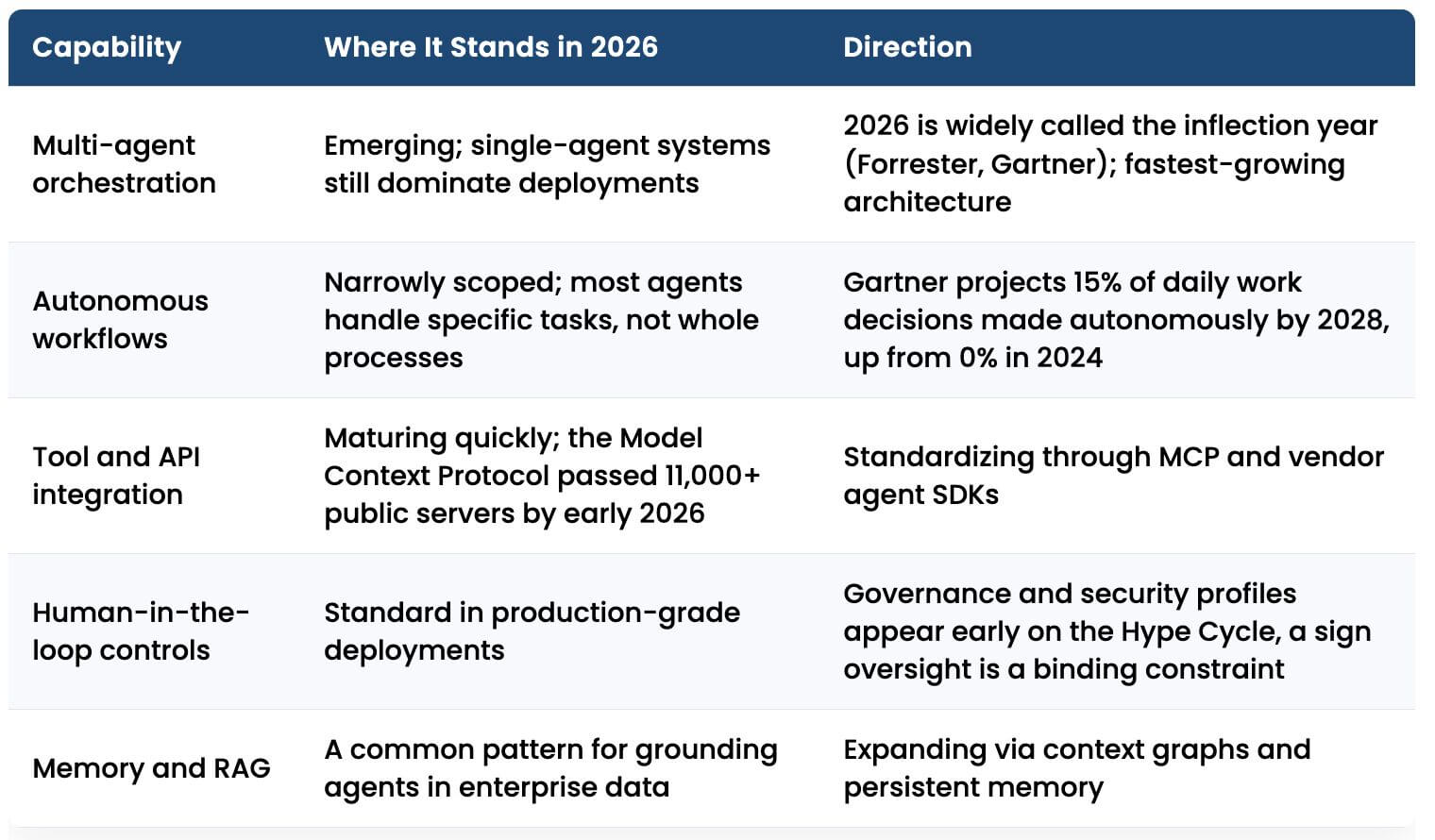
Reliable year-by-year adoption percentages do not yet exist for individual agentic capabilities, so the table below maps where each capability stands in 2026 and the direction it is heading, drawing on Gartner’s 2026 Hype Cycle for Agentic AI and related research.
Agentic Capability Maturity (2026)
| Capability | Where It Stands in 2026 | Direction |
|---|---|---|
| Multi-agent orchestration | Emerging; single-agent systems still dominate deployments | 2026 is widely called the inflection year (Forrester, Gartner); fastest-growing architecture |
| Autonomous workflows | Narrowly scoped; most agents handle specific tasks, not whole processes | Gartner projects 15% of daily work decisions made autonomously by 2028, up from 0% in 2024 |
| Tool and API integration | Maturing quickly; the Model Context Protocol passed 11,000+ public servers by early 2026 | Standardizing through MCP and vendor agent SDKs |
| Human-in-the-loop controls | Standard in production-grade deployments | Governance and security profiles appear early on the Hype Cycle, a sign oversight is a binding constraint |
| Memory and RAG | A common pattern for grounding agents in enterprise data | Expanding via context graphs and persistent memory |
Sources: Gartner 2026 Hype Cycle for Agentic AI; Forrester; Mordor Intelligence; Model Context Protocol ecosystem data (accessed June 2026). Capability positioning is directional.
Key Finding
The binding constraint on agentic AI in 2026 is governance, not intelligence. Gartner’s Hype Cycle shows governance, security, and FinOps-for-agents profiles emerging early, alongside the core technology, which is unusual and tells you where the real work sits.
The competitive advantage in 2026 is shifting away from model selection and toward system design. As frontier models continue to converge in capability, organizations increasingly differentiate themselves through orchestration, governance, integration, and evaluation rather than by choosing a single model vendor.
Single-Agent vs. Multi-Agent Deployment Share (2025)
| Architecture | Approximate Share | Outlook |
|---|---|---|
| Single-agent systems | ~59% to 62% | Dominant today; simpler to build and cheaper to run |
| Multi-agent systems | ~38% to 41% | Fastest-growing; specialized agents collaborating under coordination |
Sources: Grand View Research and Precedence Research (single-agent ~59% to 62% share); some providers (Mordor Intelligence) estimate a higher multi-agent share, so treat the split as approximate.
Build vs. Buy Split
| Approach | Approximate Share | Note |
|---|---|---|
| Buy / ready-to-deploy agents | ~58% to 76% | Ready-to-deploy held the larger share in 2025; Menlo Ventures reported roughly a 76% buy rate for enterprise AI overall |
| Build-your-own agents | Remainder | Fastest-growing where domain-specific logic or differentiation is required |
Sources: Precedence Research, Grand View Research, Menlo Ventures (2025). Build-versus-buy figures vary by category definition.
In Practice
The durable pattern we see is hybrid: organizations buy commodity agent capabilities and build the custom integration and governance layer that connects those capabilities to enterprise systems. Multi-agent designs pay off when the workflow is clearly scoped, and create cost and reliability risk when they are not.
On a recent AI-accelerated COBOL-to-Spring-Batch modernization, an architect-led team used a generative AI tool to assist the migration and reduced manual effort by roughly 20% to 30%, with the gains coming from disciplined architecture and CI/CD rather than from the tooling alone.
Across modernization projects, one of the most consistent surprises is that AI implementation is rarely limited by model quality. More often, organizations underestimate the work required around data quality, system integration, evaluation frameworks, observability, governance, and change management. Those concerns appear repeatedly throughout Gartner’s Hype Cycle and mirror what enterprise delivery teams experience when moving from proof of concept into production.
Emerging standards such as the Model Context Protocol (MCP) and AGENTS.md are also making agent behavior more portable across platforms, reducing long-term vendor lock-in while improving consistency between development environments.
4. Use Cases
Clean year-by-year deployment percentages per use case are not available, but the leading use cases and their ROI maturity are well established. The table below ranks them by adoption signal and a directional ROI tier.
Leading Agentic AI Enterprise Use Cases (2026)
| Use Case | Adoption Signal | ROI Tier |
|---|---|---|
| Software development | Among the earliest and broadest; coding agents in daily use | Proven / high |
| Customer support and service | 80% of customer service organizations applying generative and agentic AI by year-end (Gartner) | Proven / high |
| Finance operations | Close, reconciliation, and compliance workflows, especially in regulated firms | Proven / medium-high |
| Data analysis | Retrieval, reporting, and analytics agents grounded in enterprise data | Proven / medium-high |
| IT operations | Incident response, monitoring, and routine automation | Emerging / medium |
| Sales and marketing | Outreach, content, and operations; analysts note a productivity ceiling | Mixed (under 40% of sellers report agent productivity gains, Gartner) |
Sources: Gartner; provider deployment analyses (2025 to 2026). ROI tiers are directional and reflect current evidence, not guaranteed outcomes.
Key Finding
The proven-ROI cluster in 2026 is customer service, software engineering, and finance and operations automation. Analysts consistently recommend starting there, where value is measurable and workflows are bounded, before moving to more ambiguous-ROI areas.
Highest-ROI Use Cases and Why They Pay
| Use Case | Why It Pays |
|---|---|
| Customer support | High volume, repetitive resolution work with clear deflection and handle-time metrics |
| Software development | Measurable cycle-time gains on well-scoped engineering tasks under senior review |
| Finance operations | Rules-bound, auditable workflows where accuracy and speed translate directly to cost |
Sources: Gartner; IDC; enterprise delivery research (2025 to 2026).
Use Case Strength by Vertical
| Vertical | Leading Use Cases |
|---|---|
| Financial services and insurance | Fraud detection, risk and claims analysis, compliance, advisory support |
| Healthcare | Administrative automation, documentation, care-coordination support |
| Software and technology | Coding, testing, code review, and developer productivity workflows |
| Retail and eCommerce | Customer service, shopping assistants, merchandising operations |
| Manufacturing and logistics | Supply chain optimization, predictive maintenance, exception handling |
Sources: Gartner; Mordor Intelligence; provider industry analyses (2025 to 2026). Directional.
In Practice
We advise clients to start where ROI is measurable and the workflow is bounded, then expand. For a global automotive insurance technology client, Keyhole built an AI-powered claims platform that analyzes accident photos and generates repair estimates, with up to 50% of claims now automatically approved through the system, a concrete example of a scoped, high-ROI use case rather than an open-ended autonomy goal.
5. Spend, ROI, and Vendor Landscape
Enterprise AI spending is rising sharply, and reported returns are real but uneven. The figures below mix broad enterprise AI spend with agentic-specific signals, which we label accordingly.
Enterprise Spend and Reported ROI (2024 to 2026)
| Metric | Figure | Source / Note |
|---|---|---|
| Enterprise AI spend, 2024 | ~$11.5B | Broad enterprise AI (not agentic-only) |
| Enterprise AI spend, 2025 | ~$37B | Roughly triple the 2024 figure |
| Average return per $1 invested in generative AI | 3.7x | IDC with Microsoft |
| Early agentic adopters reporting positive ROI | ~88% | Market research; directional |
| AI initiatives that met expected ROI | 25% | IBM 2025 CEO study |
| Agentic AI projects expected canceled by 2027 | 40%+ | Gartner |
| Executives increasing AI budgets in next 12 months | 88% | PwC |
Sources: Menlo Ventures and industry reporting (spend); IDC and Microsoft (return); IBM 2025 CEO study; Gartner; PwC. Figures mix broad enterprise AI and agentic-specific data, and ROI definitions vary across studies.
What This Means
Strong average returns sit next to high cancellation rates because the differentiator is rarely the model. It is delivery discipline: architecture, testing, governance, and cost control. Because many agentic services use consumption-based pricing, architecture is also a direct cost lever, which is why FinOps-for-AI is emerging as a named practice.
Leading Agentic AI Platform Landscape
Reliable market-share percentages by vendor are not yet published for agentic AI, so the table below maps leading platforms by positioning rather than ranking them by share.
| Platform / Vendor | Positioning |
|---|---|
| Microsoft (Copilot Studio, Azure AI Foundry) | Governed enterprise runtime supporting multiple agent frameworks |
| Salesforce (Agentforce) | Agents embedded in CRM and customer workflows |
| Google Cloud (Vertex AI Agents, Gemini Enterprise) | Cloud and model-led agent platform |
| OpenAI | Frontier models and agent tooling for production teams |
| Anthropic (Claude, Agent SDK) | Models plus agent tooling with an enterprise governance focus |
| ServiceNow | Agents embedded in IT and enterprise service workflows |
| UiPath, Automation Anywhere, SS&C Blue Prism | RPA incumbents adding agentic layers to existing automation |
| Snowflake, Oracle | Agents embedded in data and enterprise application platforms |
| Frameworks: LangGraph, CrewAI, OpenAI Agents SDK | Open orchestration layer that leads experimentation |
An illustrative landscape, not a ranked market share. Sources: vendor announcements and provider analyses (2025 to 2026). Gartner notes that only about 130 of the thousands of self-described agentic vendors offer genuinely agentic capability.
Budget as a Share of IT and AI Spend (directional)
| Metric | Figure | Note |
|---|---|---|
| Agentic AI as a share of enterprise IT spend, 2026 | ~10% to 15% | IDC estimate; aggressive and debated |
| Preference for consumption-based pricing | ~55% | Pay-for-usage favored over fixed licensing |
| Organizations increasing AI budgets | 88% (PwC) / 92% (McKinsey, 3-year) | Broad AI, not agentic-only |
Sources: IDC; Mordor Intelligence; PwC; McKinsey (2025 to 2026). Share-of-spend figures are directional and vary by definition.
In Practice
Because agentic systems often bill by token, inference, or API call, we encourage clients to model multi-year total cost of ownership and to treat cost-per-inference and usage trends as first-class operational metrics, not afterthoughts.
In our experience, the organizations that get durable ROI treat AI as an acceleration layer inside architect-led delivery, with governance and observability built in, rather than as a standalone product bolted onto existing systems.
Putting Agentic AI Enterprise Trends Into Practice
The organizations seeing the strongest returns from agentic AI are not necessarily adopting the newest models first. They’re selecting measurable business problems, designing production-ready architectures from the beginning, and expanding only after those foundations prove successful.
That pattern appears consistently across analyst research—and it’s the same approach our architects have used while modernizing enterprise software, implementing AI-powered platforms, and helping organizations move promising prototypes into production.
If you are evaluating where agentic AI fits in your roadmap, the most useful question is not how big the market is, but where agentic workflows create measurable value in your environment and how to deliver them so they survive contact with real data, real users, and real compliance requirements.
Keyhole Software works alongside technical leaders to translate these trends into execution: scoping pilots with clear ROI criteria, defining production architecture and governance up front, and using AI-accelerated, architect-led delivery to move initiatives from pilot to production. Our 100% U.S.-based senior consultants support cloud-native development, platform engineering, AI and RAG solutions, and enterprise modernization across industries.
Talk with an expert from Keyhole Software.
Sources
This report synthesizes publicly available data from the following sources. Figures are accurate as of the publication dates noted by each provider and were accessed in June 2026. Where sources disagree, ranges are presented rather than a single figure.
1. Gartner. “Gartner Predicts 40% of Enterprise Apps Will Feature Task-Specific AI Agents by 2026, Up From Less Than 5% in 2025.” August 26, 2025. gartner.com
2. Gartner. “Gartner Predicts Over 40% of Agentic AI Projects Will Be Canceled by End of 2027.” June 25, 2025. gartner.com
3. Gartner. “2026 Hype Cycle for Agentic AI” and 2026 CIO and Technology Executive Survey. gartner.com
4. Deloitte. “Agentic AI Strategy” and 2025 Emerging Technology Trends study (30% exploring, 38% piloting, 14% deployable, 11% in production). deloitte.com
5. MuleSoft and Deloitte Digital. “2025 Connectivity Benchmark Report” (93% of IT leaders intend to introduce autonomous agents within two years). mulesoft.com
6. McKinsey & Company. “The State of AI: Global Survey 2025.” mckinsey.com
7. PwC. AI Agent Survey (88% increasing AI budgets; 79% report using AI agents in some capacity). pwc.com
8. IDC, with Microsoft. Generative AI return-on-investment research (3.7x average return per $1). idc.com
9. IBM. 2025 CEO study (25% of AI initiatives met expected ROI). ibm.com
10. Grand View Research. “AI Agents Market Report, 2026 to 2033.” grandviewresearch.com
11. Precedence Research. “AI Agents Market.” precedenceresearch.com
12. Mordor Intelligence. “Agentic AI Market” and “Agentic AI Frameworks Market.” mordorintelligence.com
13. MarketsandMarkets. “Agentic AI Market.” marketsandmarkets.com
14. SNS Insider. “Agentic AI Market.” snsinsider.com
15. Menlo Ventures. “2025: The State of Generative AI in the Enterprise.” menlovc.com
16. Forrester. Research on multi-agent systems and enterprise AI governance, 2025 to 2026. forrester.com
17. Model Context Protocol ecosystem data (11,000+ public servers by early 2026).
18. Keyhole Software project case studies: Kansas City insurance platform modernization (AI-assisted); AI-accelerated COBOL to Spring Batch; auto damage detection claims platform; enterprise generative AI proof of concept. keyholesoftware.com
Methodology note: figures were compiled from the sources above between March and June 2026. Market-size and share figures are vendor estimates produced with proprietary methodologies and differing category definitions; they are presented as ranges and directional benchmarks rather than audited totals. Keyhole project examples are illustrative and should be verified against current case studies before publication.
More From Keyhole Software
About Keyhole Software
Expert team of software developer consultants solving complex software challenges for U.S. clients.
Share This Post
Join The Thousands Of Devs Who Subscribe
[…] https://keyholesoftware.com/agentic-ai-enterprise-trends-2026/ […]