
Agentic AI Development Cost in 2026: Pricing by Complexity, Approach, and Cost Driver
From June through August 2026, the Keyhole Software research team analyzed more than 45 sources published between June 2025 and August 2026 to answer a question that we’ve been getting asked more and more: what does agentic AI development cost?
What we found was a basic single-agent build starts near $8,000, a multi-agent workflow typically lands between $50,000 and $400,000, and an enterprise autonomous system runs $150,000 to $500,000 or more1,2,3. Annual run and maintenance costs then add 15% to 25% of the build price every year2,4,5. The tables below break those figures down by complexity, agent type, delivery approach, cost component, and cost driver.
The dataset includes 20 published agency and consultancy pricing guides, current list-price pages from Salesforce, Microsoft, Amazon Web Services, Google, OpenAI, and Anthropic, U.S. Bureau of Labor Statistics wage data, and analyst research from Gartner, McKinsey, KPMG, Menlo Ventures, and MIT.
Average Agentic AI Development Cost by Project Complexity
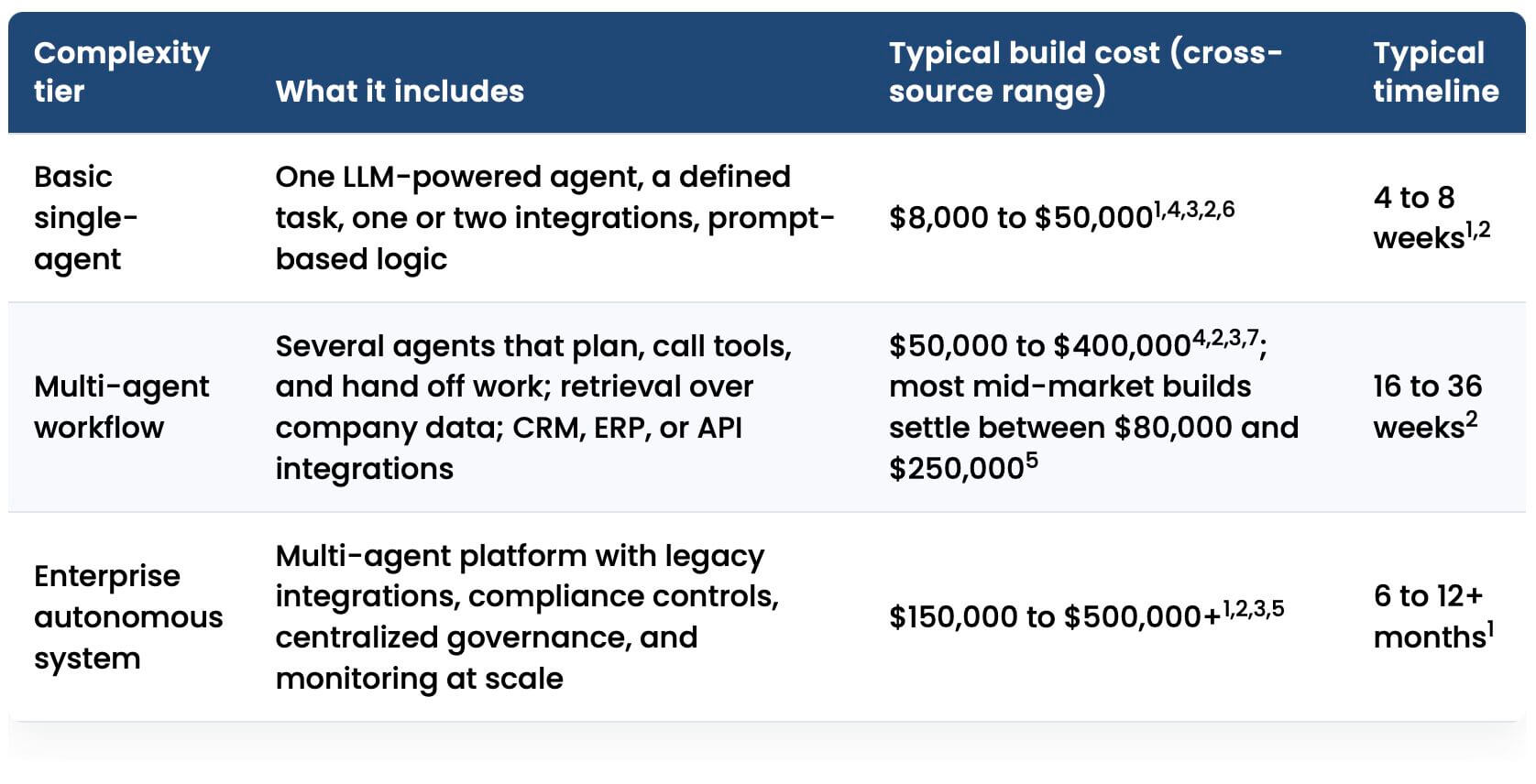
Published quotes for the same tier of agent can differ by 5x or more between firms, so this table shows the cross-source range rather than a single number. The three tiers map to how most agencies scope work: one agent doing one job, several agents coordinating a workflow, and a production platform that acts with limited human review.
Agentic AI Development Cost by Project Complexity, 2026
| Complexity tier | What it includes | Typical build cost (cross-source range) | Typical timeline |
|---|---|---|---|
| Basic single-agent | One LLM-powered agent, a defined task, one or two integrations, prompt-based logic | $8,000 to $50,0001,4,3,2,6 | 4 to 8 weeks1,2 |
| Multi-agent workflow | Several agents that plan, call tools, and hand off work; retrieval over company data; CRM, ERP, or API integrations | $50,000 to $400,0004,2,3,7; most mid-market builds settle between $80,000 and $250,0005 | 16 to 36 weeks2 |
| Enterprise autonomous system | Multi-agent platform with legacy integrations, compliance controls, centralized governance, and monitoring at scale | $150,000 to $500,000+1,2,3,5 | 6 to 12+ months1 |
Methodology Note: Ranges combine the low and high quotes across nine agency pricing guides published between February and August 2026; each guide defines its tiers slightly differently, so the columns reflect the closest matching tier in each source.
Caveat: These are published list ranges from firms that sell development services, not audited project actuals, and offshore hourly rates for the same work can run roughly 75% lower2.
What This Means
The data shows that complexity, not the AI model per se, is what moves the price. The jump from a single agent to a multi-agent workflow adds integrations, orchestration logic, and testing for non-deterministic behavior, and that is where the budget goes. Agencies that itemize their quotes report that integration and QA work together account for 40% to 60% of total build cost8.
Our analysis also reveals that the spread inside each tier is a feature of the market, not simply statistical noise. One cost index that compared competing guides found quotes for the same “simple agent” tier ranging from $8,000 to $80,000, a 10x disagreement9. Buyers should read a quote’s scope line before its dollar figure.
In Practice
The tell is usually right there in the requirements document, not the request. If it lists more than two systems the agent needs to read from or write to, it is a multi-agent workflow, no matter what the request called it, and the single-agent number in the original ask is already wrong. Keyhole’s agentic AI programs start with a focused architecture and roadmap engagement for that reason: it settles the tier, the integration count, and the governance model before anyone commits to a number.10
Agentic AI Development Cost by Agent Type
After seeing the complexity tiers, the natural follow-up is what a specific kind of agent costs. The table below lists build-cost ranges for the seven agent types that appear most often in 2026 pricing guides.
Agentic AI Build Cost by Agent Type, 2026
| Agent type | Typical scope | Published build cost range |
|---|---|---|
| Customer support agent | Ticket triage, FAQ resolution, escalation to humans | $10,000 to $150,000+11,4,3,8 |
| Sales and lead qualification agent | Lead scoring, outreach drafting, CRM updates | $25,000 to $180,0006,4,5 |
| Workflow automation agent | Multi-step back-office processes across two or more systems | $35,000 to $150,0006,12,4 |
| RAG knowledge agent | Retrieval over internal documents with cited answers | $30,000 to $180,000+2,4,3,8 |
| Data analysis agent | Querying, summarizing, and charting business data | $70,000 to $180,0004,5 |
| Voice agent | Real-time speech, telephony, and intent handling | $10,000 to $300,000+13,4 |
| Coding agent (enterprise) | Repository-integrated code generation, testing, and review | $50,000 to $500,000+14 |
Methodology Note: Each range spans the lowest and highest published figure for that agent type across the cited guides; where a guide split a type into tiers, the full span is shown.
Caveat: Agent-type ranges overlap heavily because the same type can be built at any complexity tier; a customer support agent with one knowledge base and one with six back-end integrations are different projects.
What This Means
The data shows that agent type is a weaker predictor of cost than integration depth. Customer support agents have the lowest floor because vendors have productized the pattern, while coding agents have the highest ceiling because they touch source control, CI pipelines, and security review. Voice agents carry an extra infrastructure line that text agents do not: published per-minute costs run $0.05 to $0.15 at scale13.
In Practice
Coding agents are where we see the most expensive kind of savings: the ones that show up as a lower quote and a higher bill six months later. We were brought in to rebuild and scale an AI-generated stock alerting platform after its original, rapidly assembled build could not hold up once it reached real users, a pattern common enough that it has a name internally: it worked in the demo and failed the first time it met production load and edge cases. This is just a new variant of the age old adage “it worked on my machine.”
The fix was never a better model. It was re-establishing architecture, test baselines, and deployment patterns the original build skipped to move fast. Keyhole treats coding agents as architect-directed, test-aligned iterations inside governed repositories and CI/CD pipelines from day one for exactly that reason, which is what keeps the ongoing cost predictable instead of deferred.
Upfront Build Cost vs. Ongoing Run Cost
A build quote is only the first year’s largest line. This table pairs upfront build cost with the monthly run cost and first-year total by complexity tier, using the one guide that publishes all three side by side.
Agentic AI Upfront Build Cost vs. Ongoing Run Cost by Tier, 2026
| Complexity tier | Upfront build cost | Ongoing run cost (monthly) | First-year total cost of ownership |
|---|---|---|---|
| Rule-based or simple agent | $15,000 to $40,0002 | $200 to $8002 | $21,500 to $56,0002 |
| RAG-powered agent | $30,000 to $80,0002 | $500 to $2,5002 | $46,000 to $126,0002 |
| Tool-using autonomous agent | $60,000 to $150,0002 | $1,500 to $6,0002 | $94,000 to $252,0002 |
| Multi-agent system | $120,000 to $400,000+2 | $4,000 to $20,000+2 | $204,000 to $720,000+2 |
Methodology Note: All figures in this table come from a single June 2026 pricing guide so that build, run, and first-year totals are internally consistent; run cost covers LLM API usage, hosting, monitoring, and prompt maintenance.
Caveat: Other guides put typical monthly run cost at $3,200 to $13,000 for a production agent8 and $4,200 to $18,000 for multi-agent systems3, so the run column above sits toward the low end of the market.
What This Means
Our analysis reveals a consistent rule across ten pricing guides: annual maintenance runs 15% to 25% of the original build cost, covering prompt updates as models change, model upgrades, and integration upkeep2,4,5,7,11. Two guides push the top of that range to 30%12,15. For a mid-complexity agent at moderate volume, that works out to $40,000 to $120,000 a year beyond the build5.
The data also shows that run cost is where budgets break. A May 2026 McKinsey survey found 93% of respondents had exceeded their AI budgets, and 20% to 30% of AI spend was unaccounted for across vendors and tools16. KPMG’s Q2 2026 pulse found only 26% of large U.S. companies have full, real-time visibility into what their AI systems cost to operate17.
In Practice
We recommend you ask a team how it will route requests to models before you ask what the build costs, and you learn more about the eventual bill than the SOW tells you. This gives them the chance to really think through what’s being built before actually building it. Estimating monthly task volume, choosing the model tier for each step instead of one model for everything, and deciding early which decisions still route to a human set the run line more than any vendor discount does.
Those are also the exact questions a Keyhole architecture and roadmap engagement is built to answer, and the same discipline shows up in how we encode architecture, testing expectations, and coding standards into a model’s working context so results stay repeatable as volume grows, not just fast on day one.
Agentic AI Cost by Approach: Build vs. Buy vs. Platform
Once a team knows what tier it is in, the next question is how to get there. The table below compares the three delivery approaches on upfront cost, ongoing pricing, and time to a first production agent. This is the table to keep open during a build-versus-buy review.
Agentic AI Cost Comparison: Build vs. Buy vs. Platform, 2026
| Approach | Upfront cost | Ongoing pricing (published list rates) | Time to first production agent |
|---|---|---|---|
| Build (custom, open frameworks) | $10,000 to $500,000+ by tier18; $80,000 to $180,000 for a production customer-service agent19 | $3,200 to $13,000 per month for LLM usage, retrieval, monitoring, and tuning8,19; LangSmith tracing from $39 per seat per month20 | 3 to 9+ months by tier18; custom time to value 6 to 15 weeks for a scoped agent21 |
| Platform (cloud agent runtime or low-code studio) | Configuration and integration labor; simple agents in 6 to 10 engineering days9 | Copilot Studio: $200 per 25,000 credits per month22; AgentCore: $0.0895 per vCPU-hour23; Google Agent Platform: $0.085 per vCPU-hour24 | Weeks; vendor-hosted runtimes remove infrastructure setup |
| Buy (packaged agent product) | License and rollout; little or no engineering build | Agentforce: $2 per conversation, or $5 per user per month plus $500 per 100,000 Flex Credits25; Claude Team: $20 to $25 per seat per month26 | 1 to 3 weeks for off-the-shelf agents21 |
Methodology Note: Vendor prices are U.S. list rates as published on each vendor’s pricing page on August 28, 2026; build and platform labor figures come from agency guides published between January and August 2026.
Caveat: The $80,000 to $180,000 build figure and its 3-year TCO comparison come from a vendor that sells the “buy” option, and usage-priced products can exceed a custom build at high volume, so the columns are not directly additive.
What This Means
The data shows the market has already voted. Menlo Ventures found that 76% of enterprise AI use cases were purchased rather than built in 2025, a reversal from 2024 when 47% were built internally27. MIT’s 2025 study reported that externally sourced, customized tools reached deployment about 67% of the time, versus about 33% for internally built tools28. KPMG found 57% of organizations now favor a blend of building and buying29.
Our analysis reveals why the blend wins. Packaged agents are cheapest to start and fastest to deploy, but per-conversation pricing at $2 scales linearly with volume25. Platforms shift cost to metered compute and credits, which is predictable but not free: a single agent action on Copilot Studio consumes 5 credits, and a generative answer consumes 230. Custom builds cost the most upfront and buy control over model choice, data handling, and integration depth.
In Practice
The platform option often wins the bid on its low starting price, only to lose later once metered credits catch up to what a custom build would have cost. The build-versus-buy line is really drawn by the integrations, not really just the agent: when an agent needs to act inside systems a vendor does not connect to, or the data cannot leave the client’s environment, custom build on an open framework is usually the lower-risk path even at a higher number up front.
Keyhole works across AWS, Azure, and Google Cloud and builds on portable, vendor-neutral patterns for exactly that reason, so the platform decision follows the client’s existing environment rather than a vendor’s roadmap.
In-House Team vs. Agency Cost for Agentic AI Development
For teams that choose to build, the next question is who builds it. The table compares the annual or hourly cost of each staffing model using salary surveys, federal wage data, and marketplace rate cards.
Agentic AI Development Cost by Staffing Model, 2026
| Staffing model | Cost basis | Published cost |
|---|---|---|
| In-house AI/ML engineer (U.S.) | Annual base salary, national percentiles | $134,000 (25th) / $170,750 (median) / $193,250 (75th)32 |
| In-house, fully loaded | Base salary plus benefits; benefits are 30.1% of private-industry employer cost | About $244,000 per median engineer (derived from the two figures above)32,33 |
| U.S. AI development agency | Hourly rate | $50 to $99 per hour for most Clutch-listed U.S. firms34; $150 to $250 per hour for senior AI/ML consultants2 |
| Nearshore agency (Latin America) | Hourly rate, senior developer | $60 to $75 per hour35 |
| Offshore agency (Central and Eastern Europe) | Hourly rate, senior developer | $64 to $76 per hour35 |
| Offshore agency (Asia) | Hourly rate, senior developer | $31 to $41 per hour35 |
| Freelance specialist | Median hourly rate | $50 per hour (AI engineer)36; $100 per hour (machine learning engineer)37 |
Methodology Note: Salary figures are Robert Half 2026 national base-pay percentiles; the fully loaded figure multiplies the median by the BLS March 2026 employer-cost ratio and is a Keyhole calculation, not a published statistic.
Caveat: Hourly rate bands describe the firm, not the project; Accelerance notes that hourly rates are a poor measure of true delivery cost once rework, management overhead, and time zones are counted35.
What This Means
The data shows that a four-person in-house agentic AI team costs roughly $975,000 a year before tooling and cloud, using the fully loaded figure above32,33. Against that, the average AI development project on Clutch costs $120,595 and runs about ten months34, and 72% of surveyed AI firms price small to mid-size AI projects between $50,000 and $125,00038. For a company with one or two agent programs, an agency engagement is usually the smaller number.
Surprisingly, we found that the offshore discount is real but increasingly narrowing. Senior rates in Latin America fell 7.1% year over year and Central and Eastern European rates fell 4.4%35, while U.S. mid-level AI engineer salaries rose about 9% over the same period39. The gap on a 1,500-hour project between a $180-per-hour U.S. team and a $40-per-hour offshore team is about $210,000 in labor alone2, and that gap is what the buyer is trading against integration risk, security review, and time-zone overlap.
In Practice
Ask who will still understand why a guardrail exists two model generations from now, not just what the hourly rate is today. Every foundation model update is effectively a re-certification event for an agentic system: prompts drift, tool-calling behavior shifts, and someone has to know why a rule was written before they can safely change it. Having a continuity of understanding and tribal knowledge is a large reason why 78% of last year’s projects were with repeat clients.31
But the point of that continuity is not to keep the knowledge locked inside one consultant’s head. It is to document the architecture and the reasoning behind it well enough that the client’s own team can pick it up, extend it, and maintain it long after an engagement ends, which is the same discipline that makes the tenure worth something in the first place.
Agentic AI Development Cost Breakdown by Component
Buyers reviewing a quote want to know where the money goes. The table below lists the typical build cost and share of budget for each component of an agentic system, using the two guides that itemize both.
Agentic AI Development Cost by Component, 2026
| Component | Typical build cost | Share of total build budget |
|---|---|---|
| Discovery, system design, and data preparation | $5,000 to $20,000 (design)8; 10% to 25% of budget for data acquisition and prep12 | 15% to 25%18 |
| Agent core: LLM selection, prompts, and orchestration | $20,000 to $80,0008 | 30% to 40%18 |
| Data and integration: RAG pipeline, vector store, tool and API connectors | $25,000 to $90,000 combined8 | 5% to 15% for integration and API work12; 35% to 55% on mid-to-large builds2 |
| Compute, infrastructure, and MLOps | $10,000 to $30,000 (DevOps/MLOps)8 | 20% to 30% (LLMOps and infrastructure)18 |
| QA, safety testing, guardrails, and observability | $16,000 to $45,000 combined8 | 15% to 20% (testing and red-teaming)18 |
| LLM API usage during the build | Included in run cost after launch | 5% to 15%15 |
| Talent (engineering time across all components) | Not itemized separately | 60% to 70% of build cost15 |
Methodology Note: Dollar figures are Azilen’s February 2026 component estimates for a production agent; percentage splits are from Geniusee (July 2026), Riseup Labs (updated July 2026), and CodeStore (August 2026), and they do not sum to 100% because each guide categorizes work differently.
Caveat: No analyst firm publishes a component-level budget split for a single agentic system, so these percentages come from agencies describing their own quotes.
What This Means
The data shows that model API fees are a small slice of the overall build budget. Engineering time is 60% to 70% of the bill15, and integration work routinely exceeds the LLM and core development work combined on complex projects2. That pattern matches what enterprise spend data shows at the macro level: of the $37 billion enterprises spent on generative AI in 2025, $19 billion went to the application layer and only $750 million to agent platforms27.
Our analysis reveals a second pattern that quotes hide, either intentionally or unintentionally: the components that protect the system are a substantial line item next to the components that build it, and validating them is a cost in its own right. Testing, red-teaming, guardrails, and observability together run 15% to 20% of the budget18, and one guide flags that QA for non-deterministic systems is typically underestimated by 30% to 40%40.
In Practice
The line item clients cut most often is the one they regret most: evaluation and test coverage, and the data explains why that cut is a false economy. One widely cited Carnegie Mellon and Stanford study found AI agents complete tasks 88.3% faster and 90.4% to 96.2% cheaper66 than people doing the same work, and also found the output measurably worse, with fabrication and tool-misuse errors baked into that speed gain, none of it counted in the headline comparison.
An agent without a test harness compounds that risk further, because there is no way to tell whether a prompt that worked last month still works after a model refresh, only that the output looks a little different. The savings show up on the statement of work and come back as rework months later. Keyhole ties every agent-produced change to intent, validation, and commit history for that reason.10.
Token and Inference Cost at Scale
After the build, the largest variable cost is inference. Agentic workloads consume far more tokens than a chat interaction, and the table below shows the published multipliers by workload type.
Token Consumption by Agentic Workload Type vs. Standard Chat
| Workload type | Tokens consumed vs. a standard chat interaction | Source basis |
|---|---|---|
| Standard chatbot interaction | 1x (baseline) | Reference point |
| Single agent with tool use | About 4x41 | Anthropic engineering analysis of production agents |
| Agentic reasoning model, per task | 5x to 30x42 | Gartner, March 2026 |
| Multi-agent system | About 15x41 | Anthropic engineering analysis |
| Agentic coding task | About 1,000x vs. code chat or code reasoning43 | Stanford Digital Economy Lab, May 2026 |
Methodology Note: Multipliers are as published by each source and measure token volume, not dollar cost; the same task can also vary up to 30x in tokens between runs43.
Caveat: Token multipliers depend on task length, tool count, and retry behavior, so a specific deployment can sit well outside these averages.
Those multipliers land on current per-token list prices. As of August 28, 2026, Claude Sonnet 5 is priced at $2 per million input tokens and $10 per million output tokens, Claude Opus 5 at $5 and $25, and Claude Haiku 4.5 at $1 and $544. OpenAI’s GPT-5.6 Terra lists at $2 input and $12 output per million tokens, and GPT-5.6 Luna at $0.20 and $1.2045. Google’s Gemini 3.5 Flash lists at $1.50 input and $9 output per million tokens46. Cached input tokens on the Claude platform cost one-tenth of the standard input rate44.
What This Means
The data shows two forces pulling in opposite directions. Per-token prices keep falling: the cost to query a model at GPT-3.5 performance dropped from $20 per million tokens in November 2022 to $0.07 by October 202447, and Epoch AI measured declines of 9x to 900x per year depending on the capability level48. But token volume per task is rising faster. Gartner now predicts that inference cost per agentic workflow will increase more than fivefold through 2028, because each generation of capability needs more, and often more expensive, tokens49.
Our analysis reveals that at the workflow level, tokens are still not the biggest run line. McKinsey’s August 2026 analysis of customer-facing agents in banking put the cost to run a single-agent workflow at $20,000 to $30,000 and a multi-agent team at $100,000 to $200,000, with human oversight accounting for 70% to 75% of variable cost and tokens only 20% to 25%50. About 60% of an agentic task’s cost is tied to refining answers rather than the first inference call51.
In Practice
Model routing is the single largest run-cost lever a team controls, and it is usually the first thing we change once a client moves from prototype to production. Sending every step to the most capable model is the default in most prototypes: classification and extraction steps go to a smaller model, and only planning and judgment steps use the premium tier.
Standardizing on a single vendor makes that decision harder to walk back once volume grows, which is why Keyhole builds on portable patterns like the Model Context Protocol and applies the same vendor-neutral approach to agentic delivery rather than letting the routing decision get locked to whichever platform the prototype happened to start on. Prompt caching for repeated context is the second lever, and it is often left switched off entirely.
Maintenance and Monitoring Cost
The final piece of the run budget is keeping the agent healthy after launch. The table lists the recurring lines that appear in published maintenance estimates and current list prices for observability tooling.
Agentic AI Maintenance and Monitoring Cost by Line Item, 2026
| Line item | Cost basis | Published cost |
|---|---|---|
| Annual maintenance (all-in) | Percent of original build cost per year | 15% to 25%2,4,5,7,11; up to 30%12,15 |
| Prompt updates and model upgrades | Monthly | $1,000 to $2,5008 |
| Monitoring and evaluation labor | Monthly | $200 to $1,0008 |
| Security and access control | Monthly | $500 to $2,0008 |
| Integration drift | Per integration, per year | $1,000 to $3,0002 |
| Observability tooling (list prices) | Monthly subscription | Langfuse: $29 (Core) to $2,499 (Enterprise)52; Arize AX Pro: $5053; Datadog: $160 per 100,000 LLM spans54; LangSmith Plus: $39 per seat20 |
Methodology Note: Percentages and labor figures are agency estimates published February to August 2026; tooling prices are vendor list rates as of August 28, 2026 and exclude enterprise contracts.
Caveat: Maintenance percentages assume a stable scope; adding an integration or raising the autonomy level after launch is new build work, not maintenance.
What This Means
The data shows that monitoring tools are cheap and monitoring labor is not. Observability subscriptions start under $200 a month, but the people who read the traces, tune prompts, and re-run evaluations cost $1,200 to $3,500 a month in the published estimates8. Gartner’s forecast that over 40% of agentic AI projects will be canceled by the end of 2027 names escalating costs first among the reasons55, and unplanned maintenance is where that escalation tends to show up.
In Practice
If you cannot see what an agent is doing or revert its actions safely, it truly is not production-ready, regardless of what the demo showed. That bar, more than model choice, is what separates enterprise teams that are actually ready to run agents in production from the ones still piloting, and it is why the maintenance budget belongs in the original statement of work as a percentage, not a change order filed after the first incident.
Teams that plan for 20% of build cost per year rarely overspend it, whereas teams that plan for zero spend more, because every model update becomes an emergency instead of a scheduled task, often with little to no ROI for staying on the bleeding edge.
What Drives Agentic AI Development Cost
Two agents with the same job can differ by 3x in price. The table below isolates the four drivers that explain most of that difference and quantifies each one from published pricing guides.
Agentic AI Development Cost Drivers and Their Price Impact, 2026
| Cost driver | How it moves the price | Quantified impact |
|---|---|---|
| Number of agents | Each added agent adds orchestration logic, hand-off testing, and failure modes | Multi-agent systems quote at $120,000 to $400,000+ versus $60,000 to $150,000 for a single tool-using agent, roughly 2x to 3x2; a comparable 2.5x to 3.5x gap appears in a second guide40 |
| Autonomy level | Fewer human checkpoints require more safeguards, evaluation, and fallback logic | Per workflow, an assistive agent takes 25 to 60 engineering hours, semi-autonomous 40 to 100, fully autonomous 90 to 17021 |
| Tool and system integrations | Each connector adds mapping, auth, error handling, and drift maintenance | Documented REST API $3,000 to $8,000; CRM $8,000 to $20,000; ERP $15,000 to $50,000; legacy or custom system $20,000 to $80,0002; about 40 to 60 engineering hours per integration56 |
| Accuracy requirements and guardrails | Human-in-the-loop, evaluation infrastructure, and compliance controls add scope | Human-in-the-loop adds 10% to 15% to base build40; evaluation infrastructure adds 10% to 20% to infrastructure cost2; compliance premium of 5% to 30% by industry, from retail to healthcare and banking40; regulated builds run 20% to 35% higher overall2 |
Methodology Note: Impact figures are drawn from four agency pricing guides published between February and August 2026 that itemize add-on cost by driver; the multi-agent multiplier is calculated from each guide’s own tier table rather than stated directly.
Caveat: Drivers compound: a fully autonomous, multi-agent system in a regulated industry stacks all four premiums, which is how quotes reach the $500,000+ ceiling in the primary table.
What This Means
The data shows that integrations are the driver clients most often underestimate. Integration work accounts for 35% to 55% of total cost on mid-to-large builds2, and legacy systems take 4 to 8 weeks per connection versus 1 to 2 weeks for modern SaaS platforms56. Autonomy is the driver potential clients most often overestimate their need for: a Gartner survey found only 15% of IT application leaders were even considering fully autonomous agents, while 75% were piloting or deploying some form of agent57.
Our analysis reveals that the guardrail premium is, relatively speaking, small compared to the failure it prevents. Adding human review and evaluation infrastructure costs 10% to 20% more40,2. Skipping it is a leading cause of the cancellations Gartner predicts, which it attributes to escalating costs, unclear business value, or inadequate risk controls55.
In Practice
Reducing integrations and autonomy in the first release, not testing, is the fastest way to cut an agentic AI quote. Sometimes this may not be feasible, as the largest rationale for an AI project may truly be in bringing together disparate data sources so end users can “speak” to their data via natural language. A first version that reads from three systems and writes to one, with a human approving that one write, ships sooner and teaches the team what the second version actually needs, which is usually different from what the original requirements document assumed.
The bigger budgeting mistake is treating governance and integration work as a rounding error against the platform license: in the engagements that go well, services cost lands at parity with, or above, the platform cost, not bolted on as an afterthought. Keyhole’s architect-led model is built around that sequence: governed, test-aligned iterations that expand autonomy as the evaluation results earn it.10.
AI Engineer Rates by Role and Seniority
Talent is the largest cost component, so the rates behind it deserve their own table. This one lists 2026 salary and hourly benchmarks for the roles that appear on an agentic AI team.
AI Engineer Compensation and Hourly Rates by Role, 2026
| Role | Basis | Published figure |
|---|---|---|
| Computer and information research scientist | U.S. median annual wage, May 2025 | $140,300 ($67.45 per hour)58 |
| AI/ML engineer | U.S. median base salary, 2026 | $170,75032 |
| AI architect | U.S. median base salary, 2026 | $175,00032 |
| Machine learning engineer | U.S. average total pay, 2026 | $164,349 (Glassdoor)59; $188,643 (Indeed)60 |
| AI engineer, freelance | Hourly rate range | $35 to $60, median $50; expert $75 to $100+36 |
| Machine learning engineer, freelance | Hourly rate range | $50 to $200, median $10037 |
| Senior AI/ML consultant, U.S. agency | Hourly rate range | $80 to $18061; $150 to $2502 |
Methodology Note: Salary figures are national U.S. medians or averages from the cited surveys; hourly figures are marketplace and agency rate cards as published in 2026.
Caveat: No major salary survey yet publishes a separate line for “agentic AI engineer,” so AI/ML engineer and AI architect are the closest benchmarks.
What This Means
The data shows a premium for AI skills that is still widening. Mid-level AI engineer salaries rose about 9% year over year, the largest gain of any tech role in one 2026 salary guide39, and 59% of technology leaders report paying more for AI, machine learning, and data science expertise32. At a fully loaded cost near $244,000 per median engineer32,33, a 1,500-hour agent project consumes most of one engineer-year before tooling, which is the arithmetic behind the agency price ranges in the primary table. We’ve seen this manifest with more and more candidates coming in with AI experience, and extremely few saying they are reluctant to use AI.
In Practice
Seniority changes the total more than the hourly rate suggests, and it shows up in a place most cost comparisons miss: rework that a lower rate does not eliminate, only defers. A senior architect scopes the integrations correctly the first time, chooses the model tier per step, and writes down why, so the decision doesn’t live only in one person’s head. Skip that step and a team can ship the same mistake faster and cheaper, then pay for it twice: once in the rework, and again in the reasoning that leaves with whoever fixed it. That’s why Keyhole staffs agentic engagements with senior consultants and treats documenting the reasoning, not just the code, as part of the deliverable, including through our work inside the Anthropic partner ecosystem.31
Timeline Impact on Agentic AI Development Cost
Timeline is the last driver, and it converts directly into cost through team burn rate. The table shows typical durations by delivery phase and complexity tier.
Agentic AI Development Timeline by Phase and Complexity Tier, 2026
| Phase or tier | Typical duration | Notes |
|---|---|---|
| Proof of concept | 4 to 6 weeks61 | Validates feasibility on one workflow |
| Minimum viable agent | 6 to 10 weeks61 | An MVP-first approach cuts initial spend 40% to 60%56 |
| Rule-based or simple agent | 4 to 8 weeks2 | One or two integrations |
| RAG-powered agent | 6 to 12 weeks2 | Adds retrieval pipeline and evaluation |
| Tool-using autonomous agent | 10 to 20 weeks2 | Adds multi-step execution and fallbacks |
| Multi-agent system | 16 to 36 weeks2 | Adds orchestration and hand-off testing |
| Enterprise regulated system | 20 to 52 weeks2 | Adds compliance review and governance |
Methodology Note: Durations are calendar estimates from two agency guides published March to June 2026 and assume a dedicated team; fine-tuning a model adds 4 to 8 weeks and 15% to 30% to cost56.
Caveat: Published timelines describe the build, not the approval cycle; MIT reports enterprise pilot-to-production averages nine months or longer, versus 90 days for the fastest mid-market adopters28.
What This Means
The data shows that timeline is cost by another name. Agency guides put monthly burn at $20,000 to $35,000 for a three-person MVP team, $40,000 to $60,000 for a five-person team, and $70,000 to $120,000 for eight or more62. A multi-agent build at the 36-week end of its range (about 8.3 months) with a five-person team is therefore a roughly $330,000 to $500,000 labor commitment before infrastructure, which is consistent with the top of the primary table. Overruns of 35% to 50% above initial estimates are common on agentic projects40.
Our analysis reveals that the biggest timeline risk sits outside the build. Gartner’s 2026 CIO survey found only 17% of organizations had deployed AI agents, yet more than 60% expected to within two years63, and KPMG’s Q2 2026 pulse found 53% of large U.S. companies had deployed agents while only 18% were orchestrating multiple agents17. The gap between those numbers is the pilot-to-production stall that the MIT data describes.
In Practice
The projects that hold their timeline share one trait, and it shows up before the first sprint: the architecture and roadmap work is finished before the build team is staffed. On a Kansas City insurance platform modernization, an architect-led, AI-accelerated approach delivered in roughly five months against an estimate of 18 to 24 months.10 The acceleration came from removing rework, not from skipping governance.
That is the pattern behind most of the ranges in this article: builds that stay cheap over time are the ones that were architected carefully before anyone started building, not the ones that cut testing to hit a number.
What the Agentic AI Cost Data Means for Technology Leaders
Agentic AI development cost in 2026 is wide but not random. The build price is set by complexity tier, integration count, and autonomy level; the run price is set by token volume, model routing, and human oversight; and the maintenance price is a predictable 15% to 25% of build per year when it is planned and an unpredictable multiple when it is not. The firms that publish their pricing agree on those drivers even when their dollar figures differ by 10x, which means a buyer who scopes those variables first can compare quotes on equal terms.
Keyhole Software’s approach to agentic AI reflects that data. Programs begin with an architecture and roadmap engagement that settles the tier, integrations, and governance model before a build estimate is issued, and delivery runs as architect-directed, test-aligned iterations inside governed repositories and CI/CD pipelines10. Keyhole was invited to Anthropic’s 2026 Partner Summit as part of its emerging partner ecosystem, with access to training in Claude Code workflows and agent-based development64.
For a broader view of AI budgets beyond agents, see Keyhole’s AI Software Development Costs 2026 analysis65. Technology leaders scoping an agentic program can schedule an architecture session to size the work against their actual environment.
References
1. Prismetric, “AI Agent Development Cost by Complexity: 2026 Guide,” August 21, 2026. https://www.prismetric.com/ai-agent-development-cost-by-complexity/
2. Decipher Zone, “AI Agent Development Cost in 2026,” June 4, 2026. https://www.decipherzone.com/blog-detail/ai-agent-development-cost
3. Hudasoft, “AI Agent Development Cost: $8K to $500K Complete Breakdown (2026),” August 11, 2026. https://www.hudasoft.com/blogs/ai-agent-development-cost/
4. TekRevol, “AI Agent Development Cost in 2026: Full Breakdown by Project Type,” August 27, 2026. https://www.tekrevol.com/blogs/ai-agent-development-cost/
5. Space-O Technologies, “AI Agent Development Cost in 2026: Complete Breakdown,” July 28, 2026. https://www.spaceotechnologies.com/blog/ai-agent-development-cost/
6. Biz4Group, “Agentic AI Development Cost in 2026,” updated July 8, 2026. https://www.biz4group.com/blog/agentic-ai-development-cost
7. Neontri, “AI Agent Development Cost in 2026: The Complete Budget Guide,” updated August 27, 2026. https://neontri.com/blog/ai-agent-development-cost/
8. Azilen, “AI Agent Development Cost: Full Pricing and Guide for 2026,” February 18, 2026. https://www.azilen.com/blog/ai-agent-development-cost/
9. Digital Applied, “The AI Agent Build and Run Cost Index 2026: Real Numbers,” July 3, 2026. https://www.digitalapplied.com/blog/ai-agent-build-run-cost-index-2026
10. Keyhole Software, “Agentic AI Software Development Services”. https://keyholesoftware.com/services/artificial-intelligence/agentic-ai-software-development-services/
11. Product Crafters, “How Much Does It Cost to Build an AI Agent?” updated May 20, 2026. https://productcrafters.io/blog/how-much-does-it-cost-to-build-an-ai-agent/
12. Riseup Labs, “AI Agent Development Cost: Full Breakdown for 2026,” updated July 9, 2026. https://riseuplabs.com/ai-agent-development-cost/
13. Master of Code, “Voice AI Development Costs in 2026,” updated March 19, 2026. https://masterofcode.com/blog/voice-ai-development-costs
14. Appinventiv, “AI Coding Agent Development Cost for Enterprises,” August 25, 2026. https://appinventiv.com/blog/ai-coding-agent-development-cost/
15. CodeStore Solutions, “Agentic AI Development Cost: Pricing Guide 2026,” August 18, 2026. https://www.codestoresolutions.com/ai-development/agentic-ai-development-cost-pricing-guide-2026/
16. McKinsey QuantumBlack, “The Cost of Intelligence: How CIOs Can Manage AI Demand at Scale,” July 20, 2026. https://www.mckinsey.com/capabilities/quantumblack/our-insights/the-cost-of-intelligence-how-cios-can-manage-ai-demand-at-scale
17. KPMG, “AI Quarterly Pulse Survey, Q2 2026,” June 24, 2026. https://kpmg.com/us/en/media/news/q2-ai-pulse-2026.html
18. Geniusee, “AI Agent Development Costs in 2026: Full Breakdown,” July 22, 2026. https://geniusee.com/single-blog/ai-agent-development-costs
19. SearchUnify, “AI Agent Costs 2026: The Complete TCO Guide,” updated June 4, 2026. https://www.searchunify.com/resource-center/blog/ai-agent-costs-in-customer-service-the-complete-breakdown/
20. LangChain, “LangSmith Plans and Pricing,” accessed August 28, 2026. https://www.langchain.com/pricing
21. DevCom, “AI Agent Development Cost Guide 2026: Factors and Full Breakdown,” updated August 27, 2026. https://devcom.com/tech-blog/ai-agent-development-cost/
22. Microsoft, “Microsoft Copilot Studio Pricing,” accessed August 28, 2026. https://www.microsoft.com/en-us/microsoft-365-copilot/pricing/copilot-studio
23. Amazon Web Services, “Amazon Bedrock AgentCore Pricing,” accessed August 28, 2026. https://aws.amazon.com/bedrock/agentcore/pricing/
24. Google Cloud, “Agent Platform Pricing,” accessed August 28, 2026. https://cloud.google.com/agent-platform/pricing
25. Salesforce, “Agentforce Pricing,” accessed August 28, 2026. https://www.salesforce.com/agentforce/pricing/
26. Anthropic, “Plans and Pricing,” accessed August 28, 2026. https://claude.com/pricing
27. Menlo Ventures, “2025: The State of Generative AI in the Enterprise,” December 9, 2025. https://menlovc.com/perspective/2025-the-state-of-generative-ai-in-the-enterprise/
28. MIT NANDA, “The GenAI Divide: State of AI in Business 2025,” July 2025. https://www.artificialintelligence-news.com/wp-content/uploads/2025/08/ai_report_2025.pdf
29. KPMG, “Agentic AI Untangled: Navigating the Build, Buy, or Borrow Decision,” January 2026. https://kpmg.com/kpmg-us/content/dam/kpmg/pdf/2026/25-19086-agentic-ai-untangled-navigating-the-build-buy-or-borrow.pdf
30. Microsoft Learn, “Copilot Credits Billing Rates,” updated August 3, 2026. https://learn.microsoft.com/en-us/microsoft-copilot-studio/requirements-messages-management
31. Keyhole Software, “Software Development Consulting Services”. https://keyholesoftware.com/services/
32. Robert Half, “2026 Salary Guide: AI/ML Engineer,” updated July 21, 2026. https://www.roberthalf.com/us/en/job-details/aiml-engineer
33. U.S. Bureau of Labor Statistics, “Employer Costs for Employee Compensation, March 2026,” June 12, 2026. https://www.bls.gov/news.release/ecec.nr0.htm
34. Clutch, “AI Development Pricing Guide,” August 2026. https://clutch.co/developers/artificial-intelligence/pricing
35. Accelerance, “2026 Outsourcing Rates: Global Costs Are Trending Down,” November 24, 2025. https://www.accelerance.com/blog/2026-outsourcing-rate-trends-asia-europe-latam
36. Upwork, “Artificial Intelligence Engineer Hourly Rates,” accessed August 28, 2026. https://www.upwork.com/hire/artificial-intelligence-engineers/cost/
37. Upwork, “Machine Learning Engineer Hourly Rates,” accessed August 28, 2026. https://www.upwork.com/hire/machine-learning-experts/cost/
38. GoodFirms, “Custom Software Development Cost Survey 2026,” survey fielded September to October 2025. https://www.goodfirms.co/resources/custom-software-development-cost-survey
39. Motion Recruitment, “2026 Tech Salary Guide: Machine Learning and AI Engineer Salaries”. https://motionrecruitment.com/it-salary/machine-learning
40. TechAhead, “How Much Does Agentic AI Development Cost in 2026?” updated August 5, 2026. https://www.techaheadcorp.com/blog/agentic-ai-development-costs/
41. Anthropic Engineering, “How We Built Our Multi-Agent Research System,” June 13, 2025. https://www.anthropic.com/engineering/multi-agent-research-system
42. Gartner, “Gartner Predicts That by 2030, Performing Inference on an LLM With 1 Trillion Parameters Will Cost GenAI Providers Over 90% Less Than in 2025,” March 25, 2026. https://www.gartner.com/en/newsroom/press-releases/2026-03-25-gartner-predicts-that-by-2030-performing-inference-on-an-llm-with-1-trillion-parameters-will-cost-genai-providers-over-90-percent-less-than-in-2025
43. Stanford Digital Economy Lab, “How Are AI Agents Spending Your Tokens?” May 5, 2026. https://digitaleconomy.stanford.edu/news/how-are-ai-agents-spending-your-tokens/
44. Anthropic, “Claude Platform Pricing,” accessed August 28, 2026. https://platform.claude.com/docs/en/about-claude/pricing
45. OpenAI, “API Pricing,” developer documentation, accessed August 28, 2026. https://developers.openai.com/api/docs/pricing
46. Google, “Gemini API Pricing,” accessed August 28, 2026. https://ai.google.dev/gemini-api/docs/pricing
47. Stanford HAI, “AI Index Report 2025, Chapter 1: Research and Development,” April 2025. https://hai.stanford.edu/assets/files/hai_ai-index-report-2025_chapter1_final.pdf
48. Epoch AI, “LLM Inference Prices Have Fallen Rapidly but Unequally Across Tasks,” March 12, 2025. https://epoch.ai/data-insights/llm-inference-price-trends
49. Gartner, “Gartner Predicts AI Inference Costs Per Agentic Workflow Will Increase More Than Fivefold Through 2028,” August 17, 2026. https://www.gartner.com/en/newsroom/press-releases/2026-08-17-gartner-predicts-ai-inference-costs-per-agentic-workflow-will-increase-more-than-fivefold-through-2028
50. McKinsey QuantumBlack, “Where AI Agents Pay Off: A Practical Guide to the Economics of Agentic Workflows,” August 24, 2026. https://www.mckinsey.com/capabilities/quantumblack/our-insights/where-ai-agents-pay-off-a-practical-guide-to-the-economics-of-agentic-workflows
51. McKinsey QuantumBlack, “Cost Versus Value: Managing Agentic AI System Performance,” July 8, 2026. https://www.mckinsey.com/capabilities/quantumblack/our-insights/cost-versus-value-managing-agentic-ai-system-performance
52. Langfuse, “Pricing,” accessed August 28, 2026. https://langfuse.com/pricing
53. Arize, “AX Pricing and Usage,” accessed August 28, 2026. https://arize.com/docs/ax/security-and-settings/pricing-and-usage
54. Datadog, “AI Agent Observability,” accessed August 28, 2026. https://www.datadoghq.com/products/ai/agent-observability/
55. Gartner, “Gartner Predicts Over 40% of Agentic AI Projects Will Be Canceled by End of 2027,” June 25, 2025. https://www.gartner.com/en/newsroom/press-releases/2025-06-25-gartner-predicts-over-40-percent-of-agentic-ai-projects-will-be-canceled-by-end-of-2027
56. Codewave, “AI Agent Development Cost in 2026: Complete Pricing Guide,” May 5, 2026. https://codewave.com/feeds/blog/ai-agent-development-cost
57. Gartner, “Gartner Survey Finds Just 15% of IT Application Leaders Are Considering, Piloting or Deploying Fully Autonomous AI Agents,” September 30, 2025. https://www.gartner.com/en/newsroom/press-releases/2025-09-30-gartner-survey-finds-just-15-percent-of-it-application-leaders-are-considering-piloting-or-deploying-fully-autonomous-ai-agents
58. U.S. Bureau of Labor Statistics, Occupational Outlook Handbook, “Computer and Information Research Scientists,” May 2025 wage data. https://www.bls.gov/ooh/computer-and-information-technology/computer-and-information-research-scientists.htm
59. Glassdoor, “Machine Learning Engineer Salary in United States,” August 2026. https://www.glassdoor.com/Salaries/machine-learning-engineer-salary-SRCH_KO0,25.htm
60. Indeed, “Machine Learning Engineer Salary in United States,” updated August 17, 2026. https://www.indeed.com/career/machine-learning-engineer/salaries
61. SoftTeco, “AI Agent Development Cost in 2026,” updated June 9, 2026. https://softteco.com/blog/ai-agent-development-cost
62. Cleveroad, “The Complete AI Agent Development Cost Guide for 2026,” updated February 18, 2026. https://www.cleveroad.com/blog/ai-agent-development-cost/
63. Gartner, “Hype Cycle for Agentic AI, 2026,” April 15, 2026. https://www.gartner.com/en/articles/hype-cycle-for-agentic-ai
64. Keyhole Software, “Inside Anthropic’s Emerging Partner Ecosystem: What Keyhole Is Seeing and Applying in Enterprise AI”. https://keyholesoftware.com/enterprise-ai-development-anthropic-ecosystem/
65. Keyhole Software, “AI Software Development Costs 2026: Enterprise Spending, TCO, and ROI Analysis,” March 18, 2026. https://keyholesoftware.com/ai-software-development-cost-2026/
66. Wang, Z.Z., Shao, Y., Shaikh, O., Fried, D., Neubig, G., Yang, D. (Carnegie Mellon University and Stanford University), “How Do AI Agents Do Human Work? Comparing AI and Human Workflows Across Diverse Occupations,” arXiv:2510.22780, 2025. https://arxiv.org/abs/2510.22780
More From Keyhole Software
About Keyhole Software
Expert team of software developer consultants solving complex software challenges for U.S. clients.
Share This Post
Join The Thousands Of Devs Who Subscribe
Discuss This Article
Subscribe
Login
0 Comments
Oldest