
Application Portfolio Prioritization: How to Rank Systems by Business Impact and Risk
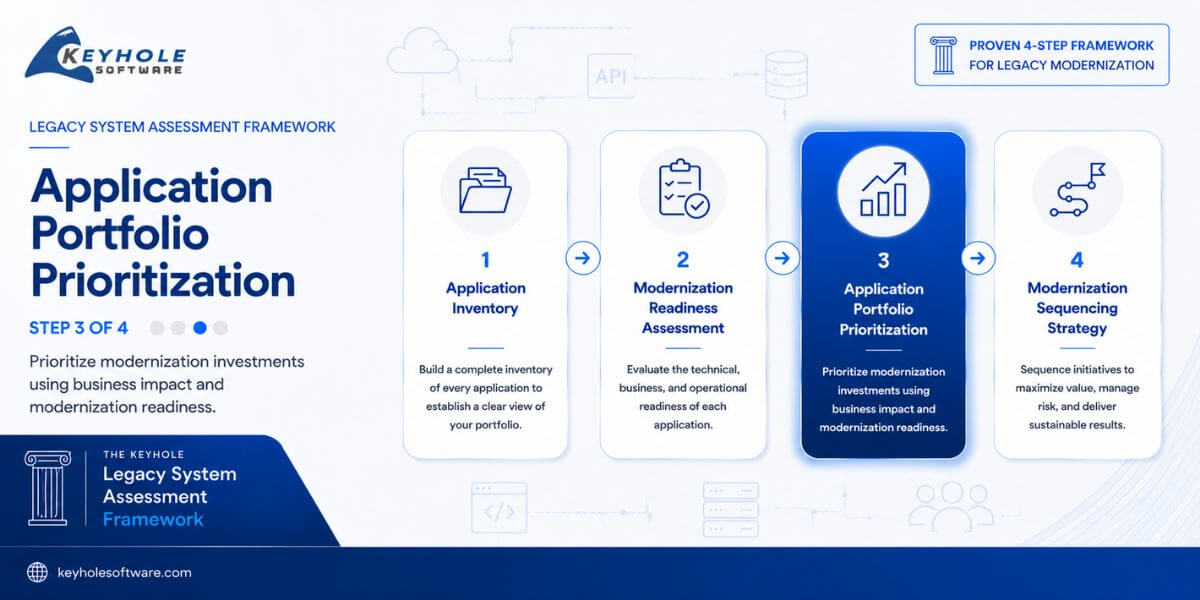
The Keyhole Application Portfolio Prioritization Model is the step that turns a legacy system assessment into an executable modernization roadmap. By combining business impact with modernization readiness, the model provides an objective starting point for deciding where modernization investments will deliver the greatest value.
This process is also commonly referred to as application portfolio analysis or legacy system prioritization, depending on the organization.
A modernization readiness score tells you how technically prepared an application is for modernization. It does not tell you whether the application is worth modernizing, nor does it determine the best modernization approach. Those decisions require business context as well as technical insight.
This article is Step 3 of a complete legacy system assessment framework, covering application inventory, modernization readiness assessment, portfolio prioritization, and modernization sequencing. Each step builds toward a practical modernization roadmap.
By the end of this guide you’ll know how to:
- Prioritize applications using both business impact and modernization readiness
- Calculate and interpret a portfolio Priority Score
- Distinguish between objective scoring and architectural decision-making
- Identify which applications to retire, replace, modernize, or strategically stabilize
- Build a prioritized modernization roadmap that aligns technical investment with business value
The Keyhole Application Portfolio Prioritization Model
Application portfolio prioritization connects technical assessment with business decision-making. Rather than evaluating applications solely by age, technology stack, or maintenance cost, organizations compare both business impact and technical readiness to determine where modernization efforts will deliver the greatest value.
This approach helps leadership focus modernization investments on the applications that matter most while balancing implementation complexity, organizational priorities, and technical risk.
From Technical Assessment to Business Decision
Two applications may receive similar technical readiness scores but require very different modernization strategies.
- A fragile payroll system may be too business-critical to replace immediately.
- A customer-facing application with a modern architecture may be an excellent early modernization candidate.
- A duplicate reporting solution may be technically healthy but no longer justify continued investment.
This is why prioritization must consider both:
- Technical readiness from Step 2
- Business impact, including revenue, operations, users, compliance, and strategic importance
Application Portfolio Prioritization Matrix: Business Impact vs. Technical Readiness
Once each application has a technical readiness score, the next step is to incorporate business impact.
The goal is to create a single comparable number for every application in your portfolio. This allows organizations to evaluate modernization opportunities consistently across systems with very different technologies, business functions, and levels of complexity.
Effective application portfolio prioritization requires balancing business impact with technical readiness. Modernization decisions should not be based solely on technical condition or business demand. Both factors must be evaluated together to identify where investment will deliver the greatest long-term value.
At the core of the Keyhole Application Portfolio Prioritization Model is a simple Priority Score that combines modernization readiness with business impact.
Priority Score Formula
The Keyhole Application Portfolio Prioritization Model uses a simple calculation to combine modernization readiness with business impact.
Priority Score = Modernization Readiness Score × Business Impact
- Modernization Readiness Score: 5–25 (from Step 2)
- Business Impact: 1–5
- Priority Score: 5–125
The formula is intentionally simple so it can be applied consistently across large application portfolios. The objective is consistency instead of mathematical precision. Higher scores generally indicate applications that combine significant business value with favorable modernization readiness.
Most organizations implement this model using a simple spreadsheet or prioritization calculator that automatically ranks applications based on these two factors.
Simple Application Portfolio Prioritization Spreadsheet
The Keyhole Application Portfolio Prioritization Model can be implemented using a simple spreadsheet or portfolio calculator. The example below illustrates the scoring approach.
| Application | Modernization Readiness Score | Business Impact | Priority Score |
|---|---|---|---|
| Customer Portal | 18 | 5 | 90 |
| ERP Platform | 14 | 5 | 70 |
| Payroll COBOL | 7 | 5 | 35 |
| CRM Custom Reports | 17 | 2 | 34 |
| File Share Workflow | 13 | 1 | 13 |
The Priority Score identifies where to focus—not what modernization approach to use.
Organizations often make the mistake of assuming a numerical score should automatically determine whether an application should be retired, replaced, or modernized. In reality, the Priority Score is an objective starting point for portfolio discussions—not the final modernization decision.
After priorities have been established, experienced architects validate each application’s business role, technical constraints, regulatory requirements, vendor dependencies, integration complexity, operational risk, and organizational priorities before recommending the most appropriate modernization strategy.
| Application | Priority Score | Initial Recommendation | Recommended Modernization Strategy |
|---|---|---|---|
| Customer Portal | 90 | Modernize | Refactor |
| ERP Platform | 70 | Modernize | API Encapsulation / Rebuild |
| Payroll COBOL | 35 | Replace | Rearchitect |
| CRM Custom Reports | 34 | Replace | Decommission |
| File Share Workflow | 13 | Retire | Decommission |
The Keyhole Application Portfolio Prioritization Model intentionally separates objective scoring from architectural judgment.
The Initial Recommendation is generated from the scoring model and provides an objective starting point for portfolio discussions. The Recommended Modernization Strategy reflects architectural review and may differ based on business criticality, regulatory requirements, technical constraints, vendor limitations, integration complexity, and organizational priorities.
This two-step approach combines quantitative scoring with experienced architectural judgment, producing modernization roadmaps that are both consistent and practical. It helps organizations prioritize the right applications while selecting modernization strategies that reflect real-world business and technical constraints.
Business Impact Scale for Modernization Prioritization
Assign a business impact multiplier based on how critical the application is to organizational success.
How to Calculate and Compare Priority Scores
Consider an application with:
- Modernization Readiness Score = 11
- Business Impact = 4
Priority Score = 11 × 4 = 44
That score can now be compared directly against every other application in the portfolio, allowing leadership to consistently rank modernization opportunities.
Remember, the Priority Score determines where to focus first. It does not determine how the application should be modernized.
Follow Along with the Workbook
The easiest way to prioritize your application portfolio is by using the free Legacy System Assessment Toolkit. The toolkit includes:
- Business Impact worksheet
- Portfolio Prioritization calculator
- Initial Recommendation formulas
- Architect Review worksheet
- Example modernization portfolio
→ Download the Free Legacy System Assessment Toolkit
What Organizations Typically Discover During Prioritization
When organizations apply a consistent prioritization model across their application portfolio, several patterns usually emerge:
- Systems receiving the most modernization attention are not always the applications delivering the greatest business value.
- Mission-critical applications often have lower modernization readiness than leadership expected.
- Low-value applications frequently consume more operational effort than anyone realizes.
- Multiple applications perform nearly identical business functions.
- Many systems become strong candidates for retirement or replacement.
These findings help organizations focus modernization investments where they will produce the greatest business impact while reducing technical risk.
Why This Prioritization Model Works
- Creates an objective starting point.
Every application is evaluated using the same business and technical criteria. - Focuses investment where it creates the most value.
High-value applications naturally rise to the top of the modernization backlog. - Encourages architectural review.
Experienced architects validate recommendations by considering business context, technical constraints, compliance requirements, and organizational priorities that scoring alone cannot capture.
This prevents a common mistake: treating the Priority Score as the final modernization decision instead of the starting point for architectural review.
Example of Application Portfolio Prioritization
This is where prioritization shifts from analysis to decision-making.
In many organizations, the most difficult conversations are not about technology. They are about deciding where limited modernization funding will produce the greatest long-term business value.
Scoring often exposes knowledge gaps as well. If applications are difficult to score consistently, it frequently indicates unclear ownership, undocumented dependencies, or limited understanding of the existing environment.
| Application | Modernization Readiness Score | Business Impact | Priority Score | Initial Recommendation | Recommended Modernization Strategy |
|---|---|---|---|---|---|
| Customer Portal | 18 | 5 | 90 | Modernize | Refactor |
| ERP Platform | 14 | 5 | 70 | Modernize | API Encapsulation / Rebuild |
| Payroll COBOL | 7 | 5 | 35 | Replace | Rearchitect |
| CRM Custom Reports | 17 | 2 | 34 | Replace | Decommission |
| File Share Workflow | 13 | 1 | 13 | Retire | Decommission |
The Initial Recommendation is generated automatically from the Priority Score. The Recommended Modernization Strategy reflects architectural review and may differ after considering technical realities, business priorities, vendor constraints, and organizational risk.
Priority Score Ranges and Initial Recommendations
Once calculated, Priority Scores generally fall into four planning categories.
| Priority Score | Initial Recommendation | Typical Interpretation |
|---|---|---|
| Below 25 | Retire | Limited business value. Evaluate retirement or consolidation before investing further. |
| 25–35 | Replace | Commodity business capability that may be better served by commercial software or SaaS. |
| 36–60 | Modernize | High-value application that warrants continued investment through modernization. |
| Above 60 | Retain / Strategic Stabilization | Critical application with significant business importance. Continue investing while managing modernization risk carefully. |
Important: The Initial Recommendation is generated from the scoring model and should be viewed as the beginning of the decision-making process. Final modernization strategies should always be validated through architectural review before implementation planning begins.
Key Principle: The Priority Score identifies where to focus. Architectural judgment determines how to modernize.
Portfolio Segmentation for Modernization Strategy
Once applications have been evaluated using the Keyhole Application Portfolio Prioritization Model, they naturally group into common modernization planning categories.
These categories provide an effective starting point for portfolio planning. In practice, architects frequently adjust the final modernization strategy after considering application-specific constraints, organizational priorities, regulatory requirements, and technical complexity.
Retire (Typically 30 to 50 percent of systems)
Applications in this category provide limited business value and no longer justify their maintenance cost, technical complexity, or operational overhead. Before retiring an application, validate downstream dependencies and ensure any required data has been archived or migrated.
Common characteristics
- Minimal or no active users
- Redundant functionality already available elsewhere
- Legacy reporting tools, one-off utilities, or obsolete internal applications
- Systems maintained “just in case”
Typical modernization strategies
- Decommission the application
- Validate downstream dependencies before shutdown
- Archive required data
- Remove infrastructure and licensing costs
Expected outcome
- Lower maintenance costs
- Simplified architecture
- Additional capacity for modernization initiatives
Best suited for: Applications that no longer provide meaningful business value and can be safely removed from the portfolio.
Replace (Typically 10–20% of systems)
Applications in this category deliver commodity business capabilities that are often better served by commercial software or SaaS platforms.
Common characteristics
- HR, finance, workflow, or reporting applications
- Custom software with little competitive differentiation
- High maintenance cost relative to business value
Typical modernization strategies
- Replace with SaaS or commercial software
- Migrate required data
- Retire the legacy application after transition
Expected outcome
- Reduced operating costs
- Improved vendor support
- Access to modern capabilities with less maintenance
Best suited for: Commodity business capabilities that are better served by commercial software or SaaS solutions.
Modernize (Typically 30 to 40 percent of systems)
These applications provide significant business value but require technical investment to improve maintainability, scalability, security, or delivery speed.
Common characteristics
- Customer-facing applications
- Revenue-generating systems
- Core operational platforms
- Applications constrained by legacy architecture
Typical modernization strategies
- Refactor
- Replatform
- Rearchitect
- API Encapsulation / Rebuild
The appropriate modernization strategy depends on the application’s technical condition, architectural constraints, and business objectives.
Expected outcome
- Improved scalability
- Faster delivery
- Reduced operational risk
- Lower long-term cost of ownership
Best suited for: High-value applications where continued investment will improve scalability, maintainability, security, or delivery speed.
Retain / Strategic Stabilization (Typically 5 to 15 percent of systems)
Applications in this category are highly valuable, but the risk of significant architectural change currently outweighs the potential benefit.
Common characteristics
- Mission-critical business systems
- Regulatory or compliance-driven platforms
- Core financial or operational systems
- Applications deeply embedded within enterprise operations
Typical modernization strategies
- Retain / Stabilize
- API Encapsulation
- Incremental modernization around the existing platform
Expected outcome
- Improved operational resilience
- Lower implementation risk
- Business continuity while enabling future modernization
Common examples
- Core banking platforms
- Claims processing systems
- Identity providers
- Regulatory reporting platforms
Best suited for: Mission-critical systems where business risk currently outweighs the benefits of significant architectural change.
These applications frequently remain in service for many years while surrounding capabilities are modernized through APIs, integrations, and incremental architectural improvements.
Mapping Prioritization to Modernization Strategies
The Initial Recommendation identifies the overall direction for an application. The next step is selecting the Recommended Modernization Strategy that best fits the application’s technical and business context.
| Initial Recommendation | Possible Modernization Strategies |
|---|---|
| Retire | Decommission |
| Replace | SaaS Adoption, Commercial Platform Replacement |
| Modernize | Refactor, Replatform, Rearchitect, API Encapsulation / Rebuild |
| Retain / Strategic Stabilization | Retain / Stabilize, API Encapsulation |
This two-step model connects portfolio prioritization with implementation planning while allowing experienced architects to select the most appropriate modernization strategy for each application.
→ Learn more about modernization approaches and the 6 Rs framework
How to Apply Application Portfolio Prioritization in Practice
Once every application has been scored:
- Sort the portfolio by Priority Score.
- Generate Initial Recommendations.
- Review recommendations with business and technical stakeholders.
- Determine the Recommended Modernization Strategy for each application.
- Build a phased modernization roadmap based on business priorities, technical dependencies, and organizational capacity.
This produces a prioritized, defensible modernization backlog while ensuring architectural judgment remains part of the decision-making process.
Although the scoring model is intentionally simple, applying it across a large enterprise portfolio often reveals competing business priorities, undocumented dependencies, organizational constraints, and modernization tradeoffs.
Experienced modernization architects help organizations navigate those tradeoffs and develop realistic modernization roadmaps.
Building a Business Case for Modernization Prioritization
Technical assessments identify readiness. Prioritization connects that readiness to business outcomes.
By combining modernization readiness with business impact, organizations can justify where modernization investments should be made while aligning technical decisions with operational goals, cost reduction, and long-term business strategy.
For many organizations, the largest value comes from:
- Retiring applications that no longer justify continued investment.
- Replacing commodity capabilities with commercial solutions.
- Modernizing the applications that provide the greatest strategic value.
- Stabilizing mission-critical systems until broader modernization becomes practical.
The result is a modernization roadmap supported by objective scoring, architectural review, and measurable business outcomes.
Common Prioritization Mistakes
- Prioritizing visibility instead of value. The loudest applications are not always the most important.
- Trying to modernize everything. Successful modernization requires focus.
- Ignoring technical constraints. Business urgency cannot eliminate architectural dependencies.
- Treating the Priority Score as the final decision. The scoring model identifies where to focus; architects determine the most appropriate modernization strategy.
- Treating every application the same. Different applications require different modernization strategies even when their Priority Scores are similar.
Common Questions About Application Portfolio Prioritization
Why doesn’t the Recommended Modernization Strategy always match the Initial Recommendation?
The Initial Recommendation is generated from the scoring model. The Recommended Modernization Strategy incorporates architectural review, business criticality, regulatory obligations, vendor constraints, technical complexity, and organizational priorities. The scoring model supports decision-making—it does not replace architectural judgment.
How do you handle mission-critical applications with low technical readiness?
These systems often require phased modernization strategies such as rearchitecting or API encapsulation rather than immediate replacement. Business continuity always takes priority over technical elegance.
How accurate does the scoring need to be?
The goal is consistency, not mathematical precision. If scoring is difficult, it often reveals missing documentation, unclear ownership, or hidden dependencies that should be addressed before modernization planning continues.
Next Step: Modernization Sequencing
Prioritization determines what to modernize. Sequencing determines when and how to modernize it.
Once applications have been prioritized and modernization strategies have been selected, the next challenge is determining the safest execution order.
Organizations that modernize infrastructure, data, and application code in the wrong sequence often introduce unnecessary risk, rework, and delays.
In the next step of the Legacy System Assessment Framework, you’ll learn how to apply the Infrastructure → Data → Code sequencing model to reduce modernization risk and build a practical execution roadmap.
👉 Continue to: Modernization Sequencing Strategy (Step 4)
Need Help Building a Modernization Roadmap?
If you’re evaluating a large or complex application portfolio, prioritization often reveals competing business priorities, undocumented dependencies, and modernization tradeoffs. Keyhole Software helps organizations:
- Facilitate structured application assessment workshops
- Validate technical findings and dependencies
- Build modernization roadmaps aligned to business goals
- Select modernization strategies that balance business value, technical readiness, and implementation risk
→ Schedule a Legacy System Assessment Workshop
→ Download the free Keyhole Legacy System Assessment Toolkit
More From Keyhole Software
About Keyhole Software
Expert team of software developer consultants solving complex software challenges for U.S. clients.
Share This Post
Join The Thousands Of Devs Who Subscribe
Discuss This Article
Subscribe
Login
0 Comments
Oldest