
Software Development Outsourcing Statistics 2026
SOFTWARE DEVELOPMENT OUTSOURCING STATISTICS: 2026 ANALYSIS
Software development outsourcing is now a core delivery strategy for organizations that need to modernize platforms, adopt AI, and scale engineering capacity faster than internal hiring allows.
In 2026, the conversation has moved beyond outsourcing cost reduction. Technical leaders are using outsourcing to access specialized expertise, accelerate product timelines, and introduce new platform capabilities that would be difficult to build with internal teams alone.
This report synthesizes software development outsourcing statistics from leading global research firms to provide a clear view of:
- Market growth and investment trends
- Adoption across enterprise and mid-market organizations
- Cost and delivery model dynamics
- The operational impact of AI on outsourced development
- The governance factors that separate successful engagements from failed ones
From December 2025 through February 2026, our research team compiled comprehensive software development outsourcing statistics from industry reports, global surveys, and market intelligence firms. We analyzed data from 14 authoritative sources including Deloitte’s 2024 Global Outsourcing Survey, Mordor Intelligence market reports, Grand View Research industry analyses, and specialized outsourcing research publications.
How Keyhole Software Uses These Statistics
At Keyhole Software, we apply these software development outsourcing statistics in real delivery planning with CTOs and engineering leaders, using them to evaluate staffing models, modernization approaches, vendor proposals, and cost assumptions.
This data helps technical leaders:
- Plan modernization roadmaps
- Evaluate software development outsourcing vendors
- Structure hybrid and onshore–offshore delivery models
- Validate cost, timeline, and capacity assumptions
With 100% U.S.-based senior consultants averaging 17+ years of experience, we operate across the full client spectrum of delivery models. That includes embedded architect led teams and partnerships that complement existing offshore capacity.
This real world perspective allows organizations to align their outsourcing model to the needs of the system they are building, with a clear understanding of the tradeoffs involved.
The State of Global Software Development Outsourcing (2026)
The software development outsourcing market is not one monolithic category. Most market research firms segment it by service type and delivery approach, which is why totals vary across reports.
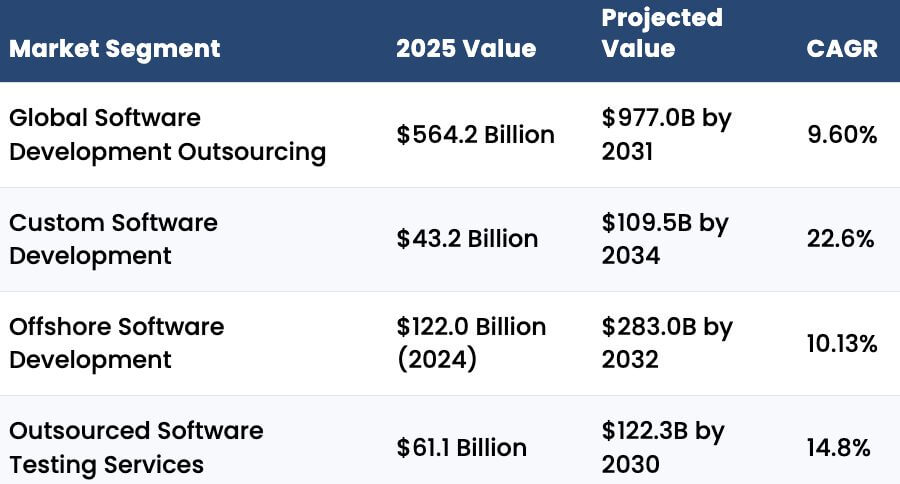
The table below summarizes software development outsourcing statistics for primary market segments. Each row represents a distinct segment with independently verified data from a leading research firm. Together, these statistics show where the market stands today and where it is projected to move over the next five to seven years.
| Market Segment | 2025 Value | Projected Value | CAGR | Source |
|---|---|---|---|---|
| Global Software Development Outsourcing | $564.2 Billion | $977.0B by 2031 | 9.60% | Mordor Intelligence ² |
| Custom Software Development | $43.2 Billion | $109.5B by 2034 | 22.6% | Grand View Research ⁴ |
| Offshore Software Development | $122.0 Billion (2024) | $283.0B by 2032 | 10.13% | Verified Market Research |
| Outsourced Software Testing Services | $61.1 Billion | $122.3B by 2030 | 14.8% | The Business Research Co. |
Note: Market size estimates vary based on the inclusion of different sub-segments of software development and business process outsourcing. The figures above are drawn from the most recent reports published by each respective firm and should be treated as directional benchmark, not as a single reconciled total.
What This Means
The segmentation shows that software development outsourcing is expanding across multiple service types, but not at the same pace.
- Custom software development, with a 22.6% CAGR, is growing more than twice as fast as the overall market. This reflects accelerating demand for AI-enabled applications, complex system integration, and core platform replacement initiatives that cannot be delivered through packaged software.
- Offshore development continues to steadily scale, indicating that cost and capacity remain important for well-defined, execution-focused work. At the same time, the rapid growth in outsourced testing services points to increasing specialization within delivery pipelines as organizations externalize discrete capabilities.
- Taken together, these software development outsourcing statistics show a shift from a single sourcing strategy to a portfolio model. Organizations are no longer choosing between onshore, nearshore, or offshore. They are distributing work across multiple delivery types based on complexity, risk, and the need for architectural continuity.
In Practice
We see clients align different outsourcing models to different layers of the delivery stack rather than relying on a single-vendor approach.
This typically means embedding expert software development partners in modernization and platform initiatives where architectural context and long-term continuity are required, while offshore capacity is reserved for well-scoped, execution-focused work with stable interfaces and clearly defined outcomes.
A common pattern we have supported is the use of a senior, architect-led team to define the transformation roadmap, establish the target architecture, and produce detailed, implementation-ready plans. Tactical build work is then executed in a lower-cost offshore model against that foundation, allowing organizations to reduce cost without transferring architectural ownership.
At Keyhole Software, this often involves leading discovery, architecture, and modernization planning phases, then remaining engaged to provide technical leadership as clients scale execution through offshore capacity. This preserves domain knowledge and decision continuity while optimizing for both speed and cost.
Global Market Growth and Contract Value
The software development outsourcing market continues to demonstrate robust growth, driven by sustained demand for specialized technical skills and cloud adoption.
According to the ISG Index, which tracks large outsourcing contracts ($5M+ annual value), the combined global market for technology services reached a record $127.4 billion in 2025, an 18% year-over-year increase from 2024¹.
The market for software development outsourcing specifically is substantial. Mordor Intelligence values the market at approximately $564 billion with projected growth to more than $977 billion by 2031, at a 9.6% compound annual growth rate (CAGR)².
Across research firms, the exact totals vary based on scope and definitions, but all point to sustained long term growth.
What This Means
The 18% annual growth in large outsourcing contracts indicates that organizations are committing to longer-term, higher-value engagements rather than short project-based work.
At the same time, the projected expansion from $564 billion to $977 billion reflects sustained demand for custom engineering capacity that cannot be met through internal hiring alone.
Within that growth, custom software development is the fastest growing segment. This aligns with the shift toward AI-enabled applications, complex system integration, and core platform replacement initiatives that cannot be solved with off-the-shelf software.
Taken together, these software development outsourcing statistics show a market that is growing not just in size, but in strategic importance to enterprise delivery.
In Practice
We frequently see organizations structuring engagements around multi-phase roadmaps rather than isolated projects. External partners are aligned to modernization programs, platform rebuilds, and cloud transformations that require continuity over several years.
As a result, vendor selection shifts toward architectural depth and delivery stability instead of short-term capacity. Funding moves from one-time project budgets to product and platform investment cycles, and internal hiring plans are supplemented with embedded expertise to meet roadmap timelines that recruiting alone cannot support.
At Keyhole Software, this model has made repeat, multi-phase engagements the norm. Clients bring us in to build or modernize a platform, then return years later for the next evolution, whether that is cloud migration, architectural refactoring, or AI enablement. Team size scales up or down by phase, but domain knowledge and decision history remain intact. That continuity allows delivery velocity (and tribal knowledge) to compound over time instead of being reset with each initiative.
Enterprise and Small Business Adoption
Outsourcing is now a nearly universal practice among large enterprises.
- 92% of G2000 companies use technology outsourcing, according to the ISG Index, with software development as a primary component.⁵ This high adoption rate is supported by executive sentiment.
- 80% of executives plan to maintain or increase outsourcing investment, based on Deloitte’s 2024 Global Outsourcing Survey.⁶
- 78% of organizations have engaged an outsourcing provider in the last six months, according to DesignRush research.⁷
Small and medium-sized businesses (SMBs) are also increasingly leveraging outsourcing to remain competitive. Approximately 37% of small businesses outsource to stay competitive, and 90% plan to outsource business functions, with software development being a key area of focus ⁵.
Software Development Outsourcing Adoption Rates by Organization Size (2026)
These software development outsourcing statistics show how adoption varies by company size and delivery objective. Adoption patterns in software development outsourcing reveal how different organization sizes use external engineering teams to support modernization, innovation, and product delivery.
| Organization Type | Adoption Rate | Primary Functions Outsourced | Key Driver |
|---|---|---|---|
| G2000 Enterprises | 92% | Application development, cloud migration, legacy modernization | Strategic capability access |
| Mid-Market Companies | 78% | Custom software development, DevOps, QA testing | Cost + speed to market |
| Small Businesses | 37% | Web & mobile development, IT support | Competitive positioning |
| SMBs Planning to Outsource | 90% | Software development, business functions | Efficiency gains |
Sources: ISG ⁵, Deloitte ⁶, DesignRush ⁷, DemandSage ⁵
Note: Adoption rates reflect survey data from different sources with varying definitions of “outsourcing” (e.g., staff augmentation vs. managed services vs. project-based contracts). Small business data skews toward companies with 10-250 employees.
What This Means
These software development outsourcing statistics show that outsourcing is now a default delivery model for large enterprises and is rapidly becoming one for smaller organizations.
- With 92% of G2000 companies using outsourcing and 80% of executives planning to maintain or increase investment, enterprise adoption is no longer driven primarily by cost. It is a structural component of modernization, cloud transformation, and large-scale application delivery.
- At the same time, 78% of organizations engaging a provider in the last six months indicates that outsourcing is not a periodic strategy. It is an active, ongoing part of the delivery lifecycle.
- Among smaller organizations, 37% already outsource to remain competitive, while 90% plan to outsource business functions, with software development as a primary focus. This reflects a different constraint. Enterprises use outsourcing to access specialized capability and maintain transformation velocity, while mid-market and SMB companies use it to extend internal capacity and accelerate time to market.
Taken together, these software development outsourcing statistics show that the question is no longer whether to outsource, but how to structure outsourcing as a long-term delivery capability across company size.
In Practice
In our experience, continuity of leadership matters more than initial team size.
A consistent delivery lead, typically an architect or project manager, keeps priorities, planning cadence, and success metrics intact as team size changes across phases. Without that anchor, goals are reset, context is lost, and each scale up behaves like a new initiative.
The most effective model is to begin with a small, senior core and expand around it. This allows enterprises to sustain transformation velocity, gives mid market teams access to targeted expertise without permanent hiring, and lets smaller organizations reach product milestones quickly while maintaining alignment to business objectives.
At Keyhole Software, this structure allows teams to grow and contract by phase without resetting goals or losing delivery momentum.
Key Drivers for Software Development Outsourcing
The latest software development outsourcing statistics show a clear shift in why organizations outsource. Cost reduction remains important, but the primary drivers are now access to specialized expertise, faster delivery, and the ability to focus internal teams on core business priorities.
Strategic Motivations for Software Development Outsourcing (2026)
| Motivation | % Companies Citing | Key Benefit | Secondary Impact |
|---|---|---|---|
| Focus on Core Business | 65% | Frees internal resources for strategic initiatives | Improves organizational focus |
| Cost Reduction | 63% | Average 30-50% savings vs. internal hiring | Converts fixed to variable costs |
| Solve Capability Issues | 53% | Access specialized skills unavailable internally | Accelerates innovation timelines |
| Increase Efficiency | 24% | Faster delivery through established processes | Reduces time-to-market by 30-50% |
| Access Greater Expertise | 18% | Senior-level expertise without full-time commitment | Elevates technical quality |
Sources: Deloitte ⁸, Clutch ⁹, Beetroot ⁸
Caveat: Motivation percentages are drawn from multiple surveys with different sample sizes and respondent profiles (C-suite executives vs. IT managers). The figures represent a composite view of industry sentiment and may not reflect any single organization’s priorities.
What This Means
- Cost reduction remains the most cited driver for software development outsourcing at 63%, but the broader distribution of responses shows a multi-objective strategy.
- A comparable 65% of organizations outsource to keep internal teams focused on core business, while 53% use external partners to solve capability gaps. Another 24% are explicitly buying speed and efficiency, and 18% are targeting senior-level expertise for high-impact initiatives.
- Taken together, these software development outsourcing statistics show that outsourcing is no longer a single-purpose cost tactic. It is being used simultaneously to manage capacity, access hard-to-hire skills, and accelerate modernization.
- More than half of organizations now depend on outsourcing for capabilities they cannot build internally fast enough, which marks the structural shift from labor arbitrage to delivery acceleration.
In Practice
We see organizations use outsourcing to deliberately control where internal engineering time is spent.
External partners take ownership of platform work that does not differentiate the business, allowing internal teams to stay aligned to product development, customer experience, and core intellectual property. Targeted expertise is introduced when specific capabilities are needed, such as modernization planning, complex integration, or cloud transformation, rather than expanding permanent headcount ahead of demand.
This shifts outsourcing from a staffing model to a focus model. Internal teams are protected from being pulled into large-scale transformation efforts, while external specialists accelerate those initiatives without disrupting long-term ownership of the system.
At Keyhole Software, this typically means engaging at the points where architectural direction and delivery momentum are most at risk, providing the expertise required to move the roadmap forward while clients retain control of their core platforms and engineering strategy.
The Transformative Impact of Artificial Intelligence
Artificial intelligence is now a core component of software development outsourcing, reshaping how services are delivered, how vendors are evaluated, and how contracts are structured. Deloitte reports that:
- 83% of executives are already leveraging AI as part of their outsourced services, and
- 92% of organizations are using or planning to use AI in their service delivery models ⁶ ⁷.
AI Integration in Software Development Outsourcing (2026)
| AI Adoption Metric | % of Organizations | Impact on Outsourcing | |
|---|---|---|---|
| Using AI in Outsourced Services | 83% | AI-assisted development now standard expectation | |
| Using or Planning AI in Delivery | 92% | Vendor selection criteria now includes AI capabilities | |
| Forming AI-Focused Partnerships | 57% | New contract structures for AI-specific deliverables | |
| Expect AI to Impact Pricing | 43% | Productivity gains expected to reduce vendor rates | |
| Include AI Terms in Contracts | 40% | Legal frameworks adapting to AI-generated code ownership | |
| Software Outsourcing Focused on AI/ML | 59% | AI consulting fastest-growing service category |
Sources: Deloitte ⁶, DesignRush ⁷, 10Pearls ²
Caveat: AI adoption percentages reflect different survey populations (C-suite vs. IT leaders vs. procurement) and timeframes (current usage vs. planned adoption). The rapid pace of AI tool evolution means these statistics may underrepresent actual adoption by publication date.
What This Means
- With 83% of organizations already using AI in outsourced engagements, AI-assisted development is no longer a differentiator. It is a baseline expectation.
- The fact that 92% are using or planning to use AI in their delivery model shows that AI capability is now a core vendor selection criterion alongside technical expertise and domain experience.
- At the same time, 43% expecting AI to influence pricing signals a shift in outsourcing economics. Productivity, delivery velocity, and outcome-based engagement models are becoming more important than hourly rates.
- The 40% including AI-specific contract terms highlights a parallel change in governance. Intellectual property ownership, validation of AI-generated output, and auditability are now central to how outsourcing relationships are structured.
- Taken together, these software development outsourcing statistics show that AI is not only accelerating delivery. It is redefining how vendors are evaluated, how work is priced, and how quality is controlled.
In Practice
In this model, experienced engineers become the force multiplier. Their role shifts to defining where AI can be safely applied, establishing usage patterns, and validating output against security, compliance, and long-term maintainability requirements. Teams with clear architectural ownership and established standards see compounding gains in throughput, while ad hoc adoption produces inconsistent results.
At Keyhole Software, AI is introduced as an acceleration layer inside architect-led delivery teams. In a recent insurance platform modernization, we led the architecture and delivery in approximately five months instead of the estimated 18 to 24 months while maintaining enterprise governance and security. AI‑accelerated platform modernization case study
This approach also extends into how engagements are structured commercially. Our contracts present AI-accelerated delivery as a distinct option alongside a baseline model, with clear cost and timeline comparisons. This allows clients to make an explicit, informed decision about where AI-driven acceleration delivers measurable value and where a traditional approach is more appropriate.
Understanding Software Outsourcing Delivery Models
Delivery model choice is a system risk decision. The more business-critical the platform, the more continuity, real-time collaboration, and architectural ownership influence the outcome. For complex systems, delivery model selection consistently has a greater impact on quality, speed, and long-term maintainability than hourly rate alone.
Most engagements align to one of four primary models, each optimized for a different type of work.
| Model | Strengths | Tradeoffs |
|---|---|---|
| Senior U.S.-based teams | Architectural depth, real-time collaboration, lower defect risk, strong continuity | Premium rates |
| Nearshore staff augmentation | Scalable capacity, moderate cost, time zone alignment | Variable experience and continuity |
| Offshore product teams | Lower cost, large teams | Time zone friction, async communication |
| Global consultancies | Strategy + scale | Less engineering consistency |
Organizations modernizing core systems, operating in regulated industries, or requiring close collaboration typically prioritize senior U.S.-based teams. Early-stage or cost-sensitive initiatives may favor nearshore or offshore models depending on budget and governance needs.
What This Means
For loosely coupled, well-defined work, lower-cost models can be effective.
For core platforms and modernization programs, the primary risk is misalignment, not rate. In these environments, continuity, shared context, and real-time collaboration have a greater impact on delivery speed and long-term maintainability than team size.
As AI accelerates implementation, the cost of rework increases, which makes delivery model fit more important than ever.
In Practice
We increasingly see organizations select 100% U.S.-based, senior teams for business-critical systems where architectural dependency, regulatory exposure, and real-time collaboration directly affect delivery risk.
In these environments, the primary concern is not hourly rate. It is decision latency, rework cost, and loss of system context. As AI accelerates implementation, the cost of correcting misalignment grows, which makes proximity, shared time zone, and deep architectural ownership materially more valuable.
Lower-cost models are still used, but they are applied selectively. Well-defined execution with stable interfaces is often scaled through nearshore or offshore capacity, while architectural direction, modernization planning, and platform evolution remain with embedded senior teams.
At Keyhole Software, this most often takes the form of serving as the architectural anchor for core platforms while clients expand delivery capacity through other models where appropriate. This allows organizations to reduce cost at the execution layer without transferring ownership of the system or slowing decision velocity.
Outsourcing Success Factors and Risk Mitigation
Despite the benefits, outsourcing is not without risk. Studies suggest that 20-25% of all outsourcing relationships fail within the first two years ⁵. However, these failures are often rooted in operational and strategic misalignment rather than vendor incompetence.
Software Development Outsourcing Success & Failure Factors (2026)
| Factor | % Citing | Classification | Mitigation Strategy |
|---|---|---|---|
| Lack of Benefit Tracking/Reporting | 55% | Leading Failure Cause | Establish KPIs and dashboards from engagement start |
| Inadequate Change Management | 53% | Leading Failure Cause | Invest in internal stakeholder alignment pre-launch |
| Poor Vendor Service Integration | 47% | Leading Failure Cause | Define integration touchpoints in SOW |
| Defined Sourcing Strategy | 57% | Success Factor | Document strategy before vendor selection |
| Operating Model Alignment | 49% | Success Factor | Align delivery model with internal processes |
| Strong Governance & Vendor Mgmt | 28% | Success Factor | Assign dedicated vendor management resources |
Sources: Deloitte ⁷, DemandSage ⁵
Caveat: Success rate statistics vary widely depending on how “failure” is defined (complete project abandonment vs. significant budget overrun vs. partial scope reduction). The figures above represent a composite view from multiple industry analyses. Organizations with mature vendor management practices and clear governance frameworks consistently report lower failure rates than these industry averages suggest.
What This Means
The primary failure point in software development outsourcing is not technical execution. It is the 55% of organizations that begin engagements without defined success metrics.
By contrast, 57% that establish a sourcing strategy upfront and 49% that align the operating model to internal delivery processes report significantly stronger outcomes.
These software development outsourcing statistics show that vendor selection is rarely the dominant risk. Lack of ownership, unclear outcomes, and weak integration into existing delivery systems are the factors that drive cost overruns, rework, and stalled initiatives.
In software development outsourcing, success is usually determined before the first line of code is written.
In Practice
High-performing organizations design outsourcing as part of their delivery operating model rather than treating it as an external service.
Engagements must start with a shared definition of measurable outcomes, clear decision ownership on both sides, and a working model that matches how internal teams plan, build, and release software. Governance is visible in day-to-day execution: how priorities are set, how progress is measured, and how quickly decisions are made.
Where this alignment is missing, teams compensate with additional status reporting, heavier process, and rework caused by late-stage misalignment.
At Keyhole Software, risk is reduced by placing senior, architect-level consultants inside the client’s existing delivery workflows. This ensures that external capacity participates in architectural decisions, follows the same planning cadence, and is measured against the same outcomes as internal teams. The result is faster decision cycles, stable delivery velocity, and significantly lower integration friction.
Finding the Best Fit for Software Development Outsourcing
These software development outsourcing statistics show a market with sustained growth driven by strategic needs beyond cost reduction.
The data shows a clear shift: outsourcing is no longer just a cost decision. It is a delivery model decision. Organizations are using external teams to add specialized capability, accelerate roadmaps, and maintain continuity across complex, multi-phase platforms.
Lower-cost, high-capacity models remain effective for well-defined work. But for business-critical systems, outcomes are driven by architectural alignment, embedded collaboration, and long-term ownership.
At Keyhole Software, we help technical leaders translate these software development outsourcing statistics into practical execution plans that fit their systems, roadmap, and risk profile, whether that means embedding senior engineers into existing teams, introducing architectural leadership for modernization, or structuring hybrid approaches that balance speed, continuity, and cost.
Our 100% U.S.-based senior consultants support custom software development, cloud-native development, platform engineering, and enterprise modernization efforts across industries.
Talk with an expert from Keyhole Software.
References
- ISG. “Global Technology Demand Reaches Record High in Q4, Fueled by AI, ISG Index™ Finds.” January 15, 2026.
- Mordor Intelligence. “Software Development Outsourcing Market Size & Share Analysis.”
- Grand View Research. “IT Services Outsourcing Market Size, Share & Trends Analysis Report.”
- Grand View Research. “Custom Software Development Market Size, Share & Trends Analysis Report.”
- DemandSage. “41 Outsourcing Statistics 2026 [US & Global Data].” November 29, 2025.
- Deloitte. “2024 Global Outsourcing Survey.”
- DesignRush. “60+ Software Development Outsourcing Statistics That Explain What’s Changing in 2026.” Updated February 10, 2026.
- Beetroot. Citing Deloitte.
- Clutch. “How Small Businesses Use Outsourcing.”
- Statista. “Number of software developers worldwide from 2019 to 2025.”
- U.S. Bureau of Labor Statistics. “Software Developers.” Occupational Outlook Handbook.
- Codebridge. “Software Development Outsourcing Rates, Costs, and Trends in 2026.”
- Emapta. “25+ Nearshoring Statistics for 2026.” December 18, 2025.
- Grand View Research. “Latin America IT Services Outsourcing Market Size & Outlook, 2030.”
Last updated: February 12, 2026
More From Keyhole Software
About Keyhole Software
Expert team of software developer consultants solving complex software challenges for U.S. clients.
Share This Post
Join The Thousands Of Devs Who Subscribe
[…] fails more often than most founders expect. Research from DemandSage puts the failure rate of outsourcing relationships at 20 to 25 percent within two years. […]
[…] another $15,000 to $50,000. At the same time, the software development outsourcing market is now valued at $564 billion and is projected to reach $977 billion by 2031, giving founders an overwhelming number of agencies, […]
[…] This shows just how many businesses are choosing this path IT Outsourcing 2026: $638B Market, 30-60% Savings. Even more, most large companies, around 92% of the biggest ones, already use technology outsourcing, especially for things like making new software Software Development Outsourcing Statistics 2026. […]
[…] בפיתוח תוכנה צפוי להגיע ל-977 מיליארד דולר עד 2031, לפי Keyhole Software. הצמיחה הזו מעידה שיש ביקוש עצום לפיתוח חיצוני, אבל גם […]
[…] Software Development Outsourcing Statistics 2026, accessed April 26, 2026, https://keyholesoftware.com/software-development-outsourcing-statistics/ […]