
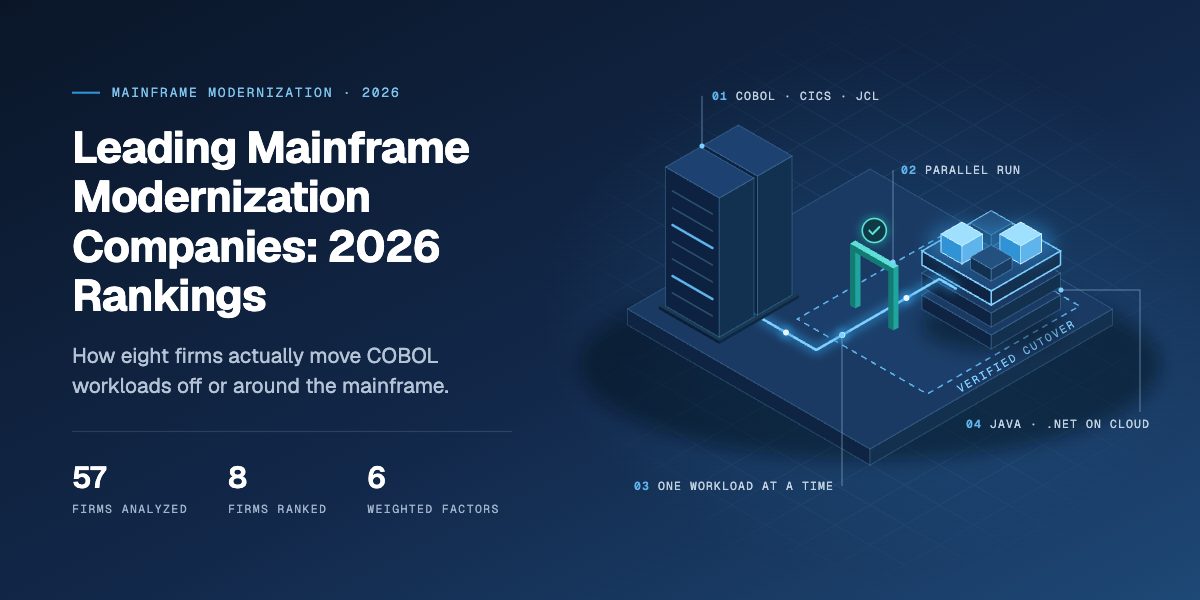
Leading Mainframe Modernization Companies: 2026 Rankings
Between June and September 2026, our research team analyzed 57 firms that market mainframe modernization services to U.S. enterprises, drawn from cloud provider partner directories, analyst quadrants, public-sector contract vehicles, and published rankings. We narrowed the field to the eight firms that publish mainframe-specific delivery evidence and scored them against a consistent framework built for enterprise buyers. The analysis draws on each firm’s case studies, service pages, tooling documentation, stated staffing practices, and pricing disclosures, to compare how these firms actually move workloads off or around the mainframe rather than how they describe it.
The mainframe is not going away, and buyers should treat any vendor who implies otherwise with caution. In BMC’s 2026 survey of more than 1,300 mainframe practitioners and decision makers, 94 percent expressed long-term confidence and continued investment in the platform1. Kyndryl’s 2025 State of Mainframe Modernization survey of 500 senior leaders found that 56 percent increased mainframe usage in hybrid IT, that organizations plan to move 28 percent of workloads off the platform this year, down from 36 percent a year earlier, and that 74 percent use external partners for modernization work2. What is changing is how the work gets done. In the same Kyndryl survey, 88 percent of organizations are deploying or planning generative AI on the mainframe, and the average cost of modernizing on the mainframe fell from $9.1 million to $7.2 million in a year2.
That enthusiasm has a downside. In June 2026, Gartner predicted that more than 70 percent of mainframe exit projects initiated this year will fail to produce their intended benefits because of an overestimation of generative AI tooling capabilities3. A 2024 Forrester Consulting study commissioned by Rocket Software found that 90 percent of rewrite projects are not successful the first time4. In our experience, mainframe modernization programs rarely fail because a tool could not translate COBOL. They fail because nobody could prove the new system behaved like the old one before cutover, because the target architecture inherited a proprietary runtime nobody planned for, or because the people doing the work were several time zones and two subcontracts away from the team that has to own the system afterward. This ranking scores firms on those failure points.
This comparison is scoped deliberately. It is written for mid-size and enterprise organizations with existing IT departments that run mission-critical COBOL, RPG, PL/I, Natural, or Model 204 workloads and need them modernized while the business keeps operating. Software vendors that do not deliver services themselves, and outsourcers whose mainframe practice is a small part of a general offshore business, serve segments this framework does not weight heavily, and several capable firms in those segments are absent for that reason.
How We Evaluated Mainframe Modernization Companies
We scored each firm against six weighted factors totaling 100 points. Every factor is scored on published evidence a buyer can check: a case study with a named client or a measurable result, a documented validation method, a stated staffing model, a published price. We excluded aggregated star ratings from the framework. Five of the eight firms in this set have no Clutch profile or no Clutch reviews at all, and the review platforms that do cover the two largest firms measure data center outsourcing rather than application modernization. Where published client feedback helps characterize a firm, it appears in the Summary of Customer Feedback boxes rather than in the score.
The weighting reflects where mainframe programs actually break. Behavior preservation and cutover method carry 20 points because functional equivalence is the outcome the business cares about; the language the code ends up in is secondary. AI-accelerated delivery is scored on governance as much as on speed, because a translation that runs fast and cannot be verified is a liability rather than an asset. Team seniority and engagement transparency together carry 30 points because a mainframe program typically runs for years, and the buyer needs to know who will be doing the work in year three and what it will cost.
- Documented Mainframe Modernization Delivery (25 points): published case studies in which a mainframe workload (COBOL, PL/I, Assembler, RPG, Natural and Adabas, Model 204, or similar) was modernized, with a named client or a measurable outcome such as cost reduction, programs converted, or timeline. Weighted toward specificity about what moved, where it landed, and what changed.
- Behavior Preservation and Cutover Method (20 points): published methods for proving the modernized system behaves like the original: functional equivalence validation, parallel or side-by-side execution against production data, automated test generation from legacy behavior, traceability from legacy code to modern code, and incremental cutover rather than a single high-risk event.
- AI-Accelerated, Architect-Governed Delivery (15 points): how the firm uses AI and automation to accelerate analysis, transformation, testing, and documentation, and how that acceleration is governed: human architectural oversight, deterministic transformation where correctness matters, test gates before code is accepted, and published acceleration figures.
- Target Architecture Independence (10 points): whether the delivered system is standard Java, .NET, or cloud-native code that the client’s own engineers can maintain, with no proprietary runtime or emulator, and whether the firm can target more than one cloud.
- Team Seniority and Delivery Model (15 points): published average experience, tenure, employment model (full-time employees versus contractors or subcontracted delivery), where engineers are located, and whether the firm delivers directly or through systems integrators. Firms that publish nothing about who does the work score lower, because that opacity is itself a procurement risk.
- Engagement and Pricing Transparency (15 points): named engagement models, published assessment or proof-of-concept pricing, rate bands, public cost guidance, and evidence of long-term client retention.
Editorial Process and Independence
This ranking was compiled using publicly available information, published client feedback, verified project case studies, and each firm’s own disclosures. The evaluation framework was defined before scoring and applied consistently to every company in the dataset.
Keyhole Software publishes this analysis and is included among the evaluated firms. All companies, including Keyhole, were scored using the same criteria and the same public 2025 and 2026 data. No company paid for placement or ranking position, and rankings reflect only the defined criteria.
A Note on Limitations: This ranking is based on public information and may not capture private, non-disclosed engagements or delivery metrics firms choose not to publish. Because the framework rewards published evidence, it rewards firms that disclose. A firm that does excellent mainframe work quietly will score lower here than one that documents comparable work openly, and buyers should treat a low score on staffing or pricing as a prompt to ask the firm directly rather than as a finding about capability. Case-study figures are self-reported by each firm unless otherwise noted, and several firms in this category publish case studies without client names, which we note where it applies. Three capable finalists were not scored: CloudFrame, whose COBOL-to-Java platform is delivered mainly through systems integrators such as GFT and EPAM5; Kumaran Systems, whose published mainframe case studies are anonymized and date from 2001 to 20206; and Modern Systems, which was acquired into IBM Consulting in 2024 and no longer publishes independently7. This is one input among many that organizations should use when evaluating potential modernization partners.
Leading Mainframe Modernization Companies: 2026 Rankings
In the table below, we break down how the highest-scoring firms performed against the weighted framework described above. Scores reflect documented public evidence as of September 2026.
| Rank | Company | Documented Mainframe Modernization Delivery (25) | Behavior Preservation and Cutover Method (20) | AI-Accelerated, Architect-Governed Delivery (15) | Target Architecture Independence (10) | Team Seniority and Delivery Model (15) | Engagement and Pricing Transparency (15) | Total |
|---|---|---|---|---|---|---|---|---|
| 1 | Keyhole Software | Almost 1,000 Model 204 batch applications converted to Spring Boot and Spring Batch microservices for a national transporter; 300+ COBOL batch jobs to Spring Batch over a 14-year investment-firm engagement; Kansas City Southern Railway COBOL and VB6 systems to .NET Core on Azure; no published cost-reduction figures (16) | Automated test generation from legacy behavior, functional equivalence validation, parallel system testing, traceability, and quality gates for AI-assisted transformations; phased delivery validating each component in production; no published parallel-run outcome (16) | Architect-led model with syntax tree and pattern-based transformation and test gating; COBOL batch job converted in roughly 16 hours at 20 to 30% less manual effort; Delphi modernization delivered in three months against a five-month estimate; agentic tools like Claude and Codex (13) | Standard Java, .NET, Spring Batch, and microservices on AWS, Azure, or Google Cloud; no proprietary conversion engine or runtime (10) | 100% U.S.-based full-time employees; no subcontractors or offshore resources; 17+ years average experience; 5+ years average tenure (15) | Four named engagement models; public cost guide; time-and-materials model; free mainframe assessment; Clutch band $100 to $149/hr; 78% of project work from repeat clients; no rate card (13) | 83 |
| 2 | TSRI | U.S. Air Force SBSS to Java on AWS GovCloud at 99.9982% automation in 10 months, annual costs from about $30M to about $3M; HUD applications live on Azure in 14 hours; AT&T billing in six months; Deutsche Bank KreditManager in 12 months (24) | Functional equivalence with telemetry injected into the legacy system to compare inputs and outputs; testing alongside the mainframe in production; transformation warranty; iterative delivery with minimal code freeze rather than a sustained parallel run (17) | Composite AI: deterministic JANUS Studio engine with GenAI layered on for documentation, test creation, and pattern recommendations under human oversight; fewer than one defect per 20,000 lines (14) | Native Java, C#, or C++ with no proprietary runtime fees; AWS, Azure, and Oracle Cloud; Google Cloud not published (9) | U.S. citizens eligible for clearance; headcount, experience, and tenure not published; frequently delivers with integrators such as NTT DATA and GovCIO (9) | No rates, models, or minimums published; code warranty; no Clutch profile (6) | 79 |
| 3 | Astadia, an Amdocs Company | 300+ mainframe migrations; 1,282 COBOL programs for a federal agency refactored to Java microservices on AWS GovCloud over 36 months; European railway freight system from Natural and Adabas to Java on AWS with €1.5M annual savings; most clients anonymized (22) | Functional, performance, and maintenance equivalence commitments; TestMatch records and replays real transactions side by side; big-bang cutovers (six hours for the railway) rather than incremental slices (17) | CodeTurn claims 100% automation of conversion; TINA applies GenAI to rearchitecting with human-in-the-loop review; AI-enhanced automation in the workforce agency case (12) | Native Java or C# free of dependencies on proprietary Astadia software; AWS, Azure, Google Cloud, and Oracle (10) | Global delivery through Amdocs, including offshore capabilities; experience and tenure not published (6) | Four-week assessment at $50,000 and ten-week proof of concept at $100,000 published on Azure Marketplace; managed services; production pricing not public (11) | 78 |
| 4 | mLogica | State treasury IMS, CICS, COBOL, and Assembler to Java with 50% lower O&M costs; payment processor COBOL and Assembler to .NET on Azure in three months; state Medicaid eligibility system with complete transaction parity; all clients anonymized (20) | Parallel run validation at every stage; evidence package for every release; treasury cutover only after full equivalence across transactions, control totals, and statutory reports; Google Cloud Dual Run (19) | Deterministic translator core with generic LLMs kept out of behavior-preserving conversion; small language models trained on production COBOL and JCL scoped to validation, documentation, and testing; estimated 60% reduction in manual effort (13) | Java, C#, or C++ refactoring across AWS, Azure, GCP, and Oracle; also sells replatforming on emulated runtimes (8) | Blended onshore, on-site, remote, and offshore delivery from centers including India and Serbia; headcount, experience, and tenure not published (5) | Fixed-price engagements; staged POC and pilot; custom pricing; Clutch not yet reviewed (9) | 74 |
| 5 | Mechanical Orchard | Fortune 500 retailer: first workload cut over June 2023, a major global inventory system retired by September 2024, batch cycle time improved 265%; manufacturer’s warranty billing to Python on AWS in four months against an 18-month estimate; SulAmérica 130,000+ lines of COBOL to verified equivalence (17) | Behavior captured from live data flows; byte-for-byte output comparison; legacy and modern components run side by side; slice-by-slice delivery with no big-bang cutover; proven fallback per slice (19) | Generative AI produces the code; governance sits in the verification harness rather than an architect; 10,000+ lines replicated per engineer per week; stated aim of no human in the loop (12) | Idiomatic Java or Python the client owns; AWS and Google Cloud evidenced; Azure not published (8) | Approximately 100 full-time staff across North America and Europe; ex-Pivotal leadership; experience and tenure not published (8) | Free proof of concept; licenses and implements software; GSA Schedule via Carahsoft; no pricing published; no Clutch profile (9) | 73 |
| 6 | Kyndryl | BT Group ten-year program targeting 70% lower mainframe operating costs, more than £17M a year; Alpitour World COBOL to Java on AWS in 16 months with 25 to 30% cost savings; Krungsri Mainframe-as-a-Service (21) | Continuous run, transform, and optimize model; big-bang cutover at Alpitour with zero disruption; equivalence tooling is partner-supplied (Google Dual Run, Astadia) rather than a published method (11) | Agentic AI framework for the mainframe; AWS Transform projected to cut timelines by about one-third; Google Cloud GenAI accelerator; conversion tooling from partners (10) | Standard Java via partner tools; AWS, Azure, Google Cloud, and IBM Z; heavy partner dependence (8) | Approximately 72,000 employees, about 90% outside the U.S.; 7,500+ mainframe experts; 2026 workforce rebalancing (6) | Consult, managed services, Mainframe-as-a-Service, and consumption models; reviewers cite high minimum spend; no rates (8) | 64 |
| 7 | Heirloom Computing | PHEAA loan servicing estate to Java on AWS with a 16,000+ MIPS mainframe decommissioned; Venerable annuity platform to AWS eight months early with operating expenses down more than 80%; Arek Oy in production within three months; OCLC in 90 days (22) | Deterministic compiler positioned as correct by construction; Probe auto-generates unit tests; incremental approach per ISG; no published parallel-run method (15) | Deterministic compilation as the foundation, with Heirloom/X applying LLM-driven refactoring and agentic AI on top; 5x faster claim (12) | Java only; transpiled code depends on licensed Heirloom runtime components unless refactored with Heirloom/X; any cloud or IBM Z (5) | Small independent software vendor delivering largely through Cognizant, Accenture, and other integrators; headcount and experience not published (4) | Per-core licensing described in a dated AWS post; no published pricing or models; no Clutch or Gartner Peer Insights reviews (4) | 62 |
| 8 | Ensono | Mainframe-as-a-Service outcomes: almost 50% more capacity and nightly batch cut from nine hours to two or three for a financial services client; 99.999% availability on a 125,000 MIPS G-SIB environment; FortitudeRe migrated in under five months; no quantified conversion case (18) | Phased approach and cloud-connected hybrid model; no published functional equivalence or parallel-run method (10) | ExperThink refactoring at up to 98% automation; AI conversion toolset; Envision AIOps platform; $250M AI investment announced (8) | COBOL v6, Java, or C# output; primary model keeps workloads on Ensono-hosted mainframes; AWS, Azure, and Google Cloud partner (6) | 3,000+ associates with delivery centers in the U.S., UK, Poland, Germany, and India; 1,500+ mainframe experts; reviewers note offshore limitations (7) | Mainframe-as-a-Service, cloud-connected mainframe, and penalty-free platform moves under Ensono Flex; no rates published (9) | 58 |
Mainframe Modernization Company Profiles
1. Keyhole Software, for incremental COBOL modernization inside existing teams
Keyhole Software is a custom software development and consulting firm founded in 2008 and headquartered in Lenexa, Kansas, with 75+ full-time consultants8. Its mainframe practice covers COBOL on z/OS, CICS, and JCL; RPG on AS/400 and IBM i; PL/I; Natural and Adabas; Model 204; and legacy batch processing, with Java, .NET, Spring Batch, microservices, and AWS, Azure, and Google Cloud as targets9. The distinguishing pattern in its published work is that mainframe modernization is delivered as an engineering engagement inside the client’s team, one batch job or application at a time, rather than as a factory conversion of an entire estate.
Three published engagements show the shape of that work. For a national transporter of industrial, commercial, and retail goods, Keyhole designed the architecture and platform under which almost 1,000 Model 204 batch applications were converted into Spring Boot and Spring Batch modules deployed in Docker containers, with Eureka service discovery and a Node.js API gateway, and transferred Docker skills to the client’s staff through hands-on mentoring10. For an investment and asset management firm, a 14-year engagement running from 2011 to 2025 converted hundreds of COBOL batch processes supporting management fee calculations, vendor file processing, and reconciliation reporting into Spring Batch applications, with 300+ batch jobs tested under JUnit, Serenity BDD, Cucumber, and Mockito and the client team moved from waterfall to SAFe along the way11. For Kansas City Southern Railway, Keyhole provided the technical lead and application architect for the first two phases of replacing the COBOL and Visual Basic 6 systems that managed the movement, financials, and mechanics of the railroad’s trains with .NET Core microservices deployed on premises and in Azure, and built the templates that let the client’s offshore partner extract subsequent services in minutes12.
On behavior preservation, Keyhole’s mainframe page describes automated test generation from legacy system behavior, functional equivalence validation between the old and modern systems, parallel system testing, regression and edge-case validation, traceability from legacy code to modern implementation, and quality gates for AI-assisted transformations, with legacy and modern systems run in parallel during transition9. Its approach to AI is architect-led. AI-assisted code analysis and syntax tree and pattern-based transformation accelerate specific phases of the work, and an architect owns the sequencing plan, the dependencies, and the validation9,13. In a proof of concept for a wholesale food distribution cooperative, that approach converted a COBOL batch job handling FTP retrieval, complex calculations, and PeopleSoft integration into a Spring Batch application in roughly 16 hours, with an estimated 20 to 30 percent reduction in manual effort, and left behind a repeatable template for the remaining jobs14. A related modernization of a decades-old Delphi application to .NET used LLM-generated documentation that was reviewed manually, AI-generated unit tests, and side-by-side comparison testing against a mock of the third-party service, and was delivered in about three months against a five-month estimate14. Keyhole uses agentic tools like Claude and Codex within that governed workflow, and was invited to the 2026 Anthropic Partner Summit and selected to participate in Anthropic’s emerging partner ecosystem15. It publishes six defined modernization strategies, from rehosting to rebuilding, with the caution that AI accelerates portions of the effort rather than replacing engineering judgment13.
Where Keyhole separates from the specialist conversion firms is disclosure about who does the work. Every consultant is a full-time, U.S.-based employee rather than a subcontractor or offshore resource, consultants average 17 or more years of experience and 5 or more years of tenure, and the firm names four engagement models: dedicated teams, staff augmentation, project outsourcing, and fractional advisory services16. 78 percent of project work last year came from repeat clients, the average client relationship exceeds four years, and more than two-thirds of initial statements of work were extended17. It publishes a cost guide, states that it works primarily on a time-and-materials model for modernization initiatives, and lists a $100 to $149 hourly band on Clutch, though it does not publish a rate card18,19. It is also a GSA Schedule vendor with 12+ years of federal work as prime contractor and subcontractor8, and it offers a free mainframe modernization assessment9.
Two gaps matter for mainframe-specific evaluation. Keyhole does not publish cost-reduction or MIPS-retirement figures for its mainframe engagements, and it does not own a proprietary conversion engine, so a buyer with a very large estate to convert on a fixed calendar will find higher automation rates among the specialist firms below. Its fit is the program where the mainframe workload has to be modernized incrementally, with the internal team learning the new stack as it goes, by engineers who will still be in the room when the last job cuts over.
- Location: Lenexa, Kansas (consultants nationwide)
- Year Founded: 2008
- Total Score: 83
- Delivery Model: 100% U.S.-based, senior-level, full-time employees; no subcontractors or offshore resources
- Services Offered: Mainframe modernization, legacy system modernization, custom software development, AI-accelerated development, cloud migration, staff augmentation, advisory services
Summary of Customer Feedback
Named clients describe a team that “integrated seamlessly with our existing team,” that “listened to our requirements,” and whose members were “instrumental” in a major product release17. None of Keyhole’s published testimonials is specific to a mainframe engagement, and Keyhole has no Clutch reviews yet19.
Delivery Considerations: Keyhole fits mid-size to enterprise organizations that need COBOL, RPG, or other mainframe workloads modernized incrementally into Java or .NET by senior U.S.-based engineers who work inside the internal team and leave behind code and practices that team can own. The onshore, senior-only model carries higher rates than offshore or factory alternatives, and the firm’s size means a program spanning many applications at once requires advance planning. Organizations that need an entire estate converted at 99 percent automation on a fixed calendar, or that want to keep workloads on the mainframe under a managed service, may find a different model a better fit.
2. TSRI, for high-automation conversion at federal scale
TSRI, The Software Revolution, Inc., has offered automated legacy modernization since 1995 from Kirkland, Washington, with offices in Washington, D.C. and Arizona20. Its JANUS Studio platform transforms more than 35 legacy languages into native Java, C#, or C++ at what the firm describes as 99.9x percent automation, with no manual intervention between source and target21. Its case library is the most quantified in this set. For the U.S. Air Force’s Standard Base Supply System, TSRI converted the COBOL and C codebase to Java on AWS GovCloud in ten months at 99.9982 percent automation; refactoring reduced the code size by 34 percent, testing found 62 transformation issues, one defect per 21,000 lines transformed, and annual costs fell from about $30 million to about $3 million, including a $25 million reduction in hosting22. For HUD, working with GovCIO, it moved the CHUMS, CAIVRS, and LOCCS applications from Unisys COBOL to Java and SQL Server on Azure at 99.67 percent automation in eight months, and the Java application went live in 14 hours with almost zero code freeze23. AT&T’s billing system, moved from z/OS COBOL and JCL to Java and Python on AWS in six months, and Deutsche Bank’s KreditManager, moved to Java and Python over 12 months, round out the named references24.
The tradeoffs are validation style, transparency, and scale. TSRI’s testing approach injects telemetry into the legacy system so inputs and outputs can be compared against the modernized application, it tested the HUD application alongside the mainframe still in production, and it backs COBOL transformations with a warranty against transformation defects21,22,23, but it describes iterative delivery with minimal code freeze rather than a sustained parallel run21. It publishes no headcount, no certifications, no rates, and no average engineer experience, hires only U.S. citizens eligible for a security clearance20, and often delivers through integrators such as NTT DATA and GovCIO23,25. Its Composite AI approach layers generative AI over the deterministic engine for documentation, test creation, and modern pattern recommendations under human oversight, on the stated view that probabilistic models cannot guarantee legacy business logic is maintained26.
- Location: Kirkland, Washington (offices in Washington, D.C. and Arizona)
- Year Founded: 1995
- Total Score: 79
- Delivery Model: U.S.-based staff (U.S. citizens eligible for clearance); headcount, experience, and tenure not published; frequently delivers with systems integrators
- Services Offered: Automated code transformation for COBOL, PL/I, Ada, Fortran, VB6, and 35+ languages, refactoring, documentation, testing support, deployment and go-live
Summary of Customer Feedback
NTT DATA’s enterprise architect on the Air Force program says TSRI “delivered on-time, on-budget, and to spec,” that it “made the modernization process easy from start to finish,” and that the modernized system “is now running at a 99.999%” uptime22,25. All published feedback is vendor-hosted; TSRI has no Clutch profile and no G2 reviews27.
Delivery Considerations: TSRI fits organizations with large, well-understood COBOL or defense-language estates that need conversion to native Java or C# on a defined schedule, particularly federal and regulated buyers who value a code warranty and U.S.-citizen staffing. Organizations that want an embedded team, published staffing and pricing data, or ongoing application development after the conversion should plan for a separate partner or confirm those arrangements during scoping.
3. Astadia, an Amdocs Company, for industrialized automated migration
Astadia has worked on mainframe modernization for over 30 years and reports more than 300 successful migrations28. It was acquired by Amdocs in November 2023 for approximately $75 million and now operates as Astadia, an Amdocs Company, with U.S. headquarters in St. Louis, Missouri and a European headquarters in Kontich, Belgium28,29,30. Its FastTrack methodology and its CodeTurn, DataTurn, TestMatch, and DataMatch tools, largely inherited from the 2021 acquisition of Anubex, are built for industrialized conversion: the firm claims 100 percent automation of the migration process, and CodeTurn’s output is described as native Java or C# that involves no emulation and is free of dependencies on proprietary Astadia software28,31. Published engagements include a 36-month refactoring of a large U.S. federal agency’s CICS and Db2 estate, 1,282 COBOL programs supporting 1.5 million daily transactions, into containerized Java microservices on AWS GovCloud32; a European national railway’s freight system, moved from Natural and Adabas to Java and PostgreSQL on AWS with a six-hour cutover and €1.5 million in annual operating savings32; and a state workforce agency’s COBOL and Db2 applications converted to C# and SQL on AWS32. Astadia holds the AWS Mainframe Migration Competency33 and publishes engagement pricing on Azure Marketplace: a four-week mainframe modernization assessment at $50,000 and a ten-week proof of concept at $100,00034.
The tradeoffs are cutover style and disclosure about people. Astadia’s methodology promises functional, performance, and maintenance equivalence, and TestMatch records real mainframe transactions and replays them against the migrated application for side-by-side comparison35, but its published cutovers are single events rather than incremental slices, and it does not describe parallel production runs. Since the Amdocs acquisition, delivery draws on Amdocs’ global network and offshore capabilities29, and the firm publishes no average engineer experience or tenure. Its generative AI offering, TINA, is scoped to rearchitecting converted code into microservice specifications with human-in-the-loop review rather than to the conversion itself36. Astadia is certified to ISO/IEC 27001 and 2701836.
- Location: St. Louis, Missouri (U.S.) and Kontich, Belgium (Europe); part of Amdocs
- Year Founded: Not published (30+ years in mainframe modernization)
- Total Score: 78
- Delivery Model: Global delivery through Amdocs, including offshore capabilities; experience and tenure not published
- Services Offered: Mainframe assessment, automated refactoring to Java or C#, replatforming, data migration, automated testing, managed services
Summary of Customer Feedback
A State of New Mexico tax administration manager credits Astadia with “the fastest migration with fewest risks,” the City of Miami’s information systems manager says “We do a better job of saving lives because we moved our system to .NET,” and a Gartner Peer Insights reviewer says functional equivalence testing “gave us confidence that the new system behaved exactly like the old one”32,35,37. Critical G2 reviews (3.0 from three reviews) cite turnover and QA gaps but relate to the firm’s earlier Salesforce consulting work rather than mainframe projects38.
Delivery Considerations: Astadia suits organizations converting a whole estate to native Java or C# that want a fixed-scope assessment and proof of concept at published prices before committing, and that can accept a single planned cutover. Buyers who need incremental production cutover, U.S.-only staffing, or published data on who will staff the program should confirm those points before contracting.
4. mLogica, for parallel-run-validated migration of complex estates
mLogica was founded in 2004 and is headquartered in Henderson, Nevada, in the Las Vegas area, with delivery centers in the U.S., Canada, the UK, Singapore, India, Italy, Serbia, and the Middle East39. Its LIBER*M Mainframe Modernization Suite, assembled in part through the 2021 purchase of the LIBER software line from Atos, covers COBOL, Assembler, Easytrieve, PL/I, Natural, and Adabas on z/OS, CICS, IMS, IDMS, and Bull GCOS, with Java, C#, and C++ as refactoring targets and AWS, Azure, Google Cloud, and Oracle as landing zones40,41. mLogica publishes the most explicit behavior-preservation method in this set. Its product page commits to behavioral equivalence through parallel run validation at every stage and an evidence package for every release stating what changed, how it was validated, and why the system is safe to cut over40. A state treasury engagement converted IMS, CICS, COBOL, and Assembler to Java, with parallel execution compared across transactions, control totals, reconciliation reports, and statutory reporting before cutover, and reported 50 percent lower annual operations and maintenance costs42. A state Medicaid eligibility system was run simultaneously in legacy and modernized form on identical input streams to reach complete transaction parity42, and a North American payment processor’s COBOL, Assembler, and JCL moved to .NET and Azure SQL in three months under a fixed-price engagement, with an estimated 60 percent reduction in manual effort42.
The tradeoffs are anonymity, delivery model, and product scope. Every mLogica mainframe case study is anonymized, so buyers must request references to attribute the outcomes. Delivery is blended onshore, on-site, remote, and offshore, and the firm publishes no headcount, average experience, or tenure39. Its AI position is deliberately conservative: a deterministic core of translators and compilers, with generic large language models kept out of behavior-preserving conversion and small language models trained on production COBOL and JCL scoped to validation, documentation, and testing43. It also sells replatforming that keeps COBOL or Natural running on a new runtime environment, which suits some estates but is not architecture-independent40. mLogica holds the AWS Migration and Modernization ISV Competency, offers LIBER*M with Google Cloud’s Dual Run through the Google Cloud Marketplace, and was named ISG’s global CX Star Performer for mainframe services in 202644,45,46.
- Location: Henderson, Nevada (Las Vegas area); delivery centers across North America, Europe, India, and the Middle East
- Year Founded: 2004
- Total Score: 74
- Delivery Model: Blended onshore, on-site, remote, and offshore delivery; headcount, experience, and tenure not published
- Services Offered: Mainframe assessment, automated refactoring to Java, C#, or C++, replatforming, data migration, parallel-run validation, post-migration maintenance
Summary of Customer Feedback
mLogica publishes no end-client testimonials. A partner CEO reports an initial proof of concept “turned around in just six working days,” ISG’s lead analyst describes “deterministic automation through its LIBER*M suite with AI-assisted validation,” and ISG’s Voice of the Customer survey gave mLogica the “highest customer satisfaction scores” among mainframe services providers in 202643,46. Its Clutch profile is not yet reviewed47.
Delivery Considerations: mLogica fits organizations whose estates include IMS, Assembler, Natural and Adabas, or other components that generic converters handle poorly, and whose auditors or regulators will want a documented parallel run and release-gate evidence. Buyers who require named references, U.S.-based staffing, or a single fully independent target architecture should raise those requirements early.
5. Mechanical Orchard, for behavior-verified AI rewrites
Mechanical Orchard was founded in October 2022 in San Francisco by Rob Mee, the founder of Pivotal Labs, and has raised more than $84 million from investors including GV and Emergence Capital48,49. Its Imogen platform inverts the usual conversion model. Rather than translating code, it captures how a system actually behaves through real data flows across component interfaces, uses that behavioral specification to guide and validate AI-generated code, and proves equivalence at every step, with legacy and modern components running side by side so the system stays live while it changes, one slice at a time and with no big-bang cutover48,50. Outputs are compared byte for byte, every divergence is logged and traced to a root cause, and the result is idiomatic Java or Python the client owns51. For a Fortune 500 retailer whose previous transpilation attempt ran at a tenth of mainframe performance after three years and $40 million, Mechanical Orchard cut over its first workload in June 2023, retired one of the retailer’s largest global inventory and supply chain systems by September 2024, and reports batch cycle time improved by 265 percent52. For a global industrial equipment manufacturer, it moved COBOL and JCL billing jobs and three Db2 schemas to Python on AWS Batch and PostgreSQL in four months against an eighteen-month estimate, with mainframe and cloud versions running side by side until automated tests verified identical outputs53. Brazilian insurer SulAmérica reported at Google Cloud Next 2026 that it had taken more than 130,000 lines of COBOL to verified equivalence with Imogen54.
The tradeoffs are track record, governance model, and disclosure. The company is four years old, its largest case is anonymized, and its published throughput metric is lines replicated per engineer per week rather than an automation percentage55. Its stated direction is a software dark factory that writes and verifies software without a human in the loop55, which places governance in the verification harness rather than in an architect, a model some regulated buyers will need to examine closely. It has approximately 100 employees with offices in San Francisco and London and teams across North America and Europe, publishes no average experience or tenure, and has no Clutch profile49,56. It earned ISO/IEC 27001:2022 certification in September 2026, holds a GSA Schedule through Carahsoft, and offers a free proof of concept48,50.
- Location: San Francisco, California (office in London)
- Year Founded: 2022
- Total Score: 73
- Delivery Model: Approximately 100 full-time staff across North America and Europe; experience and tenure not published
- Services Offered: AI-driven incremental mainframe rewrite (Imogen), behavior-based verification, free proof of concept, federal modernization
Summary of Customer Feedback
A Fortune 500 retailer’s chief enterprise architect says Mechanical Orchard has “gone further than any other modernization attempt we have ever tried,” a manufacturer’s engineering manager says the team was able to “get done in four months what probably would’ve taken eighteen,” and a Fortune 100 healthcare company was “impressed with the amount of rigor” the firm brought49,52,53. Apart from SulAmérica, published feedback is anonymized, and there are no third-party reviews.
Delivery Considerations: Mechanical Orchard fits organizations that have already been burned by a transpilation project, that need production cutover in slices rather than one event, and that want to own idiomatic code at the end. Buyers in heavily regulated environments should ask how architectural decisions and human review fit alongside AI-generated code, and buyers who need an Azure target or a long reference list should confirm both.
6. Kyndryl, for global-scale run-and-modernize programs
Kyndryl was formed in November 2021 from the spin-off of IBM’s managed infrastructure business, is headquartered in New York, and reported fiscal 2026 revenue of $15.1 billion with approximately 72,000 employees in 60 countries57. Its mainframe practice operates at a scale no other firm here approaches: a 2024 AWS partner post cites more than 7,500 mainframe experts and 61 percent of IBM Z MIPS in the service provider market58. Its published programs are correspondingly large. BT Group’s ten-year engagement is designed to cut mainframe operating costs and energy consumption by 70 percent, worth more than £17 million a year by 2026, by retiring, refactoring, and rehosting applications59. For Italian travel group Alpitour World, Kyndryl refactored thousands of COBOL programs into Java, migrated 100+ batch jobs and 1,600+ FTP workflows to AWS in 16 months, and cut over in a single big-bang event in October 2025 with zero disruption to business operations, using Astadia’s tooling for the initial conversions and reporting 25 to 30 percent cost savings60. Kyndryl earned the AWS Mainframe Modernization Competency in early 2026, launched an agentic AI framework and services for the mainframe in November 2025, and runs a generative AI accelerator program with Google Cloud61.
The tradeoffs are the tradeoffs of scale. Kyndryl’s model is continuous run, transform, and optimize rather than a defined conversion project62, and its equivalence tooling comes from partners, including Google’s Dual Run, AWS Transform, and Astadia, rather than a published method of its own60,61. Approximately 90 percent of its employees work outside the United States57, it announced a workforce rebalancing with about $200 million in charges in May 202663, and Gartner Peer Insights reviewers of its data center outsourcing services rate it 4.1 out of 5 across 223 ratings while citing high minimum spend commitments and account knowledge loss64. It publishes no rates.
- Location: New York, New York
- Year Founded: 2021 (spun off from IBM)
- Total Score: 64
- Delivery Model: Approximately 72,000 employees, about 90% outside the U.S.; 7,500+ mainframe experts
- Services Offered: Mainframe consulting and assessment, application modernization, Mainframe-as-a-Service, managed mainframe operations, agentic AI for the mainframe
Summary of Customer Feedback
BT Group’s chief digital and innovation officer says Kyndryl helped “turn legacy mainframes into modern digital apps and run them at a fraction of the cost,” Alpitour World’s technology chief credits it with “maintaining high standards of reliability and operational continuity,” and a Gartner Peer Insights reviewer calls it a “strong visionary” outsourcing vendor59,60,64. Some reviewers say the minimum spend commitment is still too high and cite ongoing loss of account knowledge and variable capability within support teams64.
Delivery Considerations: Kyndryl fits very large organizations that want one provider to operate the mainframe, modernize applications, and manage the hybrid estate over a decade, with the procurement scale to meet its commercial minimums. Mid-size organizations, or those that want a defined conversion project with a small senior team and a published equivalence method, should look at the specialist and boutique firms in this ranking.
7. Heirloom Computing, for compiler-based replatforming to Java
Heirloom Computing, founded in 2010 and based in Alamo, California, with a second entity in Dublin, sells a compiler that recompiles COBOL, PL/I, and JCL applications into Java that deploys to any Jakarta EE application server, any cloud, or IBM Z itself65,66. Its named results are among the largest in the market. For the Pennsylvania Higher Education Assistance Agency, Heirloom transpiled the agency’s COBOL, CICS, and JCL loan servicing estate to Java on AWS, moved 39 TB of Db2 data to PostgreSQL, and decommissioned a mainframe of more than 16,000 MIPS on time and on budget67. Venerable’s 1980s-era annuity platform was replatformed to AWS with Cognizant eight months ahead of schedule, reducing operational expenses by more than 80 percent and saving about $1 million a month68,69; Finnish pension processor Arek Oy was processing requests within three months of project start on Google Kubernetes Engine, with an 80 percent projected cost saving70; and OCLC moved a CICS workload to the JVM in 90 days with full return on investment within six months71. Heirloom holds the AWS Mainframe Modernization ISV Competency and was named ISG’s 2026 global leader for mainframe application modernization software72.
The tradeoffs are fundamental to the compiler model. The transpiled Java depends on Heirloom’s licensed runtime components for online and batch execution73, and the firm’s own case study for Riocard describes the client’s engineers subsequently refactoring the generated code into independent idiomatic Java73, work Heirloom now sells as its LLM-driven Heirloom/X product73. Heirloom is a small independent software vendor, 12 employees at its last PitchBook update, that delivers mostly alongside systems integrators such as Cognizant, Accenture, and Tietoevry65,69,70,74. It publishes no staffing data, no security certifications, and no current pricing, and it has no Clutch profile and no Gartner Peer Insights reviews75.
- Location: Alamo, California (also Dublin, Ireland)
- Year Founded: 2010
- Total Score: 62
- Delivery Model: Small independent software vendor delivering largely through systems integrators; headcount and experience not published
- Services Offered: COBOL and PL/I to Java compilation, Heirloom/X generative AI refactoring, Probe automated testing, replatforming to cloud or IBM Z
Summary of Customer Feedback
OCLC’s VP of enterprise applications says Heirloom “delivered on the promise of automatically transforming and deploying a complex mainframe workload to the JVM in 90 days,” Arek Oy’s CIO was “astonished that the replatformed system was processing requests within 3 months,” and PHEAA’s CIO says the agency moved off the mainframe “without disrupting the critical services that millions of students, families, and institutions of higher education depend upon”67,70,71. No third-party reviews exist75.
Delivery Considerations: Heirloom fits organizations whose priority is getting a large COBOL or PL/I workload off the mainframe quickly and at low risk, that are comfortable with a licensed runtime as an intermediate or permanent state, and that already have a systems integrator to run the program. Buyers who want framework-independent code from day one, .NET targets, or a services team of the vendor’s own should look elsewhere or price Heirloom/X into the plan.
8. Ensono, for keeping the mainframe under managed service
Ensono is a managed services provider headquartered in Downers Grove, Illinois, carved out of Acxiom in 2015, renamed in 2016, and owned by KKR since 202176,77,78. Its mainframe business is the largest part of the company: IDC notes that mainframe-related services represent half of Ensono’s business, and the firm reports more than 1,500 mainframe experts and 1.6 million MIPS under management79. Its model is to run the mainframe as a service and modernize around it. Cloud-Connected Mainframe places an Ensono-hosted mainframe on a high-speed network fabric into AWS or Azure at 2 to 3 milliseconds of latency, and Ensono Flex lets clients move workloads across platforms at any point in a contract without penalty80. Published results are operational rather than conversion outcomes: a financial services client gained almost 50 percent more capacity within its existing environment and cut nightly batch from nine or ten hours to two or three81; a G-SIB bank’s 125,000 MIPS environment has run at 99.999 percent availability with no outages since Ensono took over81; and FortitudeRe’s full mainframe migration to Ensono completed in under five months81. Ensono holds the AWS Mainframe Modernization Competency, has been a Microsoft Azure Expert MSP for six consecutive years, and is certified to ISO 27001, SOC 1 and SOC 2 Type II, and PCI DSS82,83.
The tradeoff is that Ensono’s published strength is operating mainframes, not converting them. Its ExperThink tool, acquired with ExperSolve in 2022, refactors COBOL to Java or C# at automation the firm puts as high as 98 percent84, but no named conversion case study with quantified outcomes is published, and its pages do not describe functional equivalence testing or parallel runs. Delivery centers include four Indian cities and Gdańsk, Poland76, and a Gartner Peer Insights reviewer notes offshore resource capability limitations85. Rates are not published.
- Location: Downers Grove, Illinois
- Year Founded: 2015 (carved out of Acxiom; renamed Ensono in 2016)
- Total Score: 58
- Delivery Model: 3,000+ associates with delivery centers in the U.S., UK, Poland, Germany, and India
- Services Offered: Mainframe-as-a-Service, cloud-connected mainframe, mainframe optimization, application and data modernization, multi-cloud managed services
Summary of Customer Feedback
A Washington state technology agency manager says Ensono’s “migration services were outstanding,” Arco’s digital director cites “meticulous planning and attention to detail,” and a Gartner Peer Insights reviewer calls the firm “Extremely flexible in designing the solution”85,86. One reviewer notes that the public cloud offering is not mature and cites offshore resource capability limitations85.
Delivery Considerations: Ensono fits organizations that intend to keep significant workloads on the mainframe for years, want someone else to run it at five-nines availability, and want the option to connect or migrate pieces to the cloud without contractual penalty. Organizations whose goal is to convert applications off the mainframe with a documented equivalence method should treat Ensono as a hosting and operations partner and evaluate the conversion work separately.
Mainframe Modernization Companies by Specialty
We also broke down the field into three specialty areas. Rankings within each area reflect documented capability and published evidence in that specific area, so a firm may rank higher in a specialty than in the overall comparison, and the overall leader does not appear in every list.
Top Mainframe Modernization Companies for Incremental COBOL and Batch Refactoring to Java and .NET
Rankings based on documented conversion of COBOL and mainframe batch workloads into standard Java or .NET, delivered incrementally with the client’s team.
| Rank | Company | Why They Excel |
|---|---|---|
| 1 | Keyhole Software | Almost 1,000 Model 204 batch applications to Spring Boot and Spring Batch, 300+ COBOL batch jobs to Spring Batch over 14 years, and KCS Railway COBOL and VB6 to .NET Core, each delivered inside the client’s team with knowledge transfer. |
| 2 | Mechanical Orchard | Slice-by-slice rewrites to idiomatic Java or Python verified byte for byte against production, with a Fortune 500 retailer’s first workload cut over in June 2023 after a prior transpilation attempt had failed, and a manufacturer’s billing jobs moved in four months. |
| 3 | mLogica | COBOL, Assembler, and JCL to .NET on Azure in three months for a payment processor, and IMS, CICS, and Assembler to Java for a state treasury with cutover only after parallel-run equivalence. |
Top Mainframe Modernization Companies for Large-Scale Automated Code Conversion
Rankings based on published automation rates, defect rates, and the size of estates converted in a single program.
| Rank | Company | Why They Excel |
|---|---|---|
| 1 | TSRI | 99.9982% automation on the Air Force supply system with one defect per 21,000 lines transformed, a code warranty, and annual costs cut from about $30 million to about $3 million. |
| 2 | Astadia, an Amdocs Company | 100% automated conversion to native Java or C# with no proprietary dependencies, including 1,282 COBOL programs refactored into microservices on AWS GovCloud for a federal agency. |
| 3 | Heirloom Computing | Compiler-based transpilation that moved PHEAA’s loan servicing estate off a 16,000+ MIPS mainframe and cut Venerable’s operating expenses by more than 80 percent. |
Top Mainframe Modernization Companies for Hybrid Run-and-Modernize Strategies
Rankings based on the ability to operate the mainframe as a service, connect it to public cloud, and modernize applications over time without a forced exit.
| Rank | Company | Why They Excel |
|---|---|---|
| 1 | Ensono | 1.6 million MIPS under management, cloud-connected mainframe into AWS or Azure at 2 to 3 milliseconds, and penalty-free platform moves under Ensono Flex. |
| 2 | Kyndryl | Continuous run, transform, and optimize model backed by 7,500+ mainframe experts, an agentic AI framework for the mainframe, and Mainframe-as-a-Service contracts such as Krungsri. |
| 3 | Heirloom Computing | Compiled Java that can run on IBM Z under Linux on Z or zCX as well as on any cloud, so workloads can modernize before they move. |
Choosing the Right Mainframe Modernization Partner
Selecting a mainframe modernization partner has longer consequences than most technology decisions, because the systems involved are usually the ones that move money, adjudicate claims, or dispatch trains, and the program will outlast several budget cycles. The right partner for one organization is a poor fit for another, and the deciding factors are usually whether the goal is to exit the mainframe or to modernize on and around it, whether the estate can be converted in one industrialized pass or has to be taken apart in slices while it keeps running, and how much of the resulting code the internal team must be able to maintain on its own.
In practice, most mainframe modernization challenges are not purely technical; they are architectural and organizational. Gartner’s Alessandro Galimberti put the technical point plainly in June 2026: for many mainframe customers, generative AI can be more effectively used to enable modernization in place than to accelerate migration off the platform3. One pattern stands out across this dataset. The firms with the highest automation rates and the largest named conversions tend to say the least about who staffs an engagement and how their engineers work inside a client’s team, while the firms most transparent about staffing do not own a conversion engine. Three questions expose where a firm sits. Can you show us a parallel run or equivalence report from a comparable engagement, and who signed off on it? What does the delivered code depend on at runtime that we do not already license? Who exactly will be on our team in month 18, where are they based, and what will our own engineers be able to maintain when they leave?
Which Firms Fit Which Scenario
For a large, well-documented COBOL estate that must be converted to native Java or C# on a defined schedule, TSRI publishes the strongest automation and defect-rate evidence and Astadia offers fixed-price assessment and proof-of-concept entry points. For estates with IMS, Assembler, or Natural and Adabas components and auditors who will want release-gate evidence, mLogica publishes the most explicit parallel-run method. For organizations that have already lived through a failed transpilation and need cutover in slices with idiomatic code at the end, Mechanical Orchard is the most distinctive option. For enterprises that want one provider to run and modernize the mainframe for a decade, Kyndryl operates at unmatched scale; for those keeping the mainframe under managed service while connecting it to the cloud, Ensono is the specialist; and for getting a COBOL or PL/I workload off the mainframe fast through a systems integrator, Heirloom Computing’s compiler has the largest named results.
For organizations that need COBOL, RPG, or other mainframe workloads modernized incrementally into Java or .NET, where the work has to be validated component by component inside a running business, where the target must be standard code with no vendor runtime, and where the engineers doing it need to be senior, U.S.-based, and still on the team when the last job cuts over, a senior-only consultancy such as Keyhole Software is a strong fit. We recommend using this ranking as one input alongside reference calls, proof-of-concept engagements, and technical assessments.
Ready to Evaluate a Mainframe Modernization Partner?
If you are weighing how to modernize COBOL, RPG, or other mainframe workloads without disrupting the business that depends on them, Keyhole’s senior, U.S.-based consultants are happy to provide perspective on sequencing, validation, and target architecture, whether or not Keyhole turns out to be the right fit for the engagement. Talk to Keyhole about your mainframe modernization program.
This ranking reflects publicly available data and independent analysis conducted between June and September 2026. It is provided for informational purposes and does not constitute professional advice.
References
This analysis incorporated publicly available information from the following sources. Quoted phrases in the Summary of Customer Feedback sections are drawn from named testimonials, case studies, and third-party review platforms published for each firm; where a firm publishes little attributable client feedback, that is stated directly rather than substituted.
- BMC, “Trust Powers AI on the Mainframe” (press release, September 1, 2026; 21st annual BMC Mainframe Survey of more than 1,300 mainframe practitioners and decision makers globally, fielded March 24 to April 20, 2026; “94% express long-term confidence and continued investment in the mainframe”; 45% name implementing AI a top priority; 40% are willing to have AI recommend code-management actions and 23% to allow AI to complete them). bmc.com/newsroom/releases/trust-powers-ai-on-the-mainframe.html (accessed September 2026).
- Kyndryl, “2025 State of Mainframe Modernization” (third annual survey of 500 senior IT and business leaders, conducted by Coleman Parkes Research; “56% increased usage of Mainframes in hybrid IT”; “28% of workloads are planned to move off the mainframe this year vs 36% last year”; “74% use external partners for modernization”; “88% are deploying or planning GenAI on the mainframe”; “$7.2M average cost to modernize on, down from $9.1M last year”; “70% report difficulty finding required talent”). kyndryl.com/us/en/campaign/state-of-mainframe-modernization (accessed September 2026).
- Gartner, “Gartner Predicts More Than 70% of Mainframe Exit Projects Will Fail Due to Overestimation of Generative AI’s Capabilities” (press release, Stamford, Conn., June 18, 2026; “More than 70% of mainframe exit projects initiated in 2026 will fail to produce the intended benefits due to an overestimation of generative AI (GenAI) tooling capabilities”; Alessandro Galimberti, VP Analyst: “For many mainframe customers, GenAI can be more effectively used to enable modernization in place rather than accelerate migration off the platform”). gartner.com/en/newsroom/press-releases/2026-06-18-gartner-predicts-more-than-70-percent-of-mainframe-exit-projects-will-fail-due-to-overestimation-of-generative-ais-capabilities (accessed September 2026).
- Forrester Consulting, “IT Modernization Without Disruption: External Partners Play An Essential Role In Modernizing IT Environments With Mainframes” (study commissioned by Rocket Software, August 2024; online survey of 309 global decision-makers responsible for mainframe IT modernization at companies with 1,000 or more employees, fielded May to June 2024; “90% of rewrite projects are not successful the first time”). rocketsoftware.com/sites/default/files/resource_files/rocket-it-modernization.pdf (accessed September 2026).
- CloudFrame, “Professional Services” (CloudFrame-Led Modernization, Client-Led Modernization, and SI-Led Delivery models; partners including EPAM and GFT). cloudframe.com/pro-services (accessed September 2026).
- Kumaran Systems, “US Automobile Giant: Mainframe Batch SLA 32% to 99%” (anonymized; COBOL and JCL to Java Spring Batch with NxTran; 2011 to 2020). kumaran.com/case-studies/us-automobile-giant-mainframe-batch-sla-32-to-99-percent/ (accessed September 2026).
- IBM Newsroom, “IBM to Acquire Application Modernization Capabilities from Advanced” (January 18, 2024; Modern Systems and other application modernization capabilities to join IBM Consulting). newsroom.ibm.com/blog-IBM-to-Acquire-Application-Modernization-Capabilities-from-Advanced (accessed September 2026).
- Keyhole Software, “Highlights and Awards” (founded 2008; 75+ full-time consultants; 100% U.S.-based; GSA Schedule vendor; 12+ years of federal work as prime contractor and subcontractor; AWS Consulting Partner, APN Standard Tier; Microsoft Partner; Anthropic Partner Ecosystem participation; Kansas City Southern Railway COBOL modernization). keyholesoftware.com/highlights-awards/ (accessed September 2026).
- Keyhole Software, “AI-Accelerated Mainframe Modernization Services and Consulting” (COBOL on z/OS, CICS, and JCL; RPG on AS/400 and iSeries; PL/I; Natural and Adabas; Model 204; Java and .NET targets; Spring Batch; microservices; AWS, Azure, and Google Cloud; “Syntax tree and pattern-based transformation techniques”; “Automated test generation from legacy system behavior”; “Functional equivalence validation (old vs. modern system)”; “Parallel system testing and comparison”; “Traceability from legacy code to modern implementation”; “Quality gates for AI-assisted transformations”; “Running legacy and modern systems in parallel during transition”; 20 to 30% acceleration; four engagement models; free mainframe modernization assessment). keyholesoftware.com/services/digital-transformation/mainframe/ (accessed September 2026).
- Keyhole Software, “M204 To Spring Boot Microservices” (“a national transporter of industrial, commercial and retail goods”; “almost 1,000 existing Model 204 batch applications were converted”; Java Spring and Spring Batch modules organized as microservices; Docker containers; Node.js API gateway; Spring Eureka service discovery; Jenkins; Docker knowledge transferred through “hands-on mentoring and lab/exercise type courseware”). keyholesoftware.com/projects/m204-to-spring-boot-microservices/ (accessed September 2026).
- Keyhole Software, “Modernization: COBOL Batch Processing to Spring Batch” and “Financial Services and Banking” (investment and asset management institution; “a large suite of COBOL batch processes” supporting “management fee calculations, vendor file processing, data extracts, and reconciliation reporting”; “300+ batch jobs that power daily fund and transaction workflows”; JUnit, Serenity BDD, Cucumber, and Mockito; transition from waterfall to SAFe; 14-year engagement, 2011 to 2025; “Converted hundreds of COBOL batch processes into Spring Batch applications supporting fee calculations, vendor payments, and fund reconciliations”). keyholesoftware.com/projects/modernization-cobol-batch-processing-to-spring-batch/ and keyholesoftware.com/experience/industries/finance/ (accessed September 2026).
- Keyhole Software, “COBOL Modernization and Microservices Implementation for KC Southern” (Kansas City Southern Lines Railway; COBOL and Visual Basic 6 systems managing “the movement, financials, and mechanics of all Kansas City Southern trains”; .NET Core, C#, Angular, Web API, DB2, Azure; microservices deployed on premises and in Azure; Keyhole senior consultant as technical lead and application architect; “the first two phases”; structured templates that reduced the offshore team’s migration time “to just minutes per service”; contracts extended). keyholesoftware.com/projects/cobol-modernization-and-microservices-implementation-for-kc-southern/ (accessed September 2026).
- Keyhole Software, “Legacy System Modernization Services” (“Modernize Legacy Systems Without Disrupting the Business”; six strategies: replatforming, rehosting, refactoring, rearchitecting, encapsulating, rebuilding; architect-led AI-accelerated modernization that accelerates portions of the effort while preserving architectural integrity and system behavior; AI-assisted code analysis reduced estimated migration effort by 20 to 30%; automated parsing of COBOL into a structured syntax tree; phased modernization rather than a full rewrite; running parallel systems during the transition; an architect who owns the sequencing plan and manages dependencies). keyholesoftware.com/services/digital-transformation/legacy-system-modernization/ (accessed September 2026).
- Keyhole Software, “AI-Accelerated COBOL Modernization to Spring Batch” and “Delphi to .NET Modernization Case Study: Delivering a Five-Month Migration in Three Months” (wholesale food distribution cooperative; proof of concept on a reclamation processing job handling FTP file retrieval, complex calculations, and PeopleSoft integration; conversion in approximately 16 hours; 20 to 30% reduction in manual development effort; Spring Batch, Spring Cloud Data Flow, Docker, Kubernetes; repeatable template for future migrations. Healthcare and pharmacy software company; LLM-generated documentation reviewed manually; GitHub Copilot for code conversion and unit test generation; mock of a third-party service for side-by-side comparison testing; delivered in approximately three months against a five-month estimate). keyholesoftware.com/projects/ai-accelerated-cobol-modernization-to-spring-batch/ and keyholesoftware.com/projects/delphi-to-dotnet-modernization-case-study/ (accessed September 2026).
- Keyhole Software, “Enterprise AI Development and the Anthropic Ecosystem” (April 3, 2026; “Keyhole Software was invited to the 2026 Anthropic Partner Summit and selected to participate in Anthropic’s emerging partner ecosystem”; Claude Code used within development workflows to generate code, assist with system design, and support agentic execution patterns). keyholesoftware.com/enterprise-ai-development-anthropic-ecosystem/ (accessed September 2026).
- Keyhole Software, “How We Work” (“Every Keyhole consultant is a full-time employee based in the United States” and not a subcontractor or offshore resource; 17+ years average developer experience; 5+ years average employee tenure; Dedicated Software Development Teams, Staff Augmentation, Software Project Outsourcing, and Fractional and Advisory Services). keyholesoftware.com/company/about/how-we-work/ (accessed September 2026).
- Keyhole Software, “Clients and Partners” (“78% of Keyhole’s client projects were with repeat clients” last year; average client relationship more than four years; more than two-thirds of initial SOWs extended last year; testimonials from Michael Stark, Brightway Insurance; Dana Morrow, Foresite Cybersecurity and Compliance; and Mitchell Engel, Northwell Health). keyholesoftware.com/company/clients-and-partners/ (accessed September 2026).
- Keyhole Software, “Cost of Custom Software Development” (January 14, 2026; “Keyhole operates primarily on a time-and-materials model for complex enterprise systems, modernization initiatives, and architecture-heavy projects”; rates reflect senior-level, U.S.-based expertise and are premium compared to offshore or junior staffing models; no Keyhole rate card published). keyholesoftware.com/cost-custom-software-development/ (accessed September 2026).
- Clutch, “Keyhole Software” (not yet reviewed; $100 to $149/hr; minimum project size undisclosed; Top 15 firm in Software Development, Application Modernization, and Staff Augmentation, 2026). clutch.co/profile/keyhole-software (accessed September 2026).
- TSRI, “About TSRI” and “Careers” (automated legacy software modernization since 1995; headquartered in metropolitan Seattle at Kirkland, WA, with offices in Washington, D.C. and Arizona; “we are only accepting resumes from US Citizens with the ability and willingness to receive a clearance”). tsri.com/about/ and tsri.com/careers/ (accessed September 2026).
- TSRI, “Solution: JANUS Studio” and “COBOL Modernization” (35+ languages; “99.9X% levels of code automation”; “There is no manual intervention required to transform code via our JANUS Studio toolset”; native, object-oriented C++, C#, Java, or J2EE output; iterative process with minimal code freeze and minimal business disruption; “TSRI’s transformed code carries no costly proprietary runtime fees”; comprehensive warranty on all COBOL code transformed). tsri.com/solution/ and tsri.com/cobol-modernization/ (accessed September 2026).
- TSRI, “COBOL to Java: U.S. Air Force SBSS ILS-S Modernization” (1,260,679 lines of COBOL and 10,078 lines of C to Java on AWS GovCloud; “99.9982% Automation”; 10 months; refactoring reduced code size by 34%; “only 62 transformation issues were identified: one defect per 21,000 lines of code transformed”; “We started at 30 million prior to the modernization and ended at about 3 million, post-modernization”; “$25 million reduction in annual hosting costs”; telemetry injected into the legacy system to compare inputs and outputs with the modernized system; 99.999% uptime; quotes from Paul Saladna, NTT DATA, and Herbert H. Hunter Jr., USAF). tsri.com/cobol-to-java-us-air-force-sbss-ils-s-modernization/ (accessed September 2026).
- TSRI, “Unisys COBOL to Java: HUD CHUMS, CAIVRS, LOCCS Modernization” (GovCIO engaged TSRI; Unisys COBOL with DMS and RDMS databases to Java and Microsoft SQL Server on Microsoft Azure “at 99.67% automation”; eight months; the Java application went live in 14 hours with almost zero code freeze; “TSRI could test the Java application alongside the mainframe still in production”). tsri.com/unisys-cobol-to-java-hud-chums-caivrs-loccs-modernization/ (accessed September 2026).
- TSRI, “AT&T BDS Billing System: IBM COBOL to Java Modernization on AWS” and “COBOL and JCL to Java and Python: Deutsche Bank” (AT&T: IBM z/OS COBOL, CICS, and JCL to Java and Python on AWS, 99.97% automated, six months. Deutsche Bank KreditManager: COBOL and JCL on IBM z/OS with DB2 and VSAM to Java and Python, 12 months). tsri.com/att-bds-billing-system-ibm-cobol-to-java-modernization-on-aws/ and tsri.com/cobol-and-jcl-to-java-python-deutsche-bank/ (accessed September 2026).
- TSRI, “TSRI Achieves AWS Mainframe Migration Competency Status” (press release, April 5, 2021; launch partner for the AWS Mainframe Migration Competency; Paul Saladna, Associate Director and Enterprise Architect, NTT DATA: “TSRI proved to be an optimal partner who delivered on-time, on-budget, and to spec. They made the modernization process easy from start to finish”). tsri.com/press-release-tsri-achieves-mainframe-migration-competency-status/ (accessed September 2026).
- TSRI, “Composite AI: The Key to Successful Enterprise-scale Modernizations” (November 12, 2025; deterministic AI paired with GenAI for human-readable documentation, test case creation and functional equivalence validation, and modern pattern recommendations; “LLMs, though powerful, rely on probabilistic reasoning which cannot guarantee legacy business logic is maintained”; typically fewer than one defect manually patched per 20K lines of code). tsri.com/insights/composite-ai-for-enterprise-scale-modernization (accessed September 2026).
- G2, “The Software Revolution” seller page (0 reviews; no Clutch profile exists for TSRI). g2.com/sellers/the-software-revolution (accessed September 2026).
- Astadia, “About Astadia” and “Contact” (“For over 30 years, Astadia has taken on some of the biggest challenges in mainframe modernization”; “a track record of over 300 successful migrations”; acquisition of Anubex in March 2021; U.S. headquarters 625 Maryville Centre Dr. #200, St. Louis, MO 63141; Europe headquarters Veldkant 13, 2550 Kontich, Belgium). astadia.com/about and astadia.com/contact (accessed September 2026).
- Astadia, “Astadia Joins Amdocs” (client letter, November 16, 2023, Scott G. Silk, Chairman and CEO; “Astadia has been acquired by Amdocs”; continues to operate as “Astadia: an Amdocs company”; access to “Amdocs’ delivery at scale” plus “managed services” and “offshore capabilities”). astadia.com/news/astadia-joins-amdocs (accessed September 2026).
- Amdocs Limited, Form 6-K for the quarter ended December 31, 2023 (acquisition of Astadia, “which specializes in mainframe-to-cloud migration and modernization, for an aggregate net consideration of approximately $75,000 in cash,” stated in thousands of dollars, with potential additional performance-based consideration). sec.gov/Archives/edgar/data/1062579/000095017024017098/6k_q1_24.htm (accessed September 2026).
- Astadia, “Mainframe Modernization” and “CodeTurn” (“100% Automation of the migration process”; CodeTurn converts COBOL, Assembler, Natural, CA IDMS, and PL/I to Java, C#, or modernized COBOL that is “100% functionally equivalent to the original”; “No sandboxing or emulation is involved”; “The migrated application is free of dependencies on proprietary Astadia software”; functional, performance, and maintenance equivalence). astadia.com/solutions/mainframe-modernization and astadia.com/products/codeturn (accessed September 2026).
- Astadia case studies: “Large U.S. Federal Government Agency” (IBM Z14, CICS, Db2 with 678 tables; “1,282 COBOL programs, 7 Assembler programs”; 1.5 million transactions daily from 4,000 concurrent users; Java-based containerized microservices on AWS GovCloud; 36-month core refactoring engagement; six-wave delivery); “A National Railway Freight System” (Natural and Adabas to Java and PostgreSQL on AWS; cutover in “a mere six hours”; “€1.5 million in savings per year on operating costs”); “A Workforce Services State Agency’s Modernization Journey” (z/OS COBOL and Db2 to C# and SQL on AWS with AI-enhanced automation tools); and “The City of Miami” (Unisys COBOL and DMSII dispatch system replatformed to Micro Focus COBOL on .NET in six months; testimonial from Kevin Burns, Information Systems Manager). astadia.com/case-studies/large-u-s-federal-government-agency, astadia.com/case-studies/a-national-railway-freight-system, astadia.com/case-studies/a-workforce-services-state-agencys-modernization-journey, and astadia.com/case-studies/the-city-of-miami (accessed September 2026).
- Astadia, “Astadia Achieves AWS Mainframe Migration Competency Status” (March 11, 2024; FastTrack Factory software qualified to run on AWS). astadia.com/news/astadia-achieves-aws-mainframe-migration-competency-partner-status (accessed September 2026).
- Microsoft Azure Marketplace, Astadia consulting service listings: “Mainframe Modernization Assessment: 4 Week” ($50K) and “Mainframe Migration to Azure POC: 10 Week $100K.” marketplace.microsoft.com/product/astadia1583435306758.astadia_inc_mainframe_migration_assessment and azuremarketplace.microsoft.com/marketplace/consulting-services/astadia1583435306758.sol-16238-aka (accessed September 2026).
- Astadia, “Methodology” and “TestMatch” (“Functional Equivalence: The migrated application’s behavior is identical to that of the original one”; performance equivalence; no IT development and business interruption during migration; TestMatch records mainframe OLTP transactions and replays them against the migrated application with a side-by-side diff; testimonial from Jacque Geoffrion, Administration Manager for the Tax Department, State of New Mexico). astadia.com/our-work/methodology and astadia.com/products/testmatch (accessed September 2026).
- Astadia, “Rearchitect to Microservices with GenAI” and “Security” (TINA, Transformation Intelligence for Next-gen Applications: LLM-agnostic engine, microservice specifications from business logic, human-in-the-loop reviews; ISO/IEC 27001:2013 and ISO/IEC 27018:2019 with external review in March 2022). astadia.com/solutions/rearchitect-to-microservices-with-genai and astadia.com/security (accessed September 2026).
- Gartner Peer Insights, “Astadia” (4.7 out of 5 on 2 ratings; reviewer comment that functional equivalence testing “gave us confidence that the new system behaved exactly like the old one”). gartner.com/reviews/product/astadia (accessed September 2026).
- G2, “Astadia Reviews” (3.0 out of 5 on 3 reviews; critical reviews reference Salesforce consulting engagements rather than mainframe work). g2.com/products/astadia/reviews (accessed September 2026).
- mLogica, “About Us,” “Contact Us,” and “Consulting Services” (“Founded in 2004”; Corporate Headquarters 2200 Paseo Verde Pkwy, Suite 280, Henderson, Nevada 89052; “delivery centers in the U.S., Canada, UK, Singapore, India, Italy, Serbia and the Middle East”; “blended on-shore, on-site, remote and offshore” delivery models). mlogica.com/about-us, mlogica.com/contact-us, and mlogica.com/service/consulting-services (accessed September 2026).
- mLogica, “LIBER*M Mainframe Modernization Suite” (COBOL, Assembler, Easytrieve, Telon, PL/I, Natural, Adabas; z/OS CICS, VSAM, IMS DB, Db2, IDMS, Bull GCOS8; refactoring targets Java, C#, C++; AWS, Azure, GCP, Oracle; “behavioral equivalence between legacy and modernized environments” through “parallel run validation at every stage”; “Every release produces an evidence package: what changed, how it was validated, which controls were applied, and why the system is safe to cut over”; replatforming to a new runtime environment with minimal code changes; purpose-built small language models). mlogica.com/products/liber-m-mainframe-modernization (accessed September 2026).
- Business Wire, “mLogica Announces Strategic Partnership with Global Leader in Digital Transformation, Atos” (Las Vegas, July 20, 2021; acquisition of the LIBER software suite from Atos; Amit Okhandiar, President and CEO). businesswire.com/news/home/20210720005075/en/ (accessed September 2026).
- mLogica case studies: “State Treasury Modernizes IMS/CICS and Assembler into a Java Platform” (“Parallel execution compared legacy and modern outputs across transactions, control totals, reconciliation reports, and statutory reporting artifacts. Cutover occurred only after achieving full equivalence”; “50% lower annual operations and maintenance costs”); “Medicaid Eligibility System Modernization with Parallel Run Validation” (“Both the legacy COBOL system and the modernized environment were executed simultaneously using identical input data streams”; complete transaction parity; zero operational downtime); and “Modernizing Mainframe Applications with mLogica’s LIBER*M Framework” (North American payment processor; COBOL, Assembler, JCL, and VSAM to Microsoft .NET, PowerShell, and Azure SQL; completed in three months; estimated 60% reduction in manual effort; fixed-price engagement). mlogica.com/resources/mlogica-case-studies/state-treasury-modernizes-imscics-and-assembler-into-a-java-platform, mlogica.com/resources/mlogica-case-studies/case-study-medicaid-eligibility-system-modernization-with-parallel-run-validation, and mlogica.com/resources/mlogica-case-studies/modernizing-mainframe-applications-with-mlogicas-liberm-framework (accessed September 2026).
- mLogica newsroom: “New ISG Provider Lens Briefing: LIBER*M Pairs Deterministic Automation with Small Language Models” (June 2026; “A deterministic core of translators and compilers, with generic LLMs deliberately kept out of behavior-preserving conversion”; SLMs trained on production COBOL and JCL with GenAI scoped to validation, documentation, and testing); “ISG Provider Lens Named mLogica as a Leader in Mainframes Solutions” (April 8, 2026; Pedro L. Bicudo Maschio, ISG: “mLogica combines deterministic automation through its LIBER*M suite with AI-assisted validation”); and “mLogica Supports AWS Mainframe Modernization with Assembler and Easytrieve Modernization Technology” (November 27, 2023; Alexis Rockenbach, CEO of Compass UOL: “The initial POC, for example, was turned around in just six working days”). mlogica.com/about-us/news/new-isg-provider-lens-briefing-liberm-pairs-deterministic-automation-with-small-language-models, mlogica.com/about-us/news/isg-provider-lens-named-mlogica-as-a-leader-in-mainframes–solutions, and mlogica.com/about-us/news/mlogica-supports-aws-mainframe-modernization-with-assembler-and-easytrieve-modernization-technology (accessed September 2026).
- mLogica, “mLogica Achieves AWS Migration and Modernization ISV Competency Partner Status” (July 2025, Las Vegas; “over 600 successful transformation projects”). mlogica.com/about-us/news/mlogica-achieves-aws-migration-modernization-isv-competency-partner-status (accessed September 2026).
- Google Cloud, “mLogica and Google Cloud partner on mainframe modernization” (March 26, 2025; LIBER*M available on Google Cloud Marketplace with Dual Run for parallel operation of the mainframe application and its modernized counterpart). cloud.google.com/blog/products/infrastructure-modernization/mlogica-and-google-cloud-partner-on-mainframe-modernization (accessed September 2026).
- Business Wire, ISG press release naming mLogica “the global ISG CX Star Performer for 2026 among Mainframe Services providers” (April 17, 2026; “highest customer satisfaction scores in ISG’s Voice of the Customer survey”). businesswire.com/news/home/20260417107063/en/ (accessed September 2026).
- Clutch, “mLogica” (not yet reviewed; hourly rate and minimum project size undisclosed; 250 to 999 employees; founded 2004; Las Vegas, NV). clutch.co/profile/mlogica (accessed September 2026).
- Mechanical Orchard newsroom: “Mechanical Orchard Ignites Major Shift in Enterprise IT Transformation with Imogen” (April 3, 2025; “secured over $84 million in funding”; Imogen “rewrites mainframe applications safely and quickly by focusing on the behavior of the system as represented by data flows, rather than on translating code”; patented method of creating deterministic outcomes from generative AI); “Mechanical Orchard Delegated Awardable for DoD Contracts on Tradewinds Solutions Marketplace” (July 9, 2025; “Founded in October 2022”; develops, licenses, and implements software); “Mechanical Orchard’s Federal IT Modernization Platform Now Available to the Public Sector Through Carahsoft’s GSA Schedule Contract” (April 9, 2026; backed by GV, Emergence Capital, Fin Capital, and MongoDB; based in San Francisco); and “Mechanical Orchard Achieves ISO/IEC 27001:2022 Certification” (September 18, 2026; certified by Schellman). mechanical-orchard.com/insights/mechanical-orchard-ignites-major-shift-in-enterprise-it-transformation-with-imogen, mechanical-orchard.com/insights/mechanical-orchard-delegated-awardable-for-dod-contracts-on-tradewinds-solutions-marketplace, mechanical-orchard.com/insights/mechanical-orchards-federal-it-modernization-platform-now-available-to-the-public-sector-through-carahsofts-gsa-schedule-contract, and mechanical-orchard.com/insights/mechanical-orchard-iso-iec-certification (accessed September 2026).
- Mechanical Orchard, “About Us,” “Contact,” and homepage (Rob Mee, CEO and Founder, launched Pivotal Labs; “each one has a proven fallback method”; offices at 530 Jackson St and 1 Post Street, San Francisco, and 27 Old Gloucester St, London; anonymized testimonials from a Fortune 500 retailer, a Fortune 100 healthcare company, and a Fortune 100 automotive company; “Get a free proof of concept”). mechanical-orchard.com/about-us, mechanical-orchard.com/contact, and mechanical-orchard.com (accessed September 2026).
- Mechanical Orchard, “Platform” and “Proof of Concept” (Imogen captures what a system actually does through real data flows across component interfaces and reads source directly to map dependencies; “Imogen generates modern code and verifies it against real production data, slice by slice”; “Legacy and modern components run side by side, so the system stays live while you change it”; “no big-bang cutover”; source coverage includes COBOL, Easytrieve, PL/1, Assembler, CICS, IMS, IDMS, DB2, and VSAM; free proof of concept delivering a roadmap, an initial Java replica of about 100,000 lines with characterization tests, and a demo environment under NDA). mechanical-orchard.com/platform and mechanical-orchard.com/case-study/poc (accessed September 2026).
- Mechanical Orchard research: “Modernizing Mainframes: A Behavior-Based Approach to Verification” (“Outputs are compared byte for byte, with every divergence logged and traced to a root cause”; characterization tests generated by an LLM from the structure of the code; modernized workloads run in pre-production alongside existing mainframe jobs; incremental modernization while production continues running) and “Mainframe Modernization Is a Verification Problem” (“It delivers Java that compiles, executes, and reads plausibly to a senior engineer”; the same input flows to both the original COBOL and the candidate Java and both outputs reconverge at an equivalence check). mechanical-orchard.com/research/modernizing-mainframes-a-behavior-based-approach-to-verification and mechanical-orchard.com/research/mainframe-modernization-is-a-verification-problem (accessed September 2026).
- Mechanical Orchard, “Restoring Confidence in Modernizing Mainframes” (Fortune 500 retailer; COBOL on z/OS with CICS, VSAM, and DB2 consuming roughly 6,000 MIPS across 5 LPARs; prior attempt: “At the end of three years and $40 million, the transpiled code ran at a tenth of the performance of the mainframe”; “The first workload officially cutover from the mainframe on June 27, 2023”; one of the largest global inventory and supply chain systems retired by September 2024; “Batch job cycle time has improved by 265%, and throughput has increased by 347%”; “100% equivalence against full production runs”; Chief Enterprise Architect: “After six months, you have gone further than any other modernization attempt we have ever tried”). mechanical-orchard.com/restoring-confidence-in-modernizing-mainframes (accessed September 2026).
- Mechanical Orchard, “Modernizing a Manufacturing Company’s Warranty System for the Cloud” (global industrial equipment manufacturer; COBOL and JCL batch jobs and three Db2 schemas to Python on AWS Batch and PostgreSQL; four months against an eighteen-month estimate; “Mainframe and cloud versions ran side-by-side until automated tests verified identical outputs”; Engineering Manager: “We were able to get done in four months what probably would’ve taken eighteen”). mechanical-orchard.com/case-study/modernizing-a-manufacturing-companys-warranty-system-for-the-cloud (accessed September 2026).
- Mechanical Orchard, “Customer Presentation at Google Cloud Next 2026: SulAmérica” (April 2026; Paulo Henrique Rodrigues, SulAmérica: “In mere months, we’ve taken over 130,000 lines of COBOL and reached verified equivalence with Imogen”). mechanical-orchard.com/media/customer-presentation-at-google-cloud-next-2026-sulamerica (accessed September 2026).
- Mechanical Orchard insights: “Reflections on the First Year of Imogen” (“consistently replicating upwards of 10,000 lines of COBOL per week per engineer”; “harnesses a non-deterministic technology to produce deterministic, auditable outputs”; continuous modernization rather than a single high-stakes cutover) and “The Software Dark Factory: Modernizing Legacy Systems with No Humans in the Loop” (“A software dark factory writes and verifies software without a human in the loop”; legacy and new systems run in parallel against the same inputs). mechanical-orchard.com/insights/reflections-on-the-first-year-of-imogen and mechanical-orchard.com/insights/the-software-dark-factory-modernizing-legacy-systems-with-no-humans-in-the-loop (accessed September 2026).
- Network World, “Mechanical Orchard taps gen AI for mainframe-to-cloud modernization” (April 2025; approximately 100 employees; Rob Mee: “We focus on the behavior of the system, rather than the code itself”). networkworld.com/article/3953659/mechanical-orchard-taps-gen-ai-for-mainframe-to-cloud-modernization.html (accessed September 2026).
- Kyndryl Holdings, Inc., Form 10-K for the fiscal year ended March 31, 2026, and Form 8-K exhibit 99.1, “Kyndryl Reports Fourth Quarter and Full-Year 2026 Results” (May 6, 2026) (formed in November 2021 from a spin-off from IBM; principal executive offices at One Vanderbilt Avenue, New York; “approximately 72,000 employees in 60 countries”; “Approximately 90% of our employees work outside the U.S.”; “Fiscal year 2026 revenues total $15.1 billion”). sec.gov/Archives/edgar/data/0001867072/000110465926067881/kd-20260331x10k.htm and sec.gov/Archives/edgar/data/0001867072/000110465926055902/kd-20260505xex99d1.htm (accessed September 2026).
- AWS Partner Network Blog, “Driving Innovation Through Mainframe Modernization with Kyndryl and AWS” (April 2, 2024; “more than 7,500 mainframe experts and 8,000+ AWS practitioners”; “managing 61% of IBM Z MIPS in the service provider market”; factory offerings with AWS Blu Age, Micro Focus, and Precisely). aws.amazon.com/blogs/apn/driving-innovation-through-mainframe-modernization-with-kyndryl-and-aws (accessed September 2026).
- Kyndryl, “BT Group hires Kyndryl to modernize its mainframe” (January 31, 2023; ten-year partnership “will allow BT Group to reduce mainframe operating costs and energy consumption by 70%, leading to savings worth more than £17m a year by 2026”; applications retired, refactored, or rehosted; Harmeen Mehta, Chief Digital and Innovation Officer, BT Group: “We figured out how to turn legacy mainframes into modern digital apps and run them at a fraction of the cost”). kyndryl.com/us/en/about-us/news/2023/01/bt-group-hires-kyndryl-mainframe-cloud (accessed September 2026).
- Kyndryl, “Alpitour World completes mainframe modernization to AWS with Kyndryl” (February 26, 2026; “The migration of mainframe applications to AWS Cloud was completed in 16 months”; Francesco Ciuccarelli, Chief Innovation and Technology Officer: “maintaining high standards of reliability and operational continuity”) and Alpitour World customer story (“Refactored 1000s of COBOL programs into Java”; “using a tool from third-party partner, Astadia, to automate the initial conversions”; 100+ batch jobs and 1,600+ FTP workflows migrated; “25-30% cost savings through elastic cloud infrastructure”; big-bang cutover in October 2025 “with zero disruption to business operations”). kyndryl.com/us/en/about-us/news/2026/02/alpitour-aws-cloud-modernization and kyndryl.com/us/en/customer-stories/interactive/alpitour-transformation (accessed September 2026).
- Kyndryl newsroom: “Kyndryl advances enterprise AI and modernization with AWS” (February 23, 2026; AWS Mainframe Modernization, AI, and Digital Sovereignty Competencies achieved across a three-week period in December and January); “Kyndryl launches agentic AI framework and services for the mainframe” (November 24, 2025; Kyndryl Agentic AI Framework, Kyndryl Bridge, IBM watsonx Assistant for Z); and “Kyndryl and Google Cloud expand partnership with generative AI for mainframe modernization” (March 27, 2025; Mainframe Modernization with Gen AI Accelerator Program without upfront commitments; Mainframe Assessment Tool, Dual Run, and Mainframe Rewrite; COBOL to Java conversion for a major insurance provider on Google Distributed Cloud). kyndryl.com/us/en/about-us/news/2026/02/enterprise-ai-modernization-aws, kyndryl.com/us/en/about-us/news/2025/11/agentic-ai-framework-services-mainframe, and kyndryl.com/us/en/about-us/news/2025/03/google-cloud-generative-ai-mainframe-modernization (accessed September 2026).
- Kyndryl, “Mainframe Services” (“Run, transform, and optimize mainframes simultaneously with AI-enabled continuous modernization”; positions modernization as elevating the mainframe rather than replacing it). kyndryl.com/us/en/services/mainframe (accessed September 2026).
- The Register, “Workforce rebalancing comes for Kyndryl, and delivery teams are in the firing line” (May 20, 2026; Kyndryl statement on “a limited workforce rebalancing in some countries affecting a small percentage of our workforce”; “$200 million of charges associated with the workforce rebalancing actions”; targeted annualized savings of $400 million to $500 million in fiscal 2028). theregister.com/on-prem/2026/05/20/workforce-rebalancing-comes-for-kyndryl-and-delivery-teams-are-in-the-firing-line/5243327 (accessed September 2026).
- Gartner Peer Insights, “Kyndryl Data Center Outsourcing Services” (4.1 out of 5 on 223 ratings; reviewer comments include “Strong visionary full Datacenter outsourcing services vendor developing proactive management” and “The minimum spend commitment is still too high…Ongoing loss of account knowledge…Variable capability within support teams”). gartner.com/reviews/product/kyndryl-data-center-outsourcing-services (accessed September 2026).
- Heirloom Computing, “About” and “Contact” (“Since 2010, Global 2000 companies have trusted our platform to modernize mission-critical mainframe applications with at least 60% cost reduction and zero business disruption”; “Working alongside leading systems integrators and infrastructure providers” including Accenture, Capgemini, CGI, Cognizant, and Hexaware; Heirloom Computing, Inc., 3000 Danville Blvd, Suite 148, Alamo, CA 94507; Heirloom Computing Ltd., Dublin 2, Ireland). heirloomcomputing.com/about/ and heirloomcomputing.com/contact (accessed September 2026).
- Heirloom Computing, homepage and “IBM Mainframe Modernization” (“IBM Mainframe migration solution with 5X faster modernization to Java”; “65-85% cost savings”; “Deploy to Java stacks on-premise, any cloud, or IBM/Z”; applications run on JDK 17 and JDK 21 and deploy to any Jakarta EE application server, including Linux on Z and zCX containers under z/OS; OCLC testimonial from Tim Schwab, VP Enterprise Applications). heirloomcomputing.com and heirloomcomputing.com/ibm-mainframe-modernization/ (accessed September 2026).
- Heirloom Computing, “PHEAA” (Pennsylvania Higher Education Assistance Agency; COBOL, CICS, and JCL on an IBM z15 with 16,951 MIPS and 39 TB of Db2 data transpiled to Java under Apache Tomcat on AWS with PostgreSQL; mainframe decommissioned; “on time, on budget”; Michael J. Hendler, SVP and CIO: “without disrupting the critical services that millions of students, families, and institutions of higher education depend upon every day”). heirloomcomputing.com/portfolio/pheaa/ (accessed September 2026).
- Heirloom Computing, “Venerable” (annuity platform with COBOL on z/OS replatformed to AWS; “reduced operational expenses by over 80%”; “$1 million in monthly cost savings”; “completing 8 months ahead of schedule”; Tim Billow, EVP and CIO). heirloomcomputing.com/portfolio/venerable/ (accessed September 2026).
- AWS, “Venerable Accelerates Growth by Modernizing Its Mainframes on AWS” (Modernizing with AWS blog, July 21, 2021; COBOL and Assembler on z/OS, CICS, VSAM, and DB2 with 650 online screens and 250 batch jobs; delivered with Cognizant; 16 months against a 24-month plan; in production since June 2020). aws.amazon.com/blogs/modernizing-with-aws/venerable-accelerates-growth-by-modernizing-its-mainframes-on-aws (accessed September 2026).
- Heirloom Computing, “Arek Oy” (Finnish pension infrastructure processor; COBOL across 7,000 modules to Spring Boot services on Google Anthos and GKE with Accenture and Tietoevry; “80% cost savings” projected; Satu Koskinen, CIO: “we were astonished that the replatformed system was processing requests within 3 months of the project start date”). heirloomcomputing.com/portfolio/arek-oy/ (accessed September 2026).
- Heirloom Computing, “OCLC” (COBOL, CICS, JCL, and RACF workload transformed to JBoss on Red Hat Linux in 90 days; “full return on investment within just 6 months of project completion”; mainframe decommissioned; Tim Schwab, VP Enterprise Applications: “Heirloom’s platform and outstanding project team delivered on the promise of automatically transforming and deploying a complex mainframe workload to the JVM in 90 days”). heirloomcomputing.com/portfolio/oclc/ (accessed September 2026).
- Heirloom Computing, “AWS Mainframe Modernization” and “ISG Names Heirloom Computing Global Leader for Mainframe Application Modernization Software” (“AWS-certified Mainframe Modernization ISV Competency partner”; April 12, 2026 ISG Provider Lens Mainframe Services and Solutions 2026; “Heirloom combines deterministic compilation with agentic AI”; ISG analyst Pedro L. Bicudo Maschio on Heirloom’s progressive, incremental approach). heirloomcomputing.com/aws-mainframe-modernization/ and heirloomcomputing.com/isg-mainframe-report-2026/ (accessed September 2026).
- Heirloom Computing, “Riocard,” “Heirloom/X,” and support article on Elastic COBOL IDE and ETP licensing (“Riocard’s engineering team identified refactorable patterns in the Heirloom-generated Java code and successfully transformed the entire 2 million line codebase into independent idiomatic Java”; “Heirloom/X uses semiotic analysis and LLM-driven transformation to understand your application’s business semantics and patterns, then restructures the code using modern Java idioms”; “if you need to perform system testing, you will need an ETP license”; Elastic Transaction Platform and Elastic Batch Platform runtime components). heirloomcomputing.com/portfolio/riocard/, heirloomcomputing.com/heirloom-x/, and support.heirloom.cc/hc/en-us/articles/212581246 (accessed September 2026).
- PitchBook, “Heirloom Computing” (privately held; 12 employees as of 2021; approximately $3M raised; founded 2010; Alamo, CA). pitchbook.com/profiles/company/58637-26 (accessed September 2026).
- Gartner Peer Insights, “Heirloom” (Mainframe and Legacy Systems Migration and Modernization Tools; “No Reviews Yet”; no Clutch profile exists for Heirloom Computing). gartner.com/reviews/product/heirloom (accessed September 2026).
- Ensono, “Contact Us” (headquarters 3333 Finley Road, Downers Grove, IL 60515; offices in Conway, AR; London; Meerbusch, Germany; Gdańsk, Poland; and Bangalore, Chennai, Pune, and Hyderabad, India). ensono.com/contact-us/ (accessed September 2026).
- Ensono, “KKR Completes Acquisition of Ensono” (“Charlesbank Capital Partners and M/C Partners acquired Ensono in 2015”; KKR investment primarily from its Americas XII Fund). ensono.com/insights-and-news/newsroom-and-press/kkr-completes-acquisition-ensono/ (accessed September 2026).
- Charlesbank Capital Partners, “Charlesbank to Sell Ensono to KKR” (April 14, 2021; acquired in 2015 as a corporate carve-out from Acxiom Corporation; rebranded as Ensono in 2016; financial terms not disclosed). charlesbank.com/news/charlesbank-to-sell-ensono-to-kkr/ (accessed September 2026).
- Ensono, “Ensono Named a Leader in the IDC MarketScape for Mainframe Modernization Infrastructure Solutions 2025” (“With more than 1,500 mainframe experts, 1.6 million MIPS under management, and global data center coverage”; IDC: “Mainframe-related services represent half of Ensono’s business”). ensono.com/insights-and-news/analyst-reports/ensono-named-a-leader-in-the-idc-marketscape-for-mainframe-modernization-infrastructure-solutions-2025/ (accessed September 2026).
- Ensono, “Cloud-Connected Mainframe for AWS” solution brief (July 2024) and “Ensono Expands Collaboration with Microsoft with Launch of Ensono Cloud-Connected Mainframe for Microsoft Azure” (October 30, 2023) (Ensono-hosted mainframe in a Tier III data center connected into AWS; “designed to support 2-3 ms latency” to the AWS US East onramp; “With Ensono Flex you can migrate workloads across platforms at any point in your contract without penalty”; phased approach from current state to future state; low-latency connection between the mainframe data center and an Azure region; “Ensono has over 3,000 associates globally”). ensono.com/wp-content/uploads/2024/07/Ensono-Cloud-Connected-Mainframe-for-AWS-Solution-Brief-2.pdf and ensono.com/gb/insights-and-news/newsroom-and-press/ensono-expands-collaboration-with-microsoft-with-launch-of-ensono-cloud-connected-mainframe-for-microsoft-azure/ (accessed September 2026).
- Ensono client stories: “Financial Services Client Yields $10M Savings, 50% Increased Capacity on Mainframe” (insurance, annuities, and retirement planning company with more than 10,000 staff; capacity increased “by almost 50%” within the existing environment; nightly batch from nine to ten hours to two to three hours); “Modernizing Mainframe Ops for Global Financial Stability” (U.S. G-SIB bank; 125,000 MIPS environment; “99.999% system availability, with no outages since taking over”); and “Ensono Elevates Mainframe Operations for Fortitude Re’s Independent Venture” (“a full mainframe migration in under five months, ahead of schedule”; 1,400 MIPS). ensono.com/results/case-studies/financial-services-client-yields-10m-savings-50-increased-capacity-mainframe/, ensono.com/results/client-stories/modernizing-mainframe-ops-for-global-financial-stability/, and ensono.com/results/client-stories/ensono-elevates-mainframe-operations-for-fortitude-res-independent-venture (accessed September 2026).
- Ensono newsroom: “Ensono Achieves AWS Mainframe Modernization Competency Status” (December 8, 2022) and “Ensono Earns Microsoft Azure Expert MSP Designation for the Sixth Consecutive Year” (Downers Grove, Ill., July 7, 2026). ensono.com/insights-and-news/newsroom-and-press/ensono-achieves-aws-mainframe-modernization-competency-status/ and ensono.com/insights-and-news/newsroom-and-press/ensono-earns-microsoft-azure-expert-msp-designation-for-the-sixth-consecutive-year/ (accessed September 2026).
- Ensono, “Compliance” (“ISO certifications in Information Security Management (across the US, UK, Poland, Germany, and India)”; “SOC 1 & SOC 2 Type II”; PCI DSS; Cyber Essentials Plus). ensono.com/compliance/ (accessed September 2026).
- Ensono, “Ensono Acquires ExperSolve to Expand Mainframe Modernization Services” (January 11, 2022; “ExperSolve’s proprietary software toolchain converts COBOL and other mainframe programming languages to modern languages such as Java and C#”) and “Legacy Application and Data Modernization Overview” (April 2023; “ExperThink is an automated refactoring tool that automatically transforms legacy code to modern languages. Automation can be as high as 98%”; “AI conversion toolset”). ensono.com/insights-and-news/newsroom-and-press/ensono-acquires-expersolve-to-expand-mainframe-modernization-services/ and ensono.com/wp-content/uploads/2023/04/Ensono-Legacy-App-and-Data-Modernization-Overview.pdf (accessed September 2026).
- Gartner Peer Insights, “Ensono Data Center Outsourcing Services” (4.4 out of 5 on 39 reviews; reviewer comments include “Extremely flexible in designing the solution, listen to our concerns and business” and “Public cloud offering not mature. Offshore resource capability limitations”). gartner.com/reviews/product/ensono-data-center-outsourcing-services (accessed September 2026).
- Ensono, “Testimonials” (Manager, Infrastructure and Operations, WaTech: “Ensono’s migration services were outstanding”; Richard Martin, Digital Director, Arco: “meticulous planning and attention to detail”). ensono.com/results/testimonials/ (accessed September 2026).
More From Keyhole Software
About Keyhole Software
Expert team of software developer consultants solving complex software challenges for U.S. clients.
Share This Post
Join The Thousands Of Devs Who Subscribe
Discuss This Article
Subscribe
Login
0 Comments
Oldest