
Top Banking Software Development Services (2026)
Between February 2025 and July 2026, our research team reviewed more than 50 firms that provide banking software development services, then scored the eight strongest against a consistent framework. The analysis draws on company websites, published case studies, compliance disclosures, and each firm’s own statements about how it staffs and delivers work, to compare how these firms actually operate rather than how they market themselves.
Picking a banking software partner carries more risk than picking one for almost any other product category. The vendor has to survive a compliance audit, integrate with a core system that may predate most of its own engineers, and hold customer financial data to a standard where a single gap is disqualifying. In a 2024 survey of 206 senior IT decision-makers at Tier I and Tier II banks, 55 percent said the limitations of their existing core systems were the single biggest roadblock to their transformation goals1. The firms best equipped to help are the ones that can prove they have already done this work under FFIEC, SOX, GLBA, and PCI DSS constraints rather than in a greenfield sandbox.
This comparison is scoped deliberately. It covers core banking systems, payment rails, and compliance-governed modernization of existing, business-critical platforms at banks, credit unions, and regulated fintechs. It is not a general financial-services comparison: insurance, wealth management, and early-stage fintech product development sit outside it, and several firms below serve those segments well on strengths this framework does not measure. Institutions looking for a broader view of financial software partners should start with our financial services and banking overview.
How We Evaluated Banking Software Development Firms
We scored each firm against six weighted factors totaling 100 points. Every factor is scored on published evidence, meaning something a buyer can go read for themselves: a case study, a compliance framework named on the record, a stated staffing policy. We deliberately excluded aggregated star ratings from this framework.
Review volume in this category is thin and unevenly distributed, several of the largest firms here carry no rated profile at all, and a rating built on six reviews is not comparable to one built on a hundred. Scoring what firms publish about their work produces a more useful comparison than scoring what a handful of reviewers happened to post.
- Banking and Core System Delivery Evidence (30%): documented case studies showing production work on core banking platforms, payment processing, or legacy modernization for banks, credit unions, or regulated fintechs. Weighted toward named clients and measurable outcomes, and away from pilots, anonymized summaries, and project-title lists without detail. This is the heaviest factor because it is the only one that demonstrates a firm has already solved the problem in a regulated production environment.
- Compliance and Regulatory Depth (15%): demonstrated alignment with banking-specific frameworks such as FFIEC, SOX, GLBA, and PCI DSS, evidence that security and auditability are designed in rather than added late, and relevant certifications including SOC 2 and ISO 27001.
- Location and Delivery Model (15%): U.S.-based versus nearshore versus offshore composition, and the ability to have senior engineers embedded during U.S. business hours for institutions that cannot tolerate hand-off delays on regulated work. Scored against each firm’s own published statements about where its engineers actually sit, not its headquarters address.
- Consultant Experience and Team Composition (15%): published headcount, seniority mix, average years of experience, employee tenure, and employment model, meaning full-time employees versus contractors, C2C arrangements, or subcontracted delivery. Firms that publish nothing about how they staff engagements score lower, because that opacity is itself a procurement risk.
- Client Retention and Longevity (15%): documented repeat-client percentages, named multi-year relationships, and years in operation, treated together as a proxy for delivery stability. Banking modernization programs span years, and vendor turnover mid-program is a real and expensive risk.
- Payments and Core Banking Technical Depth (10%): working fluency across core banking modules, payment rails, ACH and wire processing, ISO 20022 and real-time payments, and the integration layer that connects new software to legacy cores.
Editorial Process and Independence
This ranking was compiled using publicly available information, published client feedback, verified project case studies, and each firm’s own disclosures. The evaluation framework was defined before scoring and applied consistently to every company in the dataset.
Keyhole Software publishes this analysis and is included among the evaluated firms. All companies, including Keyhole, were scored using the same criteria and the same public 2025 to 2026 data. No company paid for placement or ranking position, and rankings reflect only the defined criteria.
A Note on Limitations: This ranking is based on public information and may not capture private, non-disclosed banking engagements, internal tooling built under confidentiality, or delivery metrics firms choose not to publish. Because the framework rewards published evidence, it necessarily rewards firms that disclose. A firm that does excellent work quietly will score lower here than one that documents comparable work openly, and buyers should treat a low score on team composition as a prompt to ask the firm directly rather than as a finding about capability. Delivery-model claims were checked against each firm’s own published statements, which in several cases differ from how the firm is described elsewhere. This is one input among many that organizations should use when evaluating potential development partners.
Top Banking Software Development Companies (2026)
In the table below, we break down how the highest-scoring firms performed against the weighted framework described above. Scores reflect documented public evidence as of July 2026.
| Rank | Company | Delivery Evidence (30) | Compliance Depth (15) | Location and Delivery (15) | Team Composition (15) | Retention and Longevity (15) | Payments Depth (10) | Total |
|---|---|---|---|---|---|---|---|---|
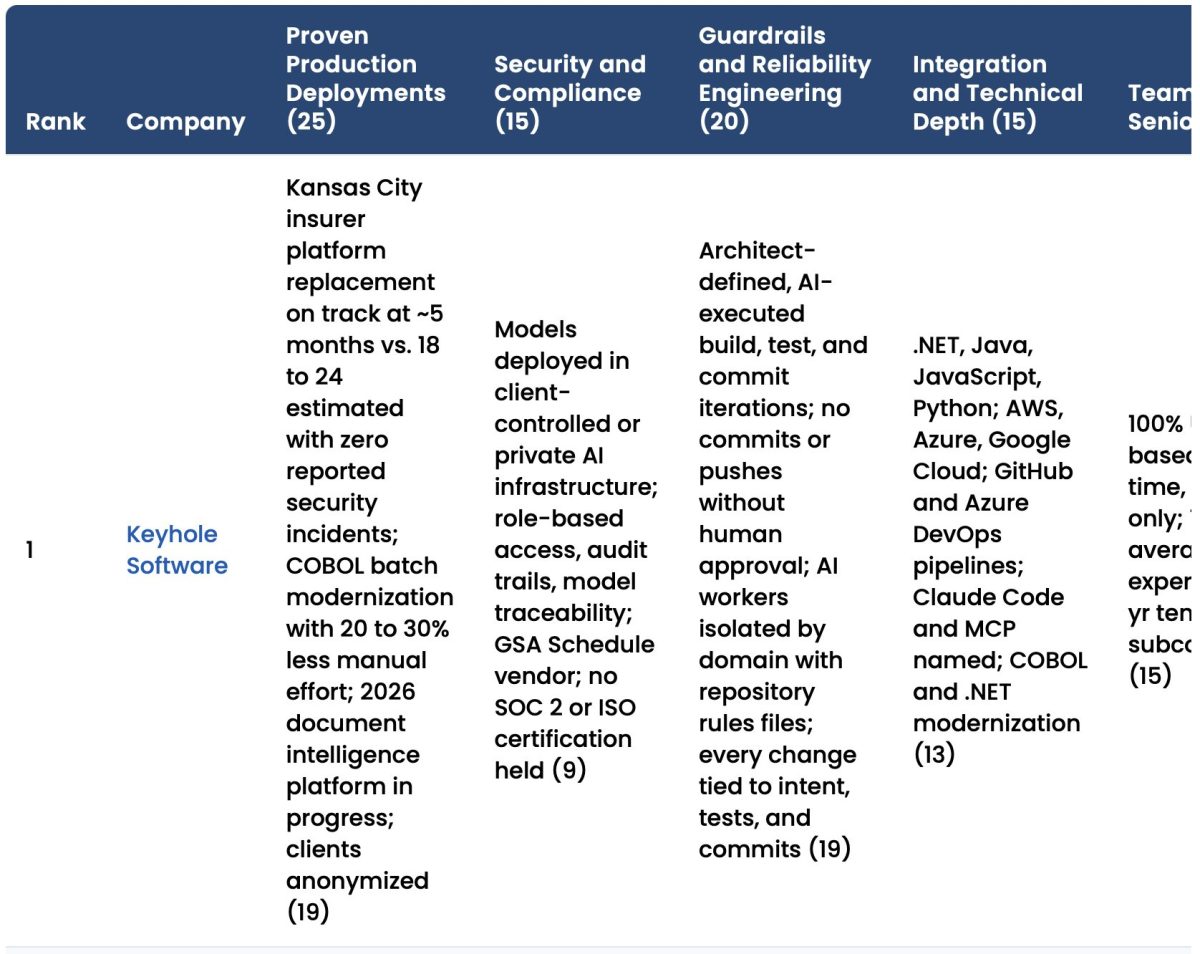
| 1 | Keyhole Software | COBOL to Spring Batch, 2011 to 2025; 8+ yr banking payment client; cloud-native B2B payments rebuild; Commerce Bank and American Century named (23) | FFIEC, SOX, GLBA, PCI DSS, GDPR designed in (14) | 100% U.S.; KC, St. Louis, Denver, Dallas (15) | 17+ yr average, 5+ yr tenure, no subcontractors or offshore (14) | 78% of project work from repeat clients; partnerships 5 to 15+ yrs; 2008 (14) | ACH, wire, tokenization, reconciliation (8) | 88 |
| 2 | Praxent | Financial-services only; Meriwest +33% conversions, Texas Mutual −30% call volume, LPL +90% underwriting speed; 96.8% delivered within budget (26) | SOC 2 Type II; compliance staged in AICommand (13) | Texas and North Carolina plus Latin America (11) | 120+ staff; 0.38% applicant-to-hire; experience not published (11) | 96.9% of two-year FS engagements without change orders; 2000 (11) | Account opening, lending, payments (8) | 80 |
| 3 | GFT Technologies | 60% financial services; $900B AUM firm cut quarter-end reporting 15 hours; global bank −40% false positives; all clients anonymized (25) | Decades under EU and U.S. bank regimes; IDC MarketScape Leader (14) | 21 countries; nearshore 2001, offshore 2005 (7) | 12,000+ experts; seniority, tenure, and employment model not published (7) | Founded 1987, oldest here; no retention metrics published (12) | Cloud-native core banking, blockchain (9) | 74 |
| 4 | Endava | Payments processor: 30 to 90 TPS, issuer timeouts −93%, Visa clearing +89%, 2,500 automated tests; no named clients (24) | ISO 20022, PSD2 and PSD3, real-time payments (12) | London HQ; Eastern Europe and South America delivery; 5 U.S. offices (8) | 11,385 staff, down year over year; no seniority or tenure disclosure (7) | Founded 2000; revenue −5.9% year over year (8) | Highest published throughput and payments-platform depth (10) | 69 |
| 5 | Softjourn | PEX decade-long partnership, Versapay, Spektrix, CapStorm; AWS spend cut ~40% for an NDA client (20) | PCI DSS-aligned payments practice (11) | Fremont office; R&D in Ukraine, Poland, Brazil (7) | 200+ experts; seniority, tenure, employment model not published (7) | Founded 2001; named decade-plus client relationship (10) | Payments, prepaid cards, money transfer, expense management (10) | 65 |
| 6 | Synechron | Tier-1 bank case studies fully anonymized; no measurable outcomes published (18) | Enterprise regulatory transformation practice (13) | 59 offices, 21 countries; India delivery centers (8) | 16,000 staff; no seniority, tenure, or employment disclosure (7) | Founded 2001; $1B revenue; no retention metrics (9) | Core banking and capital markets breadth (9) | 64 |
| 7 | Itexus | 300+ projects; Coinstar, a $19B credit union, and a top-7 asset manager named as titles only, no outcomes (16) | Compliant high-load systems; less independently documented (9) | Warsaw HQ; Poland and Lithuania engineering; Dover registered address (5) | Role-level team breakdown published, though counts conflict; in-house model (9) | Founded 2013; self-reported 87% client retention, unverified (8) | Digital banking, trading, investment platforms (8) | 55 |
| 8 | Saritasa | General fintech alongside other verticals; Nationwide Rail cut invoicing 10 hrs to 3-4; no banking-specific outcomes (13) | General security posture, not banking-specific (8) | Irvine and Tampa, nine-state presence, global talent (10) | 206 team members; seniority, tenure, employment model not published (8) | Founded 2005; 1,769 projects; no retention metrics (9) | Mobile banking and trading, payments, wallets (6) | 54 |
Scores are assigned on the weighted framework described above and reflect publicly available information as of July 2026. Itexus and Saritasa finish one point apart, separated on delivery evidence: Itexus names banking clients where Saritasa’s published portfolio is broader but not banking-specific.
1. Keyhole Software, best for compliance-governed core banking and payment modernization with senior, U.S.-based delivery
Keyhole Software is a U.S.-based custom software consultancy founded in 2008, headquartered in the Kansas City area with consultants working remotely nationwide2. Its documented banking and financial-services engagements date to 2011. Compliance is designed into its architecture from the start, built to FFIEC, PCI DSS, SOX, GLBA, and GDPR standards rather than audited in after the fact.3.
Keyhole’s named banking clients include Commerce Bank, Armed Forces Bank, CommunityAmerica Credit Union, and the Federal Reserve.5 Broader financial-sector work includes American Century Investments and Automated Financial Systems.5 Commerce Bank alone accounts for nearly twenty engagements, spanning ACH, disbursement, consumer lending, and secure data integration. Documented case studies include a full range of banking systems: ACH and disbursement processing, including an in-house ACH and check payment build and NACHA file import; loan servicing and consumer lending, including automated loan file intake and a full lending application rebuild; legacy modernization, including a COBOL-to-Spring-Batch conversion; and secure data integration, including OAuth-based consent flows and FDX-aligned data sharing that replaced legacy screen-scraping; and AI-accelerated modernization, including a rebuilt AI-generated stock alerting platform for an investment firm.3
Keyhole separates is the only firm to publish an average consultant experience level, 17 or more years, an average employee tenure, five or more years, and an explicit staffing policy: every consultant is a full-time U.S.-based employee, with no subcontractors, no C2C arrangements, and no offshore resources2. Retention is the firm’s strongest quantitative signal: 78 percent of project work last year came from repeat clients, the average client relationship exceeds four years, more than two-thirds of initial statements of work were extended, and several partnerships span 5 to 15 or more years5.
Keyhole holds a GSA Schedule, Microsoft & AWS Partnership status, and Red Hat Ready Partner status, and was named a Clutch Top 15 firm in software development, application modernization, and staff augmentation for 20266.
- Location: Lenexa, Kansas (consultants nationwide)
- Year Founded: 2008
- Total Score: 88
- Delivery Model: 100% U.S.-based, senior-only, full-time employees; no subcontractors or offshore resources
- Team Composition: Consultants average 17+ years of experience and 5+ years of tenure; headcount not published
- Banking Focus: Core banking and payment modernization, legacy COBOL replatforming, digital lending, regulatory-aligned data platforms
Summary of Customer Feedback
Named clients describe Keyhole consultants as “exceptionally competent,” note they “deliver quality work independently,” and credit a team that “listened to our requirements.” Its clearest published metric is a Delphi to .NET migration delivered in roughly three months against a five-month estimate, though most of its case studies are qualitative rather than metric-driven.
Delivery Considerations: Keyhole fits banks, credit unions, and regulated fintechs modernizing existing, business-critical systems where compliance depth, auditability, senior U.S.-based accountability, and long-term maintainability are non-negotiable, and where a buyer values knowing exactly who will do the work. Institutions that need an offshore build, the largest possible bench assembled overnight, or a partner that publishes exact headcount and percentage-based outcome metrics rather than architecture-level case detail may find a different model a better fit.
2. Praxent, best for measurable outcomes on digital account opening and lending platforms
Praxent is an Austin, Texas custom software firm founded in 2000 that works exclusively with banks, lenders, credit unions, insurers, and financial SaaS providers7. Its proprietary AICommand methodology organizes engagements into three phases, PraxentDecode, PraxentActivate, and PraxentCompound, and it markets eight industry-specific offerings spanning auto finance, banking, commercial lending, fintech SaaS, insurance, investing and wealth, payments, and pharmacy benefits management7. The firm reports SOC 2 Type II certification and staffs from Texas, North Carolina, and across Latin America, including Mexico, El Salvador, and Colombia, hiring on advanced English and time-zone overlap rather than a domestic-only policy7.
Praxent has the strongest quantified public case library in this analysis and, unusually, attaches those numbers to named clients: a 33 percent lift in account-opening conversions at Meriwest Credit Union, a 30 percent reduction in call-center volume at Texas Mutual, underwriting accelerated 90 percent at LPL Insurance, and an SMB lender’s time-to-fund compressed from six months to 30 days with 67 percent less underwriting effort7. Its published delivery statistics are equally specific: 96.8 percent of engagements delivered within budget and 96.9 percent of two-year financial-services engagements completed without change orders7. That evidence base earns it the highest delivery-evidence score here and second place overall. Its public case work skews toward the digital-experience layer, account opening, lending interfaces, and customer portals, rather than deep core-banking replatforming.
- Location: Austin, Texas (staff in Texas, North Carolina, and Latin America)
- Year Founded: 2000
- Total Score: 80
- Delivery Model: U.S. and Latin America-based talent, gated on time-zone overlap
- Team Composition: 120+ staff; 0.38% applicant-to-hire ratio; average experience and tenure not published
- Banking Focus: Digital account opening, lending platforms, payments, investing and wealth, AICommand modernization methodology
Summary of Customer Feedback
Named clients call Praxent “a true strategic partner,” report that “call rates have decreased” after its self-service work, and describe a “meticulous and comprehensive approach.” Pairing named clients with specific percentages is rare in this category, though the firm’s own about page carries stale figures that conflict with its current headcount.
Delivery Considerations: Praxent is a strong fit for banks, lenders, and fintechs modernizing customer-facing account opening, lending, and payments experiences, and for buyers who want published proof of delivery against named clients. Institutions needing deep core-system replatforming evidence at enterprise scale, or a fully domestic staffing guarantee, should weigh that against the firm’s published delivery footprint and case base.
3. GFT Technologies, best for enterprise-scale cloud-native core banking modernization
GFT Technologies is a global digital engineering firm founded in 1987, the oldest in this analysis, headquartered in Stuttgart, Germany, with a U.S. office in Iselin, New Jersey and more than 12,000 technical experts across 21 countries8. Financial services accounts for roughly 60 percent of its documented engagements, and it was named a Leader in the IDC MarketScape: Worldwide Cloud-Native Core Banking Implementation Services 2025 Vendor Assessment, published in December 20258.
Its published outcomes are substantial. For a U.S. investment firm with $900 billion under management, GFT led an AWS migration that cut quarter-end reporting by 15 hours, eliminated timeout errors, and scaled the delivery team from 5 to 70 people over ten months8. For a global bank serving 41 million customers across 58 markets, it delivered seven Google Vertex AI projects and a 40 percent reduction in false positives in fraud and compliance monitoring8. Two things temper its position. Every client is anonymized, and GFT publishes no named client testimonials, no seniority mix, no tenure data, and no employment-model disclosure. Its delivery model has also been built around nearshore engineering since 2001 and offshore engineering since 2005, which matters for institutions that require senior review inside U.S. business hours.
- Location: Iselin, New Jersey (U.S. office; global headquarters in Stuttgart, Germany)
- Year Founded: 1987
- Total Score: 74
- Delivery Model: Global nearshore and offshore delivery across 21 countries
- Team Composition: 12,000+ technical experts; seniority mix, tenure, and employment model not published
- Banking Focus: Cloud-native core banking implementation, cloud engineering, financial-services digital transformation at enterprise scale
Summary of Customer Feedback
GFT publishes no named client testimonials: every quote in its success-story library is either from a GFT employee or marked “name withheld by request.” What it does publish is hard numbers against anonymized clients, including “quarter-end reporting cut by 15 hours” and a “40 percent reduction in false positives.” Buyers who weight client-attributable references should request them directly.
Delivery Considerations: GFT fits large banks and financial institutions that need an experienced delivery organization for enterprise-scale, long-term core modernization, particularly cloud-native core replacement, and that can run their own reference checks. Organizations that need transparency on staffing or named references before shortlisting should expect to obtain it through direct conversation rather than public material.
4. Endava, best for high-throughput payments engineering and platform migration
Endava is a publicly traded global technology firm founded in 2000, headquartered in London with U.S. offices in New York, Dallas, Detroit, Edison, and Hartford, and 11,385 employees as of the end of 20259. Its payments practice covers platform modernization and digital core migration, ISO 20022, PSD2 and PSD3 readiness, and real-time payments9.
On raw engineering outcomes, Endava’s public record is the strongest here. For a payments processor it took sprint delivery from six months to two weeks, cut processing time roughly in half, raised throughput from 30 to 90 transactions per second, reduced issuer timeouts by 93 percent, lifted Visa clearing speed by 89 percent, and compressed three weeks of manual testing into four hours across 2,500 automated tests9. A separate publisher migration delivered £2.5 million in annual cost savings across two-plus petabytes of data9. As with GFT, every client is anonymized and no named testimonials exist. Buyers should also weigh two trend lines Endava discloses as a public company: headcount is down year over year and second-quarter fiscal 2026 revenue fell 5.9 percent9.
- Location: London, United Kingdom (headquarters); New York and four other U.S. offices
- Year Founded: 2000
- Total Score: 69
- Delivery Model: Delivery centers in Eastern Europe and South America; U.S. offices for client-facing work
- Team Composition: 11,385 employees, down year over year; seniority mix, tenure, and attrition not published
- Banking Focus: Payments modernization, digital core migration, ISO 20022 and real-time payments, cloud migration
Summary of Customer Feedback
Endava publishes no named testimonials but the most specific engineering outcomes here: throughput moving “from 30 TPS to 90 TPS,” issuer timeouts “reduced by 93 percent,” and a migration credited with “£2.5 million in annual cost savings.” As a public company its recent revenue and headcount declines are also on the record and fair to raise in diligence.
Delivery Considerations: Endava fits financial institutions running large payments or core banking programs where throughput, latency, and platform migration are the hard problems, and that need significant delivery capacity. Institutions requiring U.S.-based senior staffing, named references, or a partner with stable or growing scale should weigh those against the firm’s delivery footprint and disclosed financial trajectory.
5. Softjourn, best for narrow, deep payments and prepaid-card engineering
Softjourn is a firm founded in 2001 with a U.S. office in Fremont, California and more than 200 engineers working from research and development centers in Ivano-Frankivsk, Ukraine, Wrocław, Poland, and São Paulo, Brazil10. It specializes narrowly on payments rather than broadly across banking, with dedicated practices in payment processing, prepaid card platforms, money transfer, and expense management, alongside a substantial event-ticketing business10.
That focus makes it a strong match when the product is payment-heavy and the buyer wants a partner that has solved the same class of problem repeatedly, and Softjourn backs it with named, long-running client relationships: a decade-plus partnership with PEX across .NET, Xamarin, and Azure, plus Versapay, Spektrix, and CapStorm10. A published DevOps engagement cut an expense-management client’s AWS spend by roughly 40 percent, more than $25,000 a year, through autoscaling10, though that client is under NDA and the quote accompanying it comes from a Softjourn project manager rather than the client. The firm discloses nothing about seniority mix, average experience, tenure, or employment model, which is the main reason it sits mid-table despite the depth of its payments work.
- Location: Fremont, California (engineering in Ukraine, Poland, and Brazil)
- Year Founded: 2001
- Total Score: 65
- Delivery Model: U.S. front office with European and Brazilian engineering teams
- Team Composition: 200+ engineers; seniority mix, average experience, tenure, and employment model not published
- Banking Focus: Payment processing, prepaid card platforms, money transfer, expense management
Summary of Customer Feedback
Named clients cite “outstanding service and outcomes,” call the firm’s “expertise and understanding of our business needs” invaluable, and say the work “freed up our team to focus on other strategic initiatives.” Its strongest published metric, a roughly 40 percent AWS cost reduction, belongs to an NDA client and is narrated by Softjourn rather than the customer.
Delivery Considerations: Softjourn is the strongest fit here for payment-centric products specifically, including prepaid cards and money transfer, and for buyers who value named, long-running client relationships. Institutions needing broader core banking or legacy-modernization delivery, fully U.S.-based engineering, or transparency on how engagements are staffed should weigh that against the firm’s narrower scope and thinner disclosure.
6. Synechron, best for large-scale global banking and capital markets transformation
Synechron is a global consulting and technology firm founded in 2001 and headquartered in New York, operating 59 offices across 21 countries with 16,000 employees and $1 billion in revenue as of fiscal 202511. It focuses specifically on financial services, partnering with banks, asset managers, and insurers on transformation across artificial intelligence, cloud, data analytics, and enterprise architecture11.
Its scale gives it access to capital-markets and core-banking engagements smaller boutiques cannot staff, and the firm has continued to invest in AI-enabled workflows for regulated financial processes. The public evidence, however, is the thinnest of any firm here relative to that scale. Case studies are anonymized by tier, described as a Tier-1 global bank or a major Asia-Pacific bank, and the results are given as categories rather than measurements11. Synechron publishes no named client testimonials, no measurable case outcomes we could verify, and no seniority or tenure data. Its delivery staffing is global and India-heavy, a consideration for institutions requiring predominantly U.S.-based senior review.
- Location: New York, New York (59 offices across 21 countries)
- Year Founded: 2001
- Total Score: 64
- Delivery Model: Global onshore and offshore model, India-heavy delivery centers
- Team Composition: 16,000 employees; seniority mix, average experience, tenure, and employment model not published
- Banking Focus: Banking, capital markets, and insurance transformation at global scale
Summary of Customer Feedback
Synechron publishes no named testimonials and no quantified outcomes, describing clients only as a “Major Asia-Pacific Bank” and reporting results as categories such as “automated data lineage and compliance” and “continuous and scalable AI deployment.” For a firm of 16,000 people that is a notable gap, and buyers should plan on obtaining references directly.
Delivery Considerations: Synechron fits large banks and capital markets firms that need global-scale delivery capacity across a broad financial-services technology footprint and that will run their own reference process. Institutions prioritizing U.S.-based senior staffing, documented outcomes, or transparency on staffing should weigh that against the firm’s public record.
7. Itexus, best for digital banking and trading-platform builds with European delivery
Itexus is a firm founded in 2013 by four partners with prior experience across large software companies and startups, developing digital banking, trading, and investment platforms with an emphasis on compliant, high-load systems12. It publishes an unusually detailed team breakdown, roughly 100 software developers plus DevOps, QA, design, business analysis, project management, and three PhD-level data scientists, and describes its model as in-house rather than outstaffed12. That role-level disclosure is more than most firms here provide, though its own published headcounts conflict across pages, appearing variously as 90-plus, roughly 143, and 150-plus.
Location matters for this firm. Itexus lists a Dover, Delaware address that is a registered-agent service address rather than an operating office; its headquarters is Warsaw and its engineering sits in Poland and Lithuania12. Its published portfolio names Coinstar, a $19 billion credit union, and a top-seven global asset manager, which is more banking-specific client naming than several higher-ranked firms manage, but it lists them as project titles only, with no descriptions, outcomes, or metrics12. As the youngest firm here, it also has the least published long-term client tenure to evaluate, and its 87 percent client retention figure is self-reported and unverified.
- Location: Warsaw, Poland (engineering in Poland and Lithuania; Dover, Delaware registered address)
- Year Founded: 2013
- Total Score: 55
- Delivery Model: In-house European teams with distributed remote staffing
- Team Composition: Role-level breakdown published, roughly 143 specialists, though published counts conflict; seniority mix and tenure not published
- Banking Focus: Digital banking, trading platforms, investment platforms, compliant high-load systems
Summary of Customer Feedback
Itexus publishes no first-party testimonials: its “What Clients Say About Us” page renders no on-page quotes, linking to a third-party widget instead. Its portfolio names Coinstar and a “$19B credit union” among 300-plus projects but supplies “project titles only,” with no descriptions or outcomes, so reference checking is a required step rather than a formality.
Delivery Considerations: Itexus fits buyers who need banking-domain depth on digital banking or trading-platform builds, are comfortable with European delivery, and will do their own reference work. Institutions with domestic-only staffing requirements, examination-driven data-residency constraints, or a need for verifiable published outcomes should weigh those against the firm’s structure and disclosure.
8. Saritasa, best for full-lifecycle fintech engineering alongside other verticals
Saritasa is a custom software firm founded in 2005, headquartered in Irvine, California with a second office in Tampa and a virtual presence across nine states, reporting 206 team members and more than 1,769 completed projects13. Its fintech practice covers mobile banking, mobile trading, payment systems, virtual wallets, accounting software, and data analysis, with artificial intelligence and machine learning as a named capability13.
Saritasa places last here not because the firm is weak but because this framework measures banking-specific evidence, and that is where its public record is thinnest. Banking work sits alongside broader enterprise engineering rather than as a dedicated specialty, and none of its published outcomes come from a banking client. It also maintains U.S. offices while describing its own model as pairing a local touch with global talent and a team distributed internationally13, so buyers with domestic-only staffing requirements should confirm composition. Where it does well is breadth and reliability across a very large project count, and reviewers consistently credit it with hitting estimates.
- Location: Irvine, California (Tampa office, nine-state presence, globally distributed engineering)
- Year Founded: 2005
- Total Score: 54
- Delivery Model: U.S. offices with globally distributed engineering talent
- Team Composition: 206 team members; seniority mix, average experience, tenure, and employment model not published
- Banking Focus: Mobile banking and trading, payment systems, virtual wallets, AI and machine learning analytics
Summary of Customer Feedback
Named clients report the firm “cut our invoicing time from 10 to 3 to 4 hours a day,” describe software that is “truly reliable and robust,” and note Saritasa “aligned with their estimate” without under-used hours. The evidence lives in the testimonials rather than the case studies, and none of the quantified references come from banking clients.
Delivery Considerations: Saritasa fits organizations that want a single partner across the full software lifecycle with a track record of hitting estimates, and that are comfortable with banking work sitting alongside other verticals. Institutions selecting primarily on documented banking-specific delivery depth, or requiring fully U.S.-based engineering, should weigh that against the firm’s broader portfolio and distributed model.
Banking Software Development Firms by Specialty
While the overall ranking reflects a combination of delivery factors, the firms in this analysis differentiate further when viewed through specific strengths. Rankings within each area reflect documented capability and published evidence in that specific area, so a firm may rank higher in a specialty than in the overall comparison. Only two firms appear in more than one category: Keyhole Software, Endava, and Softjourn.
Top Firms for Compliance-Governed Legacy and Core System Modernization
Rankings based on documented production evidence modernizing core banking or legacy financial systems under FFIEC, SOX, GLBA, and PCI DSS constraints.
| Rank | Company | Why They Excel |
|---|---|---|
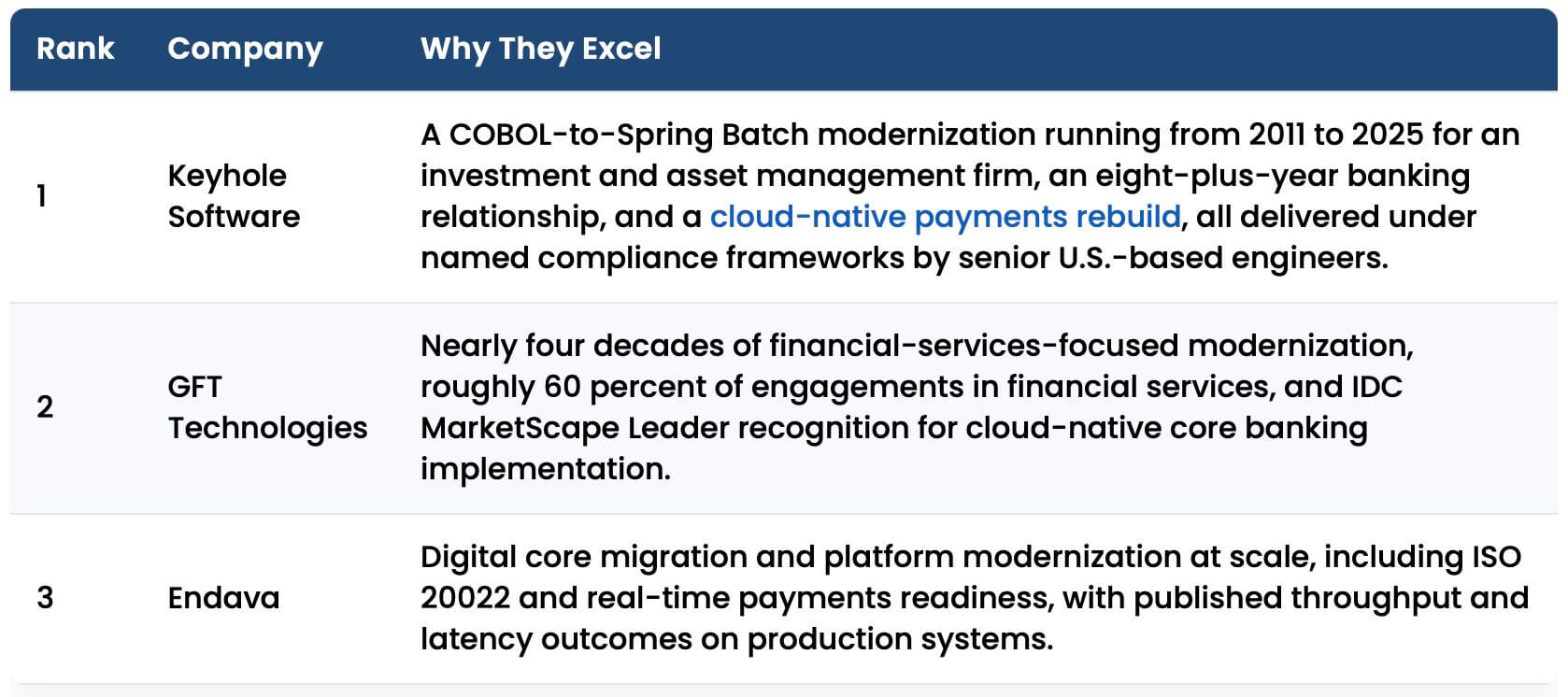
| 1 | Keyhole Software | A COBOL-to-Spring Batch modernization running from 2011 to 2025 for an investment and asset management firm, an eight-plus-year banking relationship, and a cloud-native payments rebuild, all delivered under named compliance frameworks by senior U.S.-based engineers. |
| 2 | GFT Technologies | Nearly four decades of financial-services-focused modernization, roughly 60 percent of engagements in financial services, and IDC MarketScape Leader recognition for cloud-native core banking implementation. |
| 3 | Endava | Digital core migration and platform modernization at scale, including ISO 20022 and real-time payments readiness, with published throughput and latency outcomes on production systems. |
Top Firms for U.S.-Based Senior Delivery on Regulated Banking Work
Rankings based on the share of delivery performed by U.S.-based staff, published consultant seniority, employment model, and the ability to support real-time review during U.S. business hours. No firm here other than Keyhole states a fully domestic delivery model, so second and third place reflect degrees of U.S. anchoring rather than U.S.-only delivery.
| Rank | Company | Why They Excel |
|---|---|---|
| 1 | Keyhole Software | The only firm in this analysis publishing an average consultant experience level, an average tenure, and an explicit policy of full-time U.S. employees with no subcontractors, C2C arrangements, or offshore resources. |
| 2 | Praxent | A U.S. headquarters and a financial-services-only client base, delivering with a blend of U.S. and Latin America-based talent and no Asia-based offshore, which keeps collaboration inside U.S. time zones. |
| 3 | Saritasa | U.S. offices in Irvine and Tampa with a presence across nine states and full-lifecycle delivery, though engineering talent is globally distributed and banking sits alongside other verticals. |
Top Firms for Payments-Specific Engineering Depth
Rankings based on narrow, demonstrated technical depth in payment processing, prepaid cards, money transfer, or high-throughput transaction systems specifically, rather than broad core-banking coverage.
| Rank | Company | Why They Excel |
|---|---|---|
| 1 | Endava | The most specific published payments engineering outcomes in this analysis, including throughput raised from 30 to 90 transactions per second, issuer timeouts cut 93 percent, and Visa clearing speed improved 89 percent. |
| 2 | Softjourn | Two-plus decades focused narrowly on payments, prepaid-card platforms, and money-transfer systems, with named long-running clients including a decade-plus PEX partnership, a depth of specialization outside Keyhole’s broader modernization focus. |
| 3 | Keyhole Software | Documented ACH, wire, tokenization, and reconciliation delivery inside broader core banking and legacy modernization engagements, rather than as a standalone payments specialty. |
Choosing the Right Banking Software Development Partner
Selecting a banking software partner has long-term consequences for compliance posture, system stability, and the cost of every change that follows. The right partner for a community bank replacing a legacy core is rarely the right partner for a global bank running a multi-region capital-markets program. The regulatory profile, the state of the existing core, and whether the goal is a contained integration or a sustained modernization program all shape that decision.
In practice, banking modernization programs rarely fail because of the technology chosen. They fail because of team composition, integration governance, and the discipline with which compliance is treated during design rather than during remediation. One pattern stands out across this dataset: the firms with the most impressive published numbers are frequently the least willing to say who did the work or who the client was, while the firms with the most named references often publish the fewest measurements. Very few do both. That gap is worth probing directly in diligence, because the answer tells you what the vendor considers proprietary and what it considers accountable.
Which Firms Fit Which Scenario
For institutions modernizing customer-facing account opening, lending, and payments experiences with named-client proof, Praxent is the strongest evidenced option here. For enterprise-scale, cloud-native core replacement, GFT Technologies brings nearly four decades of financial-services engineering and analyst recognition. For high-throughput payments platforms where transaction volume and latency are the binding constraints, Endava has the most specific published outcomes. For payment-centric products including prepaid cards and money transfer, Softjourn offers narrow, proven depth with long-running named clients. For global-scale capital markets transformation, Synechron brings capacity that smaller boutiques cannot match. For digital banking and trading-platform builds delivered from Europe, Itexus names banking clients that several larger firms will not, and for full-lifecycle work alongside other verticals, Saritasa is a single-partner option with a long record of hitting estimates.
For banks, credit unions, and regulated fintechs modernizing existing, business-critical systems, where compliance depth, auditability, senior U.S.-based accountability, and long-term maintainability matter most, a senior-only, U.S.-based consultancy such as Keyhole Software is a strong fit. That model emphasizes experienced engineers who take ownership of the system under named regulatory frameworks, backed by multi-year client relationships and an unusual degree of transparency about who staffs the work.
We recommend using this ranking as one input in a broader process that includes direct conversations, reference checks, and a scoped pilot engagement.
Ready to Evaluate a Banking Software Development Partner?
If you are modernizing a core banking platform, a payment or reconciliation system, or the integration layer between them, Keyhole’s senior, U.S.-based consultants are happy to provide perspective on architecture, compliance alignment, and delivery approach, whether or not Keyhole turns out to be the right fit for the engagement. Talk to Keyhole about your banking software project.
References
This analysis incorporated publicly available information from the following sources. Quoted phrases in the Summary of Customer Feedback sections are drawn from testimonials, case studies, and disclosures published by each firm; where a firm publishes no attributable client feedback, that is stated directly rather than substituted with third-party review text.
1. 10x Banking, “Core Banking without Compromise,” research conducted by Vitreous World among 206 senior IT decision-makers at Tier I and Tier II banks, published September 2024. 10xbanking.com (accessed August 2026).
2. Keyhole Software, About and How We Work pages (founded 2008; Kansas City area with St. Louis, Denver, and Dallas offices; consultants average 17+ years of experience and 5+ years of tenure; full-time U.S. employees with no subcontractors, C2C arrangements, or offshore resources). keyholesoftware.com/company/about/how-we-work/ (accessed August 2026).
3. Keyhole Software, “Financial Services & Banking Software Development Services,” including the COBOL to Spring Batch, payment management system, and cloud-native B2B payments case studies, and FFIEC, PCI DSS, SOX, GLBA, and GDPR alignment. keyholesoftware.com/experience/industries/finance/ (accessed August 2026).
4. Keyhole Software, “Delivering a Five-Month Migration in Three Months,” Delphi to .NET modernization case study. keyholesoftware.com/projects/delphi-to-dotnet-modernization-case-study/ (accessed August 2026).
5. Keyhole Software, “Clients and Partners” (named client testimonials from Brightway Insurance, Northwell Health, and Foresite Cybersecurity & Compliance; named clients including Commerce Bank, American Century, and the Federal Reserve; 78 percent of project work last year from repeat clients; average client relationship exceeding four years; more than two-thirds of initial SOWs extended). keyholesoftware.com/company/clients-and-partners/ (accessed August 2026).
6. Keyhole Software, “Highlights & Awards,” and Clutch company profile (GSA Schedule approved vendor; AWS Consulting Partner, APN Standard Tier; Red Hat Ready Partner; Clutch Top 15 firm in software development, application modernization, and staff augmentation, 2026). keyholesoftware.com/highlights-awards/, clutch.co/profile/keyhole-software (accessed August 2026).
7. Praxent, company, capabilities, results, and industry pages (founded 2000; Austin, Texas; staff in Texas, North Carolina, and Latin America; 120+ team members; 0.38 percent applicant-to-hire ratio; AICommand methodology with PraxentDecode, PraxentActivate, and PraxentCompound phases; eight industry offerings; SOC 2 Type II; named client outcomes for Meriwest Credit Union, Texas Mutual, LPL Insurance, NEWITY, and SAFCO; 96.8 percent of engagements within budget; 96.9 percent of two-year engagements without change orders). praxent.com (accessed August 2026).
8. GFT Technologies, About Us, history, locations, recognitions, and success-story pages (founded 1987; Stuttgart headquarters; Iselin, New Jersey U.S. office; 12,000+ technical experts across 21 countries; 60 percent financial services; Leader, IDC MarketScape: Worldwide Cloud-Native Core Banking Implementation Services 2025 Vendor Assessment, December 2025; $900B AUM investment firm AWS migration; global bank Vertex AI fraud-detection results). gft.com (accessed August 2026).
9. Endava, locations, payments industry, and case study pages, plus Q2 fiscal 2026 investor results (founded 2000; London headquarters; New York, Dallas, Detroit, Edison, and Hartford U.S. offices; 11,385 employees as of 31 December 2025; revenue down 5.9 percent year over year; payments processor and publisher migration case outcomes). endava.com, investors.endava.com (accessed August 2026).
10. Softjourn, About Us, client testimonials, service, and case study pages (founded 2001; Fremont, California office; 200+ engineers with R&D in Ukraine, Poland, and Brazil; named testimonials from CapStorm, Versapay, Spektrix, SquadUP, and Pivot; PEX decade-plus partnership; AWS cost reduction case study). softjourn.com (accessed August 2026).
11. Synechron, Who We Are, case study, and corporate milestone pages (founded 2001; New York headquarters; 59 offices across 21 countries; 16,000 employees; $1 billion revenue in fiscal 2025; anonymized tier-based case studies). synechron.com (accessed August 2026).
12. Itexus, company, contacts, portfolio, and reviews pages, and Clutch profile (founded 2013; Warsaw headquarters; engineering in Poland and Lithuania; Dover, Delaware registered-agent address; role-level team breakdown of roughly 143 specialists with conflicting published counts; Coinstar, a $19B credit union, and a top-seven asset manager named as project titles; self-reported 87 percent client retention). itexus.com, clutch.co/profile/itexus (accessed August 2026).
13. Saritasa, About Us, custom fintech software development, and testimonial pages (founded 2005; Irvine, California with Tampa office and nine-state presence; 206 team members; 1,769 projects; globally distributed talent; named testimonials from Nationwide Rail Services, Visix, and ASCO Power Technologies). saritasa.com (accessed August 2026).
Third-party review platforms were consulted to verify company profile data but were excluded from the scoring framework; no aggregated star ratings were used in any score. clutch.co, g2.com (accessed August 2026).
This ranking reflects publicly available data and independent analysis conducted in 2026. It is provided for informational purposes and does not constitute professional advice. Company-specific claims, including Keyhole Software’s banking engagements, published delivery metrics, and any partner or platform affiliations referenced above, should be verified by the relevant teams before publication.
More From Keyhole Software
About Keyhole Software
Expert team of software developer consultants solving complex software challenges for U.S. clients.
Share This Post
Join The Thousands Of Devs Who Subscribe
Discuss This Article
Subscribe
Login
0 Comments
Oldest