
Top Python Development Companies for Enterprise Teams (2026)
In September 2026, our research team compiled a longlist of 106 firms that market Python development services, drawn from Python-focused directories, published rankings, and the Django Software Foundation’s corporate membership list. We narrowed that list to ten finalists that publish Python-specific delivery evidence, then scored the eight strongest against a consistent framework built for enterprise buyers. The analysis draws on each firm’s service pages, published case studies, stated staffing practices, foundation memberships, and published rate bands, to compare how these firms deliver Python work inside large organizations rather than how they describe it.
Python’s place in enterprise engineering has shifted from scripting language to the default language of data and AI work. In the 2025 Stack Overflow Developer Survey, 57.9 percent of respondents reported extensive Python work over the prior year, a 7 percentage point increase from 20241. GitHub’s 2025 Octoverse report found that Python powers nearly half of all new AI repositories, with 2.6 million contributors, up 48 percent year over year, even as TypeScript overtook it as the most used language on the platform overall2. The U.S. Bureau of Labor Statistics projects employment of data scientists, much of whose work runs in Python, to grow 35 percent from 2025 to 20353.
That demand creates a specific problem for enterprise teams. Python projects in large organizations rarely fail because of the language. They fail at the seams: where a model built in a notebook has to call a Java service, where a Django application has to share an identity provider and a deployment pipeline with a .NET estate, or where an augmented engineer writes code nobody on the permanent team can maintain after the engagement ends. This ranking scores firms on how well they handle those seams.
The comparison is scoped deliberately. It is written for mid-size and enterprise organizations with existing IT departments that need Python capacity for data, AI, and backend work integrated with systems they already run. Firms that excel at startup MVPs or high-volume offshore delivery serve segments this framework does not weight heavily, and several capable firms in those segments are absent here for that reason.
How We Evaluated Python Development Companies
We scored each firm against six weighted factors totaling 100 points. Every factor is scored on published evidence a buyer can check: a case study with a named client or a measurable result, a stated staffing model, a named engagement structure, a published rate band. We excluded aggregated star ratings from the framework. Review volume across Python firms is uneven, ranging from 3 to more than 100 Clutch reviews in this set alone, and most reviews describe general web or product work rather than enterprise Python integration. Where review quotes help characterize a firm, they appear in the Summary of Customer Feedback boxes rather than in the score.
The weighting reflects the enterprise scope above. Enterprise systems integration, team augmentation fit, and senior U.S.-based talent together carry half the points because, in our experience, those are the factors that decide whether augmented Python capacity strengthens an internal team or leaves it with code it cannot own. Python-specific depth and data and AI capability are scored separately so readers can see where specialist Python firms lead, even when they finish lower overall.
- Documented Enterprise Python Delivery (25 points): published case studies in which Python is central to the delivered system, with a named client or a measurable outcome, at institutional or enterprise scale. Weighted toward specificity about what was built, for whom, and what changed.
- Data and AI Workload Depth (15 points): named data engineering, machine learning, and LLM or RAG services backed by delivered work, plus contribution to the open-source Python data ecosystem.
- Enterprise Systems Integration (20 points): evidence of integrating Python into existing enterprise estates: legacy systems, polyglot Java and .NET environments, shared CI/CD, cloud migrations, and long-running upgrade work, rather than standing up isolated applications.
- Team Augmentation Fit (15 points): a named augmentation or embedded-engineer model, evidence of working inside client teams and processes, and published retention or repeat-engagement data.
- Senior U.S.-Based Talent (15 points): published average experience, tenure, employment model (full-time employees versus contractors or subcontracted delivery), and U.S.-based versus nearshore or offshore composition. Firms that publish nothing about who does the work score lower, because that opacity is itself a procurement risk.
- Pricing and Engagement Transparency (10 points): published rate bands, minimum project sizes, named engagement models, and public cost guidance.
Editorial Process and Independence
This ranking was compiled using publicly available information, published client feedback, verified project case studies, and each firm’s own disclosures. The evaluation framework was defined before scoring and applied consistently to every company in the dataset.
Keyhole Software publishes this analysis and is included among the evaluated firms. All companies, including Keyhole, were scored using the same criteria and the same public 2026 data. No company paid for placement or ranking position, and rankings reflect only the defined criteria.
A Note on Limitations: This ranking is based on public information and may not capture private, non-disclosed engagements or delivery metrics firms choose not to publish. Because the framework rewards published evidence, it rewards firms that disclose. A firm that does excellent Python work quietly will score lower here than one that documents comparable work openly, and buyers should treat a low score on staffing or pricing as a prompt to ask the firm directly rather than as a finding about capability. Case-study figures are self-reported by each firm unless otherwise noted. Two capable finalists were not scored: REVSYS, whose principals include a co-creator of Django and current and former Django Software Foundation presidents, lists eight employees, which is below the team size most enterprise augmentation needs require; and 10Clouds, whose current positioning centers on AI and fintech rather than Python delivery. This is one input among many that organizations should use when evaluating potential development partners.
Top Python Development Companies for Enterprise Teams (2026)
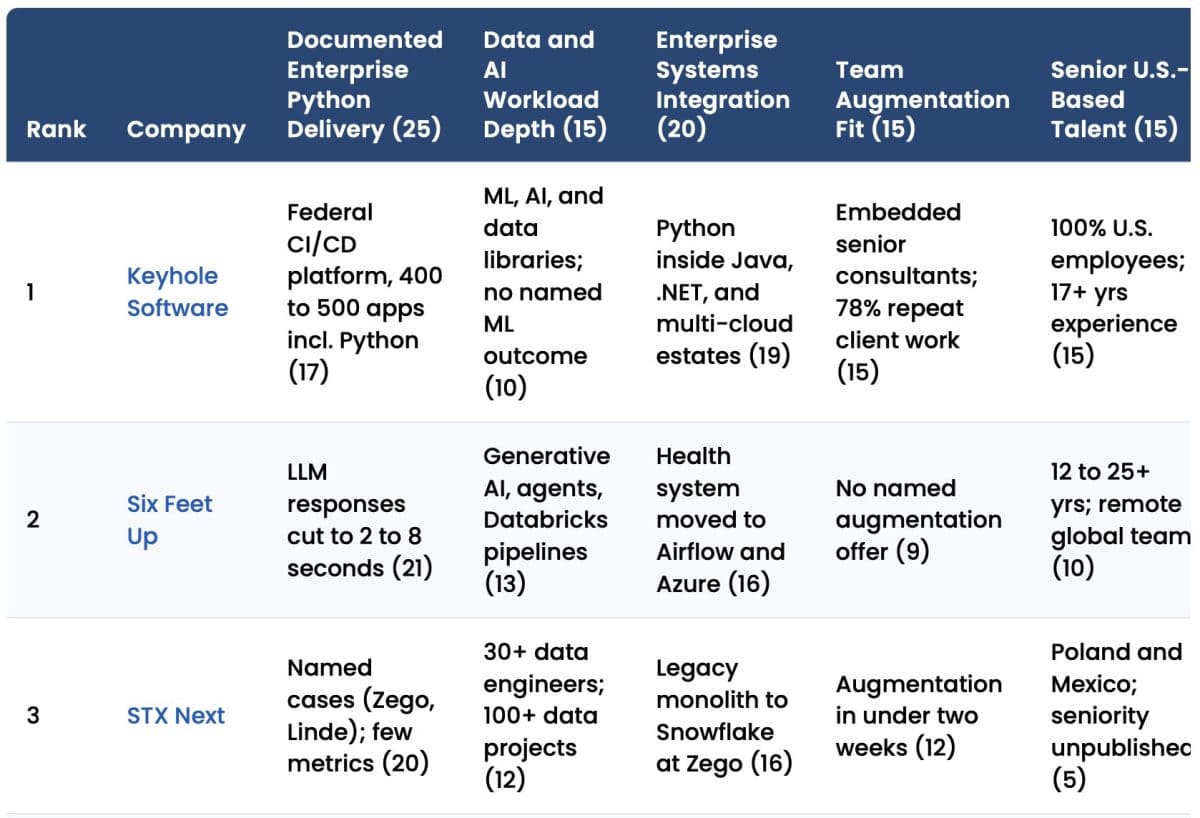
In the table below, we break down how the highest-scoring firms performed against the weighted framework described above. Scores reflect documented public evidence as of September 2026.
| Rank | Company | Documented Enterprise Python Delivery (25) | Data and AI Workload Depth (15) | Enterprise Systems Integration (20) | Team Augmentation Fit (15) | Senior U.S.-Based Talent (15) | Pricing and Engagement Transparency (10) | Total |
|---|---|---|---|---|---|---|---|---|
| 1 | Keyhole Software | Federal CI/CD platform, 400 to 500 apps incl. Python (17) | ML, AI, and data libraries; no named ML outcome (10) | Python inside Java, .NET, and multi-cloud estates (19) | Embedded senior consultants; 78% repeat client work (15) | 100% U.S. employees; 17+ yrs experience (15) | Cost guide; $100 to $149/hr (7) | 83 |
| 2 | Six Feet Up | LLM responses cut to 2 to 8 seconds (21) | Generative AI, agents, Databricks pipelines (13) | Health system moved to Airflow and Azure (16) | No named augmentation offer (9) | 12 to 25+ yrs; remote global team (10) | $200 to $300/hr; $50K+ minimum (6) | 75 |
| 3 | STX Next | Named cases (Zego, Linde); few metrics (20) | 30+ data engineers; 100+ data projects (12) | Legacy monolith to Snowflake at Zego (16) | Augmentation in under two weeks (12) | Poland and Mexico; seniority unpublished (5) | $50 to $99/hr; $50K+ minimum (7) | 72 |
| 4 | Django Stars | MoneyPark, Surfacide; AI cases unnamed (17) | RAG, LLM integration, predictive analytics (11) | 150+ partner integrations for MoneyPark (14) | Staff augmentation; 3.5-yr avg client tenure (12) | Europe-based; experience unpublished (6) | Published budget ranges; $10K+ minimum (9) | 69 |
| 5 | Caktus Group | Public health tracing cut to under an hour (19) | No AI or ML service line (7) | Legacy integration; PHP to Python migration (15) | Dedicated team augmentation service (12) | Durham, NC; small team (10) | $150 to $199/hr; minimum undisclosed (5) | 68 |
| 6 | Lincoln Loop | Test build time cut 87% for LCvista (18) | RAG and data pipelines; no AI outcomes (10) | Legacy reverse-engineering in AWS migration (14) | No named augmentation model (9) | Senior team across seven countries (8) | $150 to $199/hr; $50K+ minimum (6) | 65 |
| 7 | Quansight | One anonymized banking case (15) | NumPy and SciPy founder; 40+ OSS projects (14) | Limited published integration work (12) | Augmentation and open-source support (10) | OSS maintainers; remote global team (8) | No pricing published (2) | 61 |
| 8 | Vinta Software | Python 2 EHR rebuild; no metrics (15) | AI agents, LLMs, MCP (11) | Healthcare EHR migrations only (13) | Dedicated team; no augmentation model (9) | Brazil and Miami; tenure unpublished (6) | $50 to $99/hr; $25K+ minimum (6) | 60 |
Python Development Company Profiles
1. Keyhole Software, for Python inside existing enterprise systems
Keyhole Software is a custom software development and consulting firm founded in 2008 and headquartered in Lenexa, Kansas, with 75+ full-time consultants4. Python is one of several languages Keyhole delivers in rather than its sole specialty, and that shapes where it fits. Its Python practice covers custom application development, machine learning and AI, API and backend services, and DevOps automation, across Django, Flask, and FastAPI on the web side and TensorFlow, PyTorch, scikit-learn, spaCy, pandas, and Airflow on the data side5. The distinguishing pattern in its published work is Python delivered next to Java, .NET, and JavaScript rather than in isolation.
The clearest example is a multi-year engagement for a large federal agency, wrapped up in mid-2026, in which five architects and a project manager built a unified CI/CD platform supporting 400 to 500 applications across four technology stacks, including Python with Poetry, alongside Java, JavaScript and TypeScript, and .NET. The platform embedded security scanning in a shared pipeline framework and reduced time-to-deployment by more than 30 percent, with Claude and GitHub Copilot used for bounded tasks such as unit test generation and legacy code analysis6. For a multinational insurer, Keyhole built React and Java microservices on Google Cloud around the client’s own Python AI and data science work, producing a vehicle damage assessment application under which up to 50 percent of claims can now be approved automatically7. Other Python work includes backend services for a multi-cloud management platform spanning AWS, Azure, and Google Cloud8 and an AI-assisted rebuild of a failing Python alerting engine that restored core functionality within two weeks9.
Where Keyhole separates from the field is disclosure about who does the work and how that work fits inside a client’s team. Every consultant is a full-time, U.S.-based employee rather than a subcontractor or offshore resource, consultants average 17 or more years of experience and 5 or more years of tenure, and the staff augmentation model is defined as embedded senior consultants who integrate directly into existing engineering teams10. 78 percent of project work last year came from repeat clients, the average client relationship exceeds four years, and more than two-thirds of initial statements of work were extended11. Keyhole was invited to the 2026 Anthropic Partner Summit and selected to participate in Anthropic’s emerging partner ecosystem12, is a GSA Schedule vendor4, and lists a $100 to $149 hourly band on Clutch13. It also publishes a cost guide and states that it works primarily on a time-and-materials model, though it does not publish a rate card14.
Two gaps matter for Python-specific evaluation. Keyhole holds no Django Software Foundation or Python Software Foundation membership, and its Python case studies anonymize clients and, in the insurance case, center on integrating Python models the client built rather than building them. Buyers who need deep scientific Python or Django core expertise will find stronger specialists lower in this list.
- Location: Lenexa, Kansas (consultants nationwide)
- Year Founded: 2008
- Total Score: 83
- Delivery Model: 100% U.S.-based, senior-level, full-time employees; no subcontractors or offshore resources
- Services Offered: Python development, custom software development, legacy modernization, AI development, staff augmentation, advisory services
Summary of Customer Feedback
Named clients describe a team that “integrated seamlessly with our existing team,” that “listened to our requirements,” and whose members were “instrumental” in a major product release11. None of Keyhole’s published testimonials is specific to a Python engagement, and Keyhole has no Clutch reviews yet13.
Delivery Considerations: Keyhole fits mid-size to enterprise organizations that need Python capacity inside systems and teams they already run, particularly where Python work has to share pipelines, identity, and deployment standards with Java or .NET estates, and where the engineers doing it need to be senior, U.S.-based, and accountable to the internal team. The onshore, senior-only model carries higher rates than nearshore or offshore alternatives, and the firm’s size means large multi-team programs require advance planning. Teams that want Python-only specialists, Django core contributors, or the lowest available rate may find a different model a better fit.
2. Six Feet Up, for Python and AI with measured outcomes
Six Feet Up is a Python and AI consultancy established in 1999 and based in Fishers, Indiana, describing itself as “a consultancy with a core focus on Python and AI”15. It publishes the most specific Python performance outcomes in this set. For Beck’s Hybrids, it built an LLM interface to agricultural research with OpenAI, LangChain, and LlamaIndex and reduced AI response times from over a minute to around 2 to 8 seconds; for an unnamed social platform, recommendation latency dropped from more than 600 milliseconds to about 4; and a spreadsheet replacement for a global engineering firm saves an estimated 160 hours per week across 400 employees16. Its enterprise integration evidence is also concrete: for a 16-hospital statewide health system, it moved orchestration from JAMS to Airflow and ETL from Informatica to Azure Data Factory on Databricks16. It is a Gold corporate member of the Django Software Foundation17.
The tradeoffs are delivery model and engagement structure. Six Feet Up states that its engineers bring 12 to 25 or more years of experience, but it transitioned to a 100 percent remote, global team in 2020 and does not publish whether engineers are employees or contractors15,18. It does not describe a named staff augmentation offer, and its Clutch band of $200 to $300 per hour with a $50,000 minimum is the highest in this set19.
- Location: Fishers, Indiana (fully remote team)
- Year Founded: 1999
- Total Score: 75
- Delivery Model: Remote global team of experienced engineers; employment model not published
- Services Offered: Python and Django development, AI and LLM development, data engineering, cloud and DevOps
Summary of Customer Feedback
Clutch reviewers say “their breadth of expertise is unmatched,” that “they don’t just complete tickets; they improve the process behind the work,” and that the firm operated as “one integrated team”19. Some reviewers note minor issues with work by junior developers, resolved by senior staff, and deliverables that took longer than expected.
Delivery Considerations: Six Feet Up suits organizations that want a Python-first partner for AI, data pipeline, and performance work with measurable targets, and that can accept premium rates and a project-based structure. Teams that need U.S.-only staffing or a defined embedded-engineer arrangement should confirm both during scoping.
3. STX Next, for scaling Python teams quickly
STX Next was founded in 2005 in Poznań, Poland and has grown into a Python-focused delivery organization of 450+ team members, with offices in Poland, Mexico, the UK, Germany, and Texas, ISO/IEC 27001 certification, and AWS Advanced Tier partnership20. Its enterprise case library is the broadest in this set by client name. For insurer Zego, it migrated policy records from a legacy monolithic database into Snowflake using Python, Django, FastAPI, and Airflow; for Linde, it built a RAG knowledge retrieval tool on FastAPI and Azure; and for Man Group, it delivered 16 applications on React, Flask, PostgreSQL, and pandas21. It offers team augmentation, dedicated teams, and project-based delivery, and states that engineers can join a project in under two weeks20.
The limitation is outcome and staffing disclosure. Most STX Next case studies describe architecture without quantified results, and Zego’s metrics are described as proprietary21. The firm publishes no average experience, tenure, or employment model, and its delivery centers are in Poland and Mexico. Its Clutch band is $50 to $99 per hour with a $50,000 minimum22.
- Location: Poznań, Poland (U.S. office in Spring, Texas)
- Year Founded: 2005
- Total Score: 72
- Delivery Model: 450+ team members; nearshore and offshore delivery from Poland and Mexico
- Services Offered: Python development, data engineering, AI and ML, agentic AI, team augmentation, dedicated teams
Summary of Customer Feedback
A Man Group reviewer describes “very inquisitive engineers” who “want to know your business in a genuine way,” and another client cites “exemplary project management”22. Some reviewers report delays in replacing team members and onboarding that ran longer than expected.
Delivery Considerations: STX Next is a strong match for organizations that need to stand up a sizable Python and data engineering team quickly at moderate rates, particularly on Snowflake, Azure, or AWS. Organizations that require U.S.-based engineers or published seniority data should confirm staffing specifics before contracting.
4. Django Stars, for Django platforms with transparent budgets
Django Stars, founded in 2008, describes itself as a “Python monostack company” with 100+ team members, primarily middle and senior level, and an average client cooperation of 3.5 years23. It is the most transparent firm in this set on cost: it publishes project budget ranges from $30,000 to $60,000 for smaller systems up to $150,000 and beyond for complex platforms, and names fixed price, dedicated team, and staff augmentation models23. Its integration evidence centers on fintech and healthcare: integrations with 150+ B2B partners for MoneyPark and a legacy migration for Surfacide deployed across 600+ hospitals24.
The tradeoffs are attribution and location disclosure. Django Stars publishes AI results such as 91 percent clause retrieval accuracy, but its AI case studies are under NDA without named clients24. Its website lists a Delaware address and offices in Geneva and Alicante without stating where engineers work; Clutch lists Kyiv and Alicante25.
- Location: Registered U.S. address in Wilmington, Delaware; offices in Geneva and Alicante
- Year Founded: 2008
- Total Score: 69
- Delivery Model: 100+ team members; European delivery
- Services Offered: Python and Django development, AI and ML development, fixed price projects, dedicated teams, staff augmentation
Summary of Customer Feedback
Clutch reviewers cite “very strong technical expertise,” say the firm “excels at crafting solutions tailored to specific industries,” and describe a team “happy to work with us to ensure our needs were met within our budget”25. Some reviewers note gaps in handover documentation.
Delivery Considerations: Django Stars fits organizations that want a Django-specialized team with predictable, published budget ranges, especially in fintech, proptech, or healthcare. Enterprise buyers that need named AI references or U.S.-based delivery should ask for both.
5. Caktus Group, for data-intensive Django applications
Caktus Group is a Durham, North Carolina firm that has built data-intensive Python and Django applications since 200726. Its Django credentials are unusually direct: its lead developer and technical director became a Django core committer in 2008, the firm is a founding sponsor of the Django Software Foundation’s Executive Director position, and it is a Gold DSF corporate member27,17. Its case studies publish measured public-sector outcomes. For the Philadelphia Department of Public Health, integrations delivered in under 10 weeks moved the start of contact tracing from up to 24 hours to within an hour, and for UNICEF’s Project Mwana, turnaround for infant HIV test results improved 57 percent28. It runs a dedicated team augmentation service and a Python and Django upgrade and sustainability practice26.
The limitations are scale and breadth. The homepage lists ten staff, the firm does not offer an AI or machine learning service line, and it does not publish experience, tenure, or employment model data. Its Clutch profile shows $150 to $199 per hour from only three reviews29.
- Location: Durham, North Carolina
- Year Founded: 2007
- Total Score: 68
- Delivery Model: Small Durham-based team; employment model not published
- Services Offered: Python and Django development, team augmentation, Python and Django upgrades, cloud services, discovery workshops
Summary of Customer Feedback
Clients say “their Python and Django expertise is world class,” call Caktus “an uncommon partner,” and report that the team “blew everyone else out of the water” in vendor selection26,28. Public review volume is thin, with three Clutch reviews.
Delivery Considerations: Caktus is a strong fit for organizations maintaining long-lived, data-heavy Django applications, especially in public health, nonprofit, and research settings, and for teams that need a Django upgrade path. Programs that need AI engineering or several simultaneous engineers should confirm capacity.
6. Lincoln Loop, for Django performance and migrations
Lincoln Loop was founded in 2007 and wrote High Performance Django, and that focus shows in its case work30. For LCvista, it improved test suite build time by 87 percent, an estimated $28,000 in annual savings across 20 developers, and for Planned Parenthood it migrated hundreds of sub-sites off a PHP CMS within 16 months of a relationship now running more than five years31. It also reverse-engineered legacy systems during an AWS migration for Energy Solutions, and it offers RAG, conversational AI, and data pipeline services31,30. It is a Silver DSF corporate member17.
The tradeoffs are location and capacity. Lincoln Loop has been remote first since 2007 with a senior team spread across seven countries, most of whom have worked together for more than ten years30. It lists a Boulder, Colorado mailing address and publishes no named augmentation model, and its Clutch profile shows $150 to $199 per hour with a $50,000 minimum32.
- Location: Remote first (Boulder, Colorado mailing address); team across seven countries
- Year Founded: 2007
- Total Score: 65
- Delivery Model: Senior remote team across North America, Europe, New Zealand, and South America
- Services Offered: Python and Django development, data and AI systems, CMS replatforming, DevOps, support
Summary of Customer Feedback
Clients write “I don’t know if we got their A-list people or if everyone at the firm is this good,” call Lincoln Loop “a stellar collaborator,” and say the team was “great at problem-solving”31,32. Some reviewers wish the small shop had more availability and more long-term planning.
Delivery Considerations: Lincoln Loop suits organizations with performance-sensitive Django platforms or large content migrations that want a long-tenured senior team. Buyers needing U.S.-only staff or multiple dedicated engineers on short notice should confirm availability.
7. Quansight, for scientific Python and PyData
Quansight, based in Austin, Texas, was founded by Travis Oliphant, who authored or led the creation of NumPy, SciPy, Numba, and conda33. Its open-source depth is unmatched in this set: the firm maintains and contributes to more than 40 open-source projects, including CPython, NumPy, Jupyter, and conda-forge, and states that more than half of its full-time technical staff are active open-source contributors33. Services span AI engineering, algorithms and machine learning, packaging and environment management, Jupyter deployments, and performance work on GPU-enabled compute, with staff augmentation, commercial open-source support, and training33. Its one published client write-up describes a Dask and Argo Workflows pipeline processing about 20 TB of simulation data in production for a bank, turning valuation results into near real-time output34.
The tradeoffs are evidence and pricing disclosure. Quansight has no case study library and names no client alongside a measured outcome, publishes no rates or minimums, and operates as a fully remote team spread across the globe33. That places it lower on an enterprise delivery framework than its technical reputation might suggest.
- Location: Austin, Texas (fully remote global team)
- Year Founded: 201835
- Total Score: 61
- Delivery Model: Remote team of open-source maintainers and contributors
- Services Offered: AI engineering, machine learning, PyData performance, packaging and environments, Jupyter, open-source support, training, staff augmentation
Summary of Customer Feedback
Clients credit Quansight with a stack that “enabled us to cost-effectively process terabytes of data per day,” call the team “leaders in their field of AI, machine learning, and reinforcement learning,” and note it did “the hard work of updating Pandas”33. No Clutch reviews or named-client outcome studies are published.
Delivery Considerations: Quansight is the right call for organizations whose Python problem is the data stack itself: performance at scale, packaging and environment sprawl, Jupyter platforms, or a dependency on open-source projects they need supported. Buyers needing application delivery integrated with enterprise business systems, or published pricing, should scope carefully.
8. Vinta Software, for Python and AI in healthcare
Vinta Software has built Python products since 2013, with 60+ experts across Miami and Recife, Brazil36. Its open-source work is a practical signal of Django fluency: django-react-boilerplate and django-ai-assistant are both Vinta projects, and its AI practice covers agents, LLMs, and MCP using LangChain, LlamaIndex, and pgvector36. Its strongest integration case is a rebuild of Quilted Health’s 14-year-old Python 2 and Angular 1 electronic health record onto FHIR-native Medplum, and it ran a RAG platform discovery for the UN over more than 15,000 data resources37.
The limitations are enterprise evidence and outcome data. Vinta’s portfolio centers on healthcare and venture-backed companies, its case studies do not publish numeric outcomes, and enterprise ERP or CRM integration work is not documented37. Its Clutch band is $50 to $99 per hour with a $25,000 minimum38.
- Location: Miami, Florida and Recife, Brazil
- Year Founded: 2013
- Total Score: 60
- Delivery Model: 60+ experts; nearshore delivery from Brazil
- Services Offered: Python and Django development, AI agents and LLM development, healthcare software, dedicated teams
Summary of Customer Feedback
Clients say Vinta’s speed, “its quality, and the team’s responsiveness are very high,” that the team “can be trusted to plan and execute difficult projects independently,” and that “they really live their values”38. One reviewer wanted deeper specialized domain knowledge.
Delivery Considerations: Vinta fits product teams, especially in digital health, that want a Django and AI partner at nearshore rates. Enterprise buyers that need integration with large internal estates should ask for comparable references.
Python Development Companies by Specialty
We also broke down the field into three specialty areas. Rankings within each area reflect documented capability and published evidence in that specific area, so a firm may rank higher in a specialty than in the overall comparison, and the overall leader does not appear in every list.
Top Python Development Companies for Integration with Existing Enterprise Systems
Rankings based on documented Python delivery inside existing enterprise estates, including polyglot environments, shared pipelines, and legacy data platforms.
| Rank | Company | Why They Excel |
|---|---|---|
| 1 | Keyhole Software | Delivered Python alongside Java, .NET, and JavaScript on a federal CI/CD platform serving 400 to 500 applications, with time-to-deployment cut by more than 30 percent. |
| 2 | Six Feet Up | Moved a 16-hospital health system from JAMS and Informatica to Airflow and Azure Data Factory on Databricks. |
| 3 | STX Next | Migrated Zego’s policy records from a legacy monolithic database into Snowflake on a Python, FastAPI, and Airflow stack. |
Top Python Development Companies for Data Engineering, ML, and PyData
Rankings based on data and machine learning services, depth in the open-source Python data ecosystem, and delivered data workloads.
| Rank | Company | Why They Excel |
|---|---|---|
| 1 | Quansight | Founded by the creator of NumPy and SciPy and maintains 40+ open-source projects, with a production Dask pipeline over about 20 TB of banking data. |
| 2 | Six Feet Up | Published AI and data outcomes, including LLM response times cut from over a minute to 2 to 8 seconds for Beck’s Hybrids. |
| 3 | STX Next | Data engineering practice of 30+ specialists with 100+ projects across Snowflake, Databricks, and Airflow. |
Top Python Development Companies When Cost Is the Limiting Factor
Rankings based on published rate bands, minimums, and pricing disclosure, with evidence that lower cost still comes with documented delivery.
| Rank | Company | Why They Excel |
|---|---|---|
| 1 | Django Stars | Publishes project budget ranges and a $50 to $99 hourly band with a $10,000 minimum, the lowest entry point in the set. |
| 2 | Vinta Software | $50 to $99 per hour with a $25,000 minimum and open-source Django and AI tooling of its own. |
| 3 | STX Next | $50 to $99 per hour with engineers available in under two weeks and ISO/IEC 27001 certification. |
Choosing the Right Python Development Partner
Selecting a Python development partner has longer consequences than the first project suggests, because Python code in an enterprise tends to become infrastructure: a pipeline other teams depend on, a model service called from a Java application, a Django admin that runs a business process for a decade. The right partner for one organization can be a poor fit for another, and the deciding factors are usually whether the work is standalone or embedded in existing systems, whether the buyer needs a team or individual engineers, and how much the internal team will own afterward.
In practice, most enterprise Python challenges are not purely technical; they are architectural and organizational. One pattern stands out across this dataset. The firms with the deepest Python-specific credentials, such as Django core committers and NumPy maintainers, tend to be the least specific about who staffs an engagement and how their engineers work inside a client’s team, while the firms most transparent about staffing are generalists for whom Python is one language among several. Three questions expose where a firm sits: Can you show a Python engagement where your engineers worked inside our kind of estate, with our kind of CI/CD and identity stack? Who exactly would join our team, where are they based, and how long have they been with you? What will our permanent engineers be able to maintain without you twelve months from now?
Which Firms Fit Which Scenario
- For AI and data pipeline work with measurable performance targets, Six Feet Up publishes the most specific Python outcomes in this set.
- For organizations that need to stand up a sizable Python and data engineering team quickly at moderate rates, STX Next offers the broadest named enterprise case library.
- For Django platforms with predictable, published budgets, Django Stars leads on transparency.
- For long-lived, data-heavy Django applications in public-sector and nonprofit settings, Caktus Group brings direct Django core expertise.
- For Django performance and large migrations, Lincoln Loop brings a long-tenured senior team.
- For problems in the Python data stack itself, Quansight brings unmatched open-source depth.
- For healthcare product work at nearshore rates, Vinta Software is a practical option.
- For organizations that need Python capacity inside systems and teams they already run, where Python has to coexist with Java or .NET, share pipelines and governance, and be maintainable by the permanent team after the engagement, a senior-only, U.S.-based consultancy such as Keyhole Software is a strong fit.
We recommend using this ranking as one input alongside reference calls, proof-of-concept engagements, and technical assessments.
Ready to Evaluate a Python Development Partner?
If you are adding Python capacity for data, AI, or backend work that has to integrate with the systems your team already runs, Keyhole’s senior, U.S.-based consultants are happy to provide perspective on architecture, integration patterns, and team structure, whether or not Keyhole turns out to be the right fit for the engagement. Talk to Keyhole about your Python project.
This ranking reflects publicly available data and independent analysis conducted in September 2026. It is provided for informational purposes and does not constitute professional advice.
References
This analysis incorporated publicly available information from the following sources. Quoted phrases in the Summary of Customer Feedback sections are drawn from named testimonials, case studies, and Clutch reviews published for each firm; where a firm publishes little attributable client feedback, that is stated directly rather than substituted.
- Stack Overflow, “2025 Developer Survey: Technology” (Python used by 57.9% of all respondents; “a 7 percentage point increase from 2024 to 2025”; 49,009 responses from 177 countries, fielded May 29 to June 23, 2025). survey.stackoverflow.co/2025/technology (accessed September 2026).
- GitHub, “Octoverse: A new developer joins GitHub every second as AI leads TypeScript to #1” (October 28, 2025; TypeScript overtook Python and JavaScript in August 2025; Python has 2.6 million contributors, up 48% year over year; “Python now powers nearly half of all new AI repositories”). github.blog/news-insights/octoverse/octoverse-a-new-developer-joins-github-every-second-as-ai-leads-typescript-to-1/ (accessed September 2026).
- U.S. Bureau of Labor Statistics, “Data Scientists: Occupational Outlook Handbook” (employment projected to grow 35 percent from 2025 to 2035; last modified August 27, 2026). bls.gov/ooh/math/data-scientists.htm (accessed September 2026).
- Keyhole Software, “Highlights and Awards” (75+ full-time consultants; GSA Schedule vendor; AWS Consulting Partner, APN Standard Tier; Microsoft Partner; Anthropic Partner Ecosystem participation; Clutch Top Staff Augmentation Company, Kansas, 2026). keyholesoftware.com/highlights-awards/ (accessed September 2026).
- Keyhole Software, “Python Consulting and Custom Software Development” (100% U.S.-based vetted employee consultants; 17+ years average consultant experience; custom Python application development, machine learning and AI, API and backend services, DevOps and automation; Django, Flask, FastAPI; TensorFlow, PyTorch, scikit-learn, spaCy; pandas, Apache Airflow, Luigi, SQLAlchemy; AWS, Azure, Google Cloud; software outsourcing, dedicated dev teams, fractional and advisory services, staff augmentation). keyholesoftware.com/services/technology-consulting/python-development/ (accessed September 2026).
- Keyhole Software, “Government Enterprise CI/CD Platform Modernization Case Study” (large federal agency; 5 architects and 1 project manager; unified CI/CD platform for 400 to 500 applications across Java/Maven, JavaScript/TypeScript, .NET, and Python/Poetry stacks; time-to-deployment reduced by more than 30%; GitHub Copilot and Claude used for bounded tasks). keyholesoftware.com/projects/government-enterprise-ci-cd-platform-modernization-case-study/ (accessed September 2026).
- Keyhole Software, “Auto Damage Detection App with Java, React, and AI” (multinational insurance company; React and Java/Spring Boot microservices on Google Cloud built around the client’s Python AI and data science work; up to 50% of claims automatically approved; operating costs estimated to be reduced by 50%). keyholesoftware.com/projects/auto-damage-detection-app-with-java-react-and-ai/ (accessed September 2026).
- Keyhole Software, “Cloud Platform Integration and Serverless Architecture” (cloud computing and managed hosting provider; Python-based backend services supporting a multi-cloud management platform across AWS, Azure, and Google Cloud; no quantified outcomes published). keyholesoftware.com/projects/cloud-platform-integration-serverless-architecture/ (accessed September 2026).
- Keyhole Software, “AI-Assisted Development Challenges: Rebuilding and Scaling” (Python alerting engine rebuilt on PostgreSQL, Redis, and Docker; Claude and Cursor used during development; core functionality restored within the first two weeks; alert processing moved from consistent timeouts to a few seconds to under a minute). keyholesoftware.com/projects/ai-assisted-development-challenges-rebuilding-scaling/ (accessed September 2026).
- Keyhole Software, “How We Work” (founded 2008; every consultant a full-time employee based in the United States, not a subcontractor or offshore resource; 17+ years average developer experience; 5+ years average tenure; dedicated teams, staff augmentation of “embedded senior consultants who integrate directly into your existing engineering teams,” project outsourcing, advisory services). keyholesoftware.com/company/about/how-we-work/ (accessed September 2026).
- Keyhole Software, “Clients and Partners” (78% of client projects last year with repeat clients; average client relationship more than four years; more than two-thirds of initial SOWs extended last year; testimonials from Brightway Insurance, Foresite Cybersecurity and Compliance, and Northwell Health). keyholesoftware.com/company/clients-and-partners/ (accessed September 2026).
- Keyhole Software, “Enterprise AI Development and the Anthropic Ecosystem” (April 3, 2026; invited to the 2026 Anthropic Partner Summit and selected to participate in Anthropic’s emerging partner ecosystem). keyholesoftware.com/enterprise-ai-development-anthropic-ecosystem/ (accessed September 2026).
- Clutch, “Keyhole Software” (not yet reviewed; $100 to $149/hr; minimum project size undisclosed; Top 15 firm in Staff Augmentation, 2026). clutch.co/profile/keyhole-software (accessed September 2026).
- Keyhole Software, “Cost of Custom Software Development” (industry cost benchmarks; Keyhole operates primarily on a time-and-materials model; no Keyhole rate card published). keyholesoftware.com/cost-custom-software-development/ (accessed September 2026).
- Six Feet Up, homepage, “About Us,” and “Python Development” (Fishers, Indiana; established 1999; “a consultancy with a core focus on Python and AI”; “seasoned software engineers, each bringing 12 to 25+ years of hands-on experience”; Python, Django, LLMs and agents, AWS, GCP, Azure, Databricks; named clients including Capital One, NASA, Purdue University, and UNEP). sixfeetup.com/company/about-us and sixfeetup.com/python-development (accessed September 2026).
- Six Feet Up, case studies: “Transforming Beck’s Agricultural Research Accessibility with AI” (response times from over a minute to around 2 to 8 seconds); “Strengthening a Fast-Growing Social Platform” (recommendation latency from more than 600 ms to approximately 4 ms); “Ten Years of Spreadsheets Replaced” (an estimated 160 hours per week across 400 employees); “Constructing a Cloud-Native Big Data Pipeline” (statewide health system; JAMS to Airflow; Informatica to Azure Data Factory; Databricks). sixfeetup.com/projects/transforming-becks-agricultural-research-accessibility-with-ai, sixfeetup.com/projects/strengthening-a-fast-growing-social-platform, sixfeetup.com/projects/ten-years-of-spreadsheets-replaced, and sixfeetup.com/projects/constructing-cloud-native-big-data-pipeline (accessed September 2026).
- Django Software Foundation, “Corporate Members” (Caktus Group and Six Feet Up listed as Gold members; Lincoln Loop listed as Silver member). djangoproject.com/foundation/corporate-members/ (accessed September 2026).
- Six Feet Up, “25th Anniversary” (founded in San Francisco in 1999; moved to Indiana in 2003; transitioned to 100% remote and a global team in 2020) and “Careers.” sixfeetup.com/company/25th-anniversary and sixfeetup.com/company/careers (accessed September 2026).
- Clutch, “Six Feet Up” (5.0 from 26 reviews; $200 to $300/hr; $50,000+ minimum). clutch.co/profile/sixfeetup (accessed September 2026).
- STX Next, “About Us,” homepage, and “Python Development” (founded March 2005 in Poznań, Poland; offices in Poznań, Mérida, London, Eschborn, and Spring, Texas; 450+ team members; “Python-native team for 20+ years”; ISO/IEC 27001 and TISAX; AWS Advanced Tier Partner; team augmentation, dedicated team, and project-based delivery; team “ready to join your project in under 2 weeks”). stxnext.com, stxnext.com/about-us, and stxnext.com/python-development (accessed September 2026).
- STX Next, case studies and data engineering services: Zego (Python, Django, FastAPI, Airflow, Snowflake; policy records migrated from a legacy monolithic database to Snowflake); Linde (RAG knowledge retrieval on Python, FastAPI, Elasticsearch, Azure); Man Group (16 applications on React, Flask, PostgreSQL, pandas); data engineering team of 30+ specialists and 100+ projects. stxnext.com/case-study/zego, stxnext.com/case-study/linde, stxnext.com/case-study/man-group, and stxnext.com/services/data-engineering (accessed September 2026).
- Clutch, “STX Next” (4.7 from 103 reviews; $50 to $99/hr; $50,000+ minimum). clutch.co/profile/stx-next (accessed September 2026).
- Django Stars, “Company,” “Python and Django Development,” and “AI and ML Development” (founded 2008; 100+ team members; “Python monostack company”; primarily middle and senior-level developers; average cooperation of 3.5 years; fixed price, dedicated team, and staff augmentation; budget ranges of $30,000 to $60,000, $60,000 to $150,000, and $150,000+; ISO/IEC 27001). djangostars.com/company/, djangostars.com/services/python-django-development/, and djangostars.com/services/ai-ml-development/ (accessed September 2026).
- Django Stars, “Case Studies” (MoneyPark integrations with 150+ B2B partners; Surfacide legacy migration deployed across 600+ hospitals; Nimans legacy modernization; NDA AI cases including 91% clause retrieval accuracy). djangostars.com/case-studies/ (accessed September 2026).
- Clutch, “Django Stars” (4.8 from 61 reviews; $50 to $99/hr; $10,000+ minimum; locations Kyiv, Ukraine and Alicante, Spain). clutch.co/profile/django-stars (accessed September 2026).
- Caktus Group, homepage, “Team Augmentation,” and “Python and Django Upgrades and Sustainability” (Durham, North Carolina; since 2007; “data-intensive Python and Django applications”; team augmentation for specified or flexible timeframes). caktusgroup.com, caktusgroup.com/services/team-augmentation/, and caktusgroup.com/services/python-django-upgrades-and-sustainability/ (accessed September 2026).
- Caktus Group, “Karen Tracey” author page (Django core committer since September 2008) and “Supporting Django’s Next Chapter” (June 24, 2026; founding sponsor of the Django Software Foundation Executive Director position). caktusgroup.com/authors/karen-tracey/ and caktusgroup.com/blog/2026/06/24/supporting-djangos-next-chapter/ (accessed September 2026).
- Caktus Group, case studies: COVID-19 contact tracing for the Philadelphia Department of Public Health (from up to 24 hours to within an hour; integrations in less than 10 weeks); UNICEF Project Mwana (57% faster infant HIV result turnaround; 30% more results); Truth Initiative platform migration from PHP to Python; Duke cloud data migration. caktusgroup.com/case-study/covid-19-contact-tracing/, caktusgroup.com/case-study/project-mwana/, caktusgroup.com/case-study/team-augmentation-platform-migration/, and caktusgroup.com/case-study/health-system-leads-charge-cloud-data-migration/ (accessed September 2026).
- Clutch, “Caktus Group” (5.0 from 3 reviews; $150 to $199/hr; minimum undisclosed). clutch.co/profile/caktus-group (accessed September 2026).
- Lincoln Loop, “About,” “Expertise,” and “Data and AI Systems” (founded 2007; remote first since 2007; senior team across seven countries; most team members have worked together for 10+ years; authors of High Performance Django; RAG, conversational AI, data engineering and AI pipelines). lincolnloop.com/about/, lincolnloop.com/expertise/, and lincolnloop.com/services/data-and-ai-systems (accessed September 2026).
- Lincoln Loop, case studies: LCvista test suite audit (build time improved 87%; estimated annual savings of $28,000); Planned Parenthood multi-site CMS migration (launched within 16 months); Energy Solutions AWS cloud migration (reverse-engineered legacy systems). lincolnloop.com/work/test-suite-audit-and-optimization-for-lcvista/, lincolnloop.com/work/multi-site-cms-migration-for-planned-parenthood/, and lincolnloop.com/work/aws-cloud-migration-for-energy-solutions/, plus client testimonials on lincolnloop.com/work/ (accessed September 2026).
- Clutch, “Lincoln Loop” (4.8 from 5 reviews; $150 to $199/hr; $50,000+ minimum). clutch.co/profile/lincoln-loop (accessed September 2026).
- Quansight, homepage, “About Us,” “Consulting,” and “Careers” (Austin, Texas; founded by Travis Oliphant, who authored or led the creation of NumPy, SciPy, Numba, and conda; maintains and contributes to more than 40 open-source projects including CPython, NumPy, Jupyter, and conda-forge; staff augmentation, AI engineering, open-source support, training; fully remote team spread across the globe; testimonials from Datum, US Army DEVCOM, and USC). quansight.com, quansight.com/about-us/, quansight.com/consulting/, and quansight.com/careers/ (accessed September 2026).
- Quansight, “Scaling Python: The Banking Edition” (August 2, 2023; Dask Bag and Argo Workflows over about 20 TB of simulation files in production at a banking client, processing valuation results in near real time). quansight.com/post/scaling-python-banking-edition/ (accessed September 2026).
- CB Insights, “Quansight” (founded 2018). cbinsights.com/company/quansight (accessed September 2026).
- Vinta Software, “About Us,” “AI Agents and LLM Development,” and GitHub organization (Miami, Florida and Recife, Brazil; since 2013; 60+ experts; LangChain, LlamaIndex, pgvector, MCP; open-source django-react-boilerplate and django-ai-assistant). vintasoftware.com/about-us, vintasoftware.com/services/ai-agents-llm-development, and github.com/vintasoftware (accessed September 2026).
- Vinta Software, case studies: Quilted Health (rebuild of a 14-year-old Python 2 and Angular 1 EHR on Medplum); UN Social Protection (RAG platform discovery over 15,000+ data resources). vintasoftware.com/work/quilted-health and vintasoftware.com/work/un-social-protection-org (accessed September 2026).
- Clutch, “Vinta Software” (4.9 from 21 reviews; $50 to $99/hr; $25,000+ minimum). clutch.co/profile/vinta-software (accessed September 2026).
More From Keyhole Software
About Keyhole Software
Expert team of software developer consultants solving complex software challenges for U.S. clients.
Share This Post
Join The Thousands Of Devs Who Subscribe
Discuss This Article
Subscribe
Login
0 Comments
Oldest