
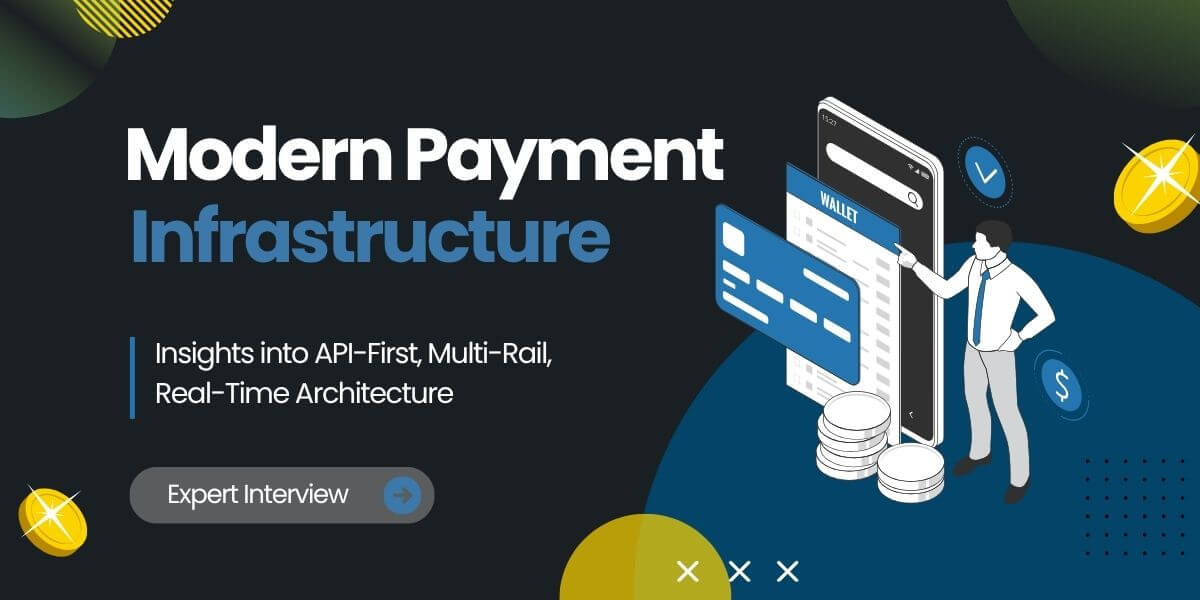
Expert Interview: Romeo Ju, CEO of Bancoli, the most comprehensive global B2B payments platform
The CEO of Bancoli discusses API-first architecture, multi-rail orchestration, and the future of developer-friendly financial platforms
 Traditional banking infrastructure is being challenged by real-time, API-driven payment platforms. Legacy systems built decades ago struggle to support the speed, transparency, and multi-currency capabilities modern businesses require.
We sat down with Romeo Ju, CEO of Bancoli, the most comprehensive global B2B payments platform, to discuss how payment infrastructure is evolving. Bancoli supports a wide range of payment rails, including ACH, SWIFT, local rails in 70+ countries, and stablecoins like USDC, making it a flexible option for businesses that need scalable global payment systems.
At Keyhole Software, we work with organizations building complex, distributed systems where payments, integrations, and external dependencies introduce real architectural challenges. Payment platforms like Bancoli are advancing payment infrastructure, and engineering teams need to evaluate how these capabilities fit within their broader system design, especially when it comes to scalability, observability, failure handling, and long-term maintainability.
For software architects and engineers building the next generation of financial products, this conversation shares insights on payment orchestration, real-time tracking, developer-friendly APIs, and what it takes to design resilient, scalable global payment systems.
Why This Matters For Engineering Teams
Supporting different payment networks, currencies, and compliance requirements within a internally-developed is not a simple integration problem. It introduces architectural complexity that must be designed and implemented thoughtfully from the start. Each payment network operates differently, creating challenges around consistency, failure handling, and orchestration across systems.
In practice, these systems often need to integrate with existing payment processors or billing platforms, which introduces additional complexity around orchestration, data consistency, and system boundaries.
This is one of the reasons some organizations choose to leverage external payment platforms to abstract that complexity, while others opt to build and maintain these capabilities in house depending on their requirements. In either case, these decisions directly impact system reliability, cost, and operational overhead, making them critical to get right early.
Q: From a systems engineering perspective, what are the core technical challenges in building a global payments platform that legacy banking infrastructure simply can’t solve?
Romeo Ju: Legacy banking wasn’t built for a real-time, global economy. It’s fragmented, slow, and lacks transparency, especially when businesses need to track payments or understand true costs across borders.
At Bancoli, we’ve rebuilt that experience to be faster, more transparent, and easier to use. Businesses get real-time visibility into every transaction, clear pricing with zero hidden fees, and the ability to move money across multiple payment rails all in one place.
We also focus heavily on cost and accessibility. Bancoli is designed to deliver the lowest-cost international transfers with local payout methods and zero FX markups across 40+ currencies, and makes it easy for non-US businesses to open and operate USD accounts without needing to come to the US.
Ultimately, the goal is to replace a fragmented system with a single, unified platform. Bancoli brings together banking, payments, and multi-currency infrastructure so businesses can operate globally without the complexity of legacy systems.
Q: Keyhole’s audience builds complex software systems. What does it take architecturally to support multiple payment rails like ACH, SWIFT, local rails, and stablecoins in a single platform?
Romeo Ju: The challenge is that every payment rail works differently. Some are slower and batch-based like ACH, others are real-time like local rails, and stablecoins introduce a completely different model.
At Bancoli, we abstract that complexity behind a unified platform. We connect to multiple rails behind the scenes and give businesses a single platform to send and receive payments globally, without needing to manage each system individually.
We handle the compliance, routing, and operational details in the background, so businesses can focus on moving money in the most efficient way based on speed, cost, and destination.
We have native integrations for more rails than anyone else: SWIFT, ACH, local payment rails in 70+ countries, and stablecoins like USDC. Developers get a single API that abstracts away managing dozens of banking relationships, shifting that complexity out of the application layer and into the platform.
Q: APIs are at the center of modern platforms. What are the technical considerations when building payment APIs that need to handle compliance, multi-currency conversion, and high-throughput processing?
Romeo Ju: Payment infrastructure needs to be both highly reliable and easy for businesses to use. From a systems perspective, the key considerations include correctness and reliability, compliance, multi-currency handling, and scalability. In practice, that means designing systems that process payments accurately, prevent duplicates, and behave consistently at scale, so teams integrating with the platform don’t have to manage those concerns themselves.
Compliance is another core consideration. It is built directly into the platform. Every transaction is checked in real time, so businesses can operate globally without managing complex regulatory requirements themselves.
Multi-currency is another critical piece. Bancoli supports 40+ currencies with full transparency, showing exact exchange rates and delivering zero FX markups, which helps businesses significantly reduce the cost of international payments.
Scalability is equally important. As companies grow, the platform needs to scale with them. Whether it’s a handful of transactions or high-volume payment flows, Bancoli is designed to handle that seamlessly across multiple payment rails.
Ultimately, the goal is to provide visibility, reliability, and control across global payment flows so businesses can operate without the friction of traditional banking.
Keyhole Perspective:
From an engineering standpoint, building APIs for financial systems requires balancing ease of integration with strict guarantees around idempotency, consistency, and error handling. These are not edge cases, they’re core requirements in systems where duplicate transactions, partial failures, or timing issues can have real financial impact.
In practice, this also means designing APIs with clear contracts, predictable behavior, and strong observability so teams can integrate and operate these systems reliably at scale. Patterns like event driven processing, retry strategies, and idempotent operations become critical as complexity increases.
Q: Real-time visibility is a major challenge in payments. What’s your technical approach to payment tracking, event notifications, and providing transparency across complex payment flows?
Romeo Ju: We treat payments as state machines with clearly defined transitions. Every state change generates an event published to our event bus, triggering webhooks to subscribed clients. Developers can subscribe to specific event types and receive instant notifications. Bancoli offers the best real-time payment tracking because we’ve instrumented every step and integrated directly with payment networks.
Transparency includes cost visibility. Before confirming a transaction, our API returns a detailed quote showing exact exchange rates, network fees, and estimated delivery time with zero hidden charges and zero FX markups.
For complex flows, we provide detailed audit trails logging every API call, state transition, and fee charged. We also built payment acceleration features: fast payment checkout with one-click embedded options and automatic buyer rewards that incentivize on-time payments, plus instant local payouts worldwide through our network of local rails.
Keyhole Perspective:
Event driven approaches like this can significantly improve system responsiveness and visibility, but they also introduce complexity around event ordering, failure recovery, and consistency. These are challenges we see frequently in enterprise systems and need to be intentionally managed through thoughtful architecture and strong observability practices.
When designed well, event driven systems can also support the level of auditability and traceability required in regulated environments by providing a clear record of state transitions and system interactions.
Q: Looking ahead, what technical capabilities or architectural decisions should engineers prioritize when building the next generation of global financial platforms?
Romeo Ju: Design for global, multi-currency operations from day one. That’s how Bancoli delivers one of the most flexible multi-currency wallets, with zero-fee transfers in 40+ currencies and full visibility into exchange rates with no FX markups.
Embrace composability through APIs. Every capability should be programmatic so businesses can embed payments directly into their workflows. At the same time, think beyond single-rail solutions. The global payment landscape is fragmented, so supporting multiple rails is critical. Bancoli brings together ACH, SWIFT, local rails in 70+ countries, and stablecoins like USDC into a single platform, giving businesses the most flexible global payout options through one integration.
Compliance and security also need to be built in early. Businesses shouldn’t have to piece that together themselves, so we handle verification, safeguards, and auditability directly within the platform.
Finally, design for completeness. Businesses don’t want five different vendors to manage payments, invoicing, and cash flow. Bancoli brings all of that into one platform, combining banking, payments, invoicing, and rewards into a single invoice-to-cash solution that reduces cost, simplifies operations, and scales with the business.
Keyhole Perspective:
From an architecture standpoint, this reflects a broader trend we’re seeing across enterprise systems: abstracting complex external dependencies behind unified APIs. While this simplifies the developer experience, it also shifts responsibility toward platform design, observability, and failure handling. In practice, this means teams need to design for resiliency, manage partial failures across external systems, and ensure visibility into how requests flow through the platform end to end.
Key Takeaways for Engineering Leaders
- Payment infrastructure is becoming a core part of platform architecture, not just a downstream integration
- Supporting multiple payment rails introduces complexity that must be intentionally abstracted and managed
- Real time visibility and event driven design are becoming standard expectations in modern payment systems
- API design, compliance, and scalability need to be considered together from the start, not as separate concerns
- As organizations modernize, payment orchestration is increasingly intersecting with broader platform engineering and system design decisions
About Bancoli: Bancoli is a global B2B payments platform, trusted by businesses and freelancers worldwide for multi-currency accounts, cross-border payments, and invoice-to-cash automation. With bank-level security, US-regulated banking, and support for 40+ currencies across more payment rails than any competitor, Bancoli delivers the lowest-cost, most transparent solution for global financial operations.
More From Keyhole Software
About Keyhole Software
Expert team of software developer consultants solving complex software challenges for U.S. clients.
Share This Post
Join The Thousands Of Devs Who Subscribe
Discuss This Article
Subscribe
Login
0 Comments
Oldest