
Java Trends of 2026: Market Position, Enterprise Adoption, Version Distribution, and the AI Acceleration Angle
Java remains one of the most widely used enterprise programming languages in the world. As organizations continue modernizing applications, adopting AI capabilities, and upgrading to newer Java LTS releases, understanding the latest Java trends and statistics has become increasingly important for technology leaders and development teams.
To understand the state of the Java ecosystem in 2026, we analyzed data from leading industry sources, including the TIOBE Index, Stack Overflow Developer Survey, JetBrains Developer Ecosystem Report, Azul State of Java surveys, GitHub Octoverse, RedMonk, PYPL, Oracle, and the Spring project team. The data collected from January through May 2026 shows that Java entered 2026 ranked #3 on the TIOBE Index1, while 62% of enterprises now use Java to support AI functionality and 81% are migrating all or part of their Oracle Java environments to OpenJDK distributions8.
Together, these trends provide a clear picture of Java enterprise adoption, Java version adoption, Spring Boot trends, and the evolving role of Java in AI-powered software development.
Java Trends Covered in This Report
- Java market position and ranking across major indices
- Enterprise vertical adoption by industry
- Java version distribution and LTS adoption rates
- Framework landscape: Spring Boot, Quarkus, Micronaut, Helidon
- Java vs. competing enterprise languages
- Java in AI/ML development and the LLM integration layer
- Runtime performance and language evolution
- Developer tooling, IDEs, and JDK distribution market shifts
How Keyhole Software Uses These Statistics
Keyhole Software has been a Java consultancy since 2008. As a U.S.-based custom software and consulting firm with senior consultants averaging 17+ years of experience, Java is a foundational skill across our engineering team. We use Java ecosystem data to advise CTOs and engineering leaders on version upgrade strategy, framework selection, modernization sequencing, and how to integrate AI tooling into Java delivery workflows without compromising governance.
The statistics in this report reflect the conditions we encounter in active Java engagements across financial services, insurance, healthcare, manufacturing, and transportation. Where the data points to a trend (rising Java 21 adoption, the Spring 7 transition, AI-augmented Java development), we explain how that trend shows up in real engineering decisions and what teams should consider when planning their next step.
Java’s Market Position in 2026
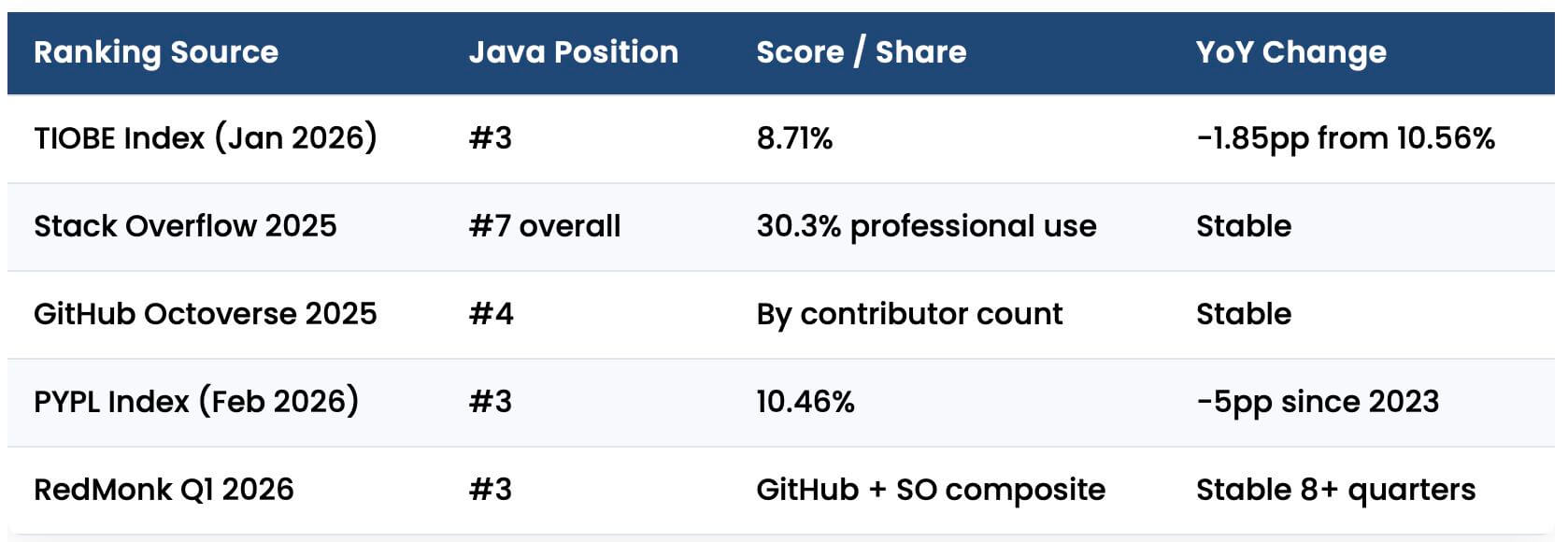
Java’s position depends on what is being measured. Different rankings use different methodologies, which means Java’s apparent standing can vary by 5 to 10 positions across major indices. The table below summarizes Java’s current placement across the most-cited rankings.
| Ranking Source | Java Position | Score / Share | YoY Change |
|---|---|---|---|
| TIOBE Index (Jan 2026) | #3 | 8.71% | -1.85pp from 10.56% |
| Stack Overflow 2025 | #7 overall | 30.3% professional use | Stable |
| GitHub Octoverse 2025 | #4 | By contributor count | Stable |
| PYPL Index (Feb 2026) | #3 | 10.46% | -5pp since 2023 |
| RedMonk Q1 2026 | #3 | GitHub + SO composite | Stable 8+ quarters |
Key Findings
- Java ranked #3 in the TIOBE Index in January 2026 at 8.71%, behind Python (22.61%) and C (10.99%) and just ahead of C++ (8.67%).1
- In the Stack Overflow 2025 Developer Survey, roughly 30% of professional developers reported using Java in the past year3, placing it firmly in the top tier of professional-use languages.
- Java’s Stack Overflow “admired” rating is 47.6%, but only 17.9% of developers report wanting to work with it3, reflecting a sentiment gap between Java’s broad use and developer preferences for modern alternatives.
- C# was named TIOBE’s 2025 Programming Language of the Year and is closing the gap with Java in business software1, but Java’s incumbent enterprise install base continues to provide strong staying power.
In Practice
The sentiment gap between Java’s use (broad) and developer preference (more modest) is something we see directly in client engagements. In financial services, insurance, and government, Java is not chosen because developers prefer it. It is chosen because the existing platform, the available talent pool, and the regulatory environment make it the lowest-risk option.
The 47.6% admiration / 17.9% desire spread reflects that reality: developers respect what Java does at enterprise scale, even if many would prefer to work in newer languages on greenfield projects.
Where the language perception is changing is among teams that have moved from Java 8 or 11 to Java 17 or 21. Modern Java reads materially differently from Java 8. Records, pattern matching, virtual threads, and the broader language evolution since 2017 have closed a real productivity gap. In our engagements, teams that complete a version upgrade often report shifted attitudes within months, particularly engineers who had not worked in Java since the 8 era.
Strategic takeaway: Java’s enterprise position in 2026 is durable, but the developer experience is materially different on modern LTS versions than on Java 8. Organizations on legacy Java versions are getting the worst of both worlds: enterprise constraints with none of the modern productivity gains. The fastest way to improve Java team velocity is often a version upgrade, not a language change.
Enterprise Vertical Adoption
Java’s enterprise footprint is concentrated in industries where reliability, regulatory compliance, and operational continuity outweigh language fashion. Azul’s 2025 State of Java Survey found that 99% of surveyed organizations actively use Java, and nearly 70% of respondents reported that more than half of their applications are built with Java or run on a Java Virtual Machine.
| Industry Vertical | Java Reliance | Primary Use Cases |
|---|---|---|
| Financial Services | Very high | Core banking, trading systems, fraud detection, regulatory reporting |
| Insurance | Very high | Policy administration, claims management, actuarial systems |
| Healthcare | High | EHR platforms, clinical decision support, HL7/FHIR integration |
| Government / Public Sector | High | Citizen-facing portals, benefits systems, tax processing |
| E-commerce and Retail | Moderate-high | Order management, inventory, payment processing |
| Telecommunications | High | Billing systems, network management, customer service platforms |
Key Findings
- Azul’s 2025 State of Java Survey found 99% of surveyed organizations actively use Java, and nearly 70% reported that more than half of their applications are built with Java or run on the JVM.2
- Financial services and insurance remain Java’s deepest enterprise verticals, with core systems for trading, banking, claims processing, and policy administration overwhelmingly running on the JVM.
- Healthcare uses Java extensively for EHR backends, HL7/FHIR integration layers, and clinical decision support systems, often alongside Python for ML and analytics workloads.
- Azul’s 2026 survey found 62% of enterprises now use Java to power AI functionality.8 While Python remains dominant for rapid prototyping and model building, enterprises rely on Java to run AI in production due to scalability, stability, and security characteristics.
In Practice
In our work across financial services, insurance, and healthcare, Java’s position is structural, not preferential. The systems already exist in Java, the integration surfaces are Java, the operational tooling is built around the JVM, and the available enterprise engineering talent is Java-fluent. Rewriting these systems in another language is rarely the right answer. Modernization, version upgrades, and architectural refactoring within the Java ecosystem produce better outcomes at lower risk. This pattern is reflected in our legacy system modernization work, where Java is very often the target language for systems migrating from COBOL, older .NET versions, or legacy proprietary platforms.
Financial services organizations continue investing heavily in Java-based modernization. One investment management firm partnered with Keyhole to migrate legacy applications to Spring Boot microservices, modernize web applications with React, and prepare workloads for cloud deployment. The client has continued expanding the engagement over time, reflecting the ongoing role of Java in mission-critical financial systems.
Strategic takeaway: For enterprise organizations evaluating language strategy, the productive question is rarely “Should we move off Java?” The more productive question is “Are we using modern Java?” Teams running on Java 8 or 11 with older Spring versions are leaving real productivity and performance gains unclaimed. Teams on Java 17 or 21 with modern Spring are positioned well for AI-augmented development workflows and cloud-native architectures.
Java Version Distribution and LTS Adoption
Java version distribution shifted meaningfully between 2023 and 2026. Azul’s 2026 State of Java Survey, administered by Dimensional Research across 2,039 qualified respondents from five continents, is the most-cited primary source for enterprise Java version data.8 The 2025 report documented a notable shift: Java 17 dropped from 48% adoption in 2024 to 34% in 2025, largely because Oracle ended free support for Java 17 for commercial use in September 2024. Java 21 reached 31% adoption within roughly 18 months of release. The table below summarizes the current distribution.
| Java Version | 2025 Adoption | 2024 | 2023 | YoY Change |
|---|---|---|---|---|
| Java 17 (LTS) | 34% | 48% | 35% | -14pp |
| Java 21 (LTS) | 31% | 8% | N/A | +23pp |
| Java 8 | 23% | 32% | 40% | -9pp |
| Java 11 (LTS) | 15% | 22% | 29% | -7pp |
| Java 25 (LTS) | Not yet measured | N/A | N/A | Released Sept 2025 |
| Non-LTS (18-24) | <10% | <10% | <8% | Transitional |
Key Findings
- Java 17 LTS adoption dropped from 48% (2024) to 34% (2025) per Azul’s State of Java Survey2, largely driven by Oracle ending free support for Java 17 commercial use in September 2024, prompting migration to Java 21 or non-Oracle distributions.
- Java 21 LTS adoption reached 31% in the same Azul survey2, reflecting one of the fastest LTS adoption curves in Java history.
- Java 8 usage dropped from 40% in 2023 to 23% in 2025 per Azul.2 Java 8 reached end of premier support in March 2022 and is now in extended support phase, with most vendors providing security updates through 2026-2030.
- Java 25 LTS released in September 2025 with day-one IntelliJ IDEA support and is the recommended baseline for new projects that want the longest LTS runway. Spring Framework 7 supports Java 17+ but unlocks full feature benefit on Java 21 or 25.
In Practice
In our modernization engagements, the Java 8 to Java 17 or 21 upgrade is one of the highest-ROI investments enterprise teams can make.
The blockers are rarely technical. Modern Java is highly backward-compatible, and most well-architected Java 8 codebases run on Java 17 with limited changes. The blockers are typically dependency-driven: legacy libraries that have not been updated, Spring versions that pin to older Java baselines, or build infrastructure that was set up for Java 8 and never modernized.
The fastest path through these blockers is to address them in dependency order: upgrade Spring (Boot 2 to Boot 3 to Boot 4), upgrade core libraries to current versions, then upgrade Java. Trying to upgrade Java first and chase dependency compatibility downstream usually takes longer and produces more rework than the dependency-first approach. We have run multiple engagements where this sequencing alone reduced upgrade timelines by months.
For teams already on Java 17, the move to Java 21 typically delivers the largest practical benefit: virtual threads alone can replace meaningful amounts of reactive complexity for I/O-bound services, simplifying codebases that had been written to work around Java’s prior thread-per-request limits.
Modernization efforts are not always limited to upgrading existing Java applications. In some cases, organizations use modernization initiatives to move from legacy platforms to Java altogether. One financial institution partnered with Keyhole across multiple phases from 2011 to 2025, modernizing COBOL-based batch processing with Spring Batch and continuing to invest in the platform for more than a decade thus far. The engagement highlights Java’s enduring role as a target platform for long-term enterprise modernization strategies.
Strategic takeaway: Java version upgrades are no longer optional infrastructure work. They are competitive infrastructure work. Teams on Java 17 or 21 with Spring Boot 3 or 4 are positioned for AI-augmented development, cloud-native architectures, and modern observability patterns. Teams on Java 8 with older Spring versions are increasingly constrained by the gap between what their stack supports and what modern tooling assumes.
Recommended Next Steps by Current Java Version
The right modernization path depends on where your team is starting from. The table below maps recommended next steps based on current Java version, Spring version, and organizational context.
| Your Current Stack | Recommended Next Step | Key Benefit | Typical Timeline |
|---|---|---|---|
| Java 8 + Spring Boot 1.x or 2.x | Upgrade to Java 17 + Spring Boot 3 | Unlocks Jakarta EE, modern security patches, Spring ecosystem compatibility; prerequisite for any further modernization | 3 to 6 months (dependency-first sequencing) |
| Java 8 + non-Spring (legacy frameworks) | Migrate to Java 17 + Spring Boot 3 or evaluate Quarkus | Modernizes both language and framework in one pass; reduces long-term maintenance burden | 6 to 12 months (framework migration adds scope) |
| Java 11 + Spring Boot 2.x | Upgrade to Java 17 + Spring Boot 3 | Smoother than Java 8 path; fewer dependency blockers; positions for Boot 4 upgrade next | 2 to 4 months |
| Java 17 + Spring Boot 3.x | Upgrade to Java 21 + evaluate Spring Boot 4 | Virtual threads replace reactive complexity; pattern matching improves code clarity; full Spring 7 feature access | 1 to 3 months (largely a version bump) |
| Java 21 + Spring Boot 3.x or 4.x | Adopt AI-augmented development tooling; evaluate Spring AI / LangChain4j for AI integration | Already on modern stack; focus shifts to productivity tooling and AI integration patterns | Ongoing (no version migration needed) |
| Java 25 + Spring Boot 4.x | Optimize: adopt virtual threads broadly, integrate Project Leyden AOT, standardize AI-assisted workflows | Longest LTS runway; newest language features; positioned for next 3 to 5 years | Incremental adoption |
Recommendations based on Keyhole’s enterprise modernization experience across financial services, insurance, healthcare, and manufacturing engagements.
Framework Landscape: Spring Boot, Quarkus, Micronaut, Helidon
Spring Boot remains the dominant enterprise Java framework in 2026, with Spring Boot 4.0 GA shipping in November 2025.9 Quarkus, Micronaut, and Helidon have carved out specialized positions around cloud-native deployment, fast startup, and Kubernetes integration. Spring AI reached 1.0 GA on May 20, 2025, providing official Spring abstractions for LLM integration.10 The table below summarizes the framework landscape.
| Framework | Market Position | Java Baseline | Key Differentiator |
|---|---|---|---|
| Spring Boot | ~60% of enterprise Java apps | Boot 3: Java 17+; Boot 4: Java 21 recommended | Broadest ecosystem; largest community; 14.7% of all web frameworks (SO 2025) |
| Quarkus (Red Hat) | Growing alternative | Java 17+ | Kubernetes-native; 12 ms native startup via GraalVM |
| Micronaut | Niche | Java 17+ | Compile-time DI; low memory; cloud-function friendly |
| Helidon (Oracle) | Specialized | Java 21+ | Built on Virtual Threads; reactive and MicroProfile variants |
Key Findings
- Spring Boot 4.0 GA shipped in November 2025 on a Spring Framework 7 baseline.9 Spring 7 adopts JSpecify annotations for null safety, deeper Project Leyden integration, and stronger Virtual Threads support, with full benefit on Java 21+.
- Spring AI reached 1.0 GA on May 20, 202510, providing official Spring abstractions for chat models, embeddings, vector stores, and structured output, and accelerating Java’s position as a viable backend for AI-augmented enterprise applications.
- Quarkus has established itself as the strongest alternative for Kubernetes-native Java workloads, with fast startup via GraalVM native compilation and a Red Hat-backed enterprise support path.
- Micronaut and Helidon occupy smaller niches, with Micronaut favored for compile-time DI and serverless-friendly patterns, and Helidon Nima notable for being built on Virtual Threads from inception.
In Practice
In our enterprise engagements, Spring Boot is often the default choice for new Java work unless there is a specific reason to choose otherwise. Spring’s ecosystem depth, integration breadth, and modernization-friendly architecture make it the lowest-risk option for most enterprise scenarios.
For example, Keyhole partnered with a national manufacturing organization on a modernization effort that replaced spreadsheet-driven production and order-management workflows with Spring Boot-based applications and automation. What began as a targeted initiative has been extended multiple times over more than 2.5 years as the platform continued to evolve and deliver measurable operational improvements.
Quarkus comes into the conversation when workloads need extremely fast startup (sub-second, often serverless), when GraalVM native compilation is a hard requirement, or when the organization is already standardized on Red Hat tooling.
The Spring 6 to Spring 7 transition (or Boot 3 to Boot 4) is the next major upgrade most enterprise teams will face. Spring 7 brings real benefits: JSpecify null safety, deeper Java 21 integration, and a cleaner story for AOT compilation via Project Leyden. The upgrade path is meaningfully smoother than the Boot 2 to Boot 3 transition (which required Jakarta EE migration). For teams already on Boot 3 and Java 17+, the Boot 4 upgrade is largely a version bump with feature unlocks, not a structural rewrite.
Strategic takeaway: For most enterprise Java teams, Spring Boot 4 on Java 21 is the right baseline for new work in 2026. Teams choosing alternatives should have specific requirements (sub-second startup, native compilation, cloud-function deployment) that justify the smaller ecosystem and narrower talent pool. The default choice is durable for good reason.
Java vs. Competing Enterprise Languages
Java’s primary competitors vary by use case. C# is the closest direct enterprise competitor. Python competes complementarily in AI/ML workloads. Kotlin competes on the JVM. Go and Rust compete in specific architectural niches.
The table below summarizes 2026 positioning based on the Stack Overflow 2025 Developer Survey and TIOBE rankings.
| Language | Pro Use (SO 2025) | TIOBE (Jan 2026) | Where It Competes With Java |
|---|---|---|---|
| Java | 30.3% | #3 / 8.71% | Reference point |
| C# | 27.5% | #5 / 6.78% (+1.82pp) | Closest direct competitor; 2025 Language of the Year |
| Python | 57.8% | #1 / 22.61% | Complementary in AI/ML; rare direct replacement |
| Kotlin | 9.4% | #19 / 1.43% | Incremental JVM adoption; interoperates with Java |
| Go | 14.1% | #8 / 2.18% | New microservices, not replacing existing Java |
| Rust | 12.8% | #18 / 1.44% | Most-admired (72-82%); selective, not general replacement |
Key Findings
- C# is Java’s closest direct competitor in enterprise business software. TIOBE named C# 2025 Programming Language of the Year1, and Microsoft’s open-sourcing and cross-platform investments continue to narrow the historical Java-C# gap.
- Python at 58% professional use per Stack Overflow3 is rarely a direct Java replacement in enterprise contexts. The two languages most often coexist, with Java anchoring transactional systems and Python anchoring data, ML, and automation workloads.
- Kotlin‘s JVM compatibility allows incremental adoption without rewriting Java code. Kotlin is gaining ground in Android and modern backend work but rarely displaces established Java enterprise systems.
- Go and Rust appear most often in new microservices, cloud infrastructure, and performance-critical paths rather than as replacements for established Java systems. Rust holds the highest “most-admired” rating at 72% to 82% across surveys3 but is used selectively rather than broadly.
In Practice
In our enterprise client engagements, language replacement decisions are dominated by integration and operational realities, not language fashion. A core banking system written in Java cannot be replaced by Go without rewriting decades of integration, operational tooling, and team expertise.
What does happen, frequently, is that new components get written in a different language: a new microservice in Go, a new ML pipeline in Python, a new mobile backend in Kotlin. The Java core persists, and the surrounding architecture diversifies.
The polyglot architecture pattern is the practical reality of 2026 enterprise Java. Java handles the transactional core. Python handles ML and data engineering. JavaScript or TypeScript handles the frontend. Go or Rust handles specific cloud infrastructure or performance-critical workloads. The architectural decision is not which language wins but how each language is sequenced into the overall system.
Strategic takeaway: For enterprise architects, the competing-languages question is less about replacing Java than about which workloads should sit alongside Java in a polyglot architecture. Teams that try to standardize on a single language across all workloads tend to make compromises in at least one direction. Teams that match language to workload typically produce stronger architectures, with Java anchoring the parts of the system that benefit most from Java’s strengths.
Java in AI and ML Development
Java’s role in AI is no longer a footnote. Azul’s 2026 State of Java Survey found 62% of enterprises now use Java to power AI functionality.8 The combination of LangChain4j, Spring AI 1.0 (released May 20, 2025)10, Deep Java Library, and the maturing AI-assisted development tooling has made Java a viable backend for LLM-integrated enterprise applications.
The table below summarizes the most-relevant Java AI/ML libraries and patterns in 2026.
| Library / Pattern | Role in Java AI/ML Development |
|---|---|
| LangChain4j | Most-adopted Java LLM integration library; supports OpenAI, Claude, Azure OpenAI, Bedrock, Vertex; active 2024-2026. |
| Spring AI (1.0 GA, May 2025) | Official Spring abstractions for chat models, embeddings, vector stores, structured output. |
| Deep Java Library (DJL) | Amazon-backed deep learning for Java; PyTorch, TensorFlow, MXNet backends; JVM-native inference. |
| RAG on JVM | Java apps retrieving from vector stores (pgvector, Weaviate, Pinecone) and composing LLM prompts. |
| Polyglot service patterns | Java backends calling Python ML inference endpoints; 31% of enterprises report >50% of Java apps now contain AI. |
| AI-assisted Java development | Java devs using AI tools: ChatGPT 58%, Gemini 51%, Amazon Q 32%, Claude 31% (Azul 2026). |
Key Findings
- Azul’s 2026 State of Java Survey found 62% of enterprises now use Java to power AI functionality.8 Enterprises rely on Java to run AI in production due to scalability, stability, and security characteristics, while Python remains dominant for prototyping and model building.
- Spring AI reached 1.0 GA on May 20, 202510, providing official Spring abstractions for chat models, embeddings, vector stores, and structured output, and positioning Spring as the default enterprise AI integration framework on the JVM.
- LangChain4j has emerged as the most-adopted LLM integration library for Java, supporting OpenAI, Anthropic Claude, Azure OpenAI, AWS Bedrock, and Google Vertex behind a consistent Java API.
- Java developers report using ChatGPT (58%), Gemini (51%), Amazon Q (32%), and Claude (31%) for code generation and refactoring per Azul’s 2026 survey.8 AI-assisted Java development is now standard practice rather than experimental.
In Practice
Keyhole’s work in AI-accelerated development, RAG architecture, and agentic AI software development reflects a clear pattern in 2026: Java is increasingly the deployment language for enterprise AI applications, with Python continuing to dominate model training and data science. The split is durable. Python’s ML library ecosystem remains unmatched. Java’s enterprise integration, transactional reliability, and operational tooling remain unmatched. The right architecture uses both.
As part of the Anthropic partner ecosystem, we have applied AI-assisted Java development across modernization engagements, including a COBOL-to-Spring-Batch migration where Keyhole consultants applied agentic agents accelerated code analysis and conversion under senior architectural oversight. Manual development effort dropped roughly 20 to 30% while business-logic validation was preserved throughout.
The pattern that makes these outcomes work is the same pattern that applies to LLM integration in production Java applications: AI accelerates the mechanical layers, and senior engineering governs the architectural and business-logic decisions AI cannot reliably make.
Strategic takeaway: Java’s place in AI is not in Python’s territory. It is alongside Python, anchoring enterprise integration and deployment while Python anchors training and data science. For enterprise architects, the right question is not whether Java can compete with Python in AI but how to integrate Java-based AI applications into existing enterprise architectures using LangChain4j, Spring AI, and the broader Java AI library ecosystem.
Runtime Performance and Language Evolution
Java’s runtime improvements between 2021 and 2026 are among the most significant in the language’s history. Virtual threads, low-latency garbage collection, pattern matching, and ahead-of-time compilation have closed real gaps with newer languages.
The table below summarizes the runtime improvements most relevant to 2026 architectural decisions.
| Runtime Improvement | Impact and 2026 Status |
|---|---|
| Virtual Threads (Project Loom) | GA in Java 21; ~1 KB stack per thread vs ~1 MB for platform threads; millions of concurrent threads; replaces reactive complexity for I/O-bound services. |
| Pattern Matching | Switch expressions, sealed classes, records, primitive patterns; baseline for modern Java code (JDK 16-21). |
| Generational ZGC | Sub-millisecond GC pauses even on multi-TB heaps; production-ready from Java 21; reduces GC tuning complexity. |
| GraalVM Native Image | AOT compilation; 10-50 ms startup (vs 1-5 sec JVM); 2-5x lower memory; Oracle detached GraalVM from Java SE in 2025. |
| Project Leyden | JDK-native AOT targeting 2-3x faster startup; Spring 7 includes Leyden support for Java 21+. |
| Project Valhalla (in progress) | Value types and primitive classes; targets eliminating object overhead; not yet in production. |
Key Findings
- Virtual threads (Project Loom) shipped in Java 21 LTS11 and replace much of the complexity reactive frameworks were introduced to solve, particularly for I/O-bound services that previously needed thread-per-request workarounds.
- Generational ZGC delivers sub-millisecond GC pause times in production from Java 21, reducing tuning complexity for applications with large heaps.
- Project Leyden’s AOT compilation work, integrated into Spring 7, targets the startup and warmup gaps that historically favored alternatives like Go or Quarkus with GraalVM native image.
- Oracle detached GraalVM from the Oracle Java SE product line with GraalVM for JDK 24 as the final release in the bundle, an organizational change with downstream implications for native-image users.
In Practice
In our engagements, the runtime improvements are reshaping architectural conversations. Teams previously committed to reactive frameworks (WebFlux, Project Reactor) are revisiting whether the complexity is still justified now that virtual threads provide much of the same concurrency benefit with imperative code. Teams considering Go for new microservices to get fast startup are revisiting Java with GraalVM native image or Project Leyden AOT now that startup gaps have narrowed.
The practical implication: language-choice conversations that ended in 2018 are worth reopening in 2026. The Java arguments against reactive complexity, slow startup, and verbose syntax are materially weaker now. Teams that left Java for runtime reasons should reassess whether those reasons still hold on modern LTS versions before committing to new platform investments.
Strategic takeaway: Java’s runtime story in 2026 is dramatically different from Java’s runtime story in 2018. Architects making language and framework decisions on assumptions from the Java 8 or 11 era are operating on stale data. The modern JVM competes credibly on dimensions (startup time, concurrency, GC pauses) where it was historically weak. Decisions to move off Java for runtime reasons should be retested against the current runtime.
Developer Tooling and JDK Distribution
The Java tooling ecosystem in 2026 looks materially different from five years ago. Oracle JDK’s market share fell sharply as open-source distributions consolidated. Azul’s 2026 State of Java Survey found 81% of enterprises migrating all or part of their Oracle Java estates to non-Oracle OpenJDK distributions, with 92% expressing concern about Oracle Java pricing.8 IntelliJ IDEA remains the dominant Java IDE but VS Code is growing.
The table below summarizes the current tooling and JDK distribution landscape.
| Tool / Category | 2025 Share | YoY Change |
|---|---|---|
| IntelliJ IDEA | 84% of Java devs | +13pp from 71% (2024) |
| VS Code (Java extensions) | 31% | Overtook Eclipse for first time |
| Eclipse | 28% | -11pp from 39% (2024) |
| Maven | 52% | Stable; slight decline |
| Gradle | 48% | Near parity with Maven; growing |
| Oracle JDK | ~21% of JDK deployments | Down from 75% (2020) |
What this means: The Java tooling ecosystem has consolidated around modern, often open-source options. IntelliJ IDEA dominates Java IDE share with day-one support for new language versions. Maven and Gradle split the build-tool space. Oracle JDK’s market share collapse reflects how completely open-source JDK distributions (Eclipse Temurin, Amazon Corretto, Microsoft OpenJDK, Azul Zulu) have replaced Oracle as the default for enterprise Java deployment.
Key Findings
- IntelliJ IDEA remains the dominant Java IDE, with day-one support for new Java versions (including Java 25) and integrated AI assistance through JetBrains’ Junie agent.
- VS Code with Microsoft’s Java extension pack has grown rapidly for lightweight Java work and is increasingly common in AI-augmented development workflows where Copilot and Claude integrations are tightly integrated.
- Azul’s 2026 survey found 81% of enterprises migrating Oracle Java estates to non-Oracle OpenJDK distributions, and 92% concerned about Oracle Java pricing.8
- Maven remains the most-used build tool in established enterprise environments, while Gradle (now at version 9.0+ with Java 17+ baseline) is preferred in newer projects and Android development.
In Practice
The Oracle-to-open-source JDK shift has had a practical impact on enterprise Java deployments we work with. Most enterprise clients now run on Eclipse Temurin or Amazon Corretto in production rather than Oracle JDK, primarily for license-cost reasons but also because the open-source distributions ship coordinated quarterly security updates for JDK 8 through JDK 25 alongside Oracle’s. The functional differences between open-source and Oracle distributions are minimal for most enterprise workloads.
Tooling decisions follow team preference more than enterprise mandate in most engagements. IntelliJ IDEA is the default for Java work where licensing allows.
VS Code is increasingly the choice for engineers who move between Java and other languages, which is why many Keyhole Software consultants prefer it. Maven and Gradle coexist in many large enterprise environments, with new projects often defaulting to Gradle and legacy projects staying on Maven.
Strategic takeaway: Tooling and JDK distribution choices in 2026 are increasingly low-stakes decisions compared to language and framework choices. The functional differences across modern distributions and IDEs are small. The high-stakes decisions are Java version, framework version, and how AI tooling integrates with the development workflow. Tooling should follow team preference; the architectural decisions deserve the strategic attention.
Need Help Translating Java Trends Into a Development or Modernization Strategy?
The Java trends and statistics highlighted in this report point to a common theme: organizations that proactively modernize their Java platforms are better positioned to improve developer productivity, accelerate cloud adoption, integrate AI capabilities, and reduce long-term technical debt.
Whether you’re planning a Java version upgrade, Spring Boot migration, legacy application modernization initiative, or enterprise AI integration strategy, the decisions you make today will influence your architecture for years to come.
Keyhole Software helps enterprise teams modernize Java applications, upgrade Spring frameworks, adopt cloud-native architectures, and integrate technologies such as LangChain4j and Spring AI without disrupting critical business systems. Our 100% U.S.-based senior consultants average 17+ years of experience and have been delivering enterprise Java solutions since 2008.
Ready to discuss your Java modernization roadmap? Contact a Java expert at Keyhole Software.
References
1. ADTmag. “Java Holds No 3 in Tiobe Index as C# Wins 2025 Programming Language of the Year.” Available at: https://adtmag.com/articles/2026/01/07/tiobe-language-rankings-for-2025.aspx. January 2026. TIOBE Index data sourced from TIOBE January 2026 release.
2. Azul. “2025 State of Java Survey & Report: 88% of Enterprises Consider Leaving Oracle Java for Alternatives.” Available at: https://www.azul.com/state-of-java-2025/. Survey administered by Dimensional Research; published January 28, 2025.
3. Stack Overflow. “2025 Developer Survey.” Available at: https://survey.stackoverflow.co/2025/. Approximately 49,000+ respondents from 177 countries. 2025.
4. GitHub. “GitHub Octoverse 2025.” Available at: https://github.blog/news-insights/octoverse/octoverse-a-new-developer-joins-github-every-second-as-ai-leads-typescript-to-1/. 2025.
5. PYPL. “PYPL Popularity of Programming Language Index.” Available at: https://pypl.github.io/PYPL.html. 2026.
6. RedMonk. “The RedMonk Programming Language Rankings: January 2026.” Available at: https://redmonk.com/sogrady/2026/04/14/language-rankings-1-26/. Published April 14, 2026.
7. JetBrains. “Developer Ecosystem 2024.” Available at: https://www.jetbrains.com/lp/devecosystem-2024/. 2024-2025.
8. Azul. “2026 State of Java Survey & Report: 62% of Enterprises Now Leverage Java to Power AI Functionality, 81% Migrating Oracle Java to OpenJDK.” Available at: https://www.azul.com/newsroom/azul-2026-state-of-java-survey-report-62-of-enterprises-now-leverage-java-to-power-ai-functionality-41-rely-on-high-performance-java-platforms-to-reduce-cloud-compute-costs/. Survey administered by Dimensional Research; 2,039 qualified respondents from five continents; published February 10, 2026.
9. Spring Blog. “Spring Boot 4.0 and Spring Framework 7 release announcements.” Available at: https://spring.io/blog. November 2025.
10. Spring Blog. “Spring AI 1.0 GA Released.” Available at: https://spring.io/blog/2025/05/20/spring-ai-1-0-GA-released/. Authored by Mark Pollack, May 20, 2025.
11. OpenJDK. “Project Loom, Project Leyden, Project Valhalla.” Available at: https://openjdk.org/projects/. 2025-2026.
12. LangChain4j Project. “LangChain4j documentation.” Available at: https://docs.langchain4j.dev/. 2025-2026.
13. Deep Java Library. “DJL: Deep Learning for Java.” Available at: https://djl.ai/. 2025-2026.
14. Oracle. “GraalVM detachment from Oracle Java SE product line.” Available at: https://www.oracle.com/. 2025.
15. Eclipse Foundation. “Eclipse Temurin distribution.” Available at: https://adoptium.net/. 2025-2026.
16. Java Code Geeks. “5 Latest Java Trends to Keep Your Eye On in 2026.” Available at: https://www.javacodegeeks.com/2026/03/5-latest-java-trends-to-keep-your-eye-on-in-2026.html. March 2026.
17. TechInformed. “What Azul’s 2026 State of Java report tells us about enterprise development.” Available at: https://techinformed.com/what-azuls-2026-state-of-java-report-tells-us-about-enterprise-development/. February 13, 2026.
More From Keyhole Software
About Keyhole Software
Expert team of software developer consultants solving complex software challenges for U.S. clients.
Share This Post
Join The Thousands Of Devs Who Subscribe
Discuss This Article
Subscribe
Login
0 Comments
Oldest