
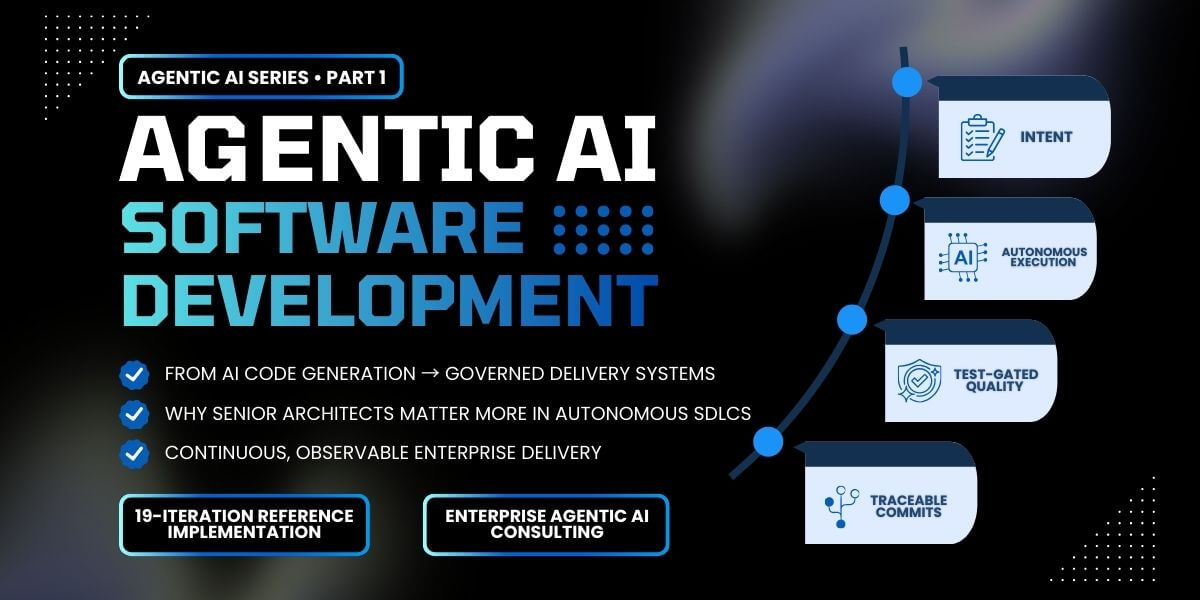
What Is Agentic AI Software Development in the Enterprise?
Agentic AI software development is an enterprise delivery model where autonomous agents execute backlog-driven implementation inside architectural guardrails, test-gated quality controls, and a fully traceable SDLC. This post introduces that model.
AI-accelerated software development is compressing implementation from weeks to hours. As speed increases, the constraint shifts from coding to alignment, architecture, governance, and real-time delivery visibility.
In this model, AI is not a coding assistant, it’s an autonomous delivery agent operating inside a controlled enterprise system.
This shift moves control up the stack—from implementation to architecture, sequencing, and delivery visibility.
Agentic delivery is the next step: a governed AI execution model that turns raw speed into predictable, production-grade throughput. This autonomous agentic delivery model is the governed execution engine powering Keyhole’s AI-accelerated modernization engagements, where speed, governance, and architectural integrity must coexist.
Most SDLC frameworks were built for slower execution and documentation written up front. In an agentic, AI-accelerated SDLC, execution is continuous; the differentiator is the delivery model that keeps that speed governed and predictable.
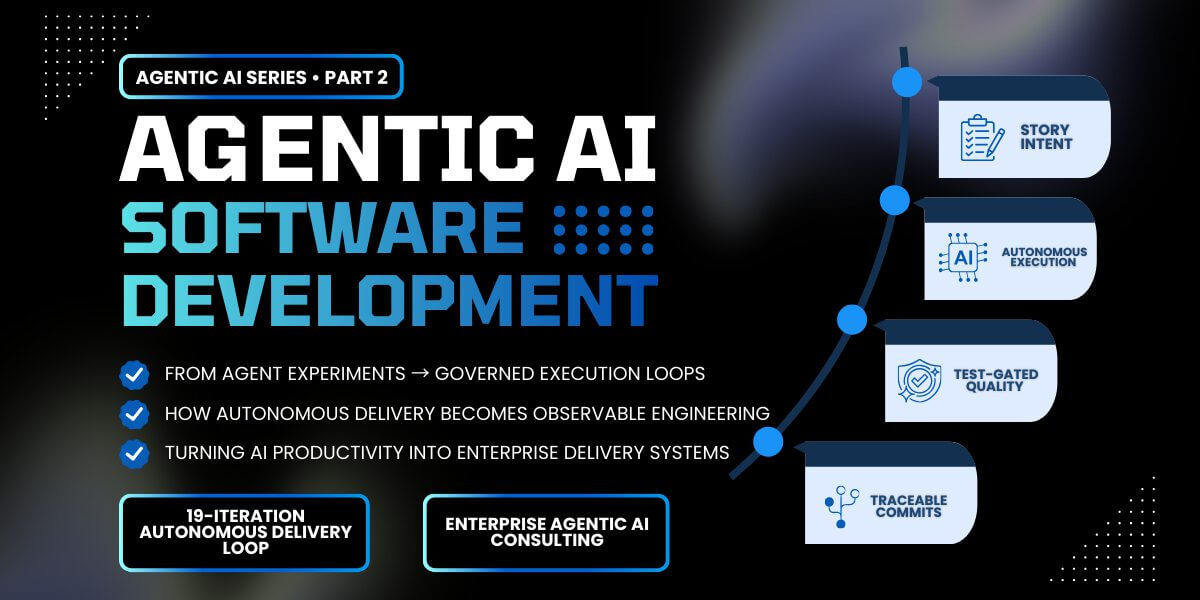
To see what that looks like in practice, we implemented an autonomous agentic development loop and used it to deliver a complete full-stack timesheet application in 19 traceable iterations. The application exists to demonstrate a governed, test-gated delivery model that can be applied to enterprise modernization and platform rebuilds. We’ll discuss this more in part two of this blog series.
What You’ll Learn In This Article:
- What “agentic AI software development” means in enterprise SDLC
- How delivery models evolve with autonomous implementation
- Where senior engineers create more value—not less
- Enterprise modernization + platform rebuild applications
What Is Agentic AI Software Development in the Enterprise?
In an enterprise SDLC, agentic AI software development is a governed delivery model where agents execute delivery inside the SDLC, while architectural standards, sequencing, and quality gates control how software is produced. Progress is measured through tested, working software and a traceable path from intent to commit, not meetings or status updates.
The goal of this initiative was to validate a repeatable, enterprise-ready approach to agentic development — one where agents execute within defined architectural guardrails and every increment of progress is observable, test-gated, and auditable.
What We Set Out to Prove About Agentic Delivery
This project began with a practical question that we are now seeing from enterprise clients: What does controlled, governed agentic delivery actually look like in practice?
Instead of ad hoc prompt-based coding, we designed a controlled execution model. That allowed us to evaluate what matters in enterprise agentic delivery:
- Can execution remain predictable?
- Is progress observable in real time?
- Are standards enforced consistently?
- Where does human leadership create the most value?
The result was a fully functional application in 19 iterations – and a repeatable enterprise delivery pattern. See the fully traceable reference implementation →
This pattern also underpins Keyhole’s Intent-Driven Development and build-first documentation approach: align on outcomes, sequence work intentionally, and capture decisions as part of delivery so knowledge transfer and auditability are built in.
What Is an Autonomous Agentic Development Loop?
An autonomous agentic development loop is a structured execution model where a delivery agent works through a prioritized backlog, implements functionality, validates it through tests, and commits completed work in a controlled, repeatable cycle.
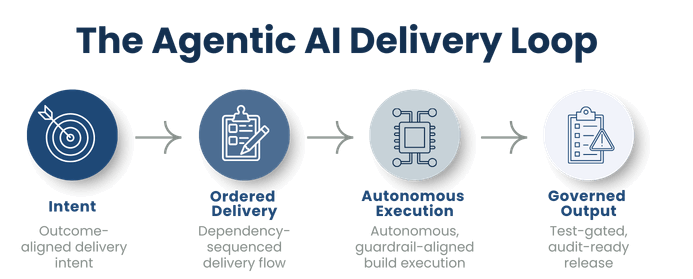
Unlike ad hoc prompt-based development, an autonomous loop runs inside a defined system: fixed architecture, established conventions, a dependency-ordered backlog, and test-gated execution with traceable commits. The result is operational control: each iteration produces a measurable unit of progress, a passing quality gate, and an auditable change record. Each iteration of delivery is a full pass through this governed loop.
Autonomous execution does not eliminate senior engineers — it makes their architectural decisions the primary driver of delivery success.
Where Senior Engineers Still Lead in Agentic Development
Autonomous execution does not eliminate the need for senior engineers. It changes where their impact is greatest.
In a traditional SDLC, a significant amount of senior engineering time is spent on coordination, task breakdown, and manual enforcement of standards. In an agentic development workflow, those responsibilities move up the stack into architecture, intent, and governance design.
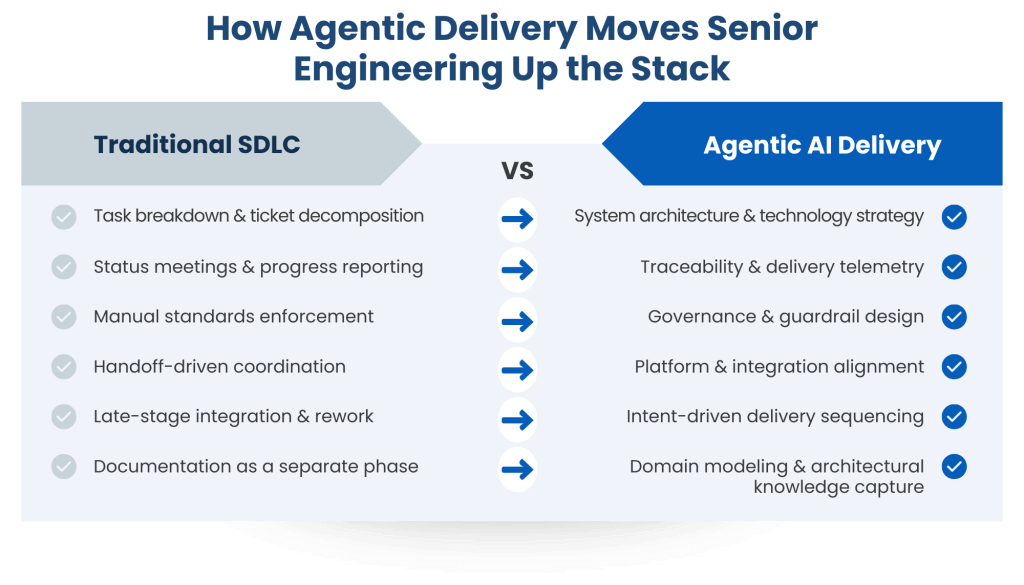
The autonomous loop executes. Senior engineers design the system it executes within.
Architecture, Domain Modeling, and Integration Strategy
Senior architects define:
- the system architecture and technology strategy
- the domain model and integration boundaries
- platform alignment across the enterprise landscape
- data and integration strategy
- reference implementation patterns that seed the agent with approved conventions, constraining output and keeping delivery iterations small and predictable
These decisions determine whether AI-accelerated delivery produces a maintainable enterprise system or a fast-moving prototype that cannot scale.
Enterprise clients are not looking for a tool that writes code. They are looking for a delivery model that fits into existing platforms, data flows, and organizational constraints.
Designing Guardrails and Delivery Sequencing
Senior engineers also define the execution framework the AI operates inside:
- the development conventions the agent must follow
- the sequencing and intent of the dependency-ordered backlog
- the security and compliance controls
- the governance model for traceability and auditability
This is where Keyhole’s senior architects focus: designing the guardrails, delivery sequencing, and integration strategy that allow AI execution to scale safely inside enterprise environments.
When these elements are in place, the result is not just faster implementation. It is predictable, governed delivery.
Why Enterprise AI Delivery Still Requires Senior Consulting Leadership
That distinction is where experienced consulting teams remain essential.
Architectural judgment, organizational change management, platform alignment, and governance design are not tasks that can be delegated to an AI agent. They require experience delivering complex systems inside real enterprise constraints.
In practice, this is where we see the highest value for AI-accelerated development. When the execution layer is automated, senior engineers spend more time on the decisions that determine long-term success — modernization strategy, system boundaries, and delivery governance.
How the Enterprise SDLC Changes With an Agentic AI-Accelerated Delivery Model
Speed alone does not make AI viable for enterprise software development. What makes it viable is the ability to embed that speed inside a governed delivery model.
An agentic, AI-accelerated SDLC is not just faster development. It shifts where effort is concentrated and how delivery is measured. In an enterprise AI-accelerated SDLC, implementation is automated and control moves to architecture, sequencing, governance, and real-time delivery visibility.
In a conventional enterprise SDLC, development is the longest and most resource-intensive phase. Planning, estimation, implementation, testing, and documentation move in sequence. Progress is often inferred from meetings and status updates rather than from working software.
In an AI-accelerated software development lifecycle, execution compresses dramatically. Features that previously required days of implementation can be delivered in hours. That shift changes the bottleneck.
Alignment, architectural clarity, and governance become the pacing factors. That is why modernization timelines compress only when the delivery model changes — not when AI is introduced in isolation.
Autonomous AI Delivery vs. a Traditional Enterprise SDLC
The impact on the enterprise SDLC is not incremental, it is structural.
| Traditional Enterprise SDLC | Agentic AI-Accelerated SDLC |
|---|---|
| Progress inferred from status updates | Progress visible in real time through tested, working software and delivery telemetry |
| Documentation written up front | Traceability created during execution |
| Manual enforcement of standards | Standards enforced by the delivery system |
| Testing after implementation | Tests as active quality gates |
What This Loop Changes in Enterprise Delivery
With the governed delivery loop in place, several structural changes occur in how enterprise software is planned, executed, and measured:
- Planning focuses on intent and ordered sequencing rather than detailed task decomposition
- Execution becomes continuous and story-driven
- Tests function as active quality gates instead of post-build validation
- Commit history becomes a real-time progress dashboard
- Documentation shifts toward traceability rather than speculative specification
For enterprise organizations, this creates a delivery system where modernization progress is measured through tested, working software with full traceability from business intent to production release. This is particularly powerful in modernization initiatives and platform rebuilds, where complexity and coordination traditionally slow progress.
For enterprise modernization programs, this shifts delivery from phase-based progress to a continuous, observable flow of tested capabilities mapped directly to business intent.
This model operates inside existing enterprise platforms—GitHub, Azure DevOps, AWS, on-prem, and hybrid environments—without requiring changes to security or compliance boundaries.
Where Enterprise Teams Apply Agentic AI Delivery
In most enterprises, agentic AI delivery is adopted incrementally, not as a wholesale SDLC replacement but as a way to remove specific delivery bottlenecks while existing governance, QA, and business processes evolve in parallel. The highest impact comes from sequencing adoption so acceleration happens where the organization can absorb it. This makes autonomous delivery viable for enterprises that cannot pause delivery, restructure teams, or relax compliance controls to adopt new development models.
This delivery model is being applied in programs where throughput, continuity, and auditability all matter:
- Legacy platform modernization and core system replacement
- Internal developer platforms and shared engineering foundations
- Net-new digital product delivery with long-term ownership
- API and integration ecosystem rebuilds
- Regulated and audit-sensitive software delivery environments
In practice, this often begins in a contained modernization or platform initiative where architecture, backlog sequencing, and test-gated delivery can be established without disrupting downstream adoption and release processes.
How Enterprise Teams Can Start With Agentic AI Delivery
Define Guardrails Before Introducing AI
The first step is not selecting an AI tool—it is defining the autonomous delivery system the agents will execute within.
- establish architectural standards and development conventions
- structure the backlog in a dependency-ordered sequence
- implement test-gated quality controls
- define how progress will be observed and audited
With these elements in place, AI can execute in a way that is predictable, traceable, and aligned with enterprise governance.
Adopting an AI-accelerated SDLC does not require a full organizational reset. The most successful efforts treat this as a delivery model evolution rather than a tooling exercise.
Start With a Contained Modernization Initiative
A practical starting point is a contained initiative with clear boundaries and measurable outcomes.
Modernization features, internal platforms, and net-new applications are ideal candidates because they allow teams to define architecture and conventions up front while validating the delivery model in a low-risk environment.
This approach produces real delivery outcomes while proving the governed execution pattern.
Once established, the agentic delivery pattern becomes repeatable across modernization initiatives, internal platforms, and net-new product delivery.
Shift Senior Engineers to Architecture and Strategy
Equally important is where human effort is focused. Senior engineers shift from manual coordination and task decomposition to:
- system design
- domain modeling
- integration strategy
Product teams shift from writing detailed specifications to defining clear intent and measurable success criteria.
Why Enterprise AI Adoption Fails Without a Delivery Model
Most organizations experiment with AI tools but do not change how delivery is governed. Without architectural standards, ordered backlogs, and test-gated execution, AI becomes an isolated productivity boost rather than a modernization accelerator.
How Keyhole Helps Enterprises Implement Agentic AI Delivery
We are actively applying this approach across legacy modernization, internal platform engineering, and net-new product development initiatives where organizations need faster iteration with built-in governance, architectural alignment, and delivery traceability.
- Increase delivery throughput without increasing team size
- Reduce rework through early decision visibility and continuous validation
- Maintain auditability and governance in regulated environments
- Accelerate modernization while keeping production systems stable
We see this resonate most with enterprise teams that are under pressure to deliver quickly but cannot afford to compromise on quality, security, or maintainability. It allows AI to become a dependable, production-ready part of the delivery process rather than a one-off experiment.
Keyhole’s Agentic AI Delivery in Action
In one modernization effort for a repeat insurance enterprise, a program originally estimated at 18–24 months was delivered in approximately five months by combining architectural leadership with agentic, test-gated execution inside a governed SDLC. By combining senior architect-led execution, agentic, repository-integrated execution inside guardrails, and intent-driven planning, our teams help clients:
To see how this delivery model operates in a real, fully traceable implementation, we built a complete full-stack application using an autonomous agentic execution loop with 1:1 story-to-commit mapping and test-gated progress across 19 iterations. In Part 2, we will break down that 19-iteration delivery loop, the control artifacts that governed it, and the measurable delivery outcomes it enables. In the meantime, explore the reference implementation and the execution model in detail →
The Takeaway: Designing the Enterprise AI Delivery Model
AI is not replacing enterprise software development. It is changing where expertise creates the most value.
Organizations that redesign their SDLC for governed, test-gated agentic delivery are compressing modernization timelines, improving product–engineering alignment, and delivering software with full architectural traceability. Those that treat AI as a faster way to generate code will see isolated productivity gains, not a structural advantage.
The differentiator is not the tool. It is the agentic, governed delivery system the tool operates within.
Senior engineers design that system—defining the architecture, sequencing, and guardrails that make autonomous execution predictable, auditable, and scalable for enterprise environments.
For enterprise teams, the starting point is not “Which AI tool should we use?” It is “How must our SDLC evolve so agentic software delivery remains controlled, observable, and aligned to long-term platform strategy?”
That is the work we are delivering with enterprise clients today: redesigning SDLC governance so agentic delivery is predictable, auditable, and aligned to long-term architecture.
More From Jaime Niswonger
About Keyhole Software
Expert team of software developer consultants solving complex software challenges for U.S. clients.
Share This Post
Join The Thousands Of Devs Who Subscribe
Discuss This Article
Subscribe
Login
0 Comments
Oldest