
Legacy System Assessment Framework: How to Audit, Score, and Prioritize Your Application Portfolio
A legacy system assessment is the foundation of an effective application portfolio strategy and modernization roadmap.
Most organizations lack a clear view of their application portfolio. Systems accumulate through growth, acquisitions, and tactical decisions, creating technical debt, ownership gaps, and unnecessary maintenance costs. Without a structured assessment, modernization efforts often focus on the wrong systems, follow the wrong sequence, and deliver less value than expected.
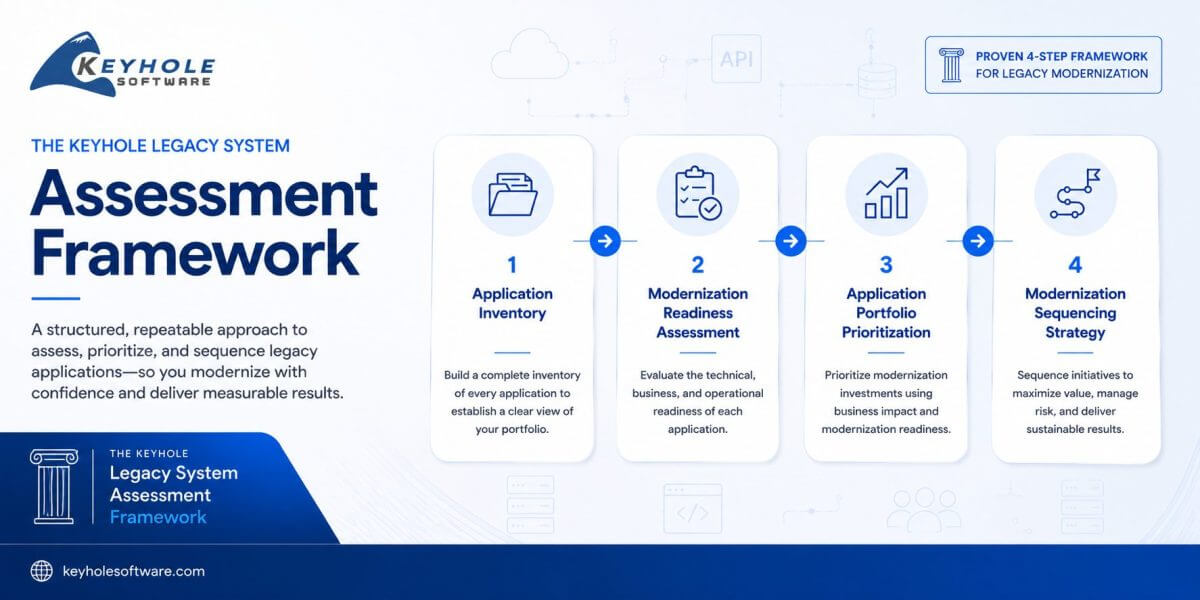
This guide introduces the Keyhole Legacy System Assessment Framework—a practical four-step methodology informed by enterprise modernization engagements across industries that helps organizations determine what to retire, what to modernize, and where to invest next.
Throughout this framework guide, you’ll learn how to:
- Inventory your application portfolio quickly and accurately
- Evaluate systems across Infrastructure, Application Code, Data, DevOps, and Team Readiness
- Prioritize modernization efforts based on business impact and risk
- Apply the correct sequencing: infrastructure → data → code
- Avoid the most common pitfalls that derail modernization efforts
This approach is commonly used in application portfolio assessment and enterprise modernization roadmap planning to create clarity across systems, reduce complexity, and guide modernization decisions.
Why Most Modernization Initiatives Fail
Many modernization initiatives begin with technology decisions instead of portfolio understanding.
Teams debate cloud platforms, AI tools, programming languages, and modernization approaches before answering more fundamental questions:
- What applications do we actually have?
- Which systems create business value?
- Which applications are technically ready?
- Which should be retired instead of modernized?
- What sequence minimizes implementation risk?
The four-step framework below answers those questions first, creating a modernization roadmap grounded in business priorities and technical reality.
Successful modernization doesn’t begin with choosing a cloud platform or rewriting code. It begins with understanding your application portfolio.
What Is a Legacy System Assessment? Quick Overview
A legacy system assessment is a structured approach to evaluating applications across your portfolio and guiding modernization decisions.
- Inventory applications across your environment
- Evaluate readiness across infrastructure, code, data, DevOps, and team capability
- Identify systems to retire, replace, or modernize
- Prioritize investments based on business impact and technical risk
You may also hear this commonly referred to as application portfolio assessment, portfolio analysis, or portfolio rationalization, depending on the organization.
This approach is especially effective for mid-market organizations that need to modernize selectively rather than rebuild everything at once. In practice, most organizations uncover immediate opportunities to reduce cost, simplify their portfolio, and focus modernization efforts where they will have the greatest impact.
Application Portfolio Assessment and Modernization Strategy
Application portfolio assessment is a core part of application modernization strategy and enterprise portfolio modernization. It connects technical evaluation with business decision-making by identifying which systems to maintain, modernize, replace, retire, or consolidate.
Without a structured assessment, modernization investments are often driven by visibility, urgency, or organizational politics rather than business value.
This approach helps organizations align application portfolio management, modernization investments, business priorities, technical reality, and available resources.
Unlike assessment frameworks that end with scoring, Keyhole combines structured portfolio assessment with architect-led validation, AI-assisted codebase analysis, dependency discovery, and incremental modernization planning. The result is a modernization roadmap organizations can actually execute rather than simply another assessment document.
Why This Matters for Mid-Market Organizations
Mid-market organizations face a unique challenge. They must modernize complex application portfolios while balancing limited time, budget, and internal resources.
This framework is designed for:
- CIOs and CTOs responsible for modernization strategy
- Enterprise and solution architects managing application portfolios
- IT leaders dealing with high maintenance costs and aging systems
- Teams evaluating legacy application modernization, cloud migration, replatforming, or re-architecture
If your team is spending more time maintaining systems than delivering new capabilities, a structured assessment helps you identify where to act first and where not to.
Without this step, organizations risk investing in the wrong systems, sequencing work incorrectly, and increasing long-term cost and complexity.
Why Legacy Assessment Comes Before Modernization Strategy
Rushed modernization does not solve problems. It relocates them into more complex and expensive environments.
A COBOL payroll system with no APIs. An undocumented VB6 reporting tool. Multiple databases with overlapping customer data. Without assessment, these issues do not disappear in the cloud. They become more complex and more expensive to manage.
A structured legacy system assessment changes the conversation by providing:
- Immediate opportunities for reduction through system retirement or SaaS replacement
- Clear visibility into business impact, helping prioritize what actually matters
- An honest view of technical reality, including skills gaps and system dependencies
- A defensible execution path, grounded in the correct sequencing of infrastructure, data, and code
Instead of guessing where to start, teams gain a clear, data-informed foundation for modernization.
A legacy system assessment provides the foundation for a successful legacy system modernization strategy by identifying technical constraints, business priorities, and execution risks before significant investment begins.
What Organizations Typically Find
One of the most common surprises is that the systems creating the most business value are often the least prepared for modernization. Years of integrations, customizations, and undocumented dependencies frequently surface during assessment.
When organizations complete a structured application portfolio assessment, several patterns emerge:
- Applications that are no longer actively used but continue to incur maintenance costs
- Redundant systems performing similar functions across business units
- Critical systems with undocumented dependencies or concentrated tribal knowledge
- Legacy applications that consume significant resources while delivering limited business value
- Opportunities to retire, replace, or consolidate systems with minimal disruption
This creates clarity and establishes the foundation for application rationalization, portfolio modernization, and long-term investment planning. Organizations can eliminate unnecessary systems, reduce ongoing costs, and redirect budget toward modernization efforts that deliver measurable business impact.
This is what enables effective portfolio rationalization before investing in modernization.
With that said, application portfolio assessment is rarely completed in a single workshop. Most organizations move through a structured process that begins with inventory, progresses through readiness evaluation and prioritization, and ultimately results in a modernization roadmap.
The 4-Step Legacy System Assessment Framework
The legacy system assessment framework below outlines each step and links to detailed implementation guidance. This four-step framework reflects how enterprise teams should approach modernization in practice, moving from visibility to execution.
How the Full Modernization Framework Fits Together
Each step in this framework answers a different modernization question:
- Step 1: What systems do we have?
- Step 2: How ready are they for modernization?
- Step 3: Which systems should we modernize first?
- Step 4: What is the safest and most effective execution sequence?
Together, these steps transform a collection of applications into a prioritized modernization roadmap. Each step produces tangible outputs that become inputs for the next phase, creating a repeatable modernization methodology rather than a one-time assessment exercise.
Legacy System Modernization Roadmap
Most organizations move through modernization in a predictable sequence. The output of each step becomes the input for the next.
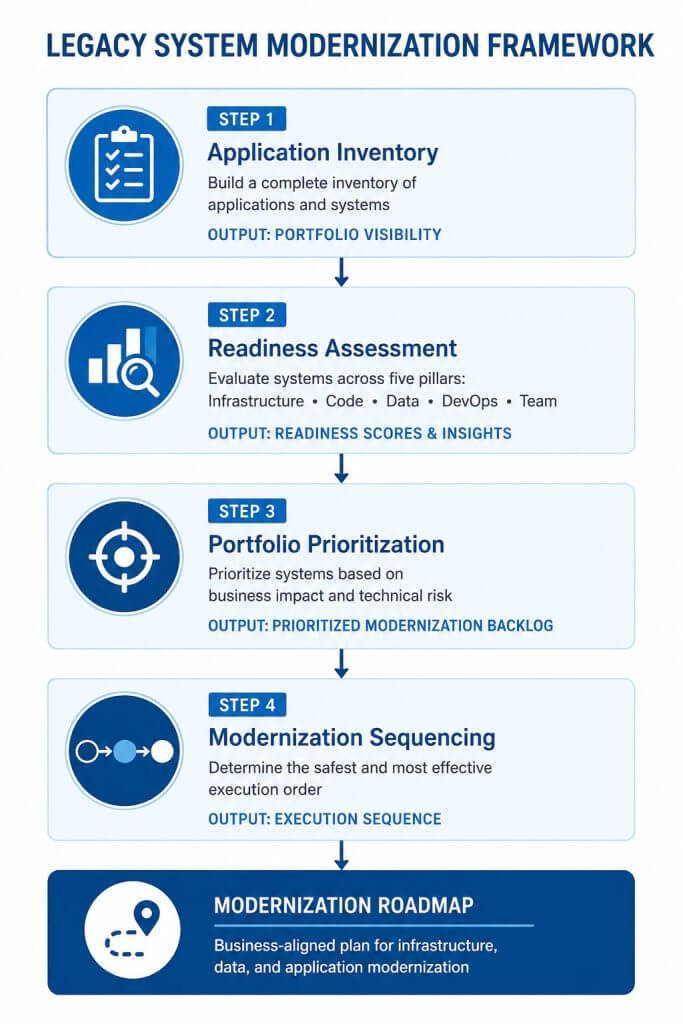
Each step builds on the previous one. Skipping steps often leads to inaccurate priorities, unrealistic timelines, and higher modernization risk. The sections below provide an overview of each step in the framework and link to detailed implementation guidance.
Explore the Four-Step Legacy System Assessment Framework
The sections below provide an overview of each step in the framework and link to detailed implementation guidance.
Step 1: Application Inventory and Portfolio Visibility
Learn how to build a complete application inventory and identify systems with unclear ownership, low usage, or limited business value.
Read: Application Inventory: How to Identify and Assess Your Systems
Step 2: Keyhole Five-Pillar Modernization Readiness Assessment
Evaluate systems across infrastructure, code, data, DevOps, and team readiness to understand modernization risk.
Read: Modernization Readiness Assessment Checklist (Available 7/15/2026)
Step 3: Keyhole Application Portfolio Prioritization Model
Combine business impact and technical modernization readiness to determine where change efforts should begin.
Read: Application Portfolio Prioritization Framework (Available 7/16/2026)
Step 4: Modernization Sequencing Strategy
Sequence modernization activities according to technical dependencies to create an executable roadmap with lower risk and faster delivery.
Read: Modernization Sequencing Strategy: Building an Executable Legacy System Roadmap (Available 7/20/2026)
How Keyhole Applies This in Practice
This approach is based on patterns observed across multiple enterprise modernization engagements.
In enterprise engagements, this assessment is not performed in isolation. We combine structured portfolio analysis with:
- Architect-led validation of dependencies and risk
- AI-assisted codebase analysis to uncover hidden dependencies, technical debt, and modernization risk
- Test-gated modernization workflows to ensure quality at each phase
- Incremental execution aligned to infrastructure → data → code sequencing
This approach allows organizations to accelerate modernization while maintaining control over risk, cost, quality, and business continuity.
This ensures that analysis translates into execution, not just documentation.
When to Bring in an External Partner
Many teams begin this process internally, but execution often becomes more complex as dependencies, risks, and organizational constraints surface.
External support is often most valuable when:
- Systems are poorly documented or high-risk
- Multiple business units have competing priorities
- Teams lack experience with modernization at scale
- Leadership requires a clear, defensible roadmap
In these cases, structured guidance can accelerate decision-making and reduce risk. Many organizations reach a point where direction is clear, but execution becomes difficult due to complexity, dependencies, or competing priorities.
Common Modernization Pitfalls Across the Portfolio
These challenges often appear across legacy system modernization and cloud migration efforts, especially in mid-market and enterprise environments.
Modernization efforts often encounter similar challenges across organizations. These are not tied to a specific phase, but to how modernization is planned and executed overall.
Siloed Analysis
Infrastructure, data, and application teams work independently without shared context.
- Impact: Decisions made in isolation create misalignment and increase integration complexity.
- How to avoid it: Run cross-functional workshops that include all five readiness pillars.
Cost Visibility Gaps
Short-term infrastructure savings can mask long-term operating costs.
- Impact: Organizations underestimate total cost of ownership and overcommit to certain approaches.
- How to avoid it: Model total cost of ownership over a multi-year horizon for each system.
Feature Pressure
New feature development is prioritized while legacy systems continue to consume most of the team’s capacity.
- Impact: Modernization stalls because teams are unable to free up time for foundational work.
- How to avoid it: Focus on early wins such as system retirement or replacement to create capacity.
Team Capability Mismatch
Modernization goals exceed the team’s current experience or available capacity.
- Impact: Projects slow down, timelines slip, and expectations become misaligned.
- How to avoid it: Use team readiness scoring to align expectations with execution reality.
Common Questions About Legacy System Modernization
How long does a legacy system assessment take?
An initial assessment can often be completed in a few hours using a structured framework. A deeper evaluation may take one to two weeks depending on system complexity.
What is included in an application portfolio assessment?
It includes system inventory, technical readiness evaluation, business impact analysis, and prioritization.
How do you determine which applications to modernize first?
Applications should be prioritized using both business impact and technical readiness. Systems that are business-critical but technically fragile often require a different modernization approach than systems that are low value and easy to replace.
What is the difference between a legacy system assessment and application portfolio assessment?
A legacy system assessment evaluates technical readiness, risk, and modernization opportunities. Application portfolio assessment is a broader discipline that includes inventory, rationalization, prioritization, and modernization planning.
What is portfolio rationalization?
Portfolio rationalization is the process of identifying which applications should be retired, replaced, consolidated, retained, or modernized based on business value and technical condition.
Can AI perform a legacy system assessment?
AI can dramatically accelerate documentation, dependency discovery, and code comprehension, but it should augment—not replace—architectural judgment. Modernization strategies require understanding business priorities, operational constraints, regulatory obligations, and organizational readiness that extend beyond source code analysis.
Start Your Legacy System Assessment
If you are unsure where to begin, start with a structured assessment using this framework. Most teams uncover meaningful cost reduction and prioritization opportunities in their first session, giving the foundation needed to move forward with confidence.
Your First Step
Begin with Application Inventory and Portfolio Visibility to identify every application in your environment, establish ownership, and understand business value before evaluating modernization readiness.
Step 1: Application Inventory: How to Identify and Assess Your Systems
Need Help?
For organizations with large or complex application portfolios, this process often uncovers hidden dependencies, competing priorities, and modernization tradeoffs that benefit from experienced guidance. Keyhole Software helps organizations:
- Assess application portfolios using a proven four-step framework
- Validate dependencies, risks, and modernization readiness
- Prioritize investments based on business impact and technical readiness
- Build executable modernization roadmaps aligned to business goals
If your assessment uncovers uncertainty about what to modernize, when to modernize, or which modernization strategy to pursue, we’re happy to help.
→ Schedule a Legacy System Assessment Workshop
Prefer to Start on Your Own?
Download the free Legacy System Assessment Toolkit and perform your own application inventory, modernization readiness assessment, portfolio prioritization, and modernization planning using the same templates and scoring model our architects use with clients.
→ Download the free Keyhole Legacy System Assessment Toolkit
More From Keyhole Software
About Keyhole Software
Expert team of software developer consultants solving complex software challenges for U.S. clients.
Share This Post
Join The Thousands Of Devs Who Subscribe
Discuss This Article
Subscribe
Login
0 Comments
Oldest