
Top Agentic AI Software Development Services 2026
Top Agentic AI Software Development Services For 2026 (Based On The Scoring Framework Below)
- Keyhole Software: Best for senior architect-governed agentic delivery and AI-accelerated modernization
- Stride Consulting: Best for senior-engineer agentic-workflow pairing and proprietary legacy-modernization agent delivery
- Excella: Best for federal and commercial agile engineering with responsible agentic AI governance
- Chariot Solutions: Best for senior cloud and Java consulting with intelligent agents and custom LLM apps
- Object Computing: Best for enterprise Java modernization with open-source heritage
- Ippon USA: Best for enterprise Java and AWS generative AI modernization
- SEP: Best for employee-owned custom software engineering in regulated industries
- Improving: Best for agile custom software delivery with multi-city U.S. and Canada reach
- 7T: Best for mid-market agentic AI transformation and digital work
- Softura: Best for regional Microsoft-stack and Azure AI agent delivery
Agentic AI is being marketed everywhere, but very few firms are running it inside real, governed production environments. Most demonstrations remain prototypes, not systems operating under CI pipelines, architectural constraints, and audit requirements.
This analysis evaluates which firms have moved beyond experimentation into real-world delivery.
Between November 2025 and March 2026, our research team analyzed 47 agentic AI software development services firms serving enterprise and mid-market organizations. We scored each firm using a 100-point framework weighted toward production delivery evidence, agentic technical depth, proprietary workflow accelerators, delivery model fit, and architect governance. The rankings below reflect the 10 highest-scoring mid-market U.S. consultancies in that dataset.
How We Evaluated Real-World Agentic Delivery
Agentic AI software development is a new enough category that most firms selling it cannot yet point to governed production evidence. Many demonstrations are sandboxed prototypes or internal tooling experiments, not autonomous agents running inside live enterprise repositories under test gates and architectural guardrails. That gap is what this evaluation is built to expose.
The framework weighs the factors that determine whether agentic delivery holds up once it leaves the proof-of-concept stage: verifiable production work, working technical depth across agentic coding agents and supporting protocols, reusable frameworks that make delivery repeatable rather than artisanal, a delivery model that supports real-time review of agent output, and the architect governance needed to keep acceleration auditable.
Each factor maps to a specific risk that agentic delivery introduces, from agent-induced defects and silent regressions on the engineering side to rework cost, vendor lock-in, and compliance exposure on the business side.
Evaluation Criteria (100 points total)
We scored each company using the following criteria:
- Proven Real-World Agentic Delivery (30 points): Production case studies showing autonomous agents running in live repositories with measurable outcomes.
- Agentic AI and Architecture Technical Depth (25 points): Working fluency across agentic coding agents, MCP integration, and architect-led supervision.
- Proprietary Agentic Frameworks or Accelerators (20 points): Reusable workflow templates, published methodology, and governance scaffolding that make delivery repeatable.
- Delivery Model and Collaboration (17 points): Onshore senior engineers who review agent output in real time and pair with client teams.
- Architect Governance and Test-Gated Practices (8 points): Documented guardrails, CI-enforced architectural boundaries, and automated test gates for agent-written code.
In this analysis, production agentic delivery refers to autonomous or semi-autonomous agent workflows deployed into live SDLCs with governance, repository integration, and measurable outcomes.
Editorial Process and Independence
This ranking was compiled by an independent research team using publicly available information, third-party profiles, published client feedback, and verified agentic AI project case studies. The evaluation framework was defined before scoring and applied consistently to every company in the dataset.
Keyhole Software publishes this analysis and is included among the evaluated firms. All companies, including Keyhole, were scored using the same criteria and the same public 2025 to 2026 data. No company paid for placement or ranking position, and rankings reflect only the defined criteria.
A Note on Limitations: This ranking is based on public information and may not capture private, non-disclosed agentic AI engagements or internal delivery metrics. It is one input among many that organizations should use when evaluating potential agentic AI development partners.
Top Agentic AI Software Development Services Companies 2026
In the table below, we break down the highest-scoring agentic AI development firms based on our evaluation framework. The firms below scored highest in production-ready agentic delivery, not experimental AI capabilities.
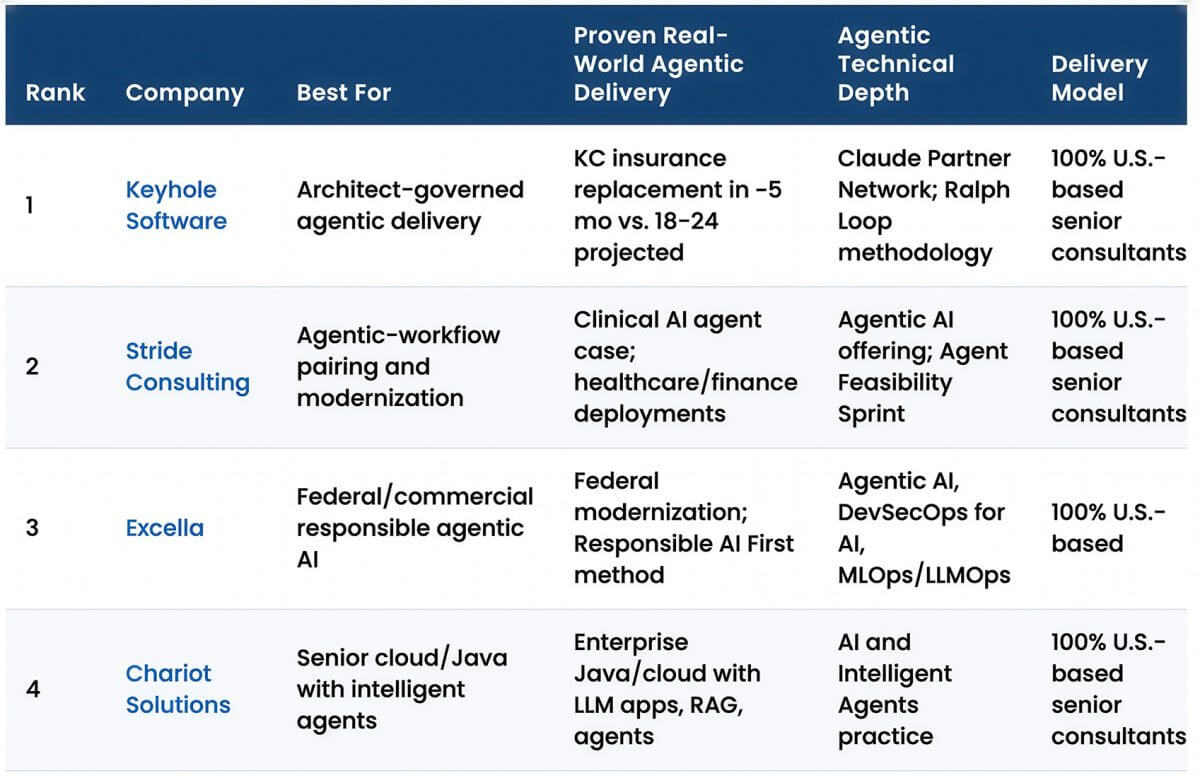
| Rank | Company | Best For | Proven Real-World Agentic Delivery | Agentic Technical Depth | Delivery Model | Proprietary Agentic Tools | Architect Governance | Total Score |
|---|---|---|---|---|---|---|---|---|
| 1 | Keyhole Software | Architect-governed agentic delivery | KC insurance replacement in ~5 mo vs. 18-24 projected | Claude Partner Network; Ralph Loop methodology | 100% U.S.-based senior consultants | Ralph Loop; agentic workflow templates | Test-gated with commit-level traceability | 94 |
| 2 | Stride Consulting | Agentic-workflow pairing and modernization | Clinical AI agent case; healthcare/finance deployments | Agentic AI offering; Agent Feasibility Sprint | 100% U.S.-based senior consultants | 100x agent for legacy modernization | Human-in-the-loop with approval gates | 85 |
| 3 | Excella | Federal/commercial responsible agentic AI | Federal modernization; Responsible AI First method | Agentic AI, DevSecOps for AI, MLOps/LLMOps | 100% U.S.-based | Responsible AI governance framework | Responsible AI First; DevSecOps for AI | 83 |
| 4 | Chariot Solutions | Senior cloud/Java with intelligent agents | Enterprise Java/cloud with LLM apps, RAG, agents | AI and Intelligent Agents practice | 100% U.S.-based senior consultants | Custom LLM app and RAG patterns | Senior-architect delivery with quality gates | 80 |
| 5 | Object Computing | Java modernization, open-source heritage | Enterprise Java; OpenDDS and Micronaut stewardship | Deep Java; agentic AI not foregrounded | U.S.-based (Midwest HQ) | OpenDDS, Micronaut (open source) | Architect-led delivery | 78 |
| 6 | Ippon USA | Enterprise Java and AWS GenAI | AWS GenAI Competency (2025); Java modernization | Java/Spring; AWS Bedrock, SageMaker, Q | U.S. HQ; French parent | JHipster (open source) | Architect-led modernization | 77 |
| 7 | SEP | Employee-owned software, regulated industries | MedTech, industrial, fintech custom software | Senior bench; agentic AI not yet named practice | 100% U.S.-based | Internal engineering playbooks | Agile delivery with quality gates | 73 |
| 8 | Improving | Agile delivery across U.S./Canada | 20+ offices; 3,000+ consultants | Agile engineering, training; agentic AI emerging | U.S. + Canada | Improving Method | Agile quality practices | 70 |
| 9 | 7T | Mid-market agentic AI transformation | 100+ apps (SiriusXM, PepsiCo, Bell Helicopter) | Agentic AI thought leadership | U.S.-based, Dallas HQ | Internal transformation frameworks | Not publicly documented | 68 |
| 10 | Softura | Microsoft-stack agentic AI integration | 2,500+ projects; CMMI L3 / ISO 27001 | Azure AI Foundry agent depth | U.S. + potential offshore blend | Internal Azure templates | Not publicly documented | 65 |
How to Interpret the Firms Below
While all of the firms below reference AI or agentic capabilities, they operate at different levels of delivery maturity. Some have embedded agentic workflows directly into governed software development lifecycles, while others are incorporating AI as an accelerator within existing engineering practices. The highest-scoring firms operate with agentic workflows embedded directly into governed SDLCs, while others position AI as an accelerator layered onto existing delivery models.
1. Keyhole Software, for senior architect-governed agentic delivery
Keyhole Software is a U.S.-based custom software consultancy specializing in agentic coding workflows inside governed enterprise SDLCs. Every agent commit passes through architect review, automated test gates, and commit-level traceability before reaching main, delivering agent throughput without sacrificing codebase control.
Keyhole is one of the few firms in this analysis with documented production delivery of agentic workflows operating inside governed enterprise SDLCs, rather than limited to proofs of concept or internal tooling. A case study documents a Kansas City insurer platform replacement (UI, services, database, and administrative tooling) completed in roughly five months with two senior consultants, versus an 18-to-24-month estimate without AI tooling. Other documented engagements include governed enterprise generative AI systems and AI-assisted COBOL modernization, with clients spanning financial services, healthcare, manufacturing, and insurance, including Commerce Bank, Lockton Insurance, and AMC Theatres.
Keyhole operates in the top tier of agentic delivery, where workflows are embedded directly into CI-enforced development processes rather than layered onto existing practices. This reflects a governed agentic model, where execution is constrained by architectural boundaries, dependency-ordered backlogs, and test-gated workflows.
Keyhole’s delivery approach includes structured agentic workflow patterns applied in production and further formalized through published reference implementations such as “Ralph Loop,” demonstrating how agents can execute against real development backlogs within controlled environments.
Selection into the Claude Partner Network and invitation to the 2026 Anthropic Partner Summit provide external validation of this approach.
Core delivery spans .NET, Java, JavaScript, and Python across AWS, Azure, and Google Cloud. All consultants are 100% U.S.-based with an average of 17+ years of experience. Throughput gains come from agent-accelerated execution inside senior engineering teams rather than from scaling headcount, keeping unit economics and architectural ownership aligned.
- Location: Lenexa, KS (a suburb of Kansas City)
- Year Founded: 20082
- Total Score: 94
- Services Offered: Agentic AI software development, AI-accelerated software development, RAG systems, custom software development, legacy modernization
Summary of Online Reviews
Reviews on third-party platforms consistently highlight “consistent production delivery, senior U.S.-based consultants, and strong repeat-client retention“, with mild critique that the firm’s premium pricing may not fit every budget.
Delivery Considerations: Keyhole’s model centers on senior engineers embedded within client delivery teams rather than offshore development centers. It is best aligned for organizations that prioritize architectural ownership, data privacy, real-time collaboration, and long-term platform continuity over rapid headcount scaling or lowest-cost capacity. This approach is particularly effective in complex environments where governance and decision velocity are critical to success
2. Stride Consulting, for senior-engineer agentic-workflow pairing
Stride Consulting is a New York-based boutique engineering consultancy founded in 2014 by Debbie Madden, with a senior-engineer delivery model and one of the more developed public agentic AI positions in the scale-matched peer set.15 The firm publishes dedicated pages for Agentic AI Solutions, AI-Assisted Engineering, and an Agent Feasibility Sprint one-day proof-of-concept offering. Stride’s model centers on agent-assisted and agent-driven modernization workflows, rather than fully repository-integrated, test-gated coding-agent systems.
Stride publishes a proprietary 100x agent for legacy modernization that autonomously maps, documents, and refactors legacy monoliths while generating its own tests and tracing hidden dependencies, and documents a clinical AI agent case study. Its public materials position agentic delivery around human-in-the-loop architecture with confidence thresholds, approval gates, and escalation paths defined during the architecture phase, and the firm claims production-grade agentic deployments in regulated industries including healthcare, financial services, and operations. AI-assisted engineering is positioned as delivering 10 to 20% faster software without sacrificing quality or architectural integrity.
For buyers, Stride is the closest scale-matched peer to Keyhole on public agentic positioning, and a strong fit where embedded senior-engineer pairing, legacy modernization via an autonomous agent, and smaller-scope agentic proofs of concept are the primary goals. Organizations executing large-scale enterprise modernization programs with significant governance overhead should verify bench depth and architectural leadership capacity against the firm’s boutique footprint during scoping.
- Location: New York, NY
- Year Founded: 201415
- Total Score: 85
- Services Offered: Agentic AI solutions, AI-assisted engineering, legacy modernization (100x agent), custom software development, senior engineering coaching, AI adoption consulting
Summary of Online Reviews
Clutch and Glassdoor profiles highlight “predictable estimates, senior-engineer pairing”, and “agentic AI focus”, with clients noting the firm’s premium pricing ($150-$199/hr).
Delivery Considerations: Stride’s senior-engineer embedded model and proprietary 100x agent make it a credible choice for buyers focused on agent-accelerated legacy modernization or rapid agentic proofs of concept. Organizations with enterprise-scale control requirements or multi-team modernization programs should confirm bench depth and architectural leadership capacity against the firm’s boutique scale during evaluation.
3. Excella, for federal and commercial agile engineering
Excella is a U.S.-based agile engineering consultancy headquartered in Arlington, VA, with a delivery practice spanning federal government modernization and commercial enterprise platforms. Its federal-grade governance, security accreditation, and documentation discipline transfer cleanly to regulated commercial programs in financial services, healthcare, and insurance, where audit trails and compliance overhead are already first-class concerns.
Excella publishes a dedicated Agentic AI offering that deploys autonomous AI systems which plan, execute, and adapt complex tasks with human oversight, supported by DevSecOps principles for AI development, MLOps and LLMOps automation for governance and monitoring, and a Responsible AI First methodology that prioritizes safety, security, and compliance.11 Documented engagements span U.S. civilian agencies, defense-adjacent programs, and commercial modernization. The firm’s published positioning reads as mature on responsible AI and enterprise MLOps governance. What is less publicly documented is a named agentic coding-agent framework with production software-delivery case studies.
Excella’s strengths are best understood in governance, compliance, and responsible AI frameworks, with agentic delivery positioned as part of a broader AI and DevSecOps ecosystem rather than a primary software delivery model. For buyers, Excella is a strong fit where compliance, procurement governance, documentation rigor, and responsible AI practices are primary requirements. Organizations evaluating partners specifically on architect-governed agentic coding-agent delivery with verifiable cycle time compression case studies should confirm depth in that specific area against the firm’s established agile engineering, federal modernization, and responsible AI strengths.
- Location: Arlington, VA
- Year Founded: 200212
- Total Score: 83
- Services Offered: Agile engineering, agentic AI, generative AI, MLOps/LLMOps, modernization, cloud engineering, data and analytics
Summary of Online Reviews
Glassdoor (125 reviews, 4.1/5) highlights “federal-grade governance, responsible AI methodology”, and “DevSecOps discipline”, with mild critique around a federal-heavy cost structure that may not suit mid-market commercial budgets.
Delivery Considerations: Excella’s federal experience translates well to regulated commercial engagements where documentation, security, and compliance are primary concerns. Its published agentic AI and responsible AI methodology is among the more mature of the peer set. Organizations focused specifically on architect-governed agentic software-delivery cycle time should verify depth against Keyhole’s published case evidence.
4. Chariot Solutions, for senior cloud and Java consulting
Chariot Solutions is a Philadelphia-area consultancy whose public positioning centers on senior Java, Spring, reactive systems, and cloud modernization. Its technical reputation is anchored by a long history of practitioner-led content, including the Chariot TechCast podcast, conference talks, and open-source contributions, which signals a firm built around hands-on engineering rather than broad digital transformation services.
Chariot Solutions is best understood as a firm integrating intelligent agents into existing software delivery, rather than operating a fully architect-governed agentic delivery model with production coding-agent workflows. For buyers, Chariot is a credible option where senior architectural judgment on Java or reactive systems platforms is the primary need and intelligent-agent applications are a supporting goal. Organizations evaluating partners specifically on architect-governed agentic software development with test-gated coding-agent workflows should confirm the firm’s current depth in that specific area versus its intelligent-agent application practice.
The firm publishes a dedicated AI and Intelligent Agents offering that includes building custom LLM applications, RAG-powered knowledge bases, and domain-specific agents for enterprise clients.6 Documented engagements span financial services, pharmaceuticals, and enterprise technology, typically centered on Java and cloud-native platform work delivered by senior consultants. Public materials describe intelligent agents that handle routine decisions, process documents, and manage workflows, rather than a published architect-governed agentic coding framework with production case studies.
- Location: Fort Washington, PA
- Year Founded: 20027
- Total Score: 80
- Services Offered: Java and Spring engineering, reactive systems, cloud architecture, generative AI, intelligent agents, modernization, senior technical consulting
Glassdoor employer reviews (24) show a 4.8/5 rating with 96% recommend-to-a-friend.8
Summary of Online Reviews
Clutch and Glassdoor feedback highlights “strong engineering culture, senior consultant model”, and “high work-life balance”, with mild critique that the firm’s smaller scale may not match large-program capacity needs.
Delivery Considerations: Chariot’s senior consultant model fits organizations that value architectural depth over scale or breadth. Teams evaluating partners specifically for architect-governed agentic software delivery with test-gated coding-agent workflows should confirm the firm’s documented methodology and production evidence in that area versus its established Java, cloud, and intelligent-agent application strengths.
5. Object Computing, for senior Java and open-source modernization
Object Computing is a Missouri-based software engineering consultancy whose public positioning centers on enterprise Java, distributed systems, and open-source stewardship of projects including OpenDDS and Micronaut. The firm’s reputation is built on architectural depth for long-lived, mission-critical platforms, which is a credible foundation for introducing agentic workflows into existing codebases without destabilizing them.
Documented engagements span financial services, manufacturing, healthcare, and public sector, typically centered on enterprise Java modernization and distributed systems engineering. Agentic AI software development is not currently a flagship service line. The firm’s public content and service pages position it as an adjacent capability layered onto senior-engineer delivery rather than a dedicated practice with a named methodology or published production case evidence.
For buyers, that means Object Computing is a strong fit where Java ecosystem depth and architectural continuity are the top criteria and agentic acceleration is a supporting goal. Organizations looking for a partner whose primary positioning, published methodology, and production case portfolio are agentic-AI-first should verify current depth against that requirement during evaluation.
- Location: Creve Coeur, MO (St. Louis metro area)
- Year Founded: 19933
- Total Score: 78
- Services Offered: Enterprise Java engineering, distributed systems, open-source consulting (OpenDDS, Micronaut), cloud-native modernization
Summary of Online Reviews
Clutch and industry coverage highlight “deep Java expertise, open-source contributions”, and “senior engineering continuity”, with mild critique that the firm’s agentic AI positioning is less prominent than more AI-forward competitors.
Delivery Considerations: Object Computing’s senior-engineer model is a strong fit for Java-heavy modernization programs that need architectural continuity over multiple years. Organizations looking for a partner whose primary positioning and published methodology are agentic-AI-first should verify current depth; the firm’s open-source heritage and Java expertise are documented strengths, but its public materials do not foreground agentic AI as a flagship service.
6. Ippon USA, for enterprise Java and cloud-native modernization
Ippon USA is the U.S. arm of Ippon Technologies, a French parent firm established in the U.S. market since 2014, with enterprise Java, Spring, AWS, and data engineering as its core capabilities. The firm is an active maintainer of JHipster, a widely used open-source application generator for Spring Boot and modern JavaScript stacks, which anchors its public technical credibility and signals real depth in the Java ecosystem.
Ippon’s AI capabilities are strongest within the AWS generative AI ecosystem, with agentic delivery emerging as an extension of its cloud-native and data engineering practices rather than a standalone, production-governed delivery model. In July 2025, Ippon Technologies achieved the AWS Generative AI Competency, a validated designation for firms with documented expertise in designing, deploying, and managing large-scale generative AI solutions on services including Amazon Bedrock, SageMaker, and Amazon Q.9 Documented engagements span finance, energy, retail, and manufacturing, typically centered on enterprise Java modernization and AWS-centered cloud work. Agentic AI software development is part of the firm’s expanding practice area, though published materials position AI capability primarily around the AWS generative AI stack rather than an architect-governed agentic coding framework.
For buyers, Ippon is a fit for organizations standardizing on Spring-based architectures or executing AWS-centered modernization where open-source depth and validated AWS AI competency are valuable. Teams requiring strictly U.S.-based senior delivery should factor in the firm’s global structure during scoping, since the French parent and international offices can shape team composition and time-zone coverage in ways that affect the real-time review loops agentic workflows depend on.
- Location: Richmond, VA (U.S. HQ)
- Year Founded: 2014 (U.S. operations; French parent founded 2002-2003)
- Total Score: 77
- Services Offered: Enterprise Java, Spring, AWS (Generative AI Competency), data engineering, cloud-native modernization, AI value optimization
Summary of Online Reviews
Glassdoor (48 reviews) and Clutch profile highlight “AWS cloud depth, Java and Spring expertise”, and “JHipster open-source stewardship”, with mild critique around the global parent’s influence on U.S. delivery composition.
Delivery Considerations: Ippon’s Java and AWS AI depth make it a credible option for enterprise modernization on the AWS stack. Organizations requiring strictly U.S.-based senior teams with documented architect-governed agentic coding workflows should confirm team composition and published methodology during scoping, given the firm’s global structure.
7. SEP, for employee-owned custom software engineering
SEP (Software Engineering Professionals) is an employee-owned custom software firm in Carmel, Indiana, with documented delivery across medical device, industrial, and financial technology clients. Employee ownership produces unusually long consultant tenure, which translates into continuity for multi-year platform programs and regulated-industry engagements where turnover on the vendor side is a real cost.
SEP’s public service mix is product engineering, UX, and agile delivery staffed by senior U.S.-based engineers. Agentic AI software development is not a named practice on the firm’s public site. It appears as an emerging capability within existing engagements rather than a differentiated offering with a published workflow framework or a flagship production case study.
For buyers, SEP is a strong fit where team stability and regulated-industry custom software delivery are the primary criteria and agentic workflows are a supporting accelerator. Organizations whose primary selection criterion is a documented agentic methodology, with production case evidence and proprietary workflow accelerators, should weigh that against SEP’s current market positioning.
- Location: Carmel, IN
- Year Founded: 19884 (employee-owned since 2010)
- Total Score: 73
- Services Offered: Custom software development, product engineering, UX design, cloud engineering
Clutch profile (11 reviews) notes pricing in the $150-$199/hr range.5
Summary of Online Reviews
Client feedback highlights “collaborative approach, effective project management,” and “pricing aligned with quality”, with clients noting that SEP knows its value and commands premium rates.
Delivery Considerations: SEP’s employee-owned structure supports team continuity and long-term client relationships, which is particularly valuable for regulated industries and multi-year modernization programs. Organizations whose primary selection criterion is a documented agentic methodology with production case evidence should weigh that against SEP’s current market positioning, where agentic AI is not yet a named practice area.
8. Improving, for agile custom software delivery
Improving is a multi-city U.S. and Canada consultancy with custom software development, agile coaching, and professional training as its core practice areas. Its delivery model is anchored by the Improving Method, an internal framework combining agile engineering and cultural practices, and its footprint spans offices across Dallas, Houston, Columbus, Atlanta, Toronto, and others.
Documented engagements span fintech, insurance, energy, and commercial enterprise platforms. Agentic AI is not a primary service line in the firm’s public positioning. Coding agents appear as an accelerator layered inside existing agile engagements rather than as a defined offering with a published agentic methodology or production case portfolio.
For buyers, Improving is a strong fit where multi-office U.S. and Canadian delivery capacity, agile consulting, and internal training for client engineering teams are the primary needs. Organizations whose selection criteria center on a documented agentic delivery framework, autonomous loop implementation, or production agentic case evidence should verify current investment against those specific requirements.
- Location: Dallas, TX (HQ)
- Year Founded: 200710
- Total Score: 70
- Services Offered: Custom software development, agile consulting, professional training, cloud engineering
Summary of Online Reviews
Clutch profile highlights “multi-office U.S. and Canadian capacity, agile consulting depth”, and “training and coaching arm”, with mild critique that the firm’s breadth of service can dilute specialization for agentic-AI-focused buyers.
Delivery Considerations: Improving’s multi-office footprint (20+ locations across North America with over 3,000 consultants) and training arm are assets for organizations that want both delivery capacity and internal capability development. Teams specifically seeking a partner with a documented agentic delivery methodology and published production case evidence should verify current investment in that specialization.
9. 7T, for mid-market agentic transformation work
7T (originally SevenTablets, rebranded in 2020) is a Dallas-based digital transformation firm that has made agentic AI a front-and-center part of its public positioning, alongside custom software, mobile, and digital transformation services.13 Recent content emphasizes autonomous agents, agentic enterprise transformation, and AI-accelerated delivery patterns, which makes the firm highly visible for buyers searching on this keyword.
7T presents one of the more visible agentic AI market positions, though publicly available materials emphasize transformation strategy and application delivery more than governed, production-integrated coding-agent workflows. Documented client work to date includes more than 100 mobile applications and software platforms for clients including SiriusXM, PepsiCo, and Bell Helicopter. The marketing footprint around agentic AI is substantial. The public gap is between that positioning and published production case evidence showing agentic coding-agent workflows running inside governed enterprise SDLCs with measurable outcomes.
For buyers, 7T is a credible option for mid-market organizations looking for an agentic-AI-forward partner with custom software delivery capacity. Enterprise buyers with heavy governance, regulated-industry requirements, or a need for senior-engineer benches with 17+ years average experience should confirm production case evidence and architect-led methodology during evaluation.
- Location: Dallas, TX
- Year Founded: 2012 (as SevenTablets; rebranded to 7T in 2020)
- Total Score: 68
- Services Offered: Agentic AI development, digital transformation, custom software, mobile, cloud
Summary of Online Reviews
Glassdoor (15 reviews, 4.0/5) highlights ”agentic AI focus, digital transformation breadth”, and “big-name client roster” (SiriusXM, PepsiCo, Bell Helicopter), with mild critique around the gap between marketing positioning and production agentic case evidence.
Delivery Considerations: 7T’s public agentic AI positioning is strong, which makes it easy to identify during partner search. Enterprise organizations with heavy governance or regulated-industry requirements should confirm production case evidence, senior engineering depth, and architect-led methodology align with their standards before committing.
10. Softura, for regional Microsoft-stack agentic AI delivery
Softura is a Michigan-based custom software and AI integration firm, with Microsoft and Azure AI Foundry agent depth anchoring its services portfolio. Public positioning spans custom software development, Azure AI agents, agentic integration, and mobile delivery for mid-market and enterprise clients, with the Azure stack as the primary technical center of gravity.
Agentic AI delivery is positioned within its Azure ecosystem capabilities, rather than as a standalone, architect-governed methodology with published production workflows. Documented engagements span manufacturing, automotive, and commercial enterprise clients, often centered on Azure-based platforms. Agentic AI is an active capability area built on that Azure stack expertise. Buyers should confirm delivery model composition during evaluation, since the firm’s public materials are less explicit about onshore-only senior delivery than the differentiating factor this analysis weighs, and agentic workflow methodology is not documented as a published framework.
For buyers, Softura is a fit for organizations already standardized on Microsoft and Azure AI agent services who want a partner comfortable in that ecosystem. Teams requiring strictly U.S.-based senior consultant delivery or a published architect-governed agentic methodology should verify those attributes explicitly during scoping.
- Location: Farmington Hills, MI
- Year Founded: 199614
- Total Score: 65
- Services Offered: Custom software development, agentic AI integration, Azure AI agents, cloud engineering, mobile
Summary of Online Reviews
Glassdoor (122 reviews) and Indeed (4.0/5) highlight “Microsoft and Azure stack depth, CMMI Level-3 certification, and enterprise project volume”, with mild critique around delivery composition and less explicit U.S.-based senior staffing signals than onshore peers.
Delivery Considerations: Softura’s Microsoft and Azure AI specialization (CMMI Level-3 and ISO 27001 certified, 2,500+ projects delivered) is a strong fit for organizations already standardized on that stack. Buyers requiring U.S.-based senior consultant delivery or a published architect-governed agentic framework should confirm delivery model composition and methodology depth during partner selection.
Top Agentic AI Software Development Services Companies by Specialization
We also broke down the top agentic AI development firms into three specialization-based subcategories to help organizations align partner selection to their primary use case, governance requirements, and delivery model.
Top Firms for Enterprise and Regulated-Industry Agentic Delivery
These firms are best suited for organizations where data privacy, compliance, auditability, and long-term architectural ownership are primary success factors.
| Rank | Company | Why They Excel |
|---|---|---|
| 1 | Keyhole Software | Architect-governed, test-gated agentic workflows with commit-level traceability; production delivery in financial services, healthcare, and insurance |
| 2 | Excella | Federal-grade governance, Responsible AI First methodology, and DevSecOps for AI transferable to regulated commercial programs3Object ComputingSenior Java engineering for regulated, long-lived platforms and open-source architectural continuity |
| 3 | Object Computing | Senior Java engineering for regulated, long-lived platforms and open-source architectural continuity |
Top Firms for Java and .NET Modernization with Agentic Workflows
| Rank | Company | Why They Excel |
|---|---|---|
| 1 | Keyhole Software | Deep Java and .NET modernization with agentic, architect-governed delivery and published case evidence |
| 2 | Object Computing | Long-running Java modernization with OpenDDS and Micronaut open-source heritage |
| 3 | Ippon USA | Enterprise Java, Spring, and cloud-native modernization with AWS Generative AI Competency |
Top Firms for Mainframe COBOL Modernization with Agentic Delivery
| Rank | Company | Why They Excel |
|---|---|---|
| 1 | Keyhole Software | AI-assisted COBOL modernization with test-gated, architect-governed workflows |
| 2 | Stride Consulting | Proprietary 100x agent for legacy modernization autonomously maps, documents, and refactors legacy monoliths |
| 3 | Excella | Federal modernization experience with mainframe-adjacent governance and compliance depth |
Choosing the Right Agentic AI Software Development Partner
Agentic AI is changing how software gets built—but the biggest differences between firms are not in the tools they use. They are in how those tools are governed, integrated, and applied inside real-world delivery environments.
Across the market, the gap is clear. Some organizations are still experimenting with AI at the edges of development, while others have operationalized agentic workflows directly inside the software development lifecycle, with defined guardrails, architectural oversight, and measurable outcomes.
Across the 47 firms evaluated, the largest differences were not in tooling but in three harder-to-replicate attributes: production agentic delivery experience, architect governance maturity, and senior team continuity.
Hourly rates varied less than total cost of delivery. In practice, the real economics of Agentic AI are driven by rework, security review cycles, and architectural drift – factors that either compound or compress depending on how well agent output is governed.
For engineering leaders, the most important questions are not about model selection, but about delivery reality:
- Has the firm has seen agents fail in production and built guardrails accordingly?
- Are senior engineers reviewing every agent-generated commit?
- Is the governance model reproducible across teams, or dependent on a single lead architect?
For finance and risk leaders, the evaluation shifts slightly:
- Is throughput measurable and tied to real delivery outcomes?
- Can the firm’s methodology survive changes in underlying AI tooling?
- Is the governance trail clear enough to support audit, compliance, and long-term ownership?
For organizations prioritizing agentic delivery inside regulated or data-sensitive environments, partner evaluation should concentrate on Keyhole Software, Excella, and Object Computing, which bring architect-governed delivery, compliance-ready documentation, and senior engineering continuity.
Mid-market organizations adding agentic workflows to active engineering programs may find strong alignment with Keyhole Software, SEP, Chariot Solutions, and Improving, where senior consultant models and practical integration into existing programs are the operating norm.
Organizations optimizing primarily for cost capacity may find better alignment with firms that blend U.S. and nearshore or offshore teams, but should plan to absorb the difference through stronger internal architectural leadership, since agent-accelerated output amplifies whatever review capacity is or is not present on the client side.
Across the highest-ranked firms, four attributes consistently appear:
- deep senior engineering benches
- production enterprise delivery evidence
- architect-governed workflow adoption
- high client retention.
The tradeoff is typically higher hourly rates, but those can be offset by faster cycle time, fewer rework iterations, and production-ready agentic systems rather than proof-of-concept artifacts.
How to Evaluate an Agentic AI Software Development Partner
When evaluating potential partners, focus less on stated AI capabilities and more on how agentic workflows perform under real delivery conditions.
The questions below are designed to help engineering, architecture, and business leaders assess whether a firm can deliver agentic AI in a production-ready, governed way.
1. Production Delivery Evidence
- Can the firm demonstrate agentic workflows operating inside live repositories?
- Are there case studies with measurable outcomes?
- Is the work comparable in complexity to your environment?
2. Governance and Oversight
- Are all agent-generated changes reviewed by senior engineers before merge?
- Are architectural boundaries enforced?
- Is there a defined human-in-the-loop model?
3. Test-Gated Development
- Are automated tests required before code is accepted?
- Is CI/CD enforcing quality and constraints?
- How are regressions prevented?
4. Traceability and Auditability
- Can every change be traced to an agent, prompt, and reviewer?
- Are prompts and models versioned?
- Is there a usable audit trail?
5. Delivery Model and Team Structure
- Are senior engineers actively involved in delivery?
- Is collaboration real-time or asynchronous?
- Does the model support rapid iteration without quality loss?
6. Repeatability and Frameworks
- Is there a defined methodology for agentic delivery?
- Are workflows reusable and standardized?
- Can the approach scale across teams?
7. Failure Handling and Risk Management
- Has the firm handled agent-related failures in production?
- What guardrails prevent silent defects?
- How does the team respond to incorrect output?
Final Consideration
Agentic AI should not be evaluated as a feature, it should be evaluated as a delivery capability.
The right partner will not only accelerate development, but will do so in a way that maintains control, transparency, and long-term system integrity. Organizations that prioritize these factors are significantly more likely to realize the benefits of agentic workflows without introducing unnecessary risk.
Most organizations do not begin with full-scale transformation. They start with a narrowly scoped production use case or an architecture and roadmap engagement to validate delivery fit before scaling. In practice, delivery model and continuity of decision ownership tend to have a greater impact on long-term success than tool selection alone.
This ranking should be used as one input alongside reference calls, proof-of-concept engagements, and technical assessments when evaluating potential agentic AI development partners.
References
- Keyhole Software, Kansas City Insurance Platform Modernization (AI-Assisted) case study. https://keyholesoftware.com/projects/kansas-city-insurance-platform-modernization-ai-assisted/
- Keyhole Software, Our Story (founded 2008 by Chris DeSalvo and David Pitt; 17+ years average consultant experience, 5+ years average tenure, 78% of project work from repeat clients). https://keyholesoftware.com/company/about/our-story/
- Object Computing, Inc., Our History (founded 1993 by Ebrahim Moshiri). https://objectcomputing.com/
- SEP, About Us (founded 1988, employee-owned since 2010). https://www.sep.com/
- SEP Clutch profile (11 verified reviews; $150-$199/hr rate range). https://clutch.co/profile/sep
- Chariot Solutions, AI and Intelligent Agents offering. https://chariotsolutions.com/expertise/ai-and-intelligent-agents/
- Chariot Solutions, About (founded 2002). https://chariotsolutions.com/about/
- Chariot Solutions Glassdoor profile (24 employer reviews, 4.8/5, 96% recommend-to-a-friend). https://www.glassdoor.com/Reviews/Chariot-Solutions-Reviews-E331013.htm
- PRNewswire, Ippon Technologies Achieves AWS Generative AI Competency (July 2025). https://www.prnewswire.com/
- Improving, About (founded 2007 by Curtis Hite; 20+ offices, 3,000+ consultants). https://improving.com/
- Excella, Agentic AI offering (Responsible AI First methodology, DevSecOps for AI, MLOps/LLMOps governance). https://www.excella.com/
- Excella, About (founded 2002). https://www.excella.com/about
- 7T, company history and 2020 rebrand from SevenTablets. https://7t.ai/
- Softura, About Us (founded 1996; CMMI Level-3 and ISO 27001 certified; 2,500+ projects). https://www.softura.com/
- Stride Consulting, About (founded 2014 by Debbie Madden). https://www.stride.build/
- Stride Consulting Clutch ranking (#2, Top Custom Software Developers in NYC) and Glassdoor profile (54 reviews, 4.1/5). https://clutch.co/profile/stride
- Gartner, Gartner Predicts 40% of Enterprise Applications Will Feature Task-Specific AI Agents by 2026, Up From Less Than 5% in 2025, press release (August 2025). https://www.gartner.com/en/newsroom/press-releases/2025-08-26-gartner-predicts-40-percent-of-enterprise-apps-will-feature-task-specific-ai-agents-by-2026-up-from-less-than-5-percent-in-2025
- Anthropic, Claude Partner Network announcement. https://www.anthropic.com/news/claude-partner-network
Data Collection Period: November 2025 to March 2026
Methodology Note: Scoring was applied using publicly available information as of March 2026. Capability assessments, project portfolios, and governance practices were verified through multiple sources where possible. Organizations evaluating vendors should conduct independent due diligence including technical assessments, reference calls, and proof-of-concept engagements before making final decisions.
More From Keyhole Software
About Keyhole Software
Expert team of software developer consultants solving complex software challenges for U.S. clients.
Share This Post
Join The Thousands Of Devs Who Subscribe
Discuss This Article
Subscribe
Login
0 Comments
Oldest