A multi-year case study in automating manual workflows, migrating to .NET 8/9, and building a data pipeline that lifted model accuracy from near zero to 0.84


A multi-year case study in automating manual workflows, migrating to .NET 8/9, and building a data pipeline that lifted model accuracy from near zero to 0.84

Client: A provincial government agency responsible for commercial vehicle safety and regulatory enforcement Industry: Government Transportation and Regulatory Compliance Services: Legacy Application Modernization, Cloud-Native Architecture and DevOps, Application Security, Custom Software Development Outcome: Modernized multiple legacy .NET and React applications into a secure, containerized cloud-native platform, cutting Windows Server licensing costs by 60% and moving release cadence from quarterly to …
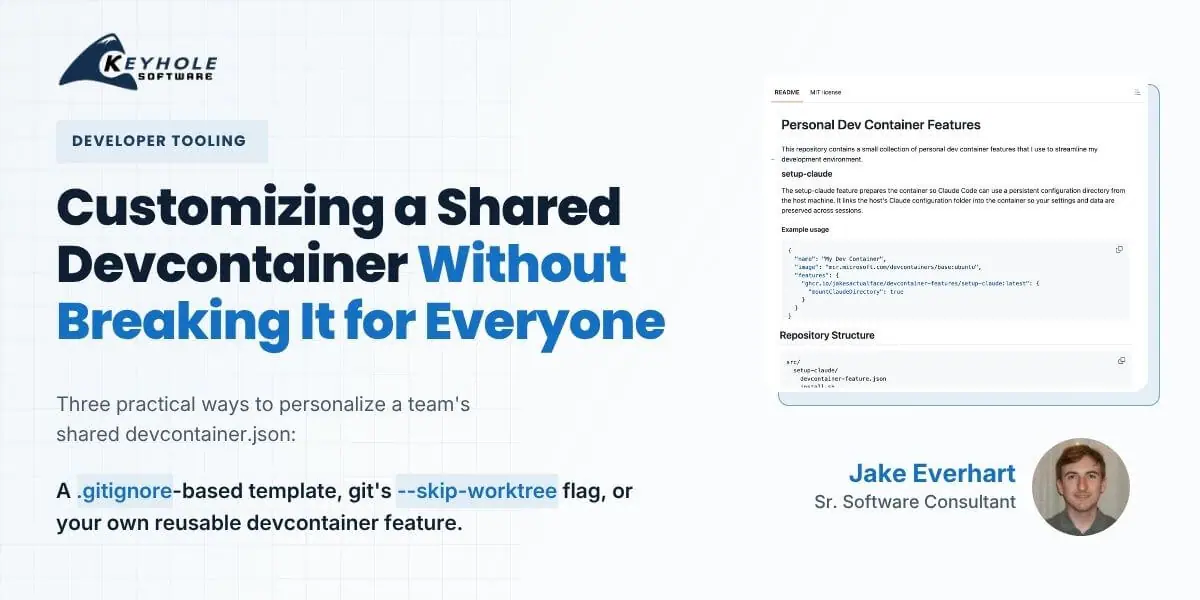
There’s no single “correct” way to customize a devcontainer, just like there’s no one right way to use most tools in software development. Devcontainers can be great for solo projects, to yield an isolated development workspace with no risks of polluting (or being polluted by) the external environment. They can also give teams a consistent, baseline environment for bootstrapping engineers, with integrations like GitHub Codespaces exposing that environment in a variety of ways. But the gap between those workflows is large, and managing it sometimes requires weighing a team’s needs vs. individual preferences.
It’s a balancing act, and getting it wrong can make your containers brittle, difficult to maintain, and cause enough overall frustration to outshine the benefits.
Yet there are options available for a more-granular approach. We don’t have to decide just between bare-minimum or include-everything – we can curate containers that are focused on the core tools used across the entire team, while still providing room for per-user expansions.
Today, we’ll explore a few approaches for customizing a shared devcontainer setup across different team scenarios, without having to abandon shared devcontainers altogether.

Compare the best cloud migration consulting services in the U.S. for 2026. Analysis of 9 firms scored on migration methodology, documented outcomes, cloud platform breadth, and team seniority.
A founder-built application created with AI coding tools ran into common AI-assisted development challenges, including missing source code and performance issues. Keyhole Software reconstructed the system, optimized Python processing, and enabled a successful launch. A client without a formal software background spent close to a year building a stock alerting app, mostly using AI-assisted coding tools and a lot of …