Quick Introduction to the Computer Vision API

Brad Kirtley .NET, API Development, Articles, ASP.NET, Development Technologies & Tools, Machine Learning, Tutorial 1 Comment

Machine learning is a hot topic these days because the biggest tech companies are focused on taking this technology to a new level. For instance, to help develop autonomous driving cars, better interaction between you and your house with products like the Amazon Echo.

Machine learning is a core sub-area of artificial intelligence. Machine learning enables computers to self-learn without being explicitly programmed. As new data comes available, the computer has the ability to learn, grow, change, and develop itself to make better decision in the future. This technology will help reduce the workload and possible incorrect diagnoses when radiologist read films, reducing the amount of accidents on our highways caused by human error, possible reduction of inappropriate message / images / videos from bullying on social network sites.

This article will touch on one of the many Artificial Intelligence API’s that Microsoft has built for public consumption. We will specifically focus on the step-by-step process of uploading a picture, passing that picture onto the Microsoft Cognitive Services – Computer Vision API, and retrieving different attributes about that image. This is an aspect of AI technology that companies like Facebook & Google are using to try to stop bullying and other issue within social networking. Let’s get started…

Real-Time Communication: Implementing Websockets With Spring Boot

Thomas Kendall Articles, Development Technologies & Tools, Java, JavaScript, Spring, Spring Boot 3 Comments

When developing web applications, we sometimes need to push server events down to connected clients. However, HTTP was not designed to allow this. To get around this limitation, a polling pattern was established where web pages would intermittently poll the server for any new events. This pattern was not ideal as it added HTTP overhead, was only as fast as the polling rate, and caused unnecessary load on the server.

Luckily, with the emergence of HTML5 came the WebSocket. The WebSocket protocol enables interaction between a browser and a web server with lower overheads. In this blog we’ll introduce the Websockets API and show how to implement Websockets with Spring Boot.

GrokOla Releases API Governance Features

Lauren Fournier Bogner API Development, Articles, Company News, Keyhole, Keyhole Creations Leave a Comment

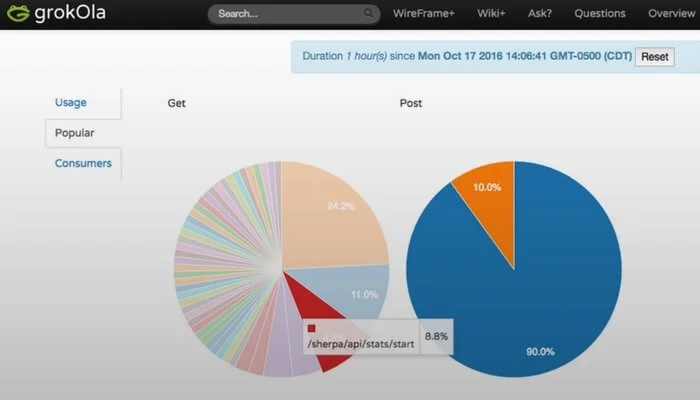
The Keyhole Labs team is excited to announce that GrokOla now offers API governance features including API documentation and real-time monitoring.

GrokOla is a knowledge documentation engine. In addition to housing wiki content, APIs can now be documented and monitored in real-time. GrokOla allows users to have all API documentation updated, centralized, and searchable from within a private GrokOla instance…

JSON Web Tokens

JSON Web Tokens With Spring Cloud Microservices

Thomas Kendall Articles, Java, JavaScript, Microservices, Security, Spring, Tutorial 6 Comments

Attention: This article was published over 10 years ago, and the information provided may be aged or outdated. While some topics are evergreen, technology moves fast, so please keep that in mind as you read the post.At Keyhole, we have published several blogs about Microservices. We’ve talked about architectural patterns used in a Microservices environment such as service discovery and …

Give Enterprise APIs Visibility With Swagger And GrokOla

Lauren Fournier Bogner API Development, Articles, Company News, Keyhole Creations Leave a Comment

Attention: This article was published over 11 years ago, and the information provided may be aged or outdated. While some topics are evergreen, technology moves fast, so please keep that in mind as you read the post.The Keyhole Labs team is excited to announce that GrokOla now offers Swagger integration. GrokOla users can now upload Swagger JSON files into GrokOla to …