
Cloud platforms now sit at the center of business planning. Many teams compare AWS for its wide service range, Azure for its ties to Microsoft, and Google Cloud for its strength in data and AI. Each option has its own role depending on how your systems are built. In the next sections, we’ll show where these platforms differ and call …
CI/CD for Legacy .NET Framework Apps: How to Automate Deployment Pipelines
Outdated deployment practices can slow down even the best software teams. When you’re still manually moving files between servers, it’s easy for small mistakes to slip through and updates to take longer than they should. At Keyhole Software, we’ve seen firsthand how this approach can hold back your projects. The solution is to automate deployment pipelines. It brings consistency, reliability, …
How to Migrate Legacy Applications to AWS or Azure (With Real Examples)
A familiar challenge for many businesses is knowing when it’s time to modernize. Legacy applications that once ran smoothly on in-house servers start to feel like a burden as competition increases and technology advances. At Keyhole Software, we help companies migrate legacy applications to AWS or Azure to stay ahead. We take what already works and move it to a …
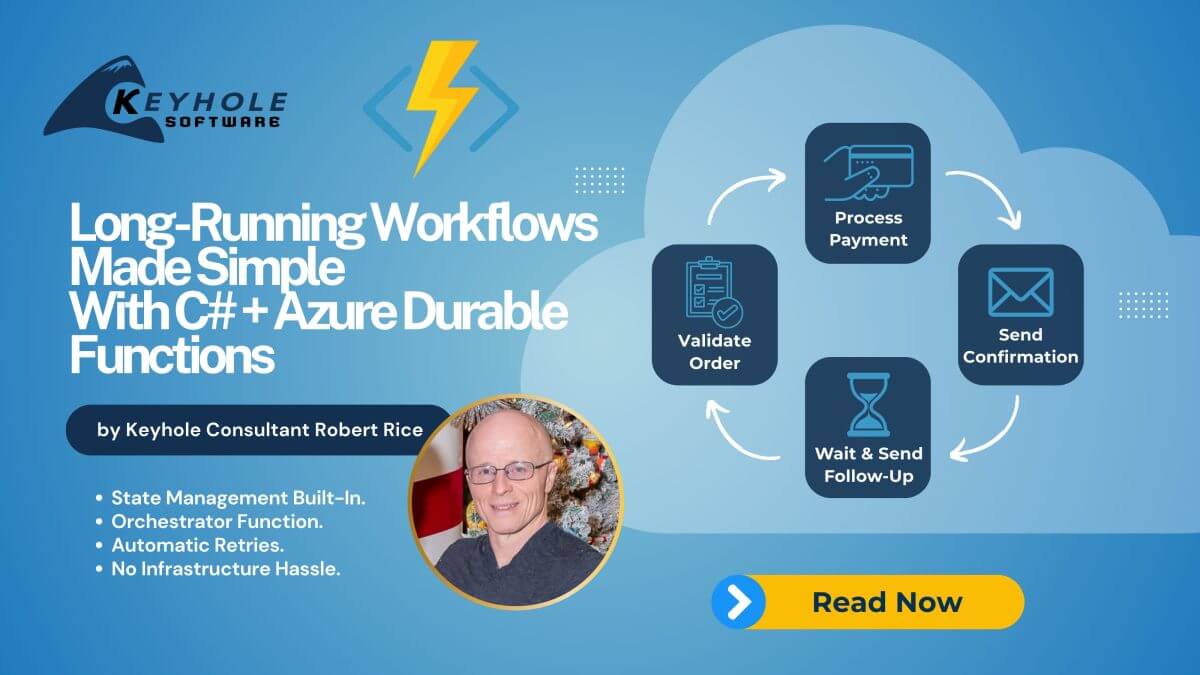
Long-Running Workflows Made Simple with C# + Azure Durable Functions
It’s common to face challenges around long-running workflows, state management, and resiliency when you’re building cloud-native applications. Traditional approaches like background services or message queues might work sometimes, but they often require a lot of “glue code” and custom retry logic. This entails not only more work up-front for the developer, but also more maintenance in the long run.
That’s where Azure Durable Functions come in.
Building Event-Driven Cloud Functions on Google Cloud Platform
Google Cloud Platform (GCP) offers developers and organizations the ability to create and deploy serverless Cloud Run functions. This code – whether it’s written in Node.js, Python, C#, or another language – can interact with other parts of GCP’s infrastructure. By default, the function is triggered by a basic HTTPS request. However, that is not our only option.
In this blog, we’ll introduce the concept of event-driven functions—a powerful way to automatically respond to changes across GCP services with minimal code. You’ll see how these functions can connect services like Cloud Storage, Firestore, and Pub/Sub, creating efficient workflows with less manual intervention…