AI-generated unit testing is changing how developers write tests. Learn a practical workflow for generating unit tests with tools like ChatGPT, Claude, and Copilot using React, TypeScript, and Vitest.
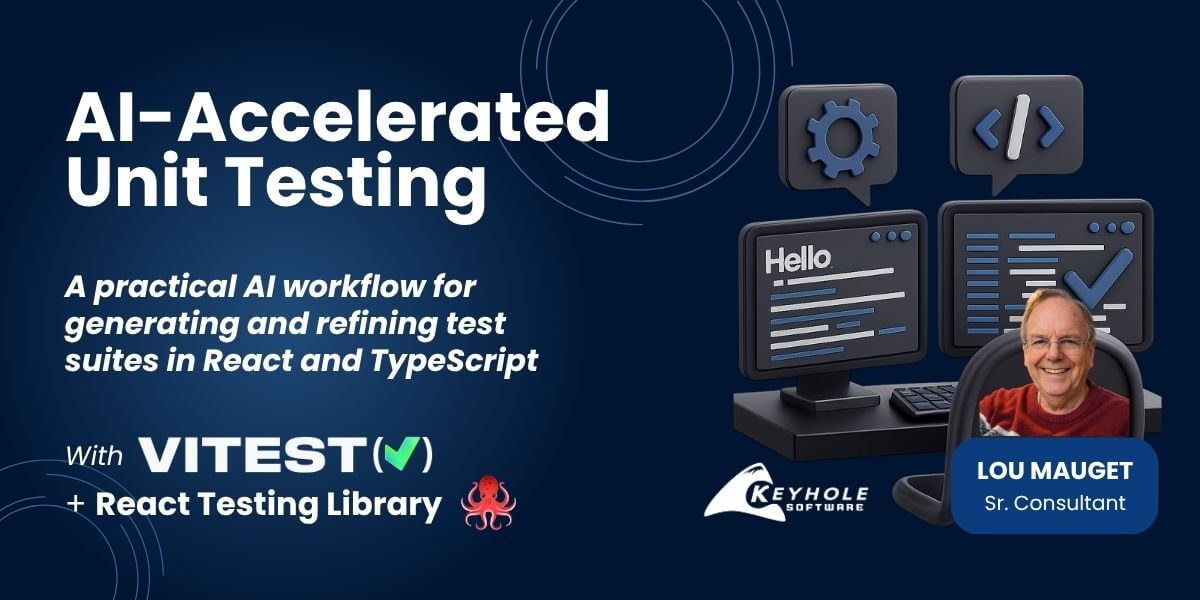

AI-generated unit testing is changing how developers write tests. Learn a practical workflow for generating unit tests with tools like ChatGPT, Claude, and Copilot using React, TypeScript, and Vitest.

For this blog, I’m going to continue using the example project I’ve used for the last several blogs, Whirlpool. You can find my last post on the Keyhole Dev Blog – Updating Microservices with Netty, Kafka, and React: Whirlpool revisited. Feel free to go back and read about microservices, Netty, Kafka, and React, or just start here with me and continue on the journey. Either way, I’m glad you’re here.
The focus of this blog will be creating Redux’s InitialState using TypeScript. It tends to be tricky to get it to stop complaining about types, so this should be helpful. Personally, I’ve encountered this issue several times across multiple projects, so I think it is worth talking about.

A one-hour discussion of Continuous Delivery with GitOps (using Kubernetes) with key concepts and real-time examples featuring trunk-based development and feature flags.

A 55-minute dive into the “Serverless” framework, an open-source tool that aims to simplify building, packaging, and deploying serverless applications across multiple cloud providers and platforms like AWS, GCP, Azure, and Kubernetes.

Attention: This article was published over 6 years ago, and the information provided may be aged or outdated. While some topics are evergreen, technology moves fast, so please keep that in mind as you read the post.Every application has some need for environmental variables that are specific to that environment. This can be database connections strings or URL to an …